
Reviewed · OLD TOWN TOURS
Split Old Town History Walking Tour
Split rewards curious walkers. This 90-minute tour brings you from the Riva waterfront through Diocletian’s Palace and the city’s handsome squares, with a local guide supplying the stories that stone walls cannot. I especially like the compact route and the chance to get practical tips on food, drinks, and places to explore. The main drawback is that one and a half hours can feel short when the palace has so much to explain.
I also like the choice of morning or evening departure. Evening can be cooler and quieter, according to one particularly pleased account, while the morning works well for getting your bearings early in a Split stay. The tour costs $30.23 per person, which is fair for a small-group introduction, though it does not include food, drinks, or paid access to any attraction beyond the guided walk.
In This Review
- Key points at a glance
- Why Diocletian’s Palace is the right place to begin
- Starting beside the Riva waterfront
- Beneath the palace in the Diocletian’s Palace cellars
- The Peristyle and Cathedral of Saint Domnius
- The Vestibule and the sound of klapa
- Jupiter’s Temple and Triklinij
- Leaving through the Golden Gate
- Pjaca and Fruit’s Square
- How the guides shape the experience
- Is $30.23 a fair price?
- Timing, group size, and practical comfort
- Who should book this Split walk?
- Should you book the Split Old Town History Walking Tour?
- FAQ
- How long is the Split Old Town History Walking Tour?
- How much does the tour cost?
- Where does the tour begin?
- Where does the tour end?
- Is the tour offered in English?
- What is included in the price?
- Are food and drinks included?
- How large can the group be?
- Can I cancel for a full refund?
Key points at a glance
- Diocletian’s Palace takes center stage: Most of the tour unfolds inside or around the emperor’s fourth-century palace complex.
- A short route with ten meaningful stops: You see the Riva, palace cellars, Peristyle, cathedral, Vestibule, Jupiter’s Temple, Golden Gate, and two central squares.
- Local guides make the difference: Anita, Iva, Katarina, Petra, Toni, and Rocco have all been praised for clear explanations, warmth, humor, and local advice.
- The evening departure has a practical advantage: It may offer cooler temperatures and less daytime noise.
- A good first-day activity: The route gives you a useful map of central Split before you explore alone.
- Come prepared to walk: Wear sensible, non-slip shoes and dress for the weather. The tour operates in rain or shine unless poor weather forces cancellation.
Why Diocletian’s Palace is the right place to begin
Split is not a city where the past sits behind glass. Daily life runs through the old Roman palace. Cafés occupy ancient rooms, people cross spaces once reserved for an emperor, and laundry, shops, stone stairways, and church bells all share the same setting.
That makes a guided walk especially useful. Without help, you can admire the columns and pale stone but miss how the palace became the center of modern Split. A good guide connects the Roman plan, Christian buildings, medieval squares, and present-day city life.
This tour is built for that first layer of understanding. It does not try to cover every museum or climb every tower. Instead, it gives you the layout and the main stories in a manageable 90 minutes.
The group can reach up to 20 people. That is not the same as a private tour, but it is still small enough to remain practical if the guide manages the group well. Several accounts describe much smaller groups, including one with only seven people and another with ten. Smaller groups make it easier to hear, ask questions, and keep pace in narrow streets.
The strongest praise goes to the guides. Anita was described as warm and passionate about Croatia. Iva received high marks for being efficient, friendly, and clear. Katarina was praised for her English and command of Split’s story, while Petra handled questions well and added humor. Toni was especially good at making the walk feel personal, mixing local life with historical facts. Rocco’s evening tour earned approval for its local insight and relaxed pace.
More Old Town Tours in Split
- Split: Old Town and Diocletian Palace Walking Tour
★ 4.9 · 4,727 reviews - Split: Diocletian Palace & Old Town Guided Walking Tour
★ 4.7 · 882 reviews - Diocletian’s Palace and Old Town SMALL GROUP Walking Tour
★ 5.0 · 502 reviews
Starting beside the Riva waterfront
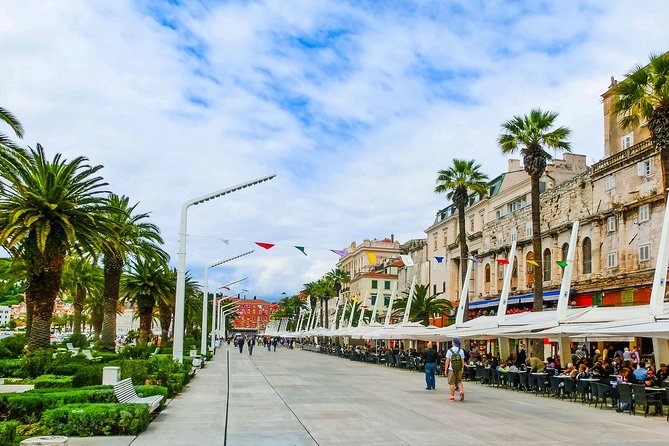
The meeting point is at Obala Hrvatskog narodnog preporoda 21, along the Riva promenade. This is a sensible place to begin because the waterfront gives you an immediate sense of Split’s shape.
You meet your guide beside the sea, with the promenade’s cafés and steady foot traffic nearby. The opening ten minutes are used to introduce Split’s history, culture, and layout. That orientation matters. Afterward, you will have a better idea of where the palace ends, where the main squares sit, and how the waterfront connects to the old center.
The Riva is also a practical meeting place near public transportation. Still, give yourself time to find the exact address. The waterfront can feel busy, and several tour companies operate in central Split.
Your guide should also explain how Roman, medieval, and modern Split overlap. Listen for that framework rather than trying to memorize every date. The value of the introduction is knowing what to look for during the rest of the walk.
Beneath the palace in the Diocletian’s Palace cellars
The next stop is the palace’s substructure, described as a 15-minute visit through well-preserved underground chambers. These rooms supported the imperial residence above and offer one of the clearest ways to understand the palace plan.
The cellars are useful because they show the practical side of Roman construction. Instead of viewing the palace only from grand courtyards and gates, you see the supporting spaces beneath it. Your guide can explain how the underground structure relates to the rooms above and what it suggests about imperial life.
This is also one of the places where footwear matters. You are walking through stone interiors and old passageways, so stable shoes are a better choice than smooth sandals or fashion-first footwear. A previous account specifically recommended non-slip shoes.
The cellars receive only about 15 minutes on this route. That is enough for an introduction, but not enough for a slow, detailed examination of every chamber. If underground architecture interests you most, you may want to return later and spend more time on your own.
The Peristyle and Cathedral of Saint Domnius
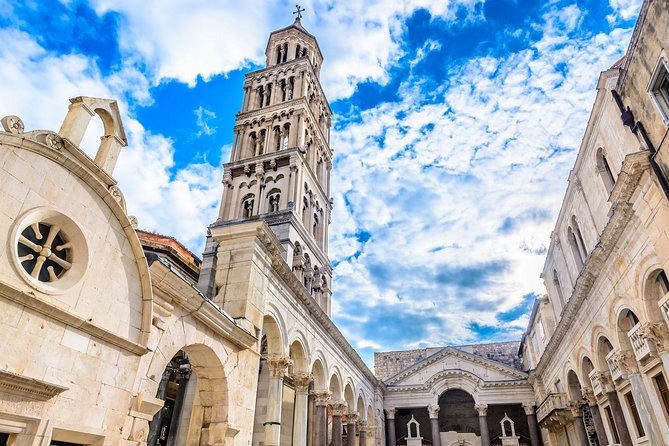
The Peristyle is the visual heart of Diocletian’s Palace. The tour allows about ten minutes here, including time to admire the Roman columns and the Cathedral of Saint Domnius.
The cathedral occupies a remarkable former imperial mausoleum. That change in purpose tells you a lot about Split: Roman authority, Christian worship, and later city life all share the same stones. Your guide can make this transformation easier to grasp than a signboard alone.
Take a moment to look up and around rather than focusing only on the cathedral façade. The surrounding columns and open court show how the palace was designed to impress. The space can also be busy, so stay close enough to hear your guide.
The schedule is brisk. One account found the tour a good quick overview but wanted more time for historical explanation. That is a fair criticism. The tour gives you the essential story, but your guide may need to keep moving to cover all ten stops.
More Walking Tours in Split
- Walking Tour of Split and Diocletian’s Palace
★ 5.0 · 2,588 reviews - Krka Waterfalls tour with Trogir Walking tour and Krka panoramic boat cruise
★ 5.0 · 1,659 reviews - Split & Diocletian’s Palace Walking Tour
★ 5.0 · 1,125 reviews - Walking Tour of Split with a ‘Magister’ of History
★ 5.0 · 1,122 reviews
The Vestibule and the sound of klapa
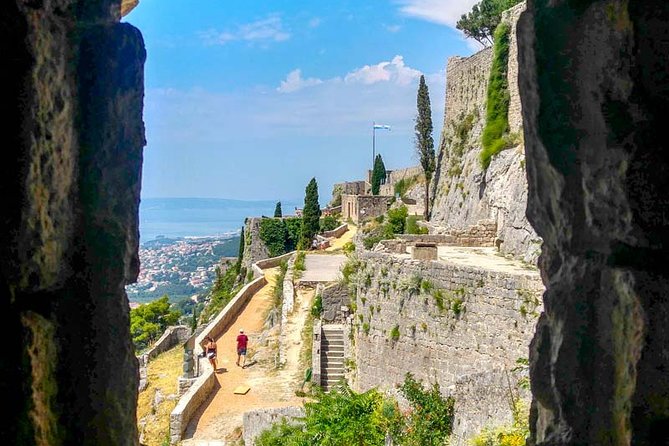
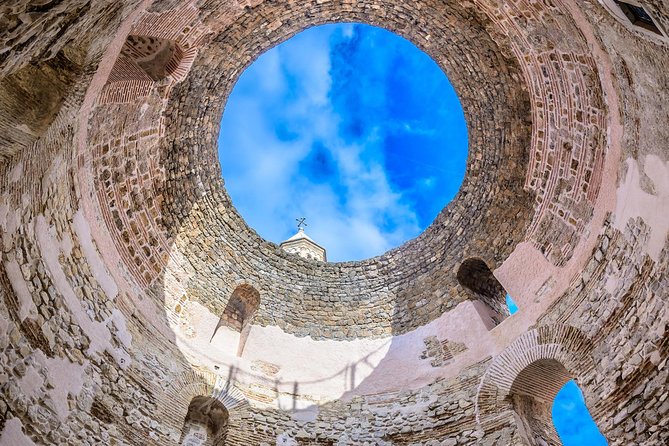
The circular Vestibule receives only five minutes, but it may become one of the walk’s most memorable moments. You stand beneath the open dome and hear how the shape affects sound.
If you are lucky, traditional klapa singers may perform there. Klapa is a Croatian vocal tradition, and the Vestibule’s acoustics make even a brief song feel closely tied to the place.
The performance is not guaranteed, so treat it as a possible bonus rather than a promised feature. Even without singers, the room is worth seeing for its unusual form and echo. Your guide may also use the stop to point out how the palace’s ceremonial spaces differed from its working areas.
Five minutes is enough to look, listen, and take a few photographs. It is not enough for a long musical presentation, which helps explain the short timing.
Jupiter’s Temple and Triklinij
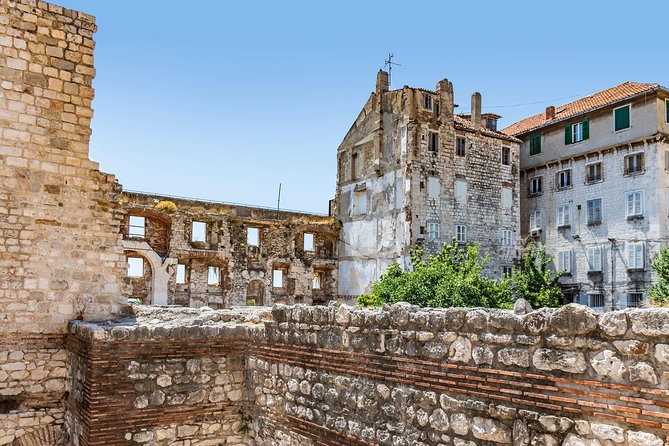
The former Temple of Jupiter is another compact stop, lasting about five minutes. The Roman temple later became a baptistery, and the space includes ancient sculptures and a preserved sarcophagus.
This is a good example of how Split’s buildings changed use over time. Rather than treating Roman and Christian history as separate subjects, the tour shows you how one period reused the structures of another.
Next comes Triklinij, where Diocletian held lavish banquets. The guide’s focus here is Roman dining and imperial luxury. Five minutes will not recreate a full Roman feast, but it gives you a clear sense of the palace as a place of ceremony and display, not simply a military or residential compound.
These two stops are short, so listen carefully. The guide’s explanation is the main attraction. If you pause to take photographs, you may miss the point of the site.
Leaving through the Golden Gate
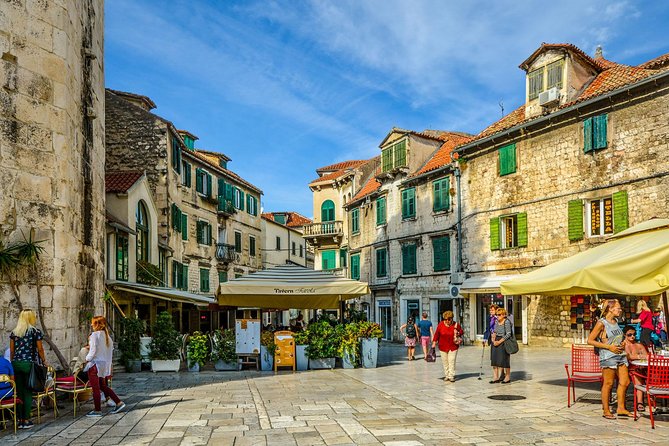
The Golden Gate is the grandest of the palace’s four gates and receives about ten minutes. This is where the scale of Diocletian’s complex becomes easier to read. Passing from the palace interior to the city outside also gives the tour a natural change of scene.
Just beyond the gate is the tall statue of Gregory of Nin. You can rub the statue’s toe for good luck, following a familiar local custom. It is a small, playful moment after the more formal Roman and religious sites.
The stop works well for families because it gives children something concrete to do. Children must be accompanied by an adult, and the walk is generally suitable for most people who can manage normal city walking.
The Golden Gate area can be crowded. Keep your group in sight and use the guide’s position, rather than trying to walk at the front while taking pictures.
Pjaca and Fruit’s Square
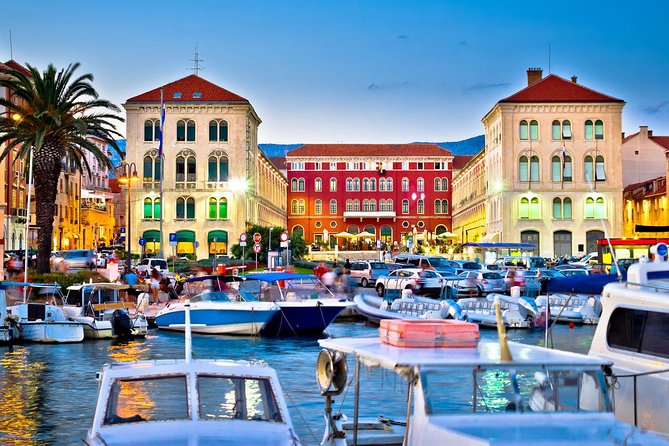
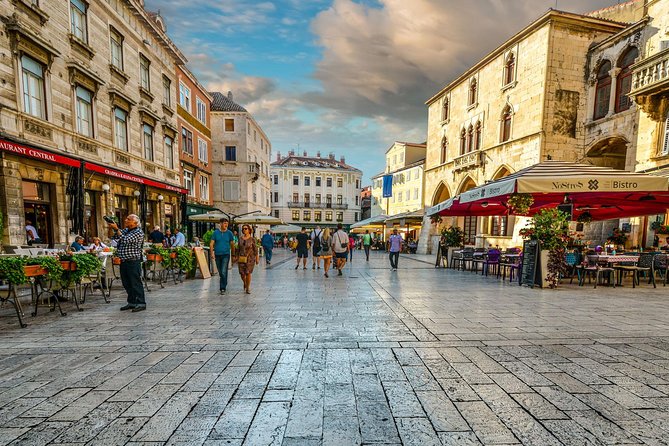
Narodni trg, commonly called Pjaca, takes the walk beyond the palace walls and into Split’s later urban life. The ten-minute stop includes Venetian-era buildings, an old city clock, and cafés around the square.
This is where you begin to see Split as more than a Roman site. The architecture and public spaces reflect later periods, while cafés and everyday movement keep the square part of the living city. Your guide can also point out where the old center shifts from imperial compound to civic meeting place.
Fruit’s Square, or Trg Brace Radic, gets about five minutes. Its name recalls the fruit markets once held there, while baroque palaces now frame the square. It is a quick stop, but it helps you notice how commerce shaped the city.
These squares are useful for your own plans after the tour. You can ask your guide where to eat, have a drink, or continue exploring. Several guides were praised for offering practical suggestions, not just reciting facts.
How the guides shape the experience
The tour’s strongest feature is the person leading it. The route is excellent, but the sites are visible to anyone with a map. The guide supplies the links between them.
Anita was praised for her passion and strong command of Croatian history. Iva was called friendly, efficient, and well informed. Katarina earned praise for her English and her ability to answer questions about the palace and Split. Petra was described as both interesting and willing to handle plenty of questions.
Toni brought a more personal style, making the walk feel like an outing with a local friend. His humor was appreciated, though one account wished he would separate jokes from factual explanations more clearly. That is useful advice for any walking tour: if a point matters to you, ask the guide to repeat or clarify it.
Rocco’s evening tour was praised for its local knowledge, humor, and flexible pacing. The guide did not stick rigidly to the time limit, giving the group more than expected. That is a pleasant bonus, though you should not assume every departure will run long.
The experience is offered in English. The quality of a walking tour can vary with the individual guide, but the repeated praise for several different guides suggests a strong team overall.
Is $30.23 a fair price?
At $30.23 per person, this is not the cheapest way to walk through Split. You can enter many streets and squares for free. The price pays for the guide’s explanation, the planned route, and the time saved working out what you are seeing.
I think the price is reasonable if you use the tour as an orientation walk. It covers ten stops in 90 minutes and helps you decide which places deserve a longer return visit. A guide can also save you from wandering past important details without noticing them.
The value is strongest for first-time visitors, cruise passengers with limited time, and anyone who wants a short introduction rather than a full-day study of the palace. If you already know Roman architecture or have researched Split closely, the tour may feel basic.
Food and drinks are not included. That is no great surprise for a walking tour, but remember to plan your own refreshment before or after the route.
Timing, group size, and practical comfort
Two departure times make it easier to fit the walk into your day. The evening option may be the better choice during hot weather, since one account found it cooler and quieter than the daytime route.
The tour runs in all weather conditions, so dress accordingly. Cancellation is possible if poor weather affects the experience, with a different date or full refund offered in that case. The same applies if the minimum number of participants is not reached.
You can cancel for a full refund up to 24 hours before the start time. Changes or cancellations inside that window are not accepted for a refund.
There is one practical warning about administration. Two accounts describe serious problems involving canceled or unrecorded bookings, including one case where the local desk and booking company appeared to have different information. These accounts are a small part of an otherwise strong record, but I would save your confirmation and check the meeting details before setting out.
Pets are not allowed. Children need an adult with them. Most people can take part, but this is a walking tour through historic stone spaces. If you use a wheelchair or have trouble with uneven surfaces, confirm suitability before booking.
Who should book this Split walk?
I would choose this tour if you want a clear first look at Split without giving up half a day. It suits couples, families with older children, solo visitors, and cruise passengers who need a well-organized introduction.
It is also a good choice for anyone who likes asking questions. The best accounts describe guides who answer freely and personalize the walk. If local food and drink suggestions matter to you, ask for them before the tour ends.
You may want something longer if Roman architecture is your main interest. The route moves quickly, and the stops at the Vestibule, Jupiter’s Temple, Triklinij, and Fruit’s Square are brief. Think of this as a strong starting point, not the final word on Diocletian’s Palace.
Should you book the Split Old Town History Walking Tour?
Yes, if you want an affordable, guided introduction to Split’s central sights. The combination of palace cellars, the Peristyle, the cathedral, the Vestibule, the Golden Gate, and the two squares gives you a lot in 90 minutes.
Book it early if your dates are fixed, since it is often reserved about 35 days ahead. Pick the evening departure for a cooler, calmer walk when available. Bring non-slip shoes, keep your booking confirmation handy, and expect a brisk route led by a local guide whose personality will shape the day.
With a 4.8 rating from 99 reviews and 96 percent recommending it, the tour has a strong record. Its value comes less from admission tickets than from having Anita, Iva, Petra, Toni, Rocco, or another local guide show you how Split’s Roman, Christian, Venetian, and modern layers fit together.
FAQ
How long is the Split Old Town History Walking Tour?
The tour lasts approximately 1 hour and 30 minutes.
How much does the tour cost?
The listed price is $30.23 per person.
Where does the tour begin?
It begins at Obala Hrvatskog narodnog preporoda 21, 21000 Split, Croatia, along the Riva promenade.
Where does the tour end?
The tour ends back at the meeting point on the Riva.
Is the tour offered in English?
Yes. The tour is offered in English.
What is included in the price?
A professional licensed local guide is included.
Are food and drinks included?
No. Food and drinks are not included.
How large can the group be?
The tour has a maximum of 20 participants. Some departures may be smaller.
Can I cancel for a full refund?
Yes. You can cancel at least 24 hours before the start time for a full refund. Cancellations or changes made less than 24 hours before the start time are not accepted for a refund.
More History Tours in Split
- Split Walking Tour with Professor of History
★ 5.0 · 926 reviews - Split: History and Heritage Walking Tour
★ 4.9 · 650 reviews - Split History and Gastro Small-Group Tour with Food and Drinks
★ 5.0 · 375 reviews - SPLIT-PREMIUM Emperor’s Walking Tour for History Lovers + Museum
★ 5.0 · 333 reviews
Just added around Split
- Walking Tour Split★ 4.7 · 61 reviews
- Unique vintage Tomos moped tour Split – Back to the ’80s★ 4.8 · 17 reviews
- Trogir: White Lagoon, Maslinica & Blue Lagoon Speedboat Tour★ 4.8 · 11 reviews
- Essential Diocletian’s Palace Tour for First-Time Visitors★ 4.8 · 19 reviews
- Split: Trogir Open Top Bus Trip + Free Split Walking Tour★ 4.1 · 17 reviews
- Trogir; Private walking tour of higlights of Trogir★ 4.7 · 3 reviews
- Trogir: Old Town Guided Walking Tour★ 4.6 · 76 reviews
- TROGIR: Blue Lagoon & 3 Islands Half-day Speedboat tour★ 4.6 · 28 reviews
Old Town Tours, compared.


Plitvice Lakes with Boat Ride and Zadar Old Town Tour
Read our review →
Plitvice Lakes with Boat Ride & Zadar Old town tour
Read our review →
Dubrovnik Combo: Old Town & Ancient City Walls
Read our review →
Browse the lists this tour appears in