Reviewed · SPLIT TOURS
Essential Diocletian’s Palace Tour for First-Time Visitors
Split makes more sense from inside the Palace. This $17 walking tour gives you a clear first look at the city’s Roman core, with stops at the Golden Gate, Peristyle, Jupiter’s Temple, the cathedral, Vestibule, and Riva. I especially like the small group, limited to 10 people, and the way guide Jelena connects ancient Split with daily life in the modern city.
I also like the useful extras: a group selfie beneath the Vestibule dome, restaurant and bar vouchers, and personal suggestions for food and sightseeing after the walk. The main limitation is important: the tour does not include entry to the Diocletian’s Palace substructures or the cathedral bell tower, so you will need to visit those separately if they are on your list.
In This Review
- Key points at a glance
- Why this tour works well on your first morning
- Meeting Gregory of Nin at the Golden Gate
- Golden Gate, Pjaca, and the shape of Old Town
- Jupiter’s Temple and the Palace’s sacred spaces
- Peristyle and the heart of Diocletian’s Palace
- Saint Domnius Cathedral and a key limitation
- The Egyptian Sphinx and the Vestibule photo stop
- Diocletian’s Cellars and what you should expect
- Finishing near Riva and getting local advice
- What the $17 price really buys you
- Who will get the most from this walk?
- Booking advice and final verdict
- FAQ
- How much does the Essential Diocletian’s Palace Tour cost?
- How long does the tour last?
- What language is the tour conducted in?
- How large is the group?
- Where does the tour begin?
- Which main sights are included?
- Are the Palace substructures and bell tower included?
- Can I cancel the booking?
Key points at a glance

- A compact Roman-to-modern introduction: In 90 minutes, you move from the Golden Gate and Palace courtyards to Split’s squares and waterfront.
- Small groups make questions easier: With no more than 10 participants, you get a better chance to speak with Jelena and ask about local life.
- The guide adds a wider Balkan view: Jelena is from Bosnia and Herzegovina and has lived in Split for years, giving her a useful regional perspective.
- The Vestibule selfie is part of the fun: The domed Vestibule provides the tour’s built-in photo moment.
- Local advice continues after the walk: You receive personal recommendations plus vouchers for selected Split restaurants and bars.
- Good value at $17: The price is modest for a guided introduction, though major interior admissions are not included.
Why this tour works well on your first morning
Diocletian’s Palace is not a single quiet monument waiting behind a gate. It is woven into Split’s Old Town, with homes, shops, cafés, lanes, churches, squares, and working streets inside and around the ancient structure. Without some explanation, you can easily walk past major features without understanding what they are.
That is where this tour earns its keep. It gives you a basic map of the historic center and explains how the Roman palace became part of the living city. I like this approach because you are not simply collecting photographs. You are learning how the different pieces fit together.
The pace is also sensible for a first visit. The walk lasts about 1.5 hours, long enough to cover the essential sights without turning into an all-day history lecture. Jelena’s style, based on the available feedback, combines facts, humor, questions, and present-day observations about Split.
That balance matters. You get enough history to understand Emperor Diocletian and the Palace, but the experience also leaves room for practical talk about eating, sightseeing, and life in the city now.
A few more Split trips worth comparing
- Split: Krka Waterfalls Trip with Boat Cruise and Swimming
★ 4.8 · 10,519 reviews - From Split: Krka Waterfalls, Food & Wine Tasting Tour
★ 5.0 · 9,326 reviews - Blue cave, Mamma Mia and Hvar, 5 islands speedboat tour
★ 5.0 · 7,150 reviews
Meeting Gregory of Nin at the Golden Gate
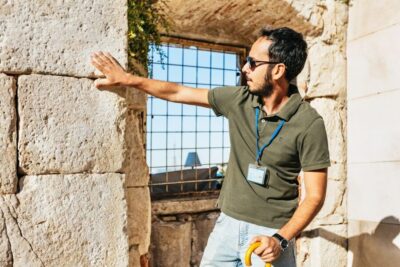
The meeting point is easy to identify: look for the large statue of Bishop Gregory of Nin, directly beside the Palace’s north entrance, the Golden Gate. The guide carries a black umbrella, which is especially helpful when several groups gather near the entrance.
The statue itself is a useful landmark. It gives you something solid to look for rather than a vague address in a maze of old streets. Arrive with a little time to spare, since the Palace area can feel confusing when you first enter it.
From here, the tour begins with the Golden Gate. This was the grand northern entrance to Diocletian’s Palace, and it gives you an immediate sense of the structure’s scale and purpose. The stop is not just a photo opportunity. It helps establish the Palace as a fortified imperial residence with formal entrances on different sides.
For a first-time visitor, that opening explanation can save you from treating the Palace as random ruins. You begin to see the Old Town as a former Roman complex that has changed purpose many times.
Golden Gate, Pjaca, and the shape of Old Town
The walk continues toward People’s Square, known locally as Pjaca, the main square of Split. This move from the Roman Palace to a later urban square is one of the tour’s useful features. You see that Split’s story did not stop when Roman rule ended.
Pjaca helps you understand the city as a place that grew around and inside the old Palace walls. The square is one of the key public spaces in central Split, and a guide can give you context that is hard to pick up from architecture alone.
I like having this stop early in the walk because it broadens the experience. You are not spending the entire 90 minutes looking only at Roman stones. You are also learning how people use the historic center as part of ordinary city life.
The guide’s regional background adds another layer here. Jelena is originally from Bosnia and Herzegovina and has lived in Split for many years. That gives her a wider view of the Balkans and allows her to connect local history with the region around it.
Jupiter’s Temple and the Palace’s sacred spaces
Jupiter’s Temple is one of the most memorable stops inside the Palace. The building is small compared with the overall complex, but it helps explain the religious side of Diocletian’s imperial world.
This is the kind of place that benefits from a live explanation. You can look at the doorway, stonework, and interior space on your own, but the meaning of the temple becomes clearer when someone places it within the Palace’s original plan.
The visit is guided, but the information provided does not promise extended interior time or a separate admission experience. Think of it as an essential orientation stop rather than a long museum visit.
That distinction is useful if you are planning the rest of your day. The tour gives you the story and setting. You may still want to return later for a slower look at the sights that interest you most.
Still Split, at a slower pace:
- From Split: Krka Waterfalls, Food & Wine Tasting Tour
★ 4.9 · 6,598 reviews - Split/Trogir: Blue Cave, Mamma Mia, Hvar and 5 Island Tour
★ 4.6 · 6,320 reviews - Blue Lagoon & 3 Islands Cruise with Lunch from Split
★ 4.5 · 5,756 reviews - Split: Old Town and Diocletian Palace Walking Tour
★ 4.9 · 4,727 reviews
Peristyle and the heart of Diocletian’s Palace
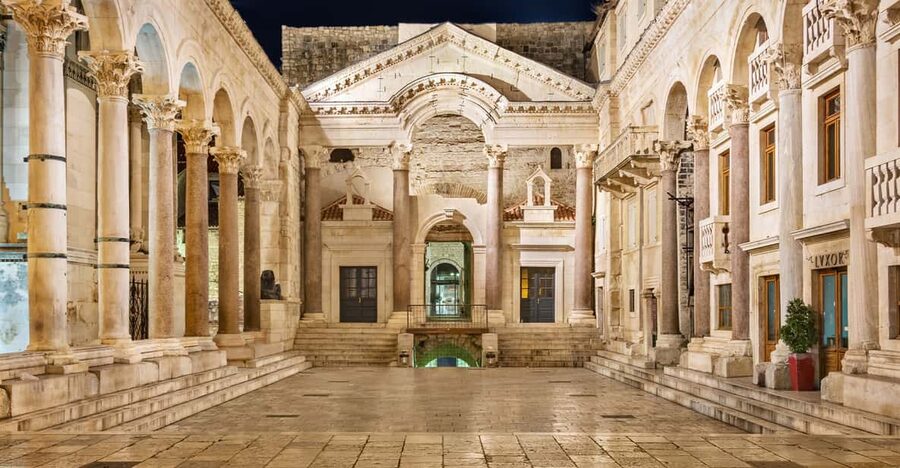
Peristyle is the dramatic center of the Palace and one of the places where the tour’s storytelling should have the most impact. This grand open space links several major sights and gives you a strong sense of the Palace’s original ceremonial role.
The value of a guide here is not just naming the square. Peristyle has layers of history, and Jelena’s job is to make those layers easy to follow. The tour promises a clear explanation from the start, then more detail as you reach each stop. That structure is helpful because you are not expected to remember a long lecture before seeing the place itself.
You will likely spend time taking photographs, but allow yourself a moment to look beyond the camera. The surrounding stone, columns, and buildings show how ancient remains have been absorbed into later city life.
This is also where the tour feels most like a useful first chapter rather than a complete study of the Palace. You get the main ideas, then you can decide which corners deserve a return visit.
Saint Domnius Cathedral and a key limitation
The Cathedral of Saint Domnius is another major landmark on the route. It is closely tied to the Palace’s central area, and its presence shows how the site changed from an imperial residence into a Christian city.
The tour includes a guided visit to the cathedral area, but you should note what is not included. The guide does not provide access to the cathedral bell tower, and the ticket for the Palace substructures is also outside this experience.
That is not necessarily a flaw. A short introductory walk has to keep moving, and the $17 price would be harder to maintain if every major paid attraction were included. Still, if you want to climb the bell tower or explore the substructures, plan those as separate visits.
I would use the tour to learn what each place is and why it matters, then return to the cathedral or underground rooms when you have more time.
The Egyptian Sphinx and the Vestibule photo stop
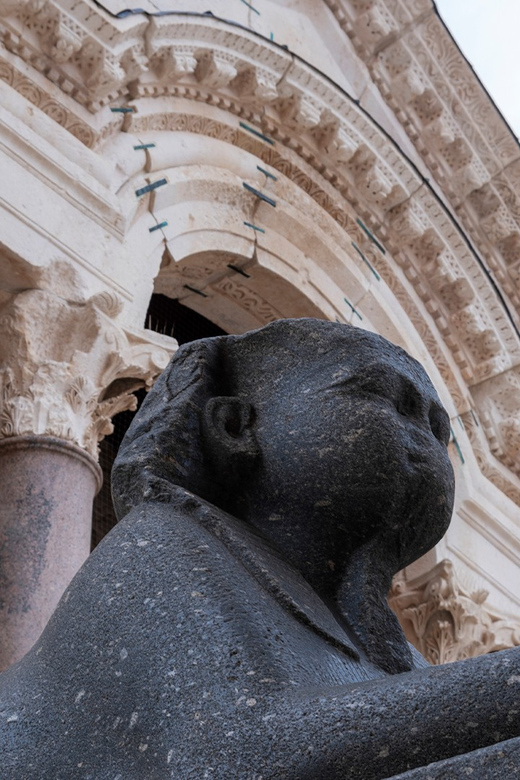
The Egyptian Sphinx is one of the Palace’s more unusual details. Its presence adds a touch of surprise to the Roman setting and gives Jelena a chance to explain the less expected pieces of the complex.
The exact amount of time spent at each sight can vary with questions and group pace, but the sphinx is included among the important places covered. It is a good reminder that Diocletian’s Palace is not a perfectly preserved single-period site. It contains objects and buildings from different stages of its long life.
The Vestibule provides the tour’s playful moment. The domed space has a strong visual character, and the group takes a selfie there as part of the experience. I like this small touch because it breaks up the information and gives you a shared memory without turning the tour into a photo-only outing.
The selfie is included, but there is no claim that professional photography is provided. Bring your own phone and be ready for a quick group picture.
Diocletian’s Cellars and what you should expect
The route includes Diocletian’s Cellars, also called the Palace substructures. However, the important practical point is that the tour does not include access to the substructures themselves.
This can sound confusing, so treat the stop as an explanation of the area rather than a paid underground visit. You can learn how the lower level relates to the Palace above and then decide if you want to buy separate access.
For some people, this will be a drawback. The substructures are one of the best-known parts of Diocletian’s Palace, and a first-time visitor may expect the entrance fee to be bundled into any Palace tour. For others, especially those with limited time, a guide’s explanation may be enough.
The same principle applies to the bell tower. If you want every major interior and a high viewpoint, budget extra time and money beyond this walk.
Finishing near Riva and getting local advice
The route takes you toward Split Riva, the famous waterfront promenade. Ending by the sea gives the walk a natural change of mood. You begin among ancient gates and imperial spaces, then finish beside one of the city’s main public gathering areas.
The supplied route identifies Riva as the finish, while the meeting information also says the activity ends back at the meeting point. Because those details do not match perfectly, confirm the precise endpoint when you book or meet the guide. Either way, you remain in central Split and can continue exploring on foot.
The post-tour recommendations are one of the strongest practical features. Jelena offers personal suggestions for restaurants, bars, things to see, and local experiences. You also receive vouchers for selected restaurants and bars in Split.
These vouchers can add real value if you planned to eat in the Old Town anyway. I would still ask exactly which businesses participate and what the voucher terms are, since the available information does not specify the discount amount or any restrictions.
What the $17 price really buys you
At $17 per person, this is priced as an affordable introduction rather than a premium private tour. The value comes from the combination of a licensed guide, a carefully chosen central route, a small group, and advice you can use for the rest of your stay.
You are paying for interpretation and orientation. That is worthwhile in Split, where the most important sights are close together but not always easy to read. A good explanation can help you recognize the Palace’s original plan, later religious changes, and the way modern Split uses the same spaces.
The price does not cover entry to the Palace substructures or the bell tower. If you compare this tour with a more expensive option, check whether those admissions are included before assuming one deal is better.
The current rating is 4.8 from 19 ratings, and the strongest praise focuses on the guide’s mix of historical information, humor, and present-day Split. One particularly useful detail is that Jelena can adapt the experience when the group is very small. On one occasion, the group effectively received a more personal walk, with extra tips about food and sightseeing.
Who will get the most from this walk?
I would choose this tour if you are visiting Split for the first time and want a simple introduction before exploring alone. It suits solo visitors, couples, friends, and families who prefer conversation and clear explanations over a formal lecture.
It is also a good match if you want local food suggestions. The vouchers and personal advice give you something practical to use after the history portion ends.
The tour is less suitable if you have already spent several days studying the Palace or if you want long interior visits. It also may disappoint anyone expecting entry to the substructures, bell tower, or other paid attractions.
The group limit of 10 is a strong middle ground. You get more room for questions than on a large city tour, but you do not pay the much higher price normally associated with a private guide.
The tour is conducted in English only. It is not suitable for wheelchair users, so accessibility should be checked carefully before booking.
Booking advice and final verdict
I would book this for your first full day in Split, especially if you want to understand the Old Town before choosing restaurants and returning to the sights that catch your eye. The 1.5-hour length leaves most of the day free, and the $17 cost is easy to justify if you use the recommendations and vouchers afterward.
Choose it with the right expectations. This is a guided orientation through the Palace and central Split, not an all-admissions archaeological tour. You will see the essential areas, hear useful stories, take the Vestibule selfie, and gain a clearer sense of modern life in the city.
The free cancellation policy allows you to cancel up to 24 hours before the activity for a full refund, and you can reserve now and pay later. For a first-time visitor who wants history without stiffness, this is a practical, friendly way to begin.
FAQ
How much does the Essential Diocletian’s Palace Tour cost?
The tour costs $17 per person.
How long does the tour last?
The walking tour lasts 1.5 hours.
What language is the tour conducted in?
The live tour is conducted in English.
How large is the group?
The tour is limited to 10 participants.
Where does the tour begin?
Meet in front of the large statue of Bishop Gregory of Nin, beside the Golden Gate, the northern entrance to Diocletian’s Palace. Look for the guide’s black umbrella.
Which main sights are included?
The route includes the Golden Gate, People’s Square, Jupiter’s Temple, Peristyle, the Cathedral of Saint Domnius, the Egyptian Sphinx, Vestibule, Diocletian’s Cellars area, and Split Riva.
Are the Palace substructures and bell tower included?
No. The tour does not include access to the Diocletian’s Palace substructures or the cathedral bell tower.
Can I cancel the booking?
Yes. You can cancel up to 24 hours in advance for a full refund. You can also reserve now and pay later.
Just added around Split
- Walking Tour Split★ 4.7 · 61 reviews
- Unique vintage Tomos moped tour Split – Back to the ’80s★ 4.8 · 17 reviews
- Trogir: White Lagoon, Maslinica & Blue Lagoon Speedboat Tour★ 4.8 · 11 reviews
- Split: Trogir Open Top Bus Trip + Free Split Walking Tour★ 4.1 · 17 reviews
- Trogir; Private walking tour of higlights of Trogir★ 4.7 · 3 reviews
- Trogir: Old Town Guided Walking Tour★ 4.6 · 76 reviews
- Trogir: Blue Lagoon, Maslinica, and Solinska Bay Boat Tour★ 4.9 · 88 reviews
- TROGIR: Blue Lagoon & 3 Islands Half-day Speedboat tour★ 4.6 · 28 reviews
Split Tours, compared.

Krka Waterfalls Trip with Boat Cruise and Swimming
Read our review →

Blue cave, Mamma Mia and Hvar, 5 islands speedboat tour
Read our review →
Split/Trogir: Blue Cave, Mamma Mia, Hvar and 5 Island Tour
Read our review →
Blue Lagoon & 3 Islands Cruise with Lunch from Split
Read our review →