
Reviewed · WALKING TOURS
SPLIT-PREMIUM Emperor’s Walking Tour for History Lovers + Museum
Split’s Roman heart still has a pulse. This two-hour walking tour brings Diocletian’s Palace and the surrounding Old Town into one clear story, led by a licensed local guide who knows how the emperor’s retirement home became a living city. I like the small maximum of 15 people, and I like the strong focus on history rather than costume shows or movie trivia. The main consideration is that the €10 Cellars museum ticket is extra, and the group tour is for adults only.
The route begins and ends beside the Riva waterfront, making it handy for a day in port or a first look at Split. Guides such as Joško, Joe, Joseph, and Daniela are praised for humor, local insight, patience, and the ability to adjust the pace. If you have limited time, a mobility concern, or a particular interest in Croatian history, speak up early.
In This Review
- What makes this Split tour worth your time
- Starting beside Split’s Riva promenade
- Diocletian’s Palace: an emperor’s retirement home
- The Peristyle and Vestibulum reveal imperial theater
- Cathedral of Saint Domnius and the Temple of Jupiter
- Split’s medieval streets grow around Rome
- The Golden Gate and Grgur Ninski
- The Cellars are the tour’s key museum option
- What the guides do best
- Group size, pace, and the adults-only rule
- Heat, timing, and cruise-day planning
- Is $30 a fair price?
- Who should book this walking tour?
- Final verdict: a strong first look at Split
- FAQ
- How long does the Emperor’s Walking Tour last?
- Where does the tour start?
- Where does the tour finish?
- Is the Diocletian’s Palace entrance included?
- How much does the Cellars museum cost?
- Is the Cathedral of Saint Domnius included?
- Is the Temple of Jupiter included?
- Are children allowed on the group tour?
- What happens if the weather is poor or the minimum group size is not met?
What makes this Split tour worth your time
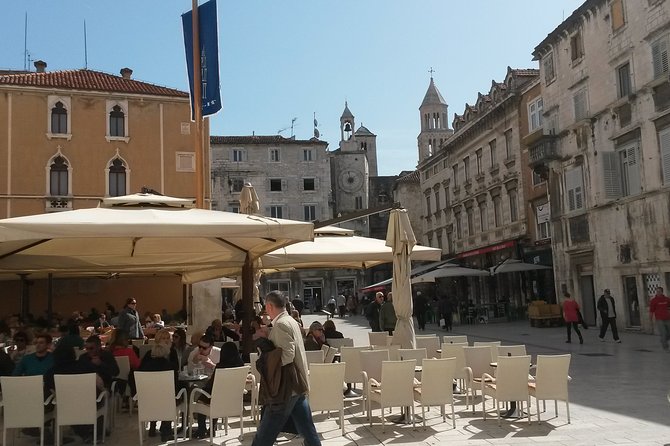
- A palace that became a city: Walk through an ancient imperial residence where homes, shops, cafés, and streets now fill the Roman framework.
- Small-group format: The tour accepts no more than 15 people, and some departures may be much smaller.
- Local guides with personality: Joško and Daniela are repeatedly praised for clear explanations, wit, kindness, and pride in Split.
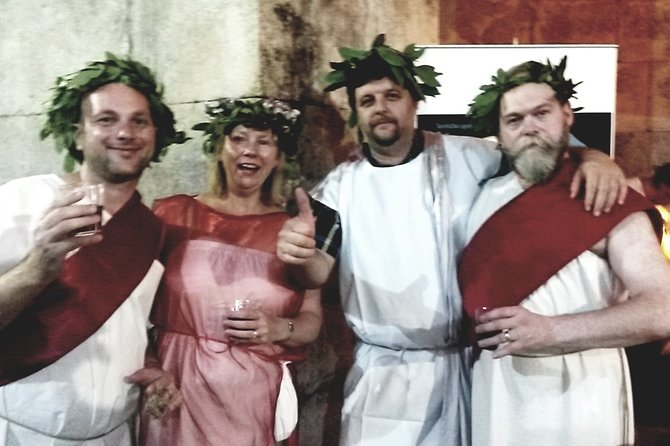
- A real history lesson: The emphasis is Diocletian, Dalmatia, Split, architecture, and Croatia, not a costumed performance or a dedicated Game of Thrones tour.
- Useful for cruise port calls: The Riva meeting point is within walking distance of the cruise port, with the route returning to where it began.
- Optional museum time: The best-preserved palace section is the Cellars, but admission costs €10 per person and is not included.
Starting beside Split’s Riva promenade
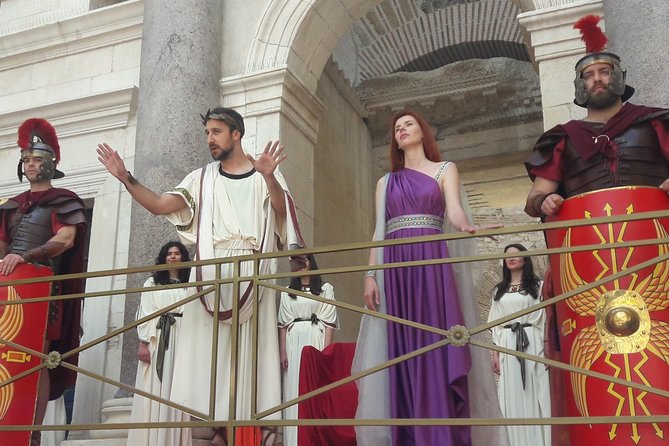
Meet at the Main Stage on the Riva promenade, at Obala Hrvatskog narodnog preporoda 22. This is a sensible starting point: the palm-lined waterfront is easy to identify, close to public transportation, and practical for a day visit from a cruise ship.
The tour finishes at the same meeting point. That matters in Split, where the old center is a maze of narrow lanes and Roman walls. You do not need to arrange a taxi at the end or guess where your guide has left you.
Allow a little flexibility beyond the advertised two hours. The official duration is approximately two hours, but some departures have lasted two and a half or even three hours when the guide answered questions, helped with photographs, or adapted to the pace of the group. That extra time can be welcome, but do not schedule your next activity too tightly.
More Walking Tours in Split
- Split: Old Town and Diocletian Palace Walking Tour
★ 4.9 · 4,727 reviews - Walking Tour of Split and Diocletian’s Palace
★ 5.0 · 2,588 reviews - Krka Waterfalls tour with Trogir Walking tour and Krka panoramic boat cruise
★ 5.0 · 1,659 reviews
Diocletian’s Palace: an emperor’s retirement home
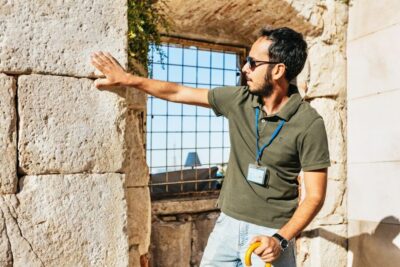
The central idea of the tour is simple and useful: Diocletian’s Palace is not a single abandoned monument sitting apart from modern life. It is the core of Split. The palace was built in 305 AD, and its walls, gates, courtyards, temples, and underground spaces are woven into the present-day city.
Your guide begins by explaining the palace as a planned imperial residence. You can expect attention to the emperor’s private quarters, the public areas, the defensive edges, and the way later generations adapted the structure. The point is not merely to identify old stones. It is to help you understand why a Roman palace still shapes the way you move through Split.
The tour spends about 25 minutes on the palace as a main subject, though the palace appears again and again throughout the walk. This layered approach works well. You see the major spaces first, then notice how they connect as you pass through the Peristyle, Vestibulum, Golden Gate, and Cellars.
The Peristyle and Vestibulum reveal imperial theater
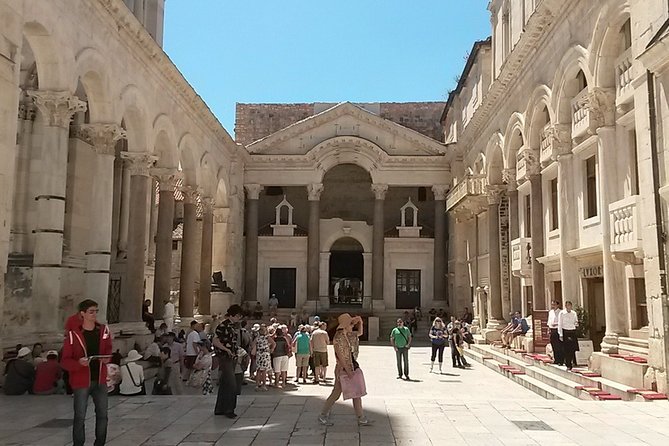
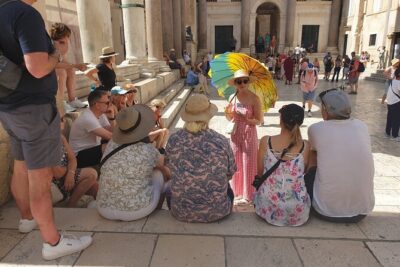
The Peristyle was Diocletian’s ceremonial square, and it remains the emotional center of the palace. You will hear why this open space mattered to an emperor and how its proportions and surrounding columns helped create a sense of power.
The square is not a quiet museum courtyard. Modern Split uses it, so the setting feels active rather than frozen. That is part of the charm, though it can also mean crowds and background noise. A small group gives your guide a better chance of keeping everyone together and finding a useful position for explanations.
Nearby, the Vestibulum marks the main entrance toward the emperor’s private residence. The stop is brief, around five minutes, but it helps complete the palace plan. You begin to see the movement from formal public space toward private imperial rooms.
Cathedral of Saint Domnius and the Temple of Jupiter
The Cathedral of Saint Domnius is seen from outside. The tour does not include entry to the cathedral or its Treasury, so treat this as an architectural and historical introduction rather than a church visit.
The same applies to the Temple of Jupiter. You will see the former Roman temple from outside, with an optional visit inside at your own cost. This is useful if you want orientation before deciding how to spend your own time afterward. One participant used the tour to understand the center, then visited the Jupiter temple, cathedral, and Treasury independently.
The outside-only approach keeps the walk moving and helps hold the price at $30 per person. Still, you should budget extra time and money if indoor visits are important to you. The guide can explain the setting, but the admission fees are separate.
Still Split, at a slower pace:
- Split: Krka Waterfalls Trip with Boat Cruise and Swimming
★ 4.8 · 10,519 reviews - From Split: Krka Waterfalls, Food & Wine Tasting Tour
★ 5.0 · 9,326 reviews - Blue cave, Mamma Mia and Hvar, 5 islands speedboat tour
★ 5.0 · 7,150 reviews - From Split: Krka Waterfalls, Food & Wine Tasting Tour
★ 4.9 · 6,598 reviews
Split’s medieval streets grow around Rome
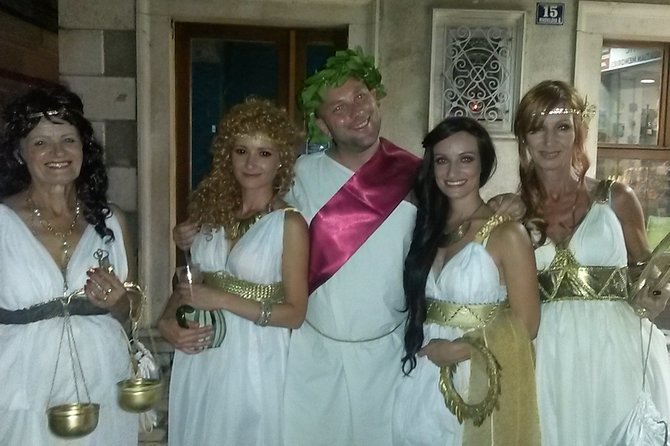
The Old Town section lasts about 25 minutes and shows how Split developed after the palace changed purpose. Medieval lanes run through and around Roman structures, producing an unusual mix of domestic buildings, small businesses, religious sites, and ancient stonework.
I especially like this part for first-time visitors because it prevents a common mistake: seeing the palace as one isolated attraction and missing the city that grew inside it. Your guide connects the Roman period with later centuries and explains how Split and Dalmatia changed over time.
The walk also passes through several squares that reveal different sides of the city. Fruit’s Square, or Trg Braće Radić, was once a green market and includes the statue of Marko Marulić, regarded as the father of Croatian literature. Narodni Trg, or People’s Square, is the largest and liveliest piazza in the Old Town. These places give the history a human scale, with everyday city life continuing around the monuments.
The Golden Gate and Grgur Ninski

The Golden Gate is the palace’s main and most impressive entrance. A short stop here gives you a chance to study the scale of the original complex and imagine how visitors approached the imperial residence.
The route also includes the statue of Grgur Ninski, one of Croatia’s major historical figures. Your guide explains his importance rather than simply pointing out the statue. This is one of the moments when a local guide adds real value, since the subject connects the physical center of Split with Croatian cultural and political history.
You will also see the old City Clock, described as about 500 years old and using a 24-hour display. It is a small detail, but these are the touches that make a walking tour more memorable. They give you things to notice later when you explore on your own.
The Cellars are the tour’s key museum option
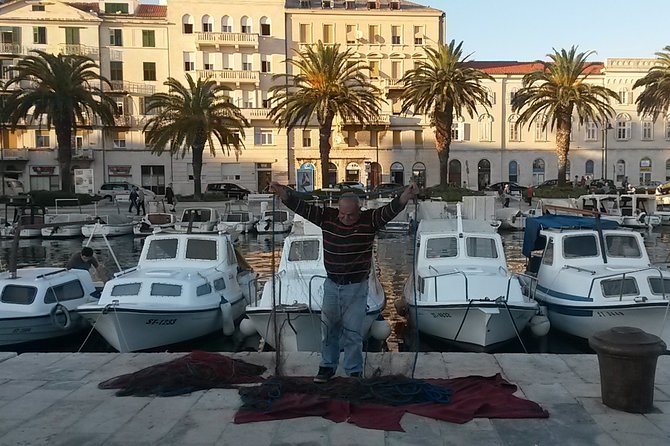
The Diocletian Palace Substructures are described as the best-preserved part of the palace. They offer a chance to understand the original layout from below and to see Roman construction in a more enclosed setting.
Admission to the Cellars museum is not included. The fee is €10 per person. That extra charge is worth considering when you compare the tour price with the total cost of the experience. At $30, the walk is reasonably priced for a licensed guide and a small group, but the museum visit raises the final bill.
The title includes a museum element, yet the included service is primarily a guided walk. Make sure you are clear on this point before booking. You can walk with the guide into the Cellars if you pay the admission fee, but the ticket is not covered by the $30 price.
What the guides do best
The most praised part of this experience is the guiding. Joško is described as funny, thorough, generous with time, and able to explain complex history in plain language. Joe and Joseph receive similar praise for local perspective, warmth, and an easy sense of humor. Daniela is singled out for detailed explanations of Split and Dalmatia, careful pacing, and sensitivity toward a participant with limited mobility.
That pattern tells you what kind of tour this is. It is built around interpretation, not a script delivered at speed. Guides answer questions, add small stories, take photographs, and sometimes offer restaurant or bakery suggestions after the walk.
One useful distinction is the subject matter. This is a serious history tour with humor. You will see locations associated with Game of Thrones, but the guide does not focus on explaining scenes or recreating the show. If television locations are your main reason for visiting Split, you will need to do some extra research or choose another activity.
Group size, pace, and the adults-only rule
The maximum group size is 15, and the small-group promise matters most in Split’s narrow streets. You can hear the guide more easily, ask questions without holding up a large crowd, and stay closer to the historical details.
Departures can be especially pleasant when numbers are low. One group had only six people while much larger tours moved nearby during a busy period with two cruise ships in port. A smaller group also gives the guide more room to adjust the route or spend longer on a subject that interests you.
The group tour is for adults only and is not recommended for anyone under 18. A private tour is available for all ages. Most people can participate, but this remains a walking experience over historic streets, so comfortable shoes and a realistic pace are sensible choices.
If you have mobility concerns, mention them at the start. Daniela is praised for handling one participant’s needs with care and allowing the group to overrun rather than forcing an uncomfortable pace. That is encouraging, though individual guide availability and group conditions can vary.
Heat, timing, and cruise-day planning
Split can be very hot in summer. One participant found the heat intense even after the sun came up, and another described a departure in 38-degree weather. I would choose an early start whenever possible, especially in July or August.
The route is close to the waterfront, but much of the palace and Old Town involves stone streets and exposed squares. Bring water, sun protection, and a hat. The guide may provide a lively pace, but no walking tour can remove the summer heat.
Cruise passengers should leave a generous margin before returning to the ship. The meeting point is walkable from the port, and the tour ends at the start point, but the walk may run longer when questions and photographs add time. The guide has helped people fit the route around ship schedules, yet you should still tell the guide about your departure time before the tour begins.
Is $30 a fair price?
At $30 per person, the price is fair for a licensed local guide, a custom-designed route, and a group capped at 15. You are paying for the story that ties separate ruins and squares together, not simply for access to places you could technically see on your own.
The value improves if you are new to Split or have only a few hours. The tour covers the palace, Old Town, major gates, squares, Roman remains, and Croatian figures in one compact outing. It can save you from walking past important sites without understanding their purpose.
The value is less clear if you want extensive indoor access. Cathedral entry, the Temple of Jupiter interior, and the €10 Cellars admission are not included. You may spend more after the walk if you want to explore those sites properly.
Free cancellation is available up to 24 hours before the start time. Within 24 hours, no refund is offered. The experience also depends on good weather and a minimum of four people. If poor weather or low numbers force cancellation, you are offered another date, another experience, or a full refund.
Who should book this walking tour?
I would choose this tour if you enjoy history, architecture, and local stories more than staged entertainment. It suits couples, solo adults, and small groups who want a strong introduction to Split before exploring independently.
It is also a good choice for cruise passengers, provided you allow extra time around the two-hour estimate. The Riva location and return to the same point make the logistics simple.
Choose something else if you need a family-focused group activity, want a full indoor museum visit included, or mainly want Game of Thrones commentary. Families with children can consider the private option, since the private tour is open to all ages.
Final verdict: a strong first look at Split
I would book the SPLIT-PREMIUM Emperor’s Walking Tour if your goal is to understand why Split feels like a Roman palace, a medieval town, and a modern Croatian city at the same time. The guides’ local connection, humor, patience, and command of the subject receive unusually consistent praise, and the small group size helps turn a crowded center into a readable place.
Just plan for the separate Cellars ticket, hot weather, adult-only group rules, and a possible finish beyond two hours. For $30, it offers a useful and personable introduction, especially for history fans and cruise passengers with limited time.
FAQ
How long does the Emperor’s Walking Tour last?
The advertised duration is approximately two hours. Some departures may last longer, with reported tours running two and a half to three hours when questions, photographs, or mobility needs require extra time.
Where does the tour start?
It starts at the Main Stage on the Riva promenade, at Obala Hrvatskog narodnog preporoda 22, 21000 Split, Croatia.
Where does the tour finish?
The activity ends back at the meeting point on the Riva promenade.
Is the Diocletian’s Palace entrance included?
The guided visits to the palace areas listed for the walk do not require a separate admission ticket. Admission to the Diocletian Palace Substructures museum is not included.
How much does the Cellars museum cost?
The admission fee for the Museum of Diocletian’s Cellars is €10 per person.
Is the Cathedral of Saint Domnius included?
The tour sees the Cathedral of Saint Domnius from outside. Entry to the cathedral and its Treasury is not included.
Is the Temple of Jupiter included?
The Temple of Jupiter is viewed from outside. An optional interior visit is possible, but its admission fee is not included.
Are children allowed on the group tour?
The group tour is for adults only and is not recommended for people under 18. The private tour is available for all ages.
What happens if the weather is poor or the minimum group size is not met?
If poor weather causes cancellation, you are offered a different date or a full refund. The tour requires at least four people to operate, and if that minimum is not met, you are offered another date, another experience, or a full refund.
More History Tours in Split
- Walking Tour of Split with a ‘Magister’ of History
★ 5.0 · 1,122 reviews - Split Walking Tour with Professor of History
★ 5.0 · 926 reviews - Split: History and Heritage Walking Tour
★ 4.9 · 650 reviews - Split History and Gastro Small-Group Tour with Food and Drinks
★ 5.0 · 375 reviews
More Museums and Galleries in Split
- Blue Lagoon & Underwater Museum from Split with Lunch & Drinks
★ 4.5 · 1,122 reviews - Split: Game of Thrones Museum Entrance Ticket
★ 3.8 · 385 reviews - Split: Klis Fortress GOT and Olive Museum Entry Tickets
★ 4.6 · 283 reviews - Split: Museum of Illusions Entrance Ticket
★ 4.2 · 254 reviews
Just added around Split
- Slatine – Island Hopping Excursion (Trogir/Blue Lagoon/Shipwreck)★ 4.0 · 24 reviews
- Krka Waterfalls & Primošten from Trogir, Seget, Čiovo & Kaštela★ 5.0 · 18 reviews
- Island Hopping Boat Excursion with Lunch (Trogir,Blue Lagoon, Šolta)★ 3.5 · 6 reviews
- From Trogir, Seget, Okrug: Krka Waterfalls & Šibenik Culture Tour★ 5.0 · 10 reviews
- From Split & Trogir: ATV Quad Tour on Island Čiovo★ 5.0 · 21 reviews
- Split: Blue Lagoon Boat Trip with Lunch, Wine and Snorkeling★ 5.0 · 3 reviews
- Split Sunset Stand Up Paddle Tour★ 5.0 · 16 reviews
- Split: Sunset Guided Kayaking Tour★ 4.8 · 71 reviews
Walking Tours, compared.
Walking Tour of Split and Diocletian’s Palace
Read our review →


Krka Waterfalls tour with Trogir Walking tour and Krka panoramic boat cruise
Read our review →
City Walls Early Morning or Sunset Walking Tour
Read our review →Browse the lists this tour appears in