
Reviewed · WALKING TOURS
Walking Tour Split
Split’s old center is a palace you can walk through. This 90-minute walking tour gives you a clear introduction to the city’s ancient core, with a licensed local guide leading you through Diocletian’s Palace and its surrounding squares. I like the compact route and the chance to see major sights without spending a full day.
I also like the personal touch promised by guides such as Anna and Victoria G, both praised for making the city’s story lively and easy to follow. The main consideration is that entrance tickets are not included, so this is primarily a guided orientation walk rather than a ticketed sightseeing tour inside every monument.
The tour costs $28 per person and begins in front of Split’s National Theatre at Trg Gaje Bulata 1. It returns to the same place, which makes it simple to fit into a day of independent exploring, a cruise stop, or a short stay in Split.
In This Review
- Key points about this Split walking tour
- Starting at Split’s National Theatre
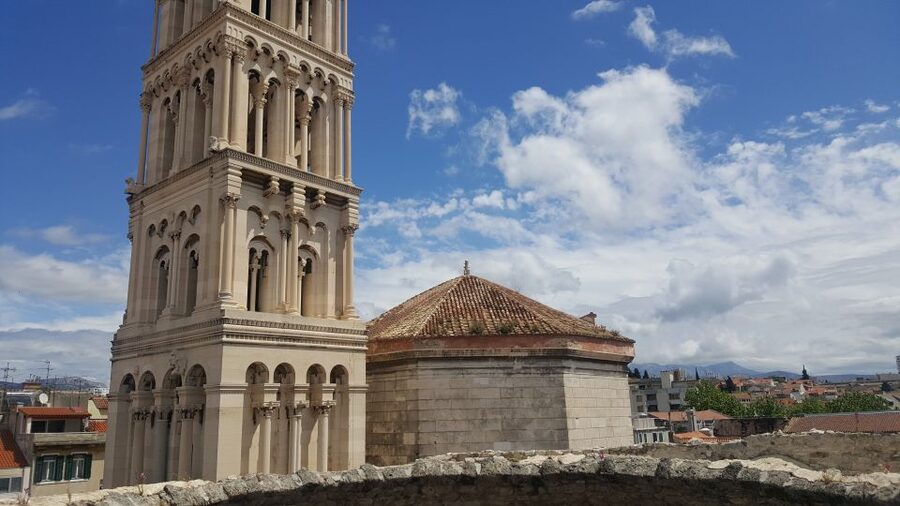
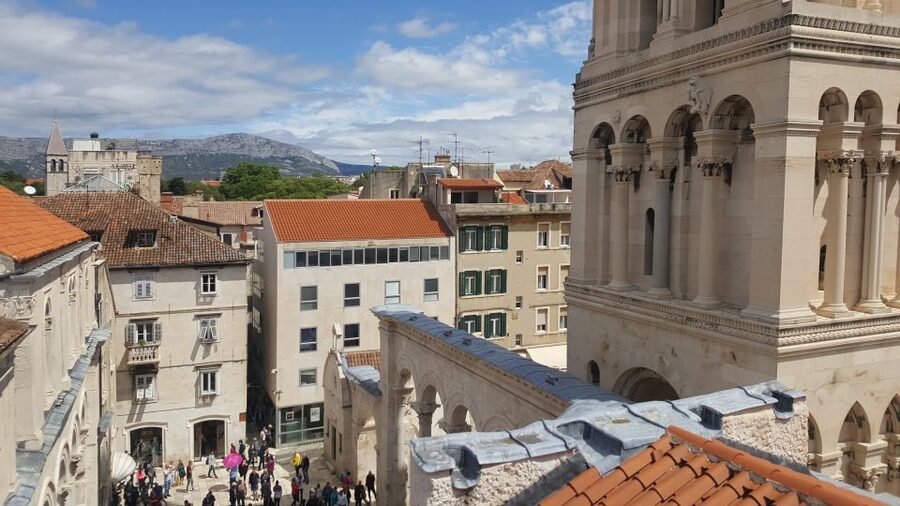
- Walking through Diocletian’s Palace
- Peristyle, Vestibul, and Jupiter’s Temple
- Cathedral of St. Duje and the Golden Gates
- Grgur Ninski, Pjaca, and Fruit Square
- What the local guides add
- Is $28 a good value?
- Who will enjoy this 1.5-hour route?
- Practical advice before you book
- Should you book Walking Tour Split?
- FAQ
- How long is the Walking Tour Split experience?
- Where does the tour begin?
- Where does the tour end?
- What sights are included in the walking route?
- Are entrance tickets included?
- What languages does the guide speak?
- Can I cancel the booking?
Key points about this Split walking tour
- Diocletian’s Palace forms the heart of the route: You walk through the UNESCO-protected palace area rather than only viewing it from outside.
- The route covers Split’s essential sights: Expect the Cathedral of St. Duje, Peristyle, Jupiter’s Temple, Vestibul, Golden Gates, Grgur Ninski statue, Pjaca, and Fruit Square.
- Local guides add the human angle: Anna and Victoria G have been praised for their clear explanations, warmth, and enthusiasm for Split.
- The 1.5-hour length is easy to fit into a busy day: You get an introduction without giving up an entire morning or afternoon.
- The price is reasonable for a guided city orientation: At $28, you pay for a licensed guide, the walking route, and insurance, but not monument admission.
- English and Spanish are available: Check the schedule when booking because starting times depend on availability.
Starting at Split’s National Theatre
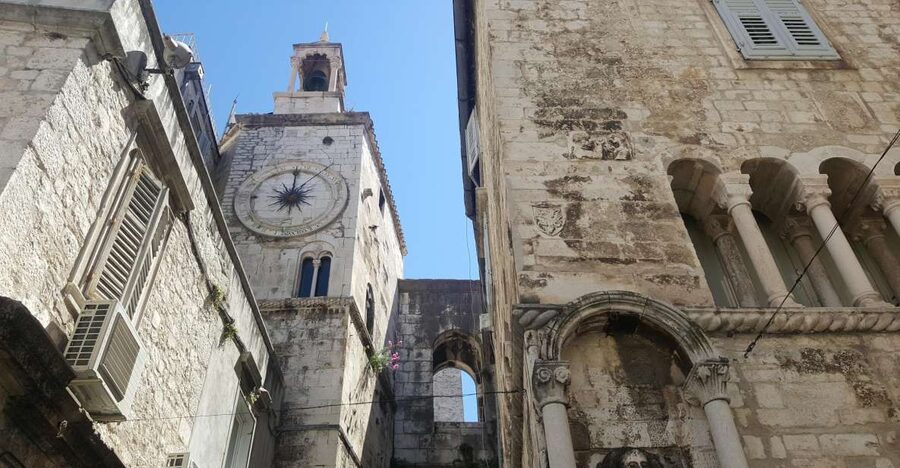
The meeting point is in front of the National Theatre at Trg Gaje Bulata 1. This is a useful place to begin because the tour starts outside the dense lanes of the Old Town, giving you a clear reference point before you head toward the palace.
You should arrive ready to walk on city streets and through the historic center. The experience ends back at the National Theatre, so you do not need to plan a complicated pickup or wonder where you will finish.
The route is guided on foot, with no transportation included or needed. That matters in Split, where the Old Town is best understood at walking pace. A bus or taxi can bring you near the center, but it cannot explain why the streets, courtyards, gates, and squares fit together as they do.
The exact starting time is not fixed in the information provided, so check availability for the date you want. If you have a ferry, cruise departure, restaurant booking, or museum visit planned, leave some breathing room around the 90-minute tour.
More Walking Tours in Split
- Split: Old Town and Diocletian Palace Walking Tour
★ 4.9 · 4,727 reviews - Walking Tour of Split and Diocletian’s Palace
★ 5.0 · 2,588 reviews - Krka Waterfalls tour with Trogir Walking tour and Krka panoramic boat cruise
★ 5.0 · 1,659 reviews
Walking through Diocletian’s Palace
The main attraction here is not a single building with a neat entrance and exit. Split’s ancient palace forms part of the working Old Town, so you walk through its streets and public spaces as the city carries on around you.
That makes the tour useful for first-time visitors. A guide can point out how the ancient palace connects with contemporary Split, helping you understand the city before you explore it on your own. Without that introduction, the Old Town can feel like a maze of handsome stone walls and narrow passages.
The route focuses on heritage and culture, not just quick photo stops. You can ask the guide about old and contemporary Split, and the provider specifically invites questions about other activities in the city center after the walk.
Do not expect a full museum visit at every stop. Tickets and entrance fees are not included, so the tour is best viewed as a guided walk around the historic core. If a particular interior matters to you, ask the guide whether there is time to return later and buy admission separately.
Peristyle, Vestibul, and Jupiter’s Temple
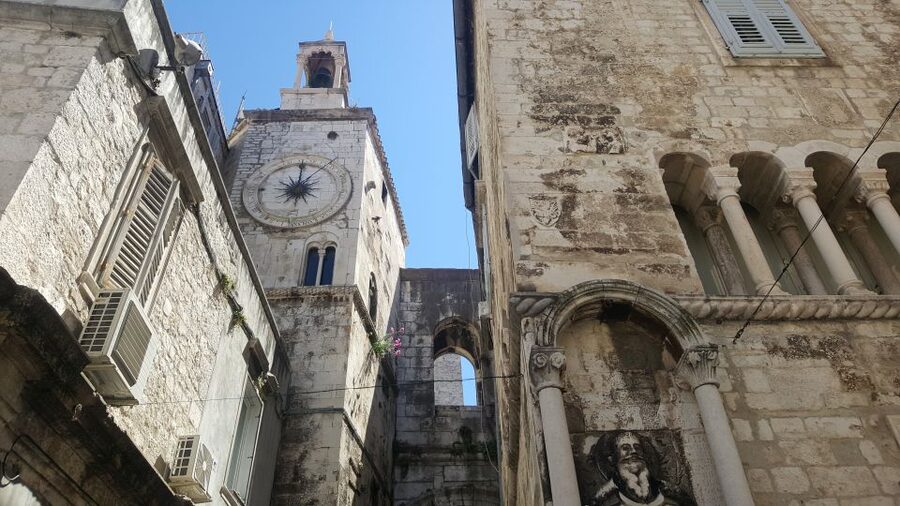
The itinerary includes several of the palace’s best-known spaces: Peristyle, Vestibul, and Jupiter’s Temple. These names can blur together when you read about Split in advance, but seeing them in sequence gives the palace a stronger sense of shape and purpose.
Peristyle is one of the central sights on the walk. The guide’s role is especially useful here because the space is more than an attractive stone square. You can ask questions and connect the setting to the Roman period and to the later life of Split.
Vestibul provides another important stop within the palace route. The tour information does not promise a performance, interior admission, or extended visit, so think of it as a place where your guide explains what you are seeing rather than a separate scheduled event.
Jupiter’s Temple adds another layer to the walk. The value is not simply checking off a Roman-era landmark. The guide can help you place the temple within the wider palace story, giving you a framework for noticing details when you pass through the area again.
Since the entire tour lasts only 90 minutes, the time at each location will be measured. That is a fair trade for a concise introduction, but visitors who want lengthy photography breaks or detailed study of every monument may prefer to return independently afterward.
Cathedral of St. Duje and the Golden Gates
The Cathedral of St. Duje is one of the most important sights included on the route. It gives the walk a chance to move beyond the Roman palace and show how Split’s identity includes both its ancient foundations and its later religious and civic life.
The itinerary also includes the Golden Gates, one of the major entrances connected with the Old Town. Gates are easy to treat as simple photo stops, but a guide can explain their place in the city’s layout and help you see how people enter and move through the historic center.
The tour does not include entrance fees, so do not assume the cathedral or other sights are entered as part of the $28 price. The supplied details confirm that the route visits these important places, while admission to sights remains separate.
One of the strengths of a walking tour is that you can ask a question at the exact moment a detail catches your eye. If you are curious about the cathedral, the palace, or the gates, use the guide rather than waiting until the end. The experience is designed around a live guide, not an audio recording.
Still Split, at a slower pace:
- Split: Krka Waterfalls Trip with Boat Cruise and Swimming
★ 4.8 · 10,519 reviews - From Split: Krka Waterfalls, Food & Wine Tasting Tour
★ 5.0 · 9,326 reviews - Blue cave, Mamma Mia and Hvar, 5 islands speedboat tour
★ 5.0 · 7,150 reviews - From Split: Krka Waterfalls, Food & Wine Tasting Tour
★ 4.9 · 6,598 reviews
Grgur Ninski, Pjaca, and Fruit Square
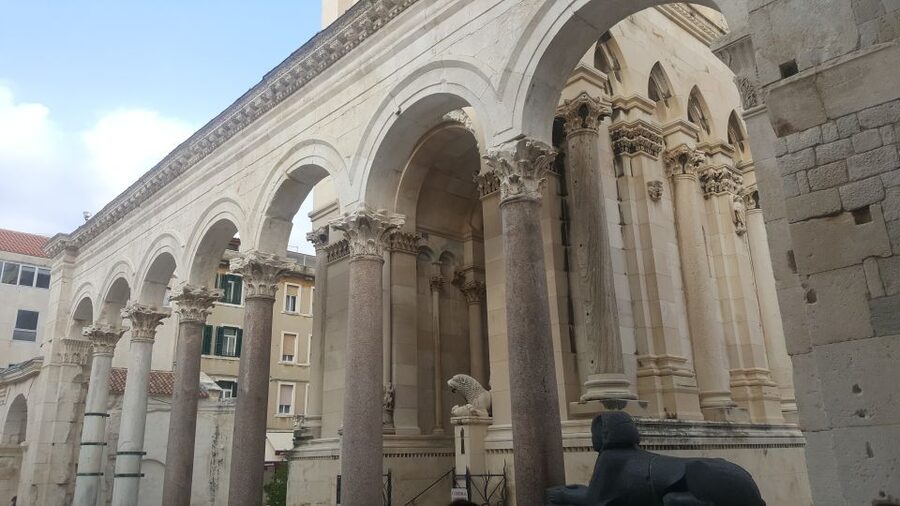
The walk also reaches the Grgur Ninski statue, Pjaca, and Fruit Square. These stops help shift the experience from a Roman site visit into a tour of Split as a living town.
Grgur Ninski is a memorable landmark and an easy meeting point for later exploring. The statue gives the tour a strong visual marker, while the squares show how the Old Town opens into places where daily city life and historic architecture meet.
Pjaca and Fruit Square are especially useful for orientation. After the guide points them out, you can return to them for a meal, a coffee, or a second look at the surrounding streets. The provider also encourages you to ask about additional activities near the center, which is practical if you have free time after the walk.
The route’s mix of palace spaces, religious sights, gates, a statue, and public squares is one of its best features. You do not see only one period of Split. Instead, you get a quick sense of how old and contemporary elements sit side by side.
What the local guides add
A good city walk depends heavily on the guide, and the strongest praise here centers on the people leading it. Anna has been described as engaging and deeply committed to the tour, even when she was guiding only two people during the December off-season.
That detail is useful. It suggests that the tour may still operate with a very small booking in quieter months, though you should not assume every departure will be private or nearly private. A small group can make it easier to ask questions and hear explanations clearly.
Victoria G has also received strong praise for combining local pride with a broad interest in travel. Her approach reportedly covers the Roman period but does not stop there, which is exactly what you want from an introduction to Split. The city is easier to understand when the guide connects its past with its present.
The available languages are English and Spanish. If language is important to your booking decision, choose the appropriate departure carefully. The live-guide format means you can ask for clarification, but only in the language offered for that tour.
The guide is licensed, and insurance is included. Those are modest but useful inclusions. You are paying for a formal guided experience rather than simply joining an informal walk led by an unknown host.
Is $28 a good value?
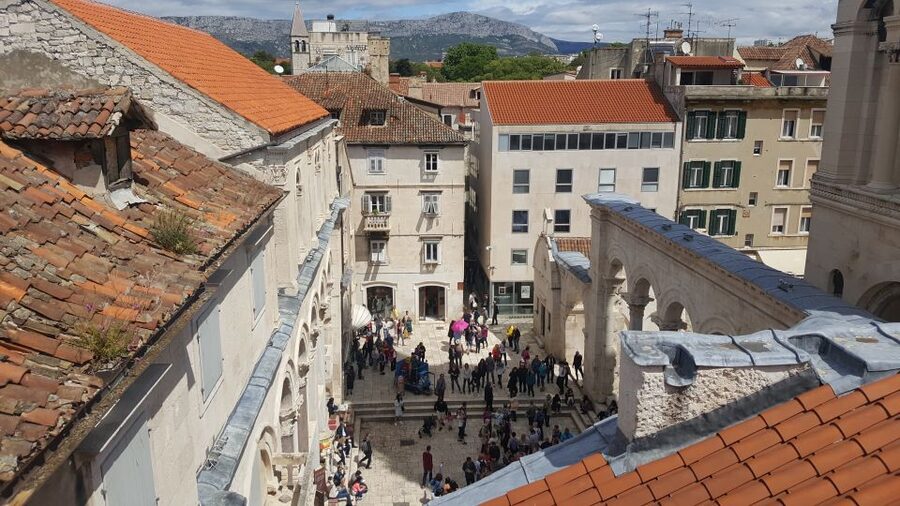
At $28 per person, the tour sits in a sensible range for a short guided introduction to a major historic center. The price includes a licensed guide, the walking tour around Split’s center, and insurance.
The value is strongest if you are new to Split and want help getting oriented. In 90 minutes, you cover the city center, Old Town, and a long list of key sights. You can then spend the rest of your day returning to the places that interested you most.
The value is weaker if you want monument admission included or expect a long, detailed visit inside each sight. The cost does not cover tickets or entrance fees, and the short duration limits how long you can stop at any one location.
I would also compare the price with your own plans. If you already intend to wander the palace alone and are happy to read signs or use a guidebook, you may prefer to keep the $28. If you want local explanations, a planned route, and a chance to ask questions, the fee is reasonable.
The free-cancellation policy adds useful flexibility. You can cancel up to 24 hours in advance for a full refund, and the reserve-now, pay-later option lets you hold a place without paying immediately. Those terms are helpful when your schedule depends on ferry connections, weather, or changing sightseeing plans.
Who will enjoy this 1.5-hour route?
This tour suits first-time visitors who want a quick but meaningful introduction to Split. It is also a good choice if you have only part of a day, are staying near the center, or want to understand the Old Town before exploring independently.
History fans will appreciate the focus on Diocletian’s Palace, Roman-era sites, and the transition into later religious and civic landmarks. You do not need specialist knowledge to enjoy it, since the guide supplies the basic story and points out the places that deserve a closer look.
It works well for people who like asking questions. The guide is available in person, and the tour specifically invites questions about other city-center activities. That makes it more useful than a fixed recording when your interests are specific.
The tour may be less suitable for anyone who wants a long museum-style visit or a detailed architectural study. It is a walking overview, not a full-day archaeological program, and admission costs are separate.
It can also suit independent-minded visitors. A guided introduction does not lock you into a full-day group schedule. Once you return to the National Theatre, you can continue on your own and revisit Pjaca, Fruit Square, the palace, or another sight at your preferred pace.
Practical advice before you book
Wear shoes you can walk in comfortably and expect to spend the full 90 minutes on foot. The route covers several parts of the Old Town, including palace spaces, squares, gates, and major landmarks.
Check the available starting times before booking. The information gives a duration but not one fixed daily departure, so the schedule may vary.
Plan for extra money if you want to enter sights along the way. The tour fee covers guiding, the walk, and insurance, but not tickets.
Use the guide’s local knowledge at the end. Ask for suggestions about additional activities around the city center while you still have the guide in front of you. That is one of the simplest ways to turn a short tour into a useful plan for the rest of your day.
The tour has a 4.7 rating from 61 reviews, with particularly strong praise for the guides’ warmth, clear explanations, and enthusiasm for Split. The comments about Anna continuing with a tiny off-season group and Victoria G making the history lesson a highlight point to the human side of the experience, which matters more than a long list of monuments.
Should you book Walking Tour Split?
Book it if you want a well-priced introduction to Split’s Old Town, especially if this is your first visit or your time is limited. The route covers the major names, the licensed guides bring local context, and the 90-minute format leaves room for your own plans.
Skip it if you mainly want included admission to monuments or prefer to explore silently at your own pace. For most visitors seeking orientation, history, and a friendly local guide, this is a practical first step into Split, with enough flexibility to continue exploring on your own afterward.
FAQ
How long is the Walking Tour Split experience?
The tour lasts 1.5 hours, or 90 minutes. Starting times vary, so you should check availability for your chosen date.
Where does the tour begin?
The meeting point is in front of the National Theatre in Split, at Trg Gaje Bulata 1, 21000 Split, Croatia.
Where does the tour end?
The tour ends back at the National Theatre meeting point.
What sights are included in the walking route?
The route includes Split’s city center and Old Town, with stops at Diocletian’s Palace, the Cathedral of St. Duje, Peristyle, Jupiter’s Temple, Vestibul, the Golden Gates, the Grgur Ninski statue, Pjaca, and Fruit Square.
Are entrance tickets included?
No. Tickets and entrance fees for sights are not included in the tour price.
What languages does the guide speak?
Live guides are available in English and Spanish.
Can I cancel the booking?
Yes. You can cancel up to 24 hours in advance for a full refund. You can also reserve now and pay later.
Just added around Split
- Unique vintage Tomos moped tour Split – Back to the ’80s★ 4.8 · 17 reviews
- Essential Diocletian’s Palace Tour for First-Time Visitors★ 4.8 · 19 reviews
- Trogir: White Lagoon, Maslinica & Blue Lagoon Speedboat Tour★ 4.8 · 11 reviews
- Split: Trogir Open Top Bus Trip + Free Split Walking Tour★ 4.1 · 17 reviews
- Trogir; Private walking tour of higlights of Trogir★ 4.7 · 3 reviews
- Trogir: Old Town Guided Walking Tour★ 4.6 · 76 reviews
- TROGIR: Blue Lagoon & 3 Islands Half-day Speedboat tour★ 4.6 · 28 reviews
- Trogir 1.5-Hour City Tour★ 4.4 · 37 reviews
Walking Tours, compared.
Walking Tour of Split and Diocletian’s Palace
Read our review →


Krka Waterfalls tour with Trogir Walking tour and Krka panoramic boat cruise
Read our review →
City Walls Early Morning or Sunset Walking Tour
Read our review →Browse the lists this tour appears in