
Reviewed · WALKING TOURS
Walking Tour of Split and Diocletian’s Palace
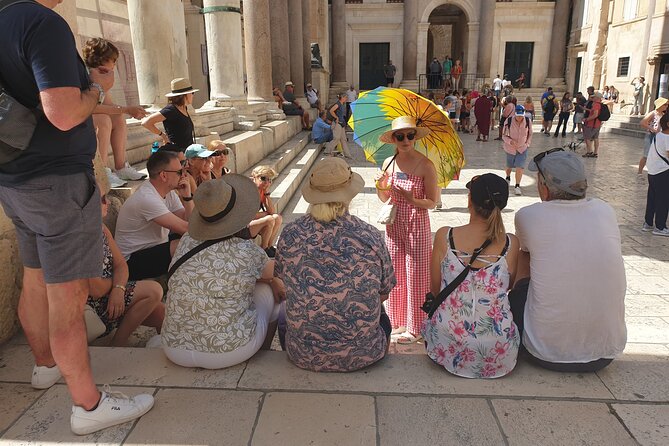
Split’s palace is still a living city. This 90-minute walk gives you a useful first look at Diocletian’s Palace, from its grand Peristyle to its Roman basement halls, while also linking the old center with the Riva harbor. I like the route’s strong mix of Roman, Venetian, Croatian, and Jewish history. I also like that several departure times and a group limit of 20 make it easier to fit into a busy Split day. The main concern is hearing the guide, since some groups have had trouble with crowd noise and no headsets.
The tour costs $48.37 per person, which is fair if you want a clear introduction rather than a do-it-yourself stroll. You will not get entry tickets to the paid sections, and the walk includes high, uneven steps. Guides such as Antonella, Anton, Mario, Marino, and Maggie have earned especially warm praise for lively storytelling and strong local knowledge, though guide quality and speaking volume can vary.
In This Review
- Key points to know before you book
- Why this walk is a smart first look at Split
- Meeting at the Peristyle, where the palace makes sense
- The Vestibule and the sound of Dalmatian singing
- Walking through the palace substructures
- The Golden Gate and Gregory of Nin
- Riva Harbor and Split’s everyday face
- Fruit’s Square, Venetian defenses, and Croatian literature
- Split’s synagogue and the city’s Jewish past
- Guide style can make or break the walk
- Is $48.37 a fair price?
- Practical advice for a smoother experience
- Who should book this Split tour?
- Should you book the Walking Tour of Split and Diocletian’s Palace?
- FAQ
- Where does the tour start?
- Where does the tour end?
- How long does the tour last?
- What language is the tour offered in?
- What is included in the price?
- Are admission tickets included?
- Does the tour visit the palace substructures?
- How large is the group?
- Is the tour suitable for people with mobility concerns?
- What is the cancellation policy?
Key points to know before you book
- The Peristyle is the essential opening scene: This central palace square helps you understand how the whole Roman complex fits together.
- The route goes beyond Roman ruins: You will also see the Riva promenade, a Venetian citadel, Marko Marulić’s connection to Croatian literature, and Split’s old synagogue.
- The basement visit is limited: You pass through the palace substructures, but the museum section requires a separate ticket.
- Guide quality matters here: Antonella, Anton, Mario, Marino, and Maggie have been praised for humor, passion, and clear explanations, while a few people struggled with soft voices or unfocused commentary.
- Crowds can affect the experience: The palace is a busy public site, and several tours may gather in the same places. Headsets are not provided.
- This is best as an early Split activity: It gives you the layout and background you need before exploring the palace on your own.
Why this walk is a smart first look at Split

Diocletian’s Palace is not a single building sitting apart from modern life. It forms the heart of Split, with homes, cafés, lanes, shops, churches, and public squares built into and around the Roman structure. That makes it fascinating, but also confusing on a first visit.
I like this tour because it gives you a map in your head. You begin at the Peristyle, the palace’s central square, then move through the Vestibule, the underground substructures, the Golden Gate, and several nearby parts of the historic center. By the end, you have seen the main landmarks and heard enough context to explore with more purpose.
The route also avoids treating Split as only a Roman attraction. You hear about Venetian influence at Fruit’s Square, Croatian language and literature through Marko Marulić, the city’s Jewish community near the synagogue, and the modern role of the Riva harbor. That broader view is important. Split is not a frozen archaeological site. It is a city that grew inside an ancient framework.
The tour is offered in English and lasts about an hour and a half. That is a good length for a first orientation, especially if you are in Split for one day or arriving from a cruise ship. You get a substantial introduction without giving away half your afternoon.
More Walking Tours in Split
- Split: Old Town and Diocletian Palace Walking Tour
★ 4.9 · 4,727 reviews - Krka Waterfalls tour with Trogir Walking tour and Krka panoramic boat cruise
★ 5.0 · 1,659 reviews - Split & Diocletian’s Palace Walking Tour
★ 5.0 · 1,125 reviews
Meeting at the Peristyle, where the palace makes sense
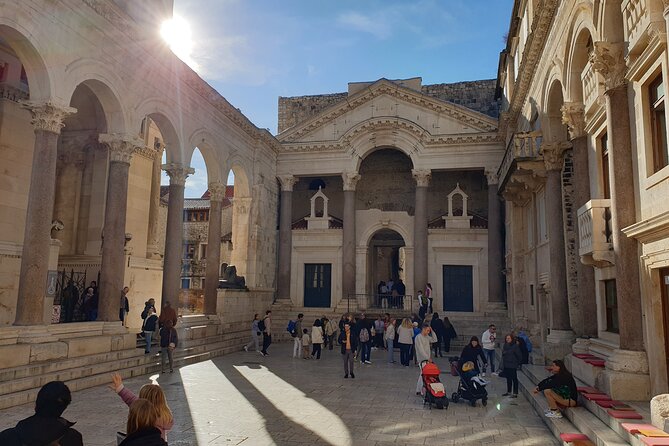
The meeting point is on Peristil ulica, at or near the Peristyle. Allow extra time to find it. The starting point can be difficult to spot because the old center is a web of narrow lanes, and several tour groups may gather in the same area.
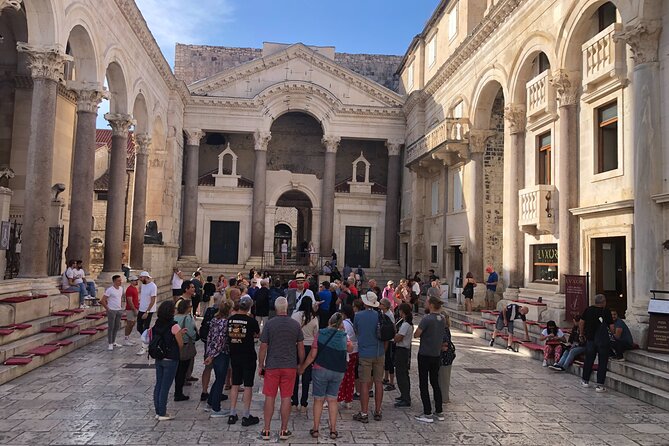
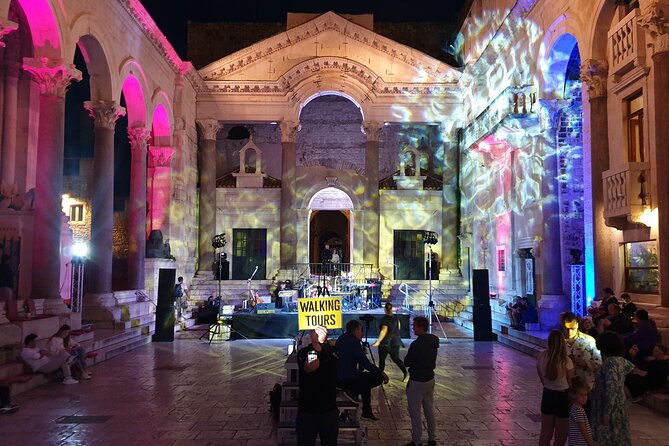
The Peristyle is the right place to begin. It is the palace’s central square, and from here you can reach many of its other sections. The guide uses the space to explain how Emperor Diocletian’s palace was organized and why this part of Split still functions as a key public gathering place.
You should expect people moving through the square, other guides speaking nearby, and ordinary city activity around you. The setting is atmospheric, but it is not a quiet classroom. Stand close to the guide and avoid drifting toward the back of the group.
The scheduled stop lasts about 15 minutes. That is enough time for a clear overview, though not enough for every architectural detail. This is a good example of the tour’s purpose: it gives you the framework, then leaves room for you to return later.
The Vestibule and the sound of Dalmatian singing
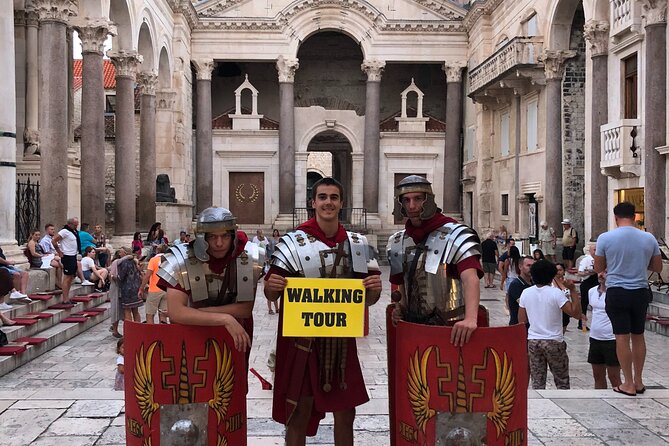
The next stop is the Vestibule, the entrance space associated with Diocletian. The guide explains its original purpose and later use, helping you see how Roman design shaped movement through the palace.
You may also hear traditional Dalmatian singing here. The rounded space can carry voices in a striking way, although the tour does not promise a formal performance. If singing happens during your visit, it adds a memorable human touch to the architecture.
The stop is short, about five minutes. That brevity is useful if you have limited time, but it also means the guide has to keep the explanation focused. If you are interested in Roman building methods or later changes to the palace, make a note of your questions and ask during a quieter stretch.
Walking through the palace substructures

The substructures are one of the most useful parts of the route. These underground halls and passages reflect the layout of the palace above, so they help you understand how the complex was built.
The guide explains their construction and the ways the spaces were used over time. This is more than a quick look at old stone. The substructures show how the palace survived as Split expanded around it.
There is an important limit. The walk passes through the substructures but does not include the museum section. No admission tickets are included in the tour, so you need to pay separately if you want to visit that paid area after the guided walk.
I see this as a sensible arrangement for a short orientation tour. You get the architectural context without committing to a longer museum visit. Still, the extra cost matters when judging the $48.37 price. If you expect full access to every palace interior, this tour will feel basic.
The uneven surfaces and high steps are also most relevant here. The activity is not recommended if you have trouble with high steps. Even if you are generally comfortable walking, wear practical shoes and stay alert on old stone stairs.
Still Split, at a slower pace:
- Split: Krka Waterfalls Trip with Boat Cruise and Swimming
★ 4.8 · 10,519 reviews - From Split: Krka Waterfalls, Food & Wine Tasting Tour
★ 5.0 · 9,326 reviews - Blue cave, Mamma Mia and Hvar, 5 islands speedboat tour
★ 5.0 · 7,150 reviews - From Split: Krka Waterfalls, Food & Wine Tasting Tour
★ 4.9 · 6,598 reviews
The Golden Gate and Gregory of Nin
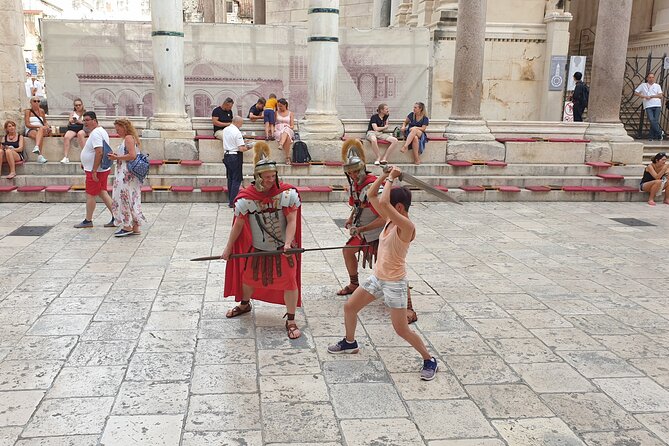
At the Golden Gate, the guide explains the palace’s main entrance and its role in the old city. This is one of the clearest places to picture how people once entered the imperial complex.
The stop also includes the statue of Gregory of Nin. You learn why he matters to Croatian history and language, which moves the story beyond emperors and military power. The statue gives the guide a chance to connect the medieval and modern identity of Split with the Roman setting around it.
The planned visit lasts about 10 minutes. That is enough for the central story and a look at the statue, but you may want to return later if you want photographs without being rushed. The Golden Gate is a natural point for orientation because it helps you understand the boundary between the palace and the surrounding city.
Riva Harbor and Split’s everyday face
The walk then heads toward Riva Harbor, the broad waterfront promenade that gives Split much of its public character. Here you see a bronze model of Diocletian’s Palace and hear how the Riva developed.
I appreciate this stop because it gives you a break from close stone walls and narrow lanes. From the harbor, you get a different sense of Split’s scale and its connection to the sea. The bronze model is also practical: it lets you study the palace as a whole after seeing its parts up close.
The stop lasts about 15 minutes, making it one of the longer pauses. The Riva is also a useful place to orient yourself for later meals, walks, or free time. You do not need a separate ticket for this part of the tour.
Because the waterfront can be active and noisy, hearing may again be an issue. Stand near the guide, and do not assume that being in a group of 20 will automatically mean perfect access to every explanation.
Fruit’s Square, Venetian defenses, and Croatian literature
Fruit’s Square, or Trg Braće Radić, adds another layer to the city’s story. The guide points out a 15th-century Venetian citadel and explains the importance of Marko Marulić, often called the father of Croatian literature.
This is a valuable change of subject. You are no longer hearing only about Roman imperial life. You are learning how Split developed under later political powers and how Croatian culture took shape.
The stop is planned for about 10 minutes. The square is compact, so the guide can explain the main points without a long walk. If literature and language interest you, this may be one of the stops where you get the most from asking a question.
It also shows why a guided route can be better than wandering alone. You could easily pass through the square without realizing why the citadel or Marulić matters. The tour gives meaning to places that might otherwise look like attractive but disconnected backdrops.
Split’s synagogue and the city’s Jewish past
The final listed stop is the Split Synagogue, a 16th-century synagogue connected to the history of the city’s Jewish community. The guide discusses the Jewish presence in Split as you pass by.
This is a brief but worthwhile inclusion. Many short city walks focus only on rulers, churches, and grand monuments. Adding the Jewish community gives you a wider view of who helped shape the city over time.
The synagogue stop is listed at about 10 minutes. Admission tickets are not included, and the tour is described as passing by the site rather than offering a guaranteed interior visit. Treat it as an outside explanation unless your guide tells you otherwise.
The activity ends back at the meeting point. That makes the route easy to combine with independent sightseeing, although the exact pace can vary. The advertised duration is approximately 90 minutes. Most accounts describe a tour close to that length, while one report described a much longer experience, so it is wise not to schedule an important timed activity immediately afterward.
Guide style can make or break the walk
The strongest part of this tour is often the person leading it. Antonella has been praised for being friendly, organized, funny, and clear. Anton and Anthony have received similar praise for energetic presentations of the palace. Mario has been described as willing to answer questions beyond the planned subject, and Marino brings a teacher’s passion to Split’s past. Maggie has also been praised for making the city easy to understand.
That range tells you what a good guide can add. Dates and construction facts are useful, but stories, humor, and local feeling help you remember the places. Several highly rated accounts describe guides who made the palace feel alive rather than simply reciting information.
There is a less positive side. A few people had difficulty understanding guides who spoke softly or used English as a second language. One guide was described as wandering into unrelated subjects, including politics, and running far beyond the planned time. That appears to be an isolated problem, but it is still worth noting.
The lack of headsets is the more consistent practical weakness. When several groups gather in the same palace spaces, a quiet guide can be hard to hear. I would stay close, ask politely if you miss a point, and avoid booking this if you strongly prefer an audio system.
Is $48.37 a fair price?
At $48.37 per person, this is not the cheapest way to see Split. You can walk around the old center without paying for a guide, and most listed stops do not require an admission ticket.
The value comes from the explanation and structure. In 90 minutes, you cover the palace’s central square, Vestibule, substructures, Golden Gate, harbor, Venetian defenses, Croatian literature, and Jewish history. If you are new to Split, that saves you from piecing together the city’s story on your own.
The price is easiest to justify when you book this near the start of your stay. Afterward, you can return to the palace substructures museum or revisit the Peristyle and Golden Gate with a better sense of what you are seeing.
It is less appealing if you want extensive indoor access. Since no admission tickets are included and the museum section is excluded, budget separately for paid areas. The tour is a guided overview, not a full archaeological visit.
Group discounts may improve the cost for a larger party. The maximum group size is 20, though the experience may feel less intimate when the full group is present. Some accounts describe very small groups, which can make the guide easier to hear and questions easier to ask.
Practical advice for a smoother experience
Book at least several days ahead if your schedule is fixed. The activity is booked on average 13 days in advance, suggesting that popular departure times can fill before arrival.
Choose an early time if you can. The tour will help you understand Split before the day gets crowded, and you will still have time to visit paid sections or explore independently afterward. Several departure times are available, so you can fit it around other plans.
Wear shoes suited to uneven stone and stairs. The warning about high steps is not a minor detail. The palace is old, and the route moves through spaces where polished modern flooring is not the rule.
Keep your confirmation available on your phone. A mobile ticket is accepted, and confirmation is provided when you book. Service animals are allowed, public transportation is nearby, and most people can take part.
Free cancellation is available if you cancel at least 24 hours before the local start time. Changes or cancellations inside that 24-hour window are not accepted for a refund. The activity also requires a minimum number of people, so a cancellation by the operator for that reason should result in an alternative date or a full refund.
Who should book this Split tour?
I would choose this walk if you are visiting Split for the first time, have only one day, or want a historian’s framework before exploring alone. It is especially useful for cruise passengers who need a compact introduction close to the center.
It also suits you if you enjoy cultural context beyond famous monuments. The stops connect Roman power with Venetian rule, Croatian writing, the Jewish community, and modern waterfront life.
I would think twice if you need guaranteed quiet, dislike stairs, or expect entry to every paid part of Diocletian’s Palace. The absence of headsets is a real weakness, and a soft-spoken guide can make the experience frustrating.
Should you book the Walking Tour of Split and Diocletian’s Palace?
Yes, if you want a lively orientation to Split and accept that this is a surface-level introduction rather than a complete palace visit. The route is well chosen, the strongest guides bring humor and passion, and the mix of Roman and later Croatian history gives you a better feel for the city.
Book it early in your Split stay, arrive at the Peristyle with extra time to find the group, and stay near the guide. If possible, select a departure that avoids the busiest part of the day. For a first look at Split, the tour offers solid value. Just plan to pay separately for the palace museum and leave room for the occasional crowd or guide-related hiccup.
FAQ
Where does the tour start?
The tour starts at Peristil ulica, Peristil ul., 21000 Split, Croatia.
Where does the tour end?
The activity ends back at the meeting point.
How long does the tour last?
The scheduled duration is approximately 1 hour and 30 minutes.
What language is the tour offered in?
The tour is offered in English.
What is included in the price?
The price includes an educated guide with strong knowledge of the palace and surrounding locations.
Are admission tickets included?
No. Admission tickets are not included. The museum section of the palace substructures also requires a separate visit after the tour.
Does the tour visit the palace substructures?
Yes. The route passes through the substructures and explains their construction and changing uses, but it does not include the museum portion.
How large is the group?
The maximum group size is 20 people. Group discounts are available.
Is the tour suitable for people with mobility concerns?
Most people can participate, but the experience is not recommended for anyone who has difficulty with high steps. The route includes uneven steps and old stone surfaces.
What is the cancellation policy?
You can cancel at least 24 hours before the local start time for a full refund. Cancellations or changes made less than 24 hours before the start are not refunded or accepted.
Just added around Split
- Slatine – Island Hopping Excursion (Trogir/Blue Lagoon/Shipwreck)★ 4.0 · 24 reviews
- Krka Waterfalls & Primošten from Trogir, Seget, Čiovo & Kaštela★ 5.0 · 18 reviews
- Island Hopping Boat Excursion with Lunch (Trogir,Blue Lagoon, Šolta)★ 3.5 · 6 reviews
- From Trogir, Seget, Okrug: Krka Waterfalls & Šibenik Culture Tour★ 5.0 · 10 reviews
- From Split & Trogir: ATV Quad Tour on Island Čiovo★ 5.0 · 21 reviews
- Split: Blue Lagoon Boat Trip with Lunch, Wine and Snorkeling★ 5.0 · 3 reviews
- Split Sunset Stand Up Paddle Tour★ 5.0 · 16 reviews
- Split: Sunset Guided Kayaking Tour★ 4.8 · 71 reviews
Walking Tours, compared.



Krka Waterfalls tour with Trogir Walking tour and Krka panoramic boat cruise
Read our review →
City Walls Early Morning or Sunset Walking Tour
Read our review →
Browse the lists this tour appears in