
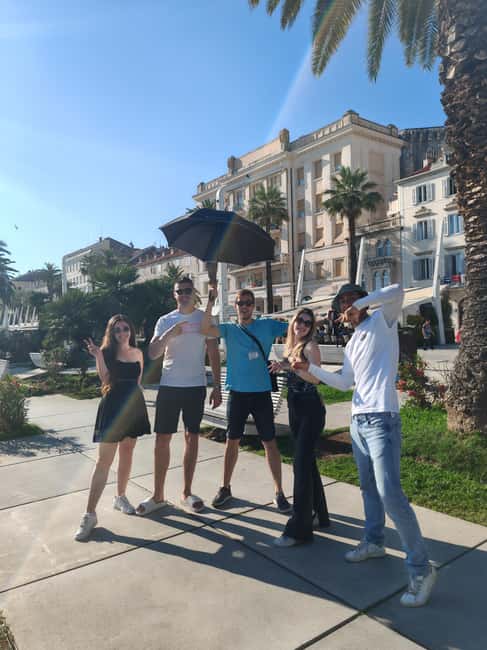
Reviewed · OLD TOWN TOURS
Split: History Walking Tour of the Old Town
Split keeps Roman life in plain sight. This 90-minute walk makes the old town easier to read, from Diocletian’s gates and palace courtyards to the sea-facing Riva. I like the clear route through the palace and the way guides connect ancient stones with modern Croatian life. I also like the practical advice on food, beaches, ice cream, and nearby islands. The main consideration is the pace: $41 is fair for a small or private group, but you will cover a lot of ground in a short time.
The tour is strongest when your guide adds personality. Maya has used photos and maps to explain the city, while Nina, Marc, and Marko have each been praised for making difficult history easy to follow. You may also spend part of the walk in full sun, so comfortable shoes, water, a hat, and sunscreen matter.
In This Review
- Five details that make this Split tour worthwhile
- Why a 90-minute walk helps you understand Split
- Starting at the Golden Gate and Đardin Park
- Peristyle and the Mausoleum: the palace center
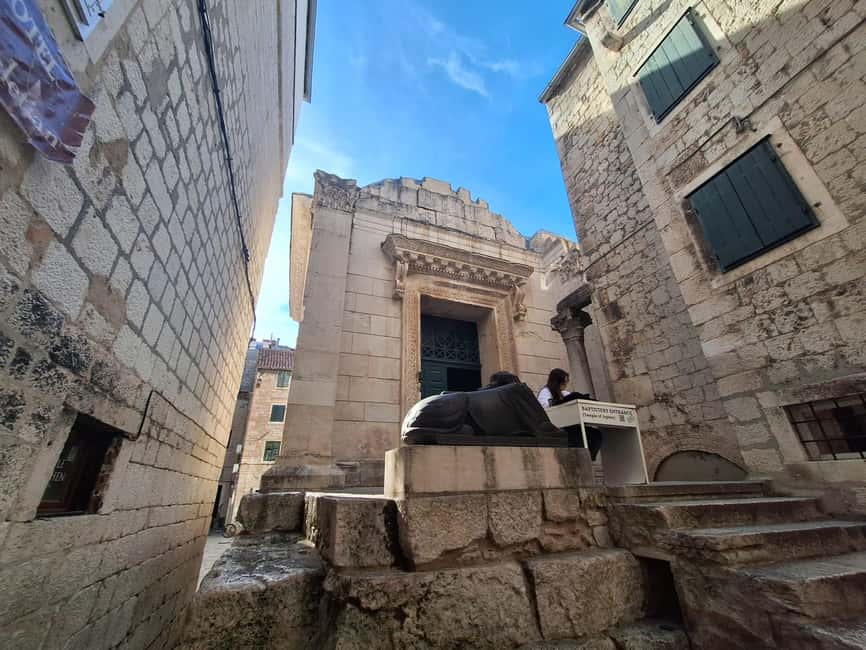
- The Temple of Jupiter and a headless Sphinx
- The Vestibule and the palace’s theatrical side
- The Diocletian’s Palace cellars and Game of Thrones
- People’s Square and Fruit Square
- Ending on the Riva with practical advice
- Guide style, language, and group size
- Is $41 a fair price?
- Who should book this walk?
- Should you book the Split history walking tour?
- FAQ
- How long does the Split history walking tour last?
- What sights are included?
- Is the tour available in Spanish?
- Is a private group option available?
- Can I arrange pickup from my hotel or cruise ship?
- What should I bring?
Five details that make this Split tour worthwhile
- A Roman palace that became a city: Diocletian’s Palace is not a fenced-off ruin. Streets, shops, homes, cafés, and churches occupy its ancient structure.
- A cool look below ground: The palace cellars provide shade and show where the layout above can be understood most clearly.
- A playful guide style: Expect questions, riddles, jokes, and stories about Diocletian, including his strange after-dinner habit.
- A Game of Thrones stop: The cellars were used for scenes involving Daenerys’s dragons and the Unsullied.
- Useful local advice at the end: The walk finishes on the Riva with suggestions for Dalmatian food, beaches, and island trips.
Why a 90-minute walk helps you understand Split
Split can feel confusing at first. It is not simply a Roman archaeological site, and it is not simply a modern Croatian city. The old town grew inside and around the palace built for Emperor Diocletian, so ancient columns, medieval lanes, stone houses, shops, and daily life all sit close together.
That is the central value of this tour. Instead of seeing isolated sights, you follow a story through the historic core. A licensed local guide points out what you are looking at, explains how the palace changed over time, and adds details you would probably miss while walking alone.
The route is compact, but the subject is large. In 90 minutes, you cover the Golden Gate, Đardin Park, Peristyle, the Mausoleum, the Temple of Jupiter, the Vestibule, the People’s Square, Fruit Square, the cellars, and the Riva. You will not study every monument at length. You will get a strong first orientation, then know where to return later.
I would book this early in a Split stay. The closing advice about food, beaches, and islands becomes more useful when you still have time to act on it.
More Old Town Tours in Split
- Split: Old Town and Diocletian Palace Walking Tour
★ 4.9 · 4,727 reviews - Split: Diocletian Palace & Old Town Guided Walking Tour
★ 4.7 · 882 reviews - Diocletian’s Palace and Old Town SMALL GROUP Walking Tour
★ 5.0 · 502 reviews
Starting at the Golden Gate and Đardin Park
The Golden Gate is a fitting opening because it introduces the scale and purpose of Diocletian’s Palace. Your guide begins here, depending on the option you book and its meeting point, then leads you through the northern side of the old town.
The gate is not just a handsome entrance for photographs. It helps you picture the palace as a fortified imperial residence with controlled access. The guide can also help you notice how later buildings were fitted into the Roman structure.
Nearby Đardin Park gives the opening section a little breathing room. This is useful because the narrow streets and stone walls can make Split feel like a puzzle. Your guide starts giving you the basic map before the route moves into the more crowded ceremonial heart.
A good guide uses this first section to explain Diocletian himself. He retired to the palace after ruling the Roman Empire and is remembered as one of the greatest persecutors of Christians. The tour adds lighter, oddball details too, including why he supposedly vomited after dinner. That mix of serious history and strange human detail makes the emperor easier to remember.
Peristyle and the Mausoleum: the palace center
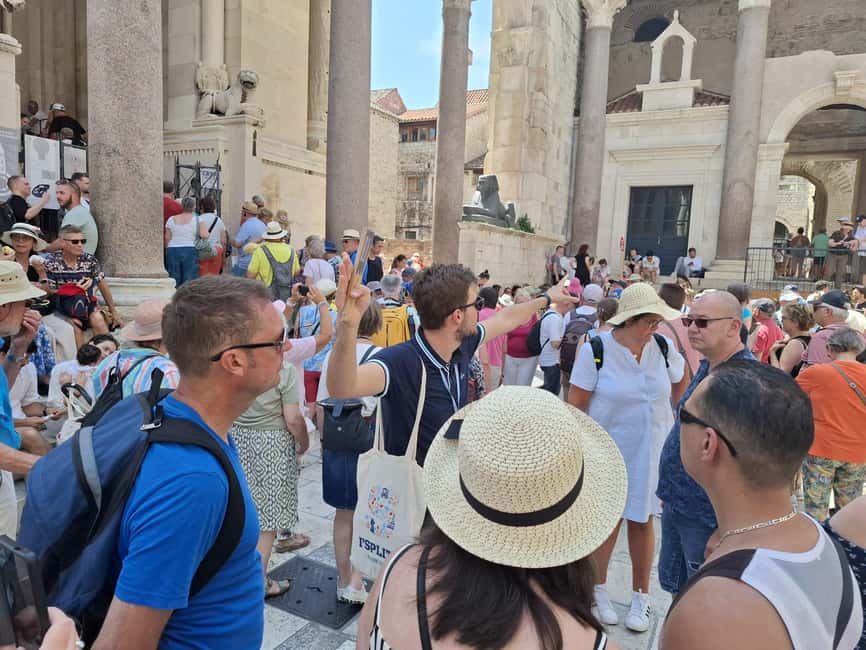
Peristyle is the grandest moment of the walk. This open courtyard was the ceremonial center of Diocletian’s palace, and the surrounding Roman architecture gives you a clear sense of imperial theater.
Your guide explains how the space worked and draws your attention to the buildings around it. The Mausoleum, now associated with Split’s cathedral, is especially important because it shows how the palace changed after the Roman period. The tour also points out the cathedral and its striking bell tower, described as the oldest cathedral in the world.
That claim needs a little care. The building began as Diocletian’s mausoleum and later became a Christian cathedral, so its story is unusual rather than simple. This is exactly the kind of detail a guide helps you sort out. You see one place, but it carries Roman, Christian, medieval, and modern meanings.
Peristyle can be busy and exposed. You might find the best listening spot is not the most obvious photo position. A guide who can manage a crowd and find shade, as local guide Maya has been praised for doing, makes a real difference on a hot day.
The Temple of Jupiter and a headless Sphinx
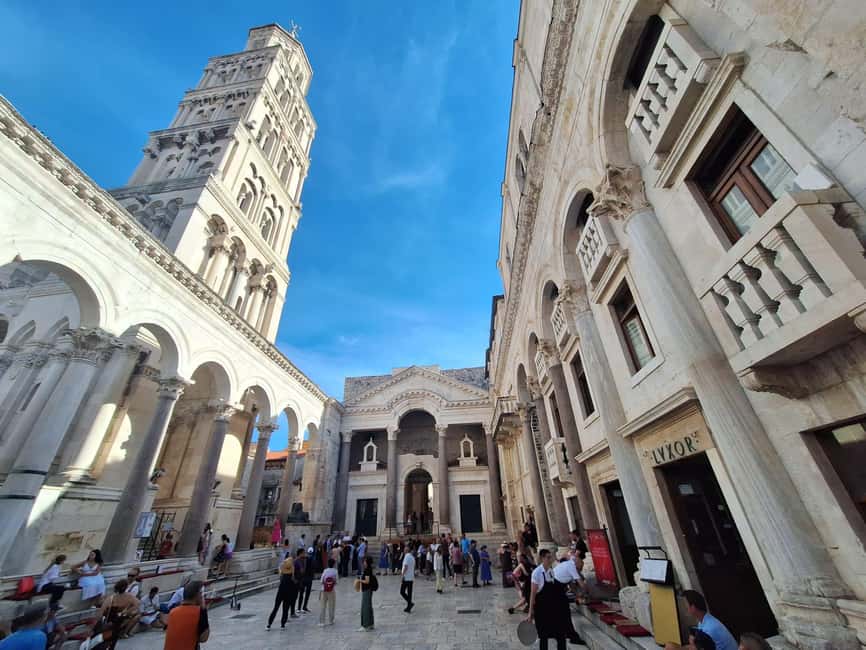
The Temple of Jupiter is a short stop, listed at about five minutes, but it packs several memorable details into a small space. Your guide explains the temple’s Roman purpose and the later changes that affected it.
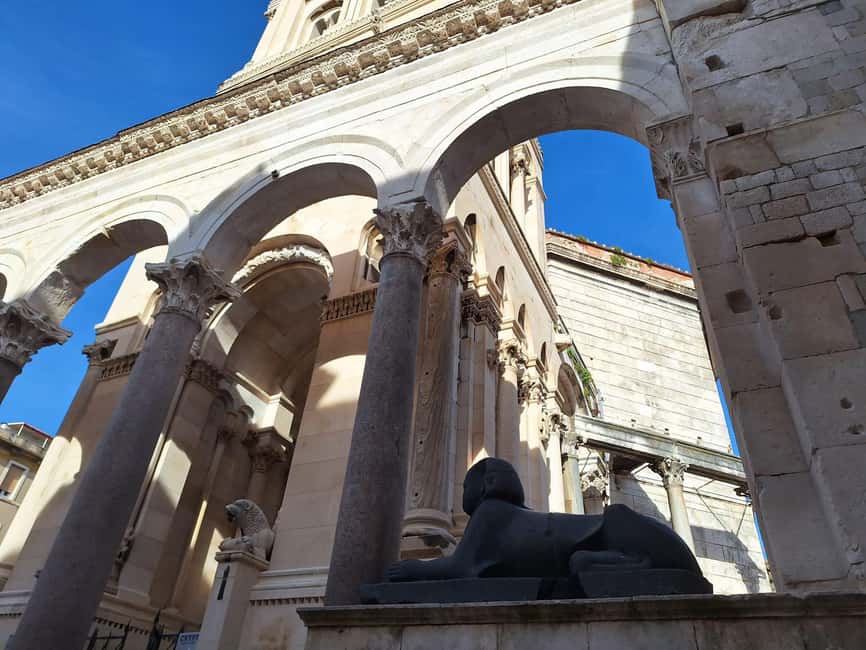
The headless Sphinx at the entrance gives the site a dramatic hook. You learn why it is there and how Egyptian elements entered Roman imperial decoration. The tour turns the stop into a small riddle of its own, asking you to imagine replacing your head with the Sphinx’s and solving the Sphinx’s question.
That playful approach is not just entertainment. Roman monuments can blur together when you are seeing several in one morning. A strange statue, a question, or a joke gives each place a separate memory.
The Temple of Jupiter is also a reminder that Split is full of reused material. Buildings were altered, religious meanings shifted, and residents adapted the old palace to new needs. You are not looking at a frozen Roman set. You are looking at a city that kept building on itself.
More Walking Tours in Split
- Walking Tour of Split and Diocletian’s Palace
★ 5.0 · 2,588 reviews - Krka Waterfalls tour with Trogir Walking tour and Krka panoramic boat cruise
★ 5.0 · 1,659 reviews - Split & Diocletian’s Palace Walking Tour
★ 5.0 · 1,125 reviews - Walking Tour of Split with a ‘Magister’ of History
★ 5.0 · 1,122 reviews
The Vestibule and the palace’s theatrical side
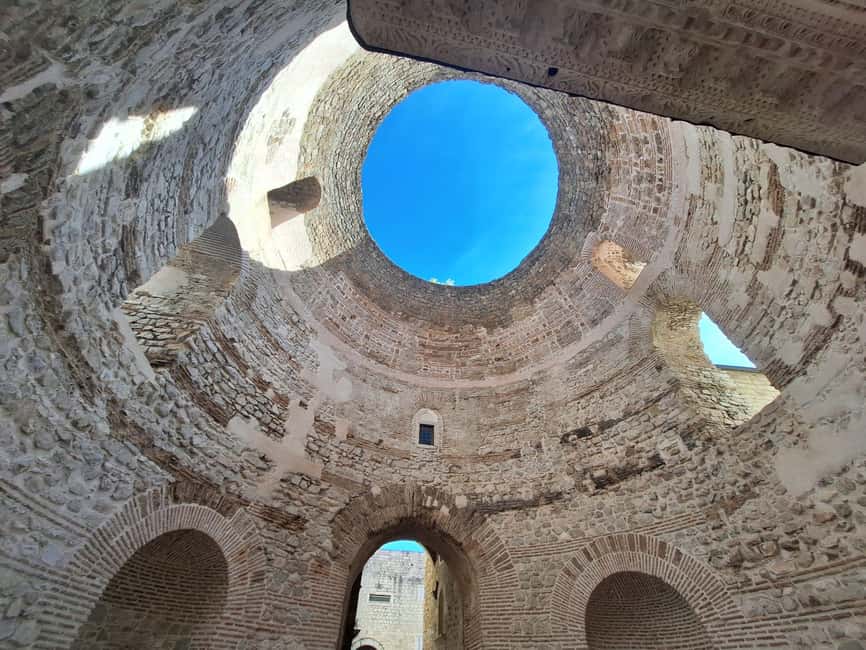
The Vestibule was a transition space leading toward the emperor’s private quarters. Its round form and unusual acoustics make it one of the more atmospheric stops on the route.
This is where the tour can feel more sensory than textbook. Look up, listen to the space, and notice how a passageway could also announce power. Diocletian did not design a modest retirement home. He created a residence meant to control movement and impress anyone who entered.
The guide may also use this section for the human mousetrap story, one of the tour’s more colorful details. You get a sense of how palace entrances and passages could be confusing or strategically arranged.
Because the Vestibule is enclosed by stone, it can offer a break from the sun. Marko has been praised for leading a walk through the cellars and helping the group avoid the heat. That points to an important practical advantage of a live guide: the route can be explained with comfort and crowd conditions in mind.
The Diocletian’s Palace cellars and Game of Thrones

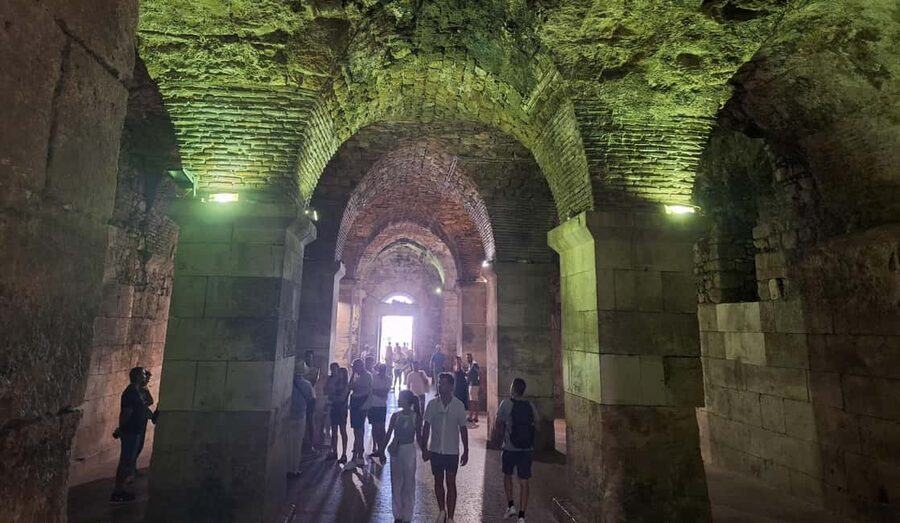
The cellars are one of the best parts of this experience, even if you have no interest in television locations. They reveal the palace’s lower structure and help you understand the plan of the rooms above.
The stone corridors can feel darker and cooler than the streets. Your guide explains how the cellars supported the palace and why they matter for understanding the Roman layout. In a city where later construction often hides the original shape, the lower level gives you a clearer view.
For Game of Thrones fans, this is also the scene-setting stop. The cellars were used as the place where Daenerys Targaryen’s dragons were chained, and where the Unsullied fought the Sons of the Harpy. You may recognize the space from the series, but the real value is seeing how television used an existing historic setting.
The tour does not treat the cellars as a film studio attraction. The show is an extra layer on top of the archaeology. That balance works well. Fans get their reference points, while other members of the group still receive an explanation of Split’s Roman foundations.
This section can be especially good in summer. Fifteen minutes underground gives you shade and a cooler pause, though the stone floor makes proper footwear important.
People’s Square and Fruit Square
The route then moves beyond the palace’s most formal spaces into the squares that show how Split developed as a lived-in town.
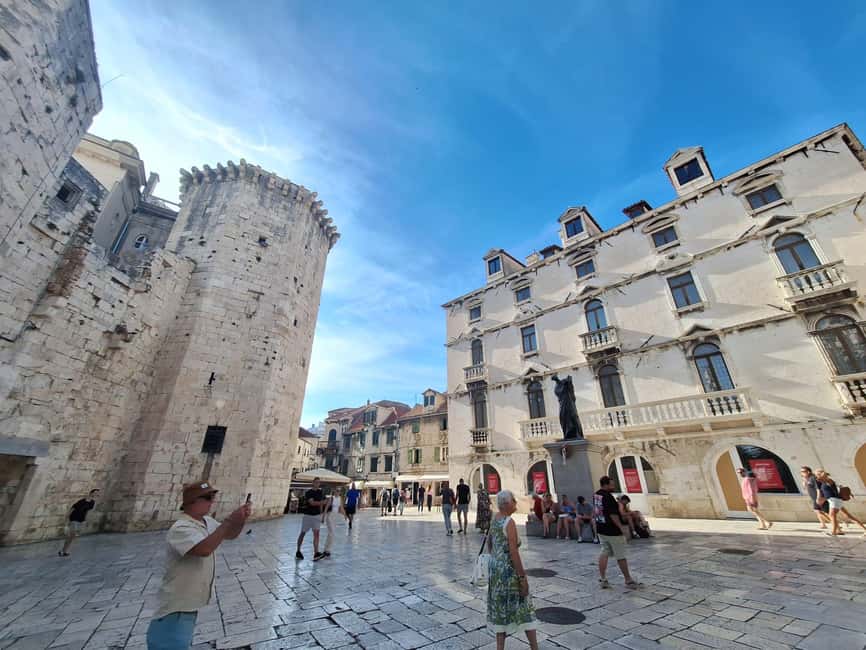
People’s Square, or Pjaca, helps you see the transition from imperial palace to urban center. Here, the story is less about one emperor and more about how residents, merchants, governments, and later powers shaped the city.
Fruit Square, or Voćni trg, adds another piece of everyday Split. The name points toward the market life that once filled the area, and the square offers a useful contrast with Peristyle. You move from imperial ceremony to the ordinary business of buying, selling, meeting, and eating.
These stops are where a local guide can add value beyond dates. You can ask about habits, modern Croatian life, and what people actually eat. Several guides have been praised for discussing Croatia as a whole, not just repeating facts about monuments. That wider view helps you connect the old town to the country you are visiting.
You should still expect a walking tour, not a food tour. The guide can point you toward Dalmatian specialties and local places, but food tastings are not listed as part of the experience.
Ending on the Riva with practical advice
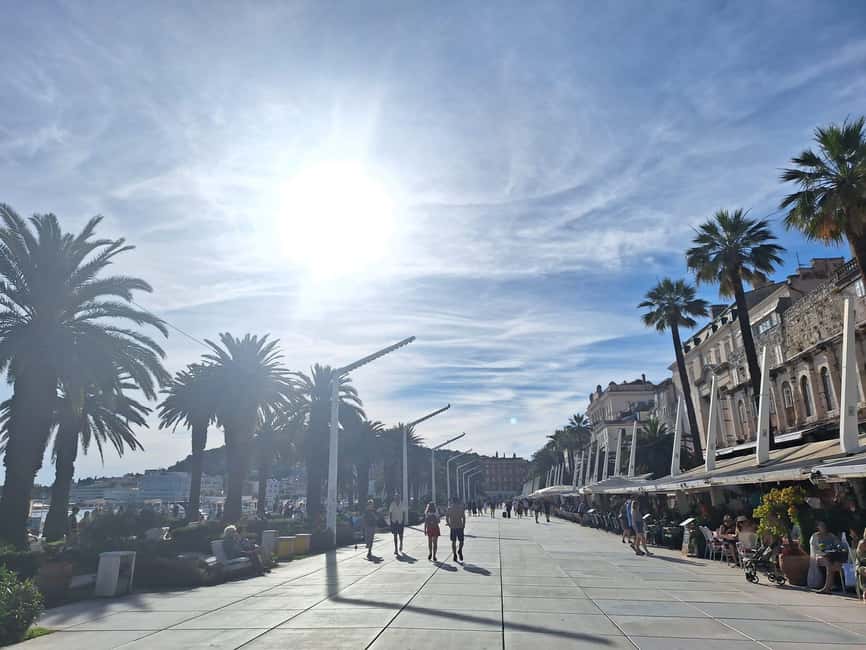
The walk ends at the Riva, Split’s palm-lined seafront promenade. This is a smart finish. After the tight lanes of the palace, the open waterfront gives you an immediate sense of how the old town meets the Adriatic.
The Riva is also a useful place to end because you can continue your day from there. Your guide can recommend ways to spend the remaining hours, places for ice cream, local food, beaches, and islands to visit. If Split is part of a longer Croatian trip, this advice may help you decide how to use your next day.
The tour has two listed drop-off points: the model of Split’s historic core and Split Riva. The exact meeting point depends on the option you choose, and pickup can be arranged as an option. You can provide a hotel name and street, or indicate that you are arriving by cruise ship.
That flexibility matters in Split, where many people arrive for only a short stop. Still, confirm the meeting details when booking. The supplied information makes clear that the start can vary by option.
Guide style, language, and group size
The tour is available in English and Spanish. That is useful if you want history explained in the language in which you can ask questions comfortably.
The strongest guide comments point to personality and clarity. Maya has brought a folder with photos and maps, Nina has made the history fun for a very small group, and Marc has handled detailed questions during a solo tour. Marko has used riddles and jokes while keeping the walk moving.
A private group is available. If you choose that option, the private meeting point is a practical benefit, especially for a family, couple, or group with limited time. A shared tour may be the better value if you mainly want orientation and basic context.
The tour has received a perfect rating from 12 reviews, with praise focused on clear explanations, local advice, crowd handling, shade, and value. That is a small sample, so I would not treat the rating as a guarantee. It does show a consistent pattern: the guide seems to be the main reason the experience works.
Is $41 a fair price?
At $41 per person, this is not the cheapest way to walk around Split. You can enter the old town on your own for free, and many of its streets and squares cost nothing to see.
The fee pays for structure and interpretation. You get a licensed local guide, a planned route through the palace and its cellars, historical context, and advice about the rest of your stay. For a first visit, that can be good value because Split’s ancient and later layers are easy to confuse.
The price makes the most sense for a small group, a private tour, or a short stay. If you are in town for a cruise day and want the city explained without spending half a day, 90 minutes is efficient. If you have several days and enjoy reading up before walking alone, you may prefer to explore independently.
The booking terms also reduce risk. You can cancel up to 24 hours in advance for a full refund, and you can reserve now and pay later. Those policies are useful when your Croatian route or cruise schedule is still shifting.
Who should book this walk?
I would recommend it to first-time visitors, history fans, Game of Thrones followers, and anyone who wants food and beach advice from a local guide. It also suits people who prefer stories and questions to a long lecture.
Families may appreciate the riddles, jokes, and unusual facts about Diocletian. The tour is also a good fit for people who want an introduction before returning to the cathedral, cellars, or squares on their own.
You should think twice if you dislike compact city walks, direct sun, or a brisk schedule. There are several stops, and the route includes uneven historic surfaces. Bring water, wear comfortable shoes, and use sunscreen. The cellars offer relief from the heat, but much of the experience takes place outdoors.
Should you book the Split history walking tour?
Book it if you want the old town to make sense quickly. The strongest reasons are the palace-to-modern-city explanation, the cellars, and the guide’s practical recommendations for the rest of your visit.
I would choose a private option for a special occasion or a group with its own pace. Otherwise, a small shared group should give you the best balance of price and personal attention.
Skip it if you only want a quick photo walk or already know Split’s Roman history well. For most first visits, though, $41 buys more than sightseeing. It gives you a map in your head, a few memorable stories, and a clearer idea of what to eat and see after the tour ends at the Riva.
FAQ
How long does the Split history walking tour last?
The tour lasts 90 minutes. Starting times depend on availability and the option you select.
What sights are included?
The route includes the Golden Gate, Đardin Park, Peristyle, the Mausoleum, Temple of Jupiter, Vestibule, Diocletian’s Cellars, People’s Square, Fruit Square, and the Riva.
Is the tour available in Spanish?
Yes. The live guide options are English and Spanish.
Is a private group option available?
Yes. A private group is available, with a private meeting point for private tours.
Can I arrange pickup from my hotel or cruise ship?
Pickup is optional. You can provide your hotel name and street, or indicate that you are arriving by ship. The meeting point may vary by booking option.
What should I bring?
Bring comfortable shoes, a hat, sunscreen, and water. These are especially useful because the tour includes outdoor walking through Split’s historic center.
More History Tours in Split
- Split Walking Tour with Professor of History
★ 5.0 · 926 reviews - Split: History and Heritage Walking Tour
★ 4.9 · 650 reviews - Split History and Gastro Small-Group Tour with Food and Drinks
★ 5.0 · 375 reviews - SPLIT-PREMIUM Emperor’s Walking Tour for History Lovers + Museum
★ 5.0 · 333 reviews
Just added around Split
- Slatine – Island Hopping Excursion (Trogir/Blue Lagoon/Shipwreck)★ 4.0 · 24 reviews
- Krka Waterfalls & Primošten from Trogir, Seget, Čiovo & Kaštela★ 5.0 · 18 reviews
- Island Hopping Boat Excursion with Lunch (Trogir,Blue Lagoon, Šolta)★ 3.5 · 6 reviews
- From Trogir, Seget, Okrug: Krka Waterfalls & Šibenik Culture Tour★ 5.0 · 10 reviews
- From Split & Trogir: ATV Quad Tour on Island Čiovo★ 5.0 · 21 reviews
- Split: Blue Lagoon Boat Trip with Lunch, Wine and Snorkeling★ 5.0 · 3 reviews
- Split Sunset Stand Up Paddle Tour★ 5.0 · 16 reviews
- Split: Sunset Guided Kayaking Tour★ 4.8 · 71 reviews
Old Town Tours, compared.


Plitvice Lakes with Boat Ride and Zadar Old Town Tour
Read our review →
Plitvice Lakes with Boat Ride & Zadar Old town tour
Read our review →
Dubrovnik Combo: Old Town & Ancient City Walls
Read our review →
Browse the lists this tour appears in