
Reviewed · WALKING TOURS
Pula: Historic Walking Tour with Local Guide & City Views
Pula’s old center rewards a closer look. I like that Marina, a Pula-born licensed guide with more than 18 years of experience, brings both local memory and lively historical detail to a German-language walking tour. I also like the route’s mix of famous sights and everyday places, especially the farmer’s market and the city gates. The main limitation is the short 1.5-hour format, so this is an introduction rather than a full study of Pula.
You meet beneath the wooden roof at the entrance to Pula’s Roman amphitheater, then walk through streets shaped by Roman, Venetian, and other cultures. Marina can adapt the conversation to local food, daily life, culture, or nature, but the tour remains focused enough to give you a clear first look at the city. It costs $28 per person, a fair price if you want context rather than a quick stroll past monuments.
In This Review
- Key points to know before booking
- Starting at Pula’s Roman amphitheater
- Following Pula’s old streets and Roman gates
- A local pause at Pula’s farmer’s market
- Reading Forum square through Roman and Venetian layers
- Marina’s style and the value of a local guide
- Is $28 a fair price for 90 minutes?
- Timing, access, and practical details
- Who will get the most from this Pula walk?
- Should you book it?
- FAQ
- How long does the Pula walking tour last?
- Where does the tour begin?
- Where does the tour end?
- What language is the tour conducted in?
- Are entrance fees included?
- Is the tour wheelchair accessible?
Key points to know before booking
- Begin beneath Pula’s Roman amphitheater: The meeting point is easy to identify and puts the city’s biggest ancient monument first.
- Hear more than the gladiator story: Marina explains the amphitheater’s wider purpose and place in Pula’s past.
- See three surviving Roman gates: The Twin, Hercules, and Sergii gates each offer details that are easy to miss alone.
- Visit the farmer’s market: This brings local produce and present-day life into a tour otherwise filled with ancient remains.
- Finish at Forum square: Roman ruins, the August Temple, Venetian city hall, and the regional goat symbol come together here.
- German-speaking and wheelchair accessible: The tour is designed for German-speaking visitors and ends where it begins.
Starting at Pula’s Roman amphitheater
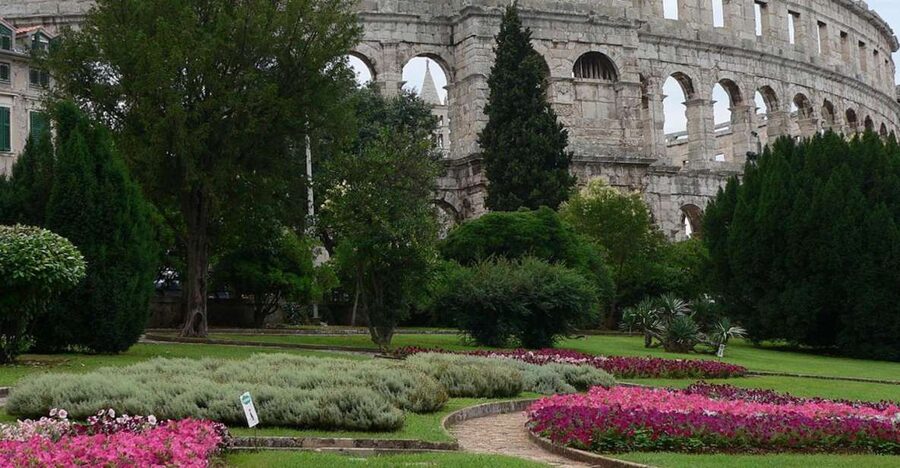
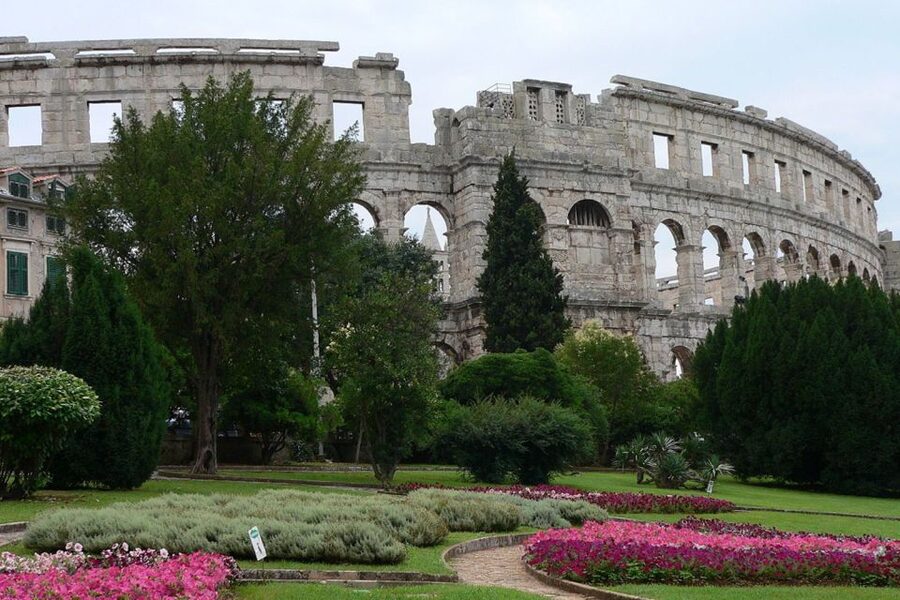
The tour begins at the entrance to the Pula amphitheater, under the wooden roof. This is a practical meeting place because the amphitheater is Pula’s clearest landmark, and you do not need to search through narrow streets to find the guide.
Marina starts with the building itself. You learn what it was built for and how its use went beyond the familiar gladiator contests. That broader explanation matters because the amphitheater can otherwise become a quick photo stop. With context, the massive stone structure becomes part of the city’s working past, not just a dramatic shell from antiquity.
The monument also sets the scale for the rest of the walk. Pula is not a city where Roman remains sit in one isolated archaeological park. Ancient gates, streets, temples, and public spaces are woven into the modern center. Starting here helps you understand why later stops feel connected rather than scattered.
The tour does not include entrance fees. The walk begins outside the amphitheater, so you should not assume that admission inside is part of the $28 price. If entering the arena is important to you, check the available arrangements before booking or plan a separate visit.
More Walking Tours in Istria
- Pula walking tour
★ 5.0 · 96 reviews - Pula: Historic Sites Guided Walking Tour
★ 4.8 · 78 reviews - Pula Essentials Walking Tour
★ 4.8 · 64 reviews
Following Pula’s old streets and Roman gates
From the amphitheater, the route leads naturally toward older parts of town. Pula’s streets have belonged to more than one culture over the centuries, and the tour uses that layered setting to explain how the city changed.
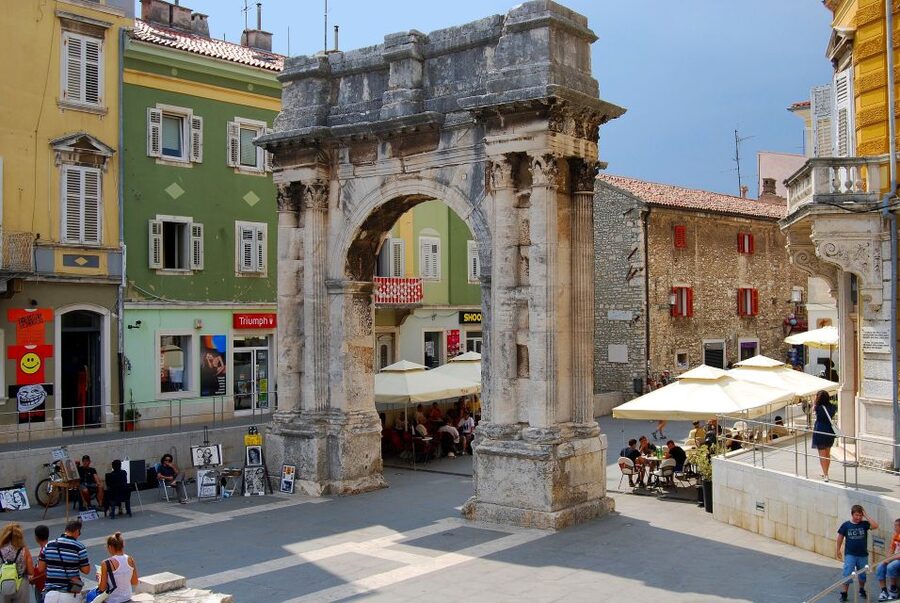
The Roman gates are one of the strongest parts of the route. Pula still has three gates from the Roman period: the Twin Gate, Hercules Gate, and Sergii Gate. Their names alone may blur together if you see them without guidance, but Marina points out the preserved details and uses them to tell the story behind each entrance.
The Twin Gate is linked to the old approach toward the city’s ancient center. The Hercules Gate is especially useful for understanding how small architectural details can carry a great deal of information. The Sergii Gate, also known as the Golden Gate, adds another grand marker to the route. The important point is not simply counting three Roman gates. It is seeing how these entrances helped define movement into and through Pula.
I like this part of the tour because it rewards attention. You are not only looking at large monuments. You are studying carved stone, surviving forms, and the shape of the old city. Marina’s local knowledge is useful here, especially for the alternative facts and small observations that rarely appear on a basic city map.
The route is also a reminder that historic Pula is a living center. Cars, shops, homes, and daily errands exist beside ancient stone. That can make the setting less polished than a purpose-built museum area, but it also gives the city a more honest feel.
A local pause at Pula’s farmer’s market
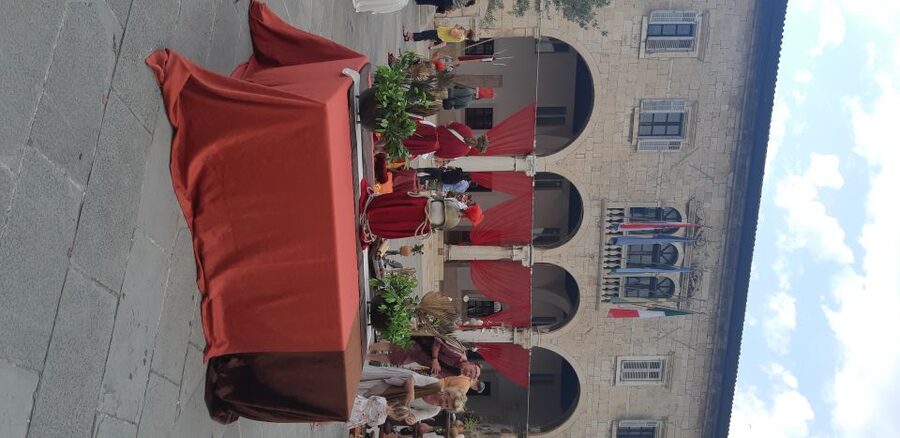
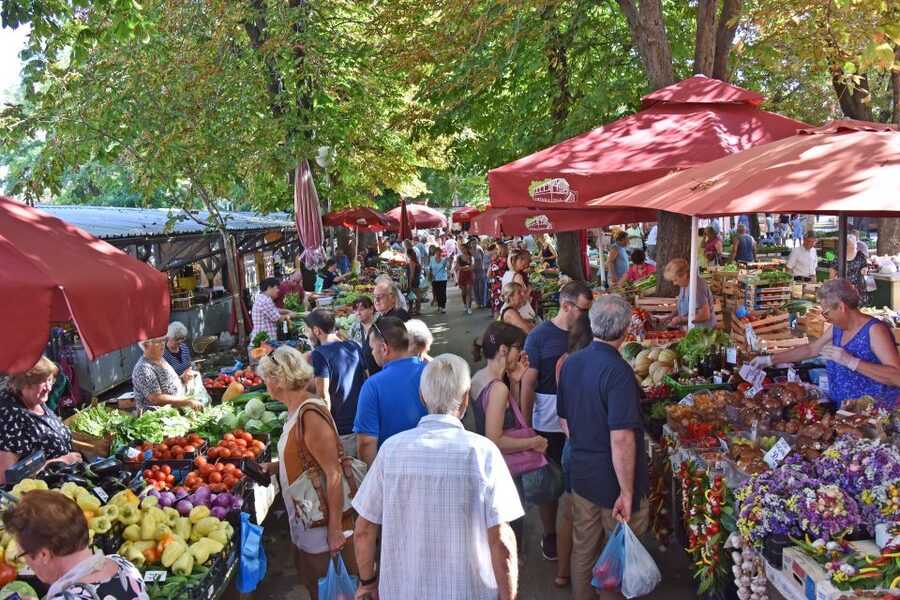
The farmer’s market gives the walking tour a welcome change of pace. Instead of looking only at ruins, you see where local people buy and sell products native to Istrian soil.
Marina is a passionate cook and foodie, and that interest shapes this stop. You can ask about local ingredients, food customs, and the way the market fits into daily life. The tour description does not promise tastings, so I would treat this as a place for explanation and observation rather than a food tour.
This is one of the most useful stops for understanding Pula today. Ancient monuments tell you why the city matters historically. The market shows how people use the city now. It also gives you a chance to ask about dishes or products you may want to seek out later on your own.
The market’s value depends partly on the day and time of your tour. Market activity can change, and the supplied details do not specify exact opening hours or what will be available during every departure. Still, including it in a short route is a smart choice. It keeps the experience from becoming a parade of old stones.
If food interests you, tell Marina at the start. The tour can focus on local lifestyle, culture, nature, or food, so this is a good chance to make the conversation more relevant to your plans.
Reading Forum square through Roman and Venetian layers
The route continues to Forum square, the old public heart of the city. In Roman times, the Forum was much more than an open square. It was a place tied to public life, trade, and civic activity.
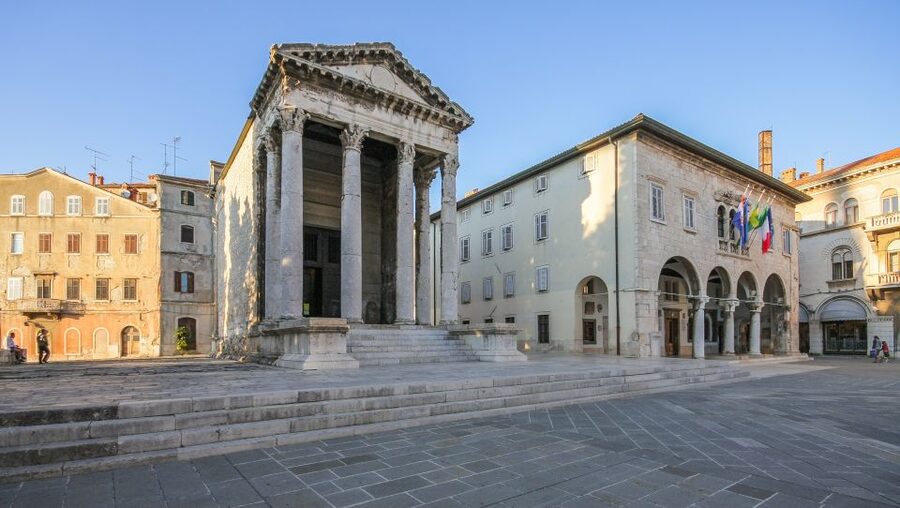
Here you see the remains of the August Temple. The surviving structure gives you a direct link to Roman public religion and political power, even though the square has changed greatly over time. Marina’s job is to connect what remains to the larger purpose of the Forum, so the columns and stone fragments do not feel like disconnected pieces.
You also see Pula’s Venetian city hall. Its presence beside Roman remains makes the square a useful lesson in the city’s long succession of rulers and cultures. Pula is not presented as a single-period museum. Roman, Venetian, and later layers share the same space.
The goat on the regional flag is another small but memorable detail. Marina uses it to explain a local symbol, giving you a story to carry away that is less predictable than another date or architectural label. These details are exactly why a local guide can add value on a short walk.
Forum square is a natural final stop because it gathers so many themes in one place: trade, government, religion, local identity, and changing architectural styles. You finish with a better sense of how Pula’s past continues to shape its center.
More Walking Tours in Pula:
- Pula Essentials Walking Tour
★ 5.0 · 62 reviews - Pula: Old Town Walking Tour for Foodies with Dinner and Wine
★ 4.6 · 18 reviews - Pula Sightseeing Walking Tour
★ 5.0 · 3 reviews - Dubrovnik: Old Town Walking Tour
★ 4.8 · 5,174 reviews
Marina’s style and the value of a local guide
Marina was born in Pula and has worked as a licensed guide in Istria for more than 18 years. She specializes in German-speaking visitors and speaks German very well, which makes this experience especially suitable if you want detailed explanations without relying on translated notes.
Her local connection is important. A guide who grew up in the city can explain more than dates and building names. Marina also knows how to discuss the people of Pula, local habits, food, and the changes she has experienced herself. That personal angle helps explain why the tour receives a 4.8 rating from 143 reviews.
The strongest praise centers on two things: the tour feels lively rather than dull, and it gives people a different view of Pula. That matches the design of the route. You move from a major Roman monument to less obvious gates, then to the market and Forum square. The content keeps shifting, which helps the 90 minutes pass quickly.
The individualized format is another advantage. The supplied details do not state a fixed private-tour arrangement or a guaranteed group size, so you should not assume you will have Marina entirely to yourself. Still, she can adjust the discussion toward your interests. Tell her early if you care most about food, local life, nature, or history.
There is also a useful balance between formal history and alternative facts. You get the main structure of Pula’s story, but you are not limited to textbook information. That mix suits people who want to learn without sitting through a long lecture.
Is $28 a fair price for 90 minutes?
At $28 per person, this is priced as a focused guided introduction. You are paying for Marina’s time, language skills, local perspective, and route planning rather than for entry to a monument.
The value is strongest if you are visiting Pula for the first time. In 90 minutes, you see the amphitheater, three Roman gates, the farmer’s market, and Forum square. Doing that alone is possible, but you may miss the meaning of the gates, overlook the market’s role, or leave the Forum without understanding the connection between the August Temple and city hall.
The price is less compelling if you want long interior visits or a very detailed archaeological tour. Entrance fees are not included, and the compact schedule cannot cover every corner of the old center. You may still want separate time for the amphitheater itself, museums, or places not included on this route.
I see the tour as a good use of the first part of your Pula visit. Afterward, you can return to the sights that interested you most, order local food with more confidence, and recognize the main historic areas when walking alone.
Timing, access, and practical details
The activity lasts 1.5 hours. Starting times vary, so check availability for the date you want rather than assuming a morning or afternoon departure.
You meet at the entrance to the amphitheater under the wooden roof. The walk ends back at this same meeting point, which simplifies planning if you have a later reservation or need to return to your accommodation.
The tour is conducted in German. This is a clear benefit for German-speaking visitors who want natural explanations and the ability to ask questions. It is not the right choice if you need an English-language tour, since German is the only language provided.
The activity is wheelchair accessible. The information does not describe every surface or street condition, so if you have specific mobility needs, it is sensible to confirm the details before arrival. The return to the starting point is helpful, since you do not need to arrange transport from a different ending location.
You can cancel up to 24 hours before the tour for a full refund. There is also a reserve-now, pay-later option, which gives you some flexibility while arranging a trip. These terms are useful if your Pula plans are still shifting.
Who will get the most from this Pula walk?
I would choose this tour for a first visit, especially if you want the main historic sights explained in a short period. It also suits anyone who prefers a conversation with a local guide over a recorded audio tour.
Food-minded visitors should pay attention to the market stop and tell Marina about that interest. Families and mixed-age groups may appreciate the changing subjects, since the route includes dramatic architecture, stories, local symbols, and everyday life rather than only formal dates.
German-speaking couples, families, and small groups are the clearest match. The tour also works well near the start of a stay, when you need to get your bearings before exploring alone.
I would think twice if you want a long, highly academic treatment of Roman architecture. You should also look elsewhere if you need the tour in English or if entering the amphitheater is essential to your plan. Since admission is not included, the walk is best viewed as a guided city orientation around the monument, not a complete arena visit.
Should you book it?
Book this Pula walking tour if you want a friendly, local introduction that links Roman remains with the city people live in today. Marina’s background, strong German, food interest, and ability to adapt the discussion give the short route a personal touch.
The best reason to choose it is the combination of major sights and small stories. You see the amphitheater, three Roman gates, the market, and Forum square, but you also learn why those places matter. Skip it only if you need English, want included entry tickets, or prefer several hours at each monument.
FAQ
How long does the Pula walking tour last?
The tour lasts 1.5 hours. Starting times vary, so you need to check availability for your preferred date.
Where does the tour begin?
You meet at the entrance to Pula’s Roman amphitheater, under the wooden roof.
Where does the tour end?
The walking tour ends back at the meeting point.
What language is the tour conducted in?
The live tour guide speaks German. German is the listed tour language.
Are entrance fees included?
No. The price includes the 1.5-hour walking tour with a local guide, but entrance fees are not included.
Is the tour wheelchair accessible?
Yes, the activity is listed as wheelchair accessible. If you have specific access needs, confirm the route details before booking.
More History Tours in Pula
- Olive Oil Guided Tasting and History in Pula
★ 4.5 · 34 reviews - Dubrovnik Old Town History Walking Tour
★ 5.0 · 1,684 reviews - Walking Tour of Split with a ‘Magister’ of History
★ 5.0 · 1,122 reviews - Split Walking Tour with Professor of History
★ 5.0 · 926 reviews
Just added around Pula
- Pula Sightseeing Walking Tour★ 5.0 · 3 reviews
- Pula Essentials Walking Tour★ 5.0 · 62 reviews
- Pula: Sunset/Night-time Illuminated Transparent Kayak Tour★ 4.0 · 9 reviews
- Pula Discover Scuba Diving Package★ 4.5 · 18 reviews
- Pula Boat Trip with Snorkeling★ 4.0 · 7 reviews
- Pula Kayak, Cliffs & Snorkeling Adventure★ 5.0 · 164 reviews
- Pula Kayaking at Blue Cave with Cliffs Tour and Snorkeling★ 5.0 · 4 reviews
- Pula Arena Amphitheater Admission Ticket★ 4.0 · 68 reviews
Walking Tours, compared.
Walking Tour of Split and Diocletian’s Palace
Read our review →
Krka Waterfalls tour with Trogir Walking tour and Krka panoramic boat cruise
Read our review →
City Walls Early Morning or Sunset Walking Tour
Read our review →Browse the lists this tour appears in