
Reviewed · ZAGREB TOURS
Zagreb Photo Safari
See Zagreb through a working photographer’s eyes. Zagreb Photo Safari turns a city walk into a practical photo lesson, mixing camera advice with local history, old streets, markets, parks, and rooftop views.
I like the private format, since your guide can adjust the pace to your skill level and camera. I also like the mix of famous sights and useful shooting locations, from the King Tomislav Statue to the Stone Gate and Lotrščak Tower. The main consideration is time: with up to 17 stops in roughly two to four hours, the tour can feel brisk, especially if you want to linger over every composition.
The guide, Darko Jelicic, has earned praise for his patient teaching and friendly manner. One guest used an iPhone 14 and received help with composition as well as camera use, while another learned new functions on a regular camera. That tells you something important: you do not need expensive gear to get value here.
In This Review
- Key points to know before booking
- Why a photo safari works well in Zagreb
- King Tomislav Square, the Art Pavilion, and Zrinjevac
- Ban Jelačić Square, the cathedral, and Dolac Market
- Opatovina, Tkalčićeva Street, and the Mill Stairs
- St. Mark’s Church, the Stone Gate, and Lotrščak Tower
- The funicular, Ilica, Flower Square, and the National Theatre
- What the $117 price really includes
- How long the route takes and who should book
- Should you book Zagreb Photo Safari?
- FAQ
- Where does Zagreb Photo Safari begin?
- Where does the tour end?
- How long does the experience last?
- Is this a private tour?
- Is the tour suitable for beginners?
- Can I use a smartphone instead of a camera?
- Is photography equipment provided?
- Is the Lotrščak Tower viewpoint ticket included?
- Are drinks included?
- Can I cancel for a full refund?
Key points to know before booking
- Seventeen central Zagreb photo stops: The route covers parks, squares, churches, markets, old gates, shopping streets, and the Croatian National Theatre.
- Private instruction with a professional photographer-guide: Your group receives direct help instead of general advice meant for a large crowd.
- Useful for phone photographers: The included Phone Photography Upgrade focuses on making stronger images with the device already in your pocket.
- Lotrščak Tower viewpoint ticket included: You receive access to the 360-degree city view from one of Zagreb’s best-known towers.
- A local history walk as well as a photo lesson: Expect stories about Zagreb’s buildings, customs, streets, and the odd lengths photographers go to for a great shot.
- $117 can be fair value for a private outing: The price includes the guide, a beverage break, phone photography help, skill tracking, and the tower ticket, but not camera equipment.
Why a photo safari works well in Zagreb
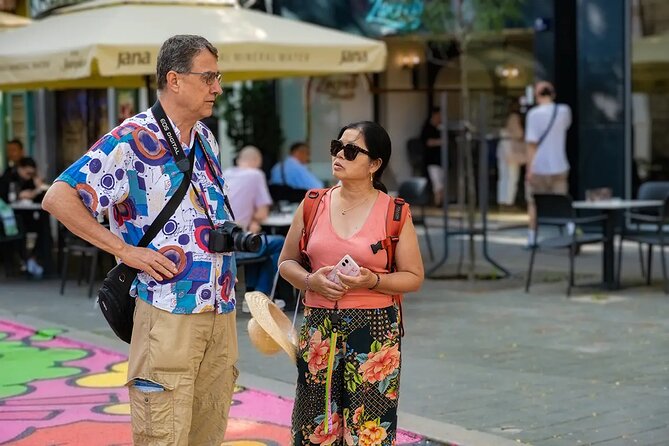
Zagreb is a good city for learning photography because its sights come in manageable clusters. Parks lead to formal squares. Medieval lanes rise toward churches and defensive towers. A market, a tram-lined street, and a grand theatre can all fit into one walking route.
The tour begins at Trg Kralja Tomislava 12, near King Tomislav Square. From there, the route moves through central Zagreb and into the old Upper Town before returning to the starting point. You are not simply pointed toward a landmark and left to take a quick snapshot. The stated aim is to help you think creatively about travel photography.
For a beginner, that can mean working on composition, camera controls, and the choice between a wide view and a close detail. For an experienced photographer, it means moving quickly between locations and timing each stop for good light. The guide says the locations are planned in advance, which matters when you have limited time in the city.
The private setup is especially useful. You can ask for help with your own camera or phone rather than listening to a generic lecture. If one church interests you more than another, you may be able to spend more time there, though the large number of stops means the overall plan is active.
A few more Zagreb trips worth comparing
- From Zagreb: Plitvice & Rastoke Guided Day Trip with Ticket
★ 4.9 · 2,955 reviews - Zagreb: Rastoke & Plitvice Lakes Guided Tour with Ticket
★ 4.9 · 1,897 reviews - Communism & Croatian Homeland War Tour
★ 5.0 · 1,355 reviews
King Tomislav Square, the Art Pavilion, and Zrinjevac
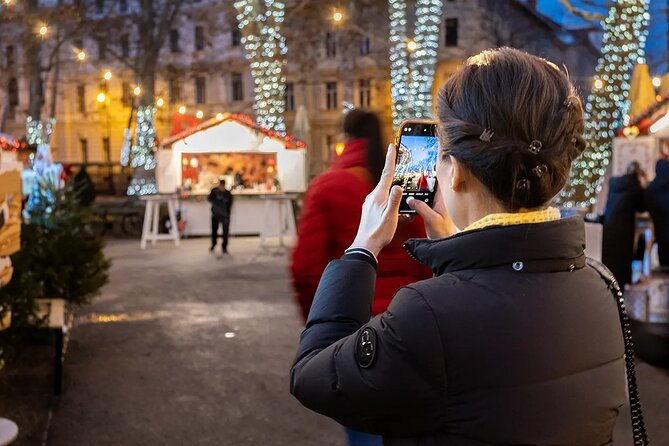
The first part of the walk gives you some of Zagreb’s easiest city compositions. King Tomislav Statue sits in a broad central park surrounded by older buildings. The open space lets you experiment with symmetry, foreground figures, reflections, and the relationship between the statue and the architecture behind it.
The park is described as photogenic by day and night, so light can change the mood of the scene. Your allotted stop is about 10 minutes, enough for guidance and a few careful frames, but not enough for a long tripod session.
The Art Pavilion is next. It is identified as the oldest gallery in Southeastern Europe, and its exterior is decorated with busts of artists including Michelangelo, Raphael, and Titian. Those details give you several ways to photograph the building: a full architectural view, a crop of the sculptural decoration, or a more abstract study of lines and repeating forms.
Behind the pavilion, the guide points out a particularly picturesque fountain in the park. This is the kind of detail that gives the route more value than a basic sightseeing loop. You get the main building, then a smaller subject nearby that may produce a less predictable photograph.
Zrinjevac, also called Nikola Subic Zrinski Square, is part of Zagreb’s Green Horseshoe, a chain of parks and squares in the central Donji Grad district. You can walk through it or sit for a moment and enjoy the setting. The park is about two blocks from King Tomislav Square, so this section should feel easy and compact.
The nearby Meteorological Post dates to 1884. It remains a public station where people can check temperature, humidity, and air pressure. It may not be Zagreb’s grandest sight, but it is a fine example of how a good photo walk uses small public objects as subjects. Look for lettering, metal details, scale, and the contrast between a scientific device and an ornamental park.
Ban Jelačić Square, the cathedral, and Dolac Market
Ban Josip Jelačić Square is Zagreb’s main meeting place. A statue of the 19th-century governor of Croatia dominates the square, giving you a clear central subject amid the city’s surrounding buildings and daily movement.
This stop can teach you how to photograph an open public space without producing a flat record shot. You may work with the statue as a foreground anchor, use the square to frame nearby buildings, or focus on small details around the meeting place. The guide’s local context should help explain why this square matters to residents, not just why it appears on a sightseeing map.
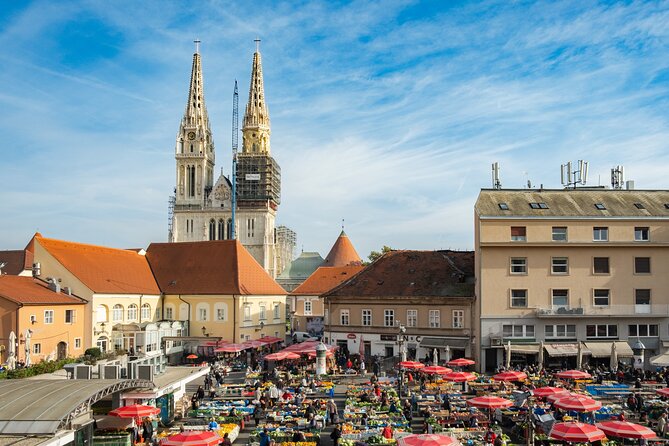
The Cathedral of Zagreb follows. Its twin spires rise above the center, though they have often been under repair. From the outside, the building remains a strong subject, with its Gothic origins and later Neo-Gothic reconstruction.
An earthquake in 1880 caused major damage, and rebuilding began around the turn of the 20th century. The sacristy still contains a cycle of 13th-century frescoes, though this short photo stop focuses on the exterior. You should expect a view of the cathedral rather than a long interior visit.
Dolac Market is one of the most useful stops for anyone who wants photographs with local life in them. The market has operated as Zagreb’s major trading place since 1930. Farmers from nearby villages sell homemade food, fresh fruit, and vegetables in the raised open market, with a sheltered market below.
This setting gives you color, texture, signs, produce, and human activity. It also requires good manners. Ask before making close portraits, and remember that a market is a workplace, not only a photo set. Ten minutes goes quickly here, so decide in advance if you want wide environmental scenes or tight details.
Opatovina, Tkalčićeva Street, and the Mill Stairs
Opatovina Park adds a modern note to the route. Murals by four Croatian artists appear along the eastern walls of the green area. These painted walls offer bold color and strong shapes, useful for practicing composition with less formal architecture.
Tkalčićeva Street is one of the most social parts of central Zagreb, lined with cafes, restaurants, shops, and casual nightlife. It was once a stream separating the old settlements of Gradec and Kaptol. Contamination from nearby shops led to the stream being diverted.
The street also has a surprising past. From 1899 to 1941, almost every house there was a brothel. Opaque windows and red lanterns were used because of its central location, and Zagreb became the first city in Europe with a proper red-light district. Today, Tkalčićeva is known for cafes, restaurants, boutiques, traditional shops, and outdoor events.
That history makes this more than a pretty street. You can photograph the present while learning how the street changed over time. The guide’s stories are likely to add the most value here, especially if you enjoy the human side of city history.
Mlinarske stube, or the Mill Stairs, connect Kožarska Street with Radićeva Street. This is a brief stop, but stairs can create strong leading lines and changing views. You may want to photograph upward, downward, or from the side to show the slope. It is also a reminder that Zagreb’s old center is not entirely flat.
Still Zagreb, at a slower pace:
- Best of Zagreb with the WW2 Tunnels
★ 5.0 · 973 reviews - Plitvice Lakes with Ticket & Rastoke Guided Tour from Zagreb
★ 5.0 · 966 reviews - Zagreb: Small Group Walking Tour City Center and WW2 Tunnels
★ 4.9 · 895 reviews - Zagreb: Skip-the-Ticket-Line Museum of Broken Relationships
★ 4.5 · 847 reviews
St. Mark’s Church, the Stone Gate, and Lotrščak Tower
St. Mark’s Church is one of Zagreb’s most recognizable buildings. Its patterned tile roof carries much of the visual interest, while the church itself has medieval origins. Fires and the 1880 earthquake destroyed much of the original 13th-century structure, but an ornate Gothic portal survived.
The interior contains devotional sculptures and frescoes by leading Croatian artists, though the tour’s short timing and stated focus on photography mean you should not assume a lengthy interior visit. The exterior roof is the main photo subject.
The next stop, called Petrini Pyli in the supplied tour details, is the Stone Gate. This is the only surviving gate from Zagreb’s old fortifications and the eastern entrance to the medieval town. Inside is a shrine to the Mother of God, with a painting said to have survived a 17th-century fire. An artistically forged iron fence protects the shrine.
This is a quieter and more reflective photo stop than the market or main square. Be respectful inside the gate, especially if people are praying. The place has religious importance, so the best photograph may be a restrained one that shows the gate, the shrine, and the passage through the old wall.
Lotrščak Tower dates from the 13th century and helped defend Gradec. A cannon is fired every day at noon to mark the hour. The tower sits beside the Strossmayer promenade and is one of the best-preserved parts of Zagreb’s defensive system.
The included ticket for the tower viewpoint is a real benefit. The 360-degree city view changes the rhythm of the tour, taking you above the streets after a series of close architectural scenes. You can photograph rooftops, church spires, and the wider city from a different height. The cannon tradition also gives the stop a memorable bit of local character.
The funicular, Ilica, Flower Square, and the National Theatre
Zagreb’s Funicular is only 66 meters long. It is described as the shortest funicular in the world and the oldest and first form of public transportation in Zagreb, dating to the end of the 19th century.
Its short length makes it an amusing subject. You can frame the car, the track, and the steep connection between the Upper and Lower Town. The tour lists the stop as free admission, but the information provided does not say that a ride is included, so treat it as a photo stop rather than a guaranteed transport segment.
Ilica is one of Zagreb’s oldest and longest streets, stretching from Ban Jelačić Square westward through Črnomerec toward Vrapče. It has more than 500 addresses and serves as a main shopping street, with banks and major clothing and shoe brands.
This part of the route shifts from medieval Zagreb to everyday city life. Storefronts, signs, street views, and older facades can help you make photographs that feel less like postcards. Since Ilica is long, the tour can only show you a section during the scheduled stop.
Petar Preradović Square is better known locally as Flower Square because of its traditional flower kiosks. It sits about 200 meters from Ban Jelačić Square and offers a compact city-center scene with flowers, buildings, and public space.
The final listed stop is the Croatian National Theatre in Zagreb, a drama, opera, and ballet institution with three ensembles. It stages classics from Croatia and abroad, along with modern works, and presents many performances each year.
The theatre’s grand exterior makes a strong closing subject. You can work on centered architectural compositions, details around the entrance, or a wider view that places the building within the square. After so many smaller streets and historic structures, it gives the route a formal finish.
What the $117 price really includes
At $117, this is not the cheapest way to walk around Zagreb. It is also not priced like a basic group orientation. You are paying for a private activity, a professional photographer-guide, direct instruction, a beverage break, phone photography help, progressive tracking of your photography skills, and a ticket for the Lotrščak Tower viewpoint.
The value depends on how much you want instruction. If you only need a list of Zagreb sights, you can visit most of these places independently. If you want someone to help you use your camera, improve composition, and choose better viewpoints, the private format makes the cost easier to justify.
The phone upgrade is especially useful for people using an iPhone or another smartphone. One guest worked with an iPhone 14 and received composition advice as well as help with phone photography. You do not need to own a dedicated camera to take part.
Camera equipment is not included. Bring your own camera or phone, and do not expect to borrow photography gear. Alcoholic drinks are also excluded, while a beverage break is included.
How long the route takes and who should book
The advertised duration is about two to four hours. The listed stops total roughly 175 minutes if you spend 10 minutes at most locations and 15 minutes at the Stone Gate, before counting the walking between them. That explains the wide time range.
A two-hour version will feel fast and selective. A longer outing gives you more room for instruction, questions, and careful shooting. Experienced photographers who want to cover many locations may prefer the quicker pace, while beginners may benefit from fewer rushed compositions and more explanation.
This tour suits:
- Beginners who want help with composition and camera controls.
- Experienced photographers looking for planned viewpoints and good light.
- Phone photographers who want more than automatic snapshots.
- Couples, families, or friends who prefer a private activity.
- Visitors who want Zagreb history delivered during a practical walk.
It may not suit you if you dislike walking, want a slow interior tour of every church, or plan to spend a long time at only one subject. The route is broad by design. Its strength is variety, not extended study of a single building.
The activity begins and ends at Trg Kralja Tomislava 12. It is near public transportation, and most people can participate. Confirmation is sent at booking. Free cancellation is available up to 24 hours before the start time for a full refund. Inside 24 hours, refunds and changes are not accepted.
Should you book Zagreb Photo Safari?
Book it if you want to come home with better photographs and a clearer sense of Zagreb’s layout. The strongest reasons are the private guide, the large mix of locations, the practical help for both cameras and phones, and the included Lotrščak Tower view.
I would choose it early in a Zagreb stay, since the route introduces many places you may want to revisit. Ask Darko Jelicic, if he is your guide, to tailor the balance between camera instruction and sightseeing. Beginners should request time to practice. Experienced photographers should say if they prefer speed and a wider range of locations.
Skip it if you only want a standard walking tour or if $117 feels too high for a short city visit. But for a private, photo-focused introduction with local stories and a planned route through both Lower and Upper Town, it offers a useful blend of skill-building and sightseeing.
FAQ
Where does Zagreb Photo Safari begin?
The tour begins at Trg Kralja Tomislava 12, 10000 Zagreb, Croatia.
Where does the tour end?
The activity ends back at the meeting point.
How long does the experience last?
The approximate duration is two to four hours.
Is this a private tour?
Yes. Only your group participates in the activity.
Is the tour suitable for beginners?
Yes. Beginners can work on composition and camera use with the professional photographer-guide.
Can I use a smartphone instead of a camera?
Yes. A Phone Photography Upgrade is included, and the experience is designed to help you create stronger phone photographs.
Is photography equipment provided?
No. Cameras and photography equipment are not included, so you need to bring your own.
Is the Lotrščak Tower viewpoint ticket included?
Yes. A ticket for the 360-degree cityscape viewpoint at Kula Lotrščak is included.
Are drinks included?
A beverage break is included, but alcoholic beverages are not.
Can I cancel for a full refund?
Yes, if you cancel at least 24 hours before the experience start time. Cancellations within 24 hours are not refunded, and changes within that period are not accepted.
Just added around Zagreb
- Zagreb: Explore with an Art Historian – Private Walking Tour★ 4.9 · 9 reviews
- Zagreb: VR 3D Immersive Film Experience – Voucher★ 4.6 · 9 reviews
- Zagreb: Plitvice With Secured Tickets, Boat And Train Ride★ 4.6 · 15 reviews
- Zagreb: Private custom tour with a local guide★ 4.6 · 48 reviews
- Zagreb: Pub Crawl, 1-Hour of Unlimited Drinks, & Club Entry★ 4.1 · 86 reviews
- Zagreb: Guided City Tour with WWII Tunnels★ 4.9 · 155 reviews
- Zagreb : Must-See Attractions Walking Tour With A Guide★ 4.6 · 11 reviews
- Zagreb BIG Tour – Private Tour★ 4.8 · 48 reviews
Zagreb Tours, compared.
Plitvice & Rastoke Guided Day Trip with Ticket
Read our review →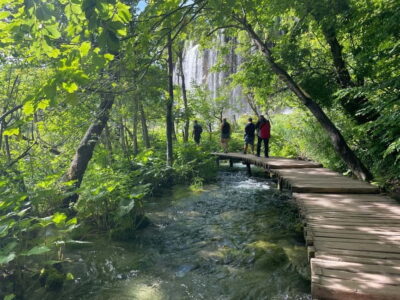
Rastoke & Plitvice Lakes Guided Tour with Ticket
Read our review →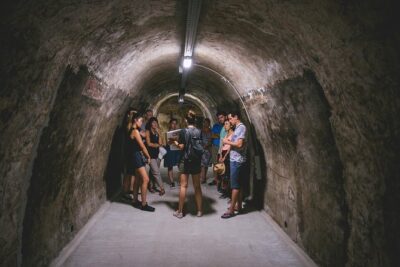
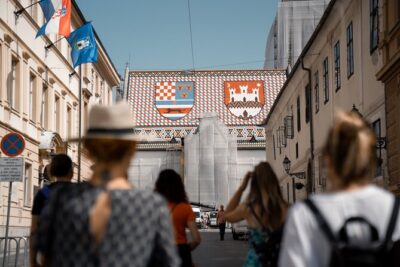
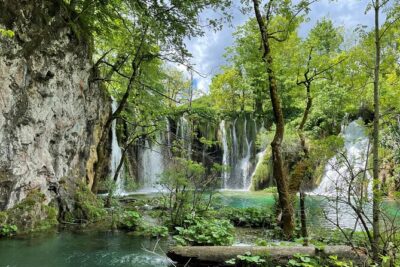
Plitvice Lakes with Ticket & Rastoke Guided Tour from Zagreb
Read our review →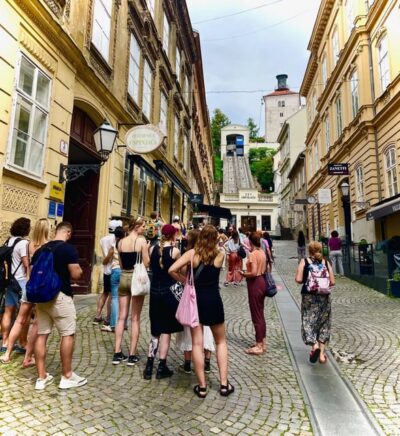
Small Group Walking Tour City Center and WW2 Tunnels
Read our review →
Skip-the-Ticket-Line Museum of Broken Relationships
Read our review →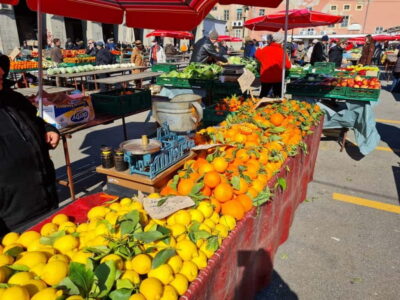
Browse the lists this tour appears in