
Reviewed · CITY TOURS
Back to Yugoslavia Private City Tour in Old-Timer Yugo Car
See Zagreb from the driver’s seat of history. This private tour pairs a 35-year-old original Yugo car with a licensed local guide and a sharp focus on Yugoslav-era Zagreb. Rather than following a large group from one famous sight to another, you ride through neighborhoods, pause at striking buildings, and hear how the city’s past shaped everyday life.
I like the tour’s personal format and its unusual route. The Mammoth apartment block, Kockica, the Sava River levee, and the old Eurovision venue give you a side of Zagreb that standard city tours often skip. The main drawback is the short two-and-a-half-hour schedule, which means some places receive only a quick look rather than a full visit.
The price is $102.41 per person, which is fair if you value private transport, a dedicated guide, snacks, and the character of the old car. I would choose it early in a Zagreb stay, especially if you want context for the city beyond the historic center.
In This Review
- Key points before you book
- Why the old Yugo makes this tour different
- Starting at Lisinski Concert Hall
- Gorica, the market, and Zagreb’s everyday texture
- Travno and Zagreb’s Mammoth apartment building
- Zagreb Fair and the public face of the city
- Kockica, the political center in concrete form
- Walking beside the Sava River
- Lisinski Hall and the 1990 Eurovision connection
- The Lady from Zagreb and Dražen Petrović
- What the private format is worth at $102.41
- Who should book this Zagreb tour
- Practical details that matter
- Should you book the Back to Yugoslavia tour?
- FAQ
- Where does the tour start?
- Where does the tour end?
- How long does the tour last?
- Is the tour private?
- What language is offered?
- What is included in the price?
- What sights are included?
- Is admission included?
- Can I cancel for a refund?
Key points before you book
- Ride in an original Yugo: The car is not just transport. It is the visual and mechanical centerpiece of the outing, a fitting way to explore former Yugoslavia.
- See modern Zagreb beyond the center: The route reaches Travno, the Zagreb Fair, the Sava River, and the Cibona area.
- Hear the Yugoslav story from a local guide: A licensed guide provides information about politics, buildings, daily life, and Zagreb’s place in Yugoslavia.
- Enjoy a private route: Only your group takes part, so you can focus on the topics that interest you most.
- Expect short stops: The listed visits to the Mammoth, Kockica, the Sava River, and Dražen Petrović Memorial Center last about five to ten minutes each.
- Plan around the weather: The tour requires good weather, and poor conditions can lead to a new date or a full refund.
Why the old Yugo makes this tour different
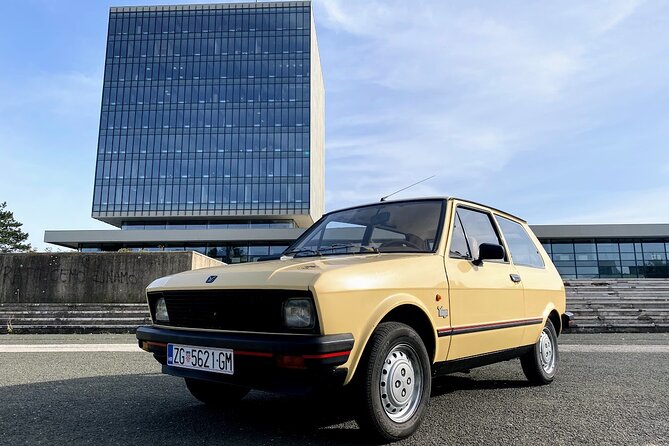
A city tour can be useful without being memorable. This one has a built-in conversation starter: an original Yugo that is about 35 years old. The car connects the sightseeing to the subject. You are not simply hearing about Yugoslavia from a modern vehicle. You are moving through Zagreb in an object from that period.
That detail will appeal most to anyone interested in twentieth-century Europe, local industry, design, or ordinary life under socialism. Even if you know little about Yugoslav history, the car gives the tour an immediate sense of place.
The old vehicle also makes the experience feel more intimate than a coach tour. This is a private activity, so your group does not have to share the guide’s attention with strangers. You can ask about a building, a political period, or a detail of daily life as it comes up.
Still, the Yugo is the reason to choose this tour, not a minor extra. If you prefer a spacious, polished vehicle with lots of room, this may not be your ideal city outing. The supplied information does not give exact seating details, so it is sensible to ask the operator about comfort if your group is large or if anyone needs extra space.
A few more Zagreb trips worth comparing
- From Zagreb: Plitvice & Rastoke Guided Day Trip with Ticket
★ 4.9 · 2,955 reviews - Zagreb: Rastoke & Plitvice Lakes Guided Tour with Ticket
★ 4.9 · 1,897 reviews - Communism & Croatian Homeland War Tour
★ 5.0 · 1,355 reviews
Starting at Lisinski Concert Hall
The tour begins and usually ends at Koncertna dvorana Vatroslav Lisinski, at Trg Stjepana Radića 4. This gives you a clear meeting point outside the central old town and places you near several of the route’s Yugoslav-era sights.
The return arrangement is flexible. You can finish back at the concert hall, or request another location within the city limits, defined here as within three kilometers of the main square. That is handy if you are continuing with dinner, a museum visit, or a walk through central Zagreb.
The outing lasts about two hours and thirty minutes. That is long enough to cover a broad section of the city, but not long enough for leisurely visits at every stop. Think of it as a guided city circuit with selected walks and photo pauses, not a series of extended museum visits.
Snacks are included. The information does not specify what they are, so do not treat them as a meal. You should still plan food separately if you are booking this around lunch.
Gorica, the market, and Zagreb’s everyday texture
The route includes an open-air market and an abandoned dishes factory known as Gorica. These are the kinds of places that give the outing its local character. They are not presented as grand monuments. Instead, they point toward work, shopping, production, and the physical remains of an earlier city.
The market helps connect political history with ordinary routines. A discussion of Yugoslavia can easily become a lesson in dates and leaders. A market and a former factory shift the subject toward how people lived, bought food, worked, and used urban space.
The abandoned dishes factory adds another layer. Its condition makes the past visible in a direct way, though the supplied details do not promise an interior visit. Expect to see or pass the site and hear about its place in Zagreb’s story rather than tour a preserved industrial museum.
This part of the route may be especially useful if you have already seen Zagreb’s main churches, squares, and historic streets. You get a broader sense of the city, including places that are not polished for sightseeing.
Travno and Zagreb’s Mammoth apartment building
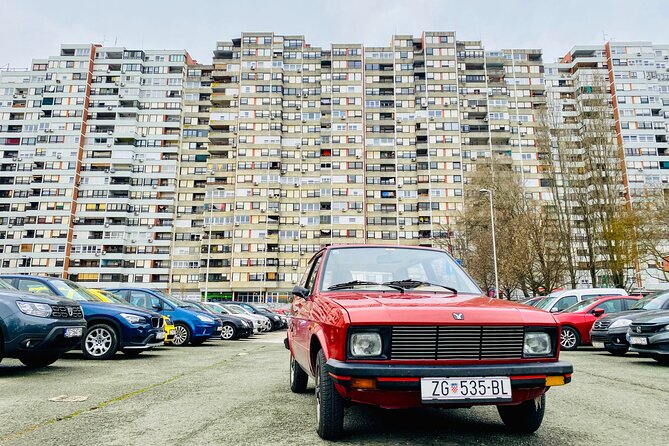
In Travno, the tour stops in front of The Mammoth, described as the largest apartment building in Zagreb. You have about five minutes here, and admission is free.
The name tells you how the building is meant to be read: as a huge piece of urban housing. It offers a strong visual entry into the planning and architecture associated with modern Zagreb. Your guide can explain how the building fits the city’s Yugoslav period and what large-scale apartment living meant in that setting.
Do not expect a long architectural visit. Five minutes is enough to see the building, take photographs, and ask a few focused questions. It is not enough to explore the surrounding district in detail.
I like this stop because it changes the subject from political offices to ordinary housing. A massive residential building can tell you more about daily life than a formal monument. If you are curious about how cities housed growing populations, this is one of the more useful pauses on the route.
Still Zagreb, at a slower pace:
- Best of Zagreb with the WW2 Tunnels
★ 5.0 · 973 reviews - Plitvice Lakes with Ticket & Rastoke Guided Tour from Zagreb
★ 5.0 · 966 reviews - Zagreb: Small Group Walking Tour City Center and WW2 Tunnels
★ 4.9 · 895 reviews - Zagreb: Skip-the-Ticket-Line Museum of Broken Relationships
★ 4.5 · 847 reviews
Zagreb Fair and the public face of the city
The tour passes Zagreb Fair, the city’s main venue for fairs and trade shows. The information does not list a timed stop here, so you should expect a drive-by explanation rather than a full visit.
That is still worthwhile. A major fairground says something about how a city presented business, technology, products, and public events. It also shows how the tour moves between residential Zagreb, institutional Zagreb, and places built for large gatherings.
The short format requires the guide to keep moving. If Zagreb Fair is a major interest for you, mention it when booking or at the beginning. The tour is private and described as bespoke, so the guide can focus on what interests your group, within the limits of the route and available time.
Kockica, the political center in concrete form
Kockica, or The Dice, is one of the clearest political stops. The building was built to house the Central Committee of Croatian Communists, and the tour pauses here for about five minutes. Admission is free.
This is a compact stop with a large subject behind it. The building gives your guide a place to discuss the political structure of communist-era Croatia and the role of Zagreb within Yugoslavia. You are looking at an office building, but its original purpose gives it considerable historical weight.
The five-minute pause means you will not be touring the building’s interior. The value comes from the exterior, the story, and the chance to connect the architecture with the institutions once housed there.
For me, Kockica is one of the strongest reasons to pick this experience over a general city tour. Zagreb’s historic center is filled with attractive façades and familiar cultural sights. Kockica points to a less decorative, more political chapter of the city.
Walking beside the Sava River

At the Sava River, you walk along the levee and see the famous Hendrix Bridge. This stop lasts about ten minutes and is the clearest opportunity to get out of the car, stretch your legs, and experience Zagreb’s open space.
The levee gives you a different view of the city. Instead of looking up at buildings from a street, you see the river corridor and the bridge as part of a wider urban setting. The Hendrix Bridge is also a memorable visual landmark, making this a good place for photographs.
Weather matters most here. The tour requires good conditions, and this outdoor stop is one reason why. If rain or poor weather cancels the experience, you are offered another date or a full refund.
The river walk is short, so do not expect a long riverside stroll. It works as a pause in the driving route and as a chance to see a less formal side of Zagreb.
Lisinski Hall and the 1990 Eurovision connection
The route includes the concert hall known as the venue that hosted the Eurovision Song Contest in 1990. Since the tour begins at Vatroslav Lisinski Concert Hall, this part of the route gives the starting point extra meaning.
The Eurovision connection is a useful reminder that Yugoslavia was not only about government buildings and apartment blocks. Music, television, public events, and cultural exchange also shaped how the country presented itself.
The supplied details do not list a separate timed admission or interior tour of the hall. Treat it as a point of interest seen from the route, with the guide supplying the historical context.
If you enjoy music history or remember the 1990 contest, this stop may carry special appeal. If not, it still adds a cultural note to a route otherwise focused on architecture, politics, and urban life.
The Lady from Zagreb and Dražen Petrović
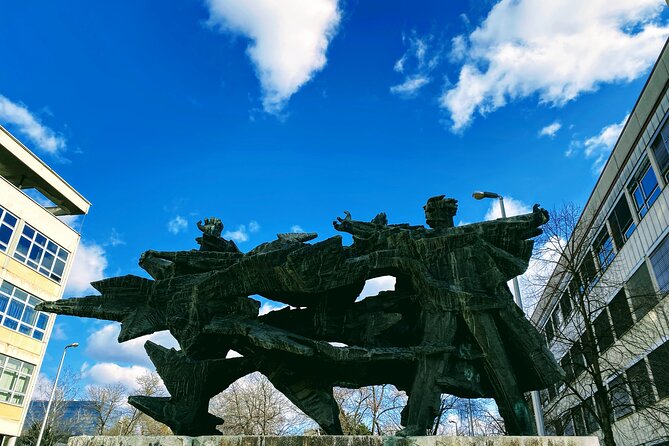
The car also passes the attraction known as The Lady from Zagreb. No visit duration is listed, so this appears to be another brief sight along the route rather than a full stop.
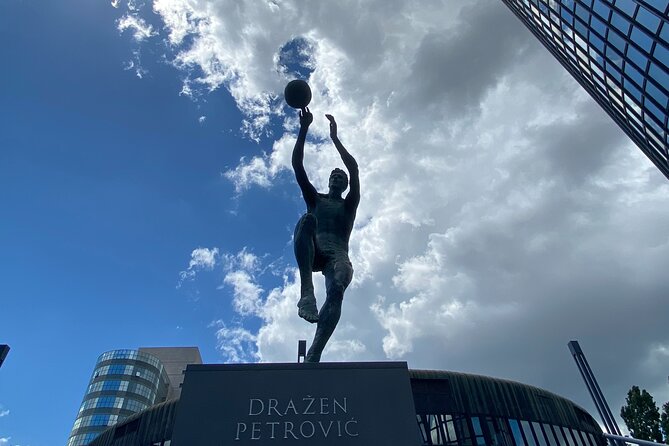
The final timed stop is the Dražen Petrović Museum and Memorial Center. You see the statue of Dražen Petrović, the famous basketball player, and the Cibona Tower. The listed stop lasts about ten minutes, with no admission charge.
This adds sport to the tour’s mix of politics, housing, music, and public space. The statue and tower give the guide a way to discuss a widely recognized Croatian figure while showing you a distinct part of Zagreb.
Again, ten minutes is a quick visit. You are not promised entry to the museum, and the information does not include an indoor museum tour. If you want to spend serious time learning about Petrović, you would need a separate visit.
The combination of the memorial and Cibona Tower works well as a closing scene. It leaves you with a modern Zagreb landmark rather than sending you back only through the political history of the former state.
What the private format is worth at $102.41
At $102.41 per person, the price is not the cheapest way to see Zagreb. You are paying for more than a ride between sights, though. The fee includes private transportation, an experienced licensed local guide, snacks, and the original Yugo ride.
The value improves as your group gets larger, since the cost buys a private experience rather than a seat on a shared bus. It also makes more sense if Yugoslav history is a central interest. A standard sightseeing tour may cover more famous landmarks, but it is unlikely to use an old Yugo or give you this particular focus.
The tour is also a good use of time at the start of a Zagreb visit. After two and a half hours, you should have a better mental map of neighborhoods outside the historic core and a clearer sense of which places you want to revisit on foot.
The limitation is depth. Several stops last only five or ten minutes, and some sights are passed without a listed stop. You are paying for a private overview with interpretation, not admission-heavy sightseeing.
Who should book this Zagreb tour
I would recommend it to you if you:
- Want Zagreb history connected to Yugoslav politics and everyday life
- Prefer a private guide to a large group
- Like unusual transport and classic vehicles
- Have already seen, or do not want to focus only on, the old town
- Enjoy architecture, urban planning, sports, music, and local stories
- Want a flexible route with the option to finish near central Zagreb
I would be more cautious if you want long museum visits, extensive walking, or a conventional list of Zagreb’s headline sights. The experience is also less suitable if bad weather is likely during your available day, since the outing requires good conditions.
The guide’s name is not included in the tour details, but one account specifically praises Theo and describes him as a strong part of a great day in Zagreb. If Theo is available for your date, you may want to request him, though availability is not guaranteed.
Practical details that matter
Confirmation arrives within 48 hours of booking, subject to availability. The experience is offered in English, and service animals are allowed.
Most people can participate, and the meeting point is near public transportation. Since the experience takes place in a classic car and includes outdoor stops, ask the provider ahead of time if your group has specific mobility or seating needs.
Free cancellation is available if you cancel at least 24 hours before the start time. Cancellations or changes made inside that window are not accepted for a refund. If poor weather causes the operator to cancel, you are offered another date or a full refund.
Should you book the Back to Yugoslavia tour?
Book it if you want Zagreb explained through its recent past rather than only its medieval streets. The Yugo car, Kockica, The Mammoth, the Sava River, and the Dražen Petrović stop create a varied route with a clear point of view.
I would especially choose it for a first or second day in Zagreb, when a private overview can help you understand the city before exploring on foot. At $102.41 per person, it is best value for couples, families, or small groups who will use the private format and ask plenty of questions.
Skip it if your priority is a long indoor museum visit or a slow walking tour. For everyone else, this is a lively, focused way to see a less familiar side of Zagreb, with an old Yugo doing much of the storytelling before the guide even begins.
FAQ
Where does the tour start?
The tour starts at Koncertna dvorana Vatroslav Lisinski, Trg Stjepana Radića 4, 10000 Zagreb, Croatia.
Where does the tour end?
It usually ends back in front of the Lisinski concert hall. You can also choose another location within the city limits, defined as within three kilometers of Zagreb’s main square.
How long does the tour last?
The tour lasts approximately two hours and thirty minutes.
Is the tour private?
Yes. Only your group participates in the private tour.
What language is offered?
The tour is offered in English.
What is included in the price?
The price includes snacks, private transportation, an experienced licensed local guide, the ride in an original 35-year-old classic Yugo, and information about Zagreb’s history and everyday life.
What sights are included?
The route includes the Gorica open-air market and abandoned dishes factory, The Mammoth in Travno, Zagreb Fair, Kockica, the Sava River and Hendrix Bridge, the 1990 Eurovision concert hall, The Lady from Zagreb, and the Dražen Petrović Memorial Center with Cibona Tower.
Is admission included?
The listed stops at The Mammoth, Kockica, the Sava River, and the Dražen Petrović Memorial Center have no admission charge. The tour details do not list an admission fee or interior visit for the other sights.
Can I cancel for a refund?
You can cancel up to 24 hours before the start time for a full refund. If the tour is canceled because of poor weather, you are offered a different date or a full refund.
Just added around Zagreb
- Zagreb: Explore with an Art Historian – Private Walking Tour★ 4.9 · 9 reviews
- Zagreb: VR 3D Immersive Film Experience – Voucher★ 4.6 · 9 reviews
- Zagreb: Plitvice With Secured Tickets, Boat And Train Ride★ 4.6 · 15 reviews
- Zagreb: Private custom tour with a local guide★ 4.6 · 48 reviews
- Zagreb: Pub Crawl, 1-Hour of Unlimited Drinks, & Club Entry★ 4.1 · 86 reviews
- Zagreb: Guided City Tour with WWII Tunnels★ 4.9 · 155 reviews
- Zagreb : Must-See Attractions Walking Tour With A Guide★ 4.6 · 11 reviews
- Zagreb BIG Tour – Private Tour★ 4.8 · 48 reviews
City Tours, compared.
City Walls Early Morning or Sunset Walking Tour
Read our review →
Dubrovnik Combo: Old Town & Ancient City Walls
Read our review →
Small Group Walking Tour City Center and WW2 Tunnels
Read our review →
Hop On Hop Off Panoramic bus – Zagreb City Tour
Read our review →
Browse the lists this tour appears in