
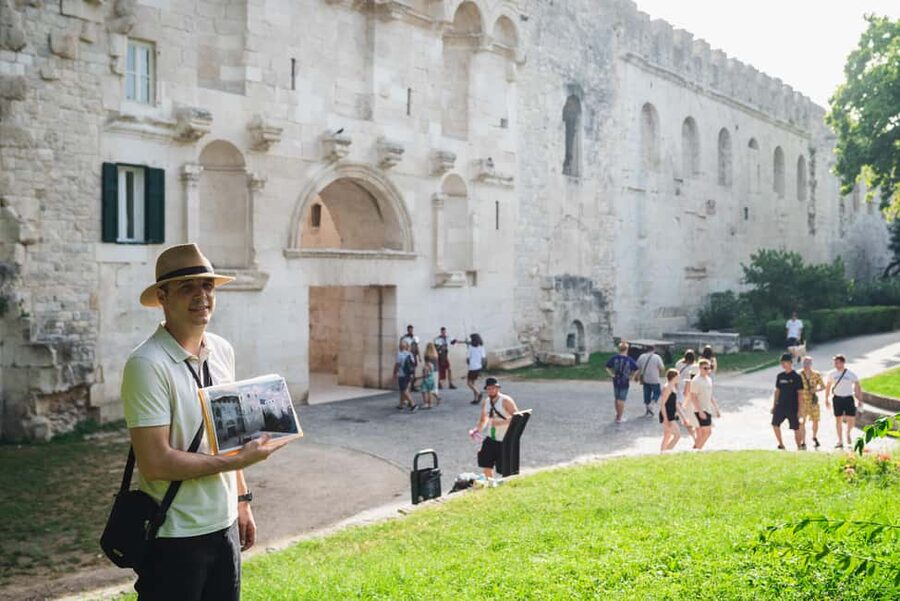
Reviewed · WALKING TOURS
Split: Walking tour of Split with a ‘Magister’ of History
Split’s stones still carry several centuries. This 110-minute walking tour makes the city’s layered past easier to read, led by Toni Šare, a Split-born historian with a master’s degree and a former history teacher. I especially like the 3D reconstructions, which show how the Palace may have looked in Roman times, and the open question-and-answer style, which keeps the tour from feeling like a memorized speech. The main consideration is that you will not enter any paid museums or monuments, and the route is not suitable for wheelchair users.
At $33 per person, this is not the cheapest way to see Diocletian’s Palace. Still, I think the price is fair if you want more than a quick walk through old stone corridors. Toni’s personal connection to Split, his classroom experience, and his willingness to explain both ancient and recent events give the tour useful depth.
In This Review
- Key points to know before you book
- Why this Split walking tour is different
- Starting beside the Riva at the Bronze Gate
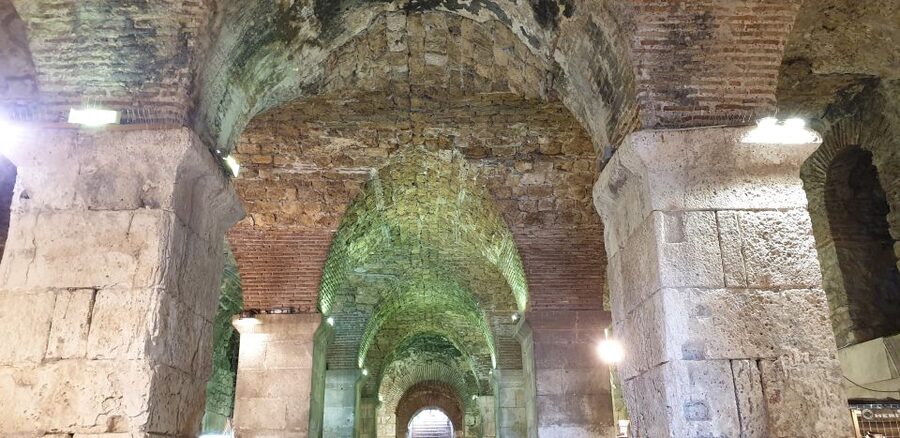
- The Bronze Gate and Diocletian’s Cellars
- One hour inside Diocletian’s Palace
- Peristyle, the Palace’s grand central space
- Vestibule, Triklinij, and the imperial private world
- Saint Domnius Cathedral and Jupiter’s Temple
- Silver Gate, Golden Gate, and the medieval city
- What Toni adds as a Split local
- Is $33 a fair price?
- Who should book this tour?
- Should you book the Magister of History tour?
- FAQ
- How long does the walking tour last?
- What is the price per person?
- Where does the tour begin?
- Where does the tour finish?
- What language is the tour conducted in?
- Who leads the tour?
- Does the tour enter paid sites or museums?
- Are food and drinks included?
- Does the tour operate in bad weather?
- Is the tour suitable for wheelchair users?
Key points to know before you book
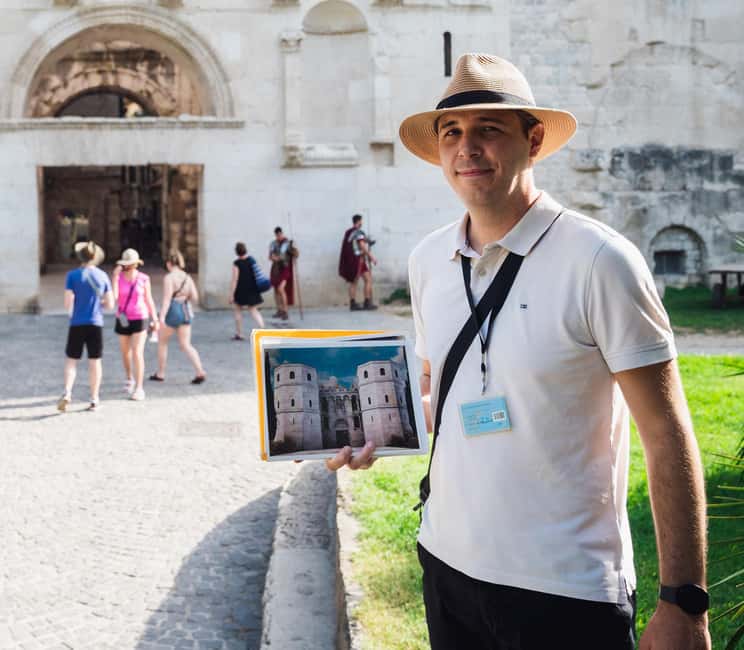
- A local historian leads the walk: Toni Šare was born in Split and has lived there all his life.
- Roman Split comes first: The route begins at the southern entrance to Diocletian’s Palace and works forward through medieval, Venetian, and modern history.
- Printed 3D images bring ruins back to life: Toni uses reconstructions to show the original appearance of major Palace structures.
- Questions are part of the format: You can ask about architecture, politics, Croatian history, or modern Split as you walk.
- The route takes 110 minutes: It covers the Palace core and ends at the Golden Gate.
- No paid sights are entered: You see and discuss major landmarks from the route, but entrance tickets, food, and drinks are not included.
Why this Split walking tour is different
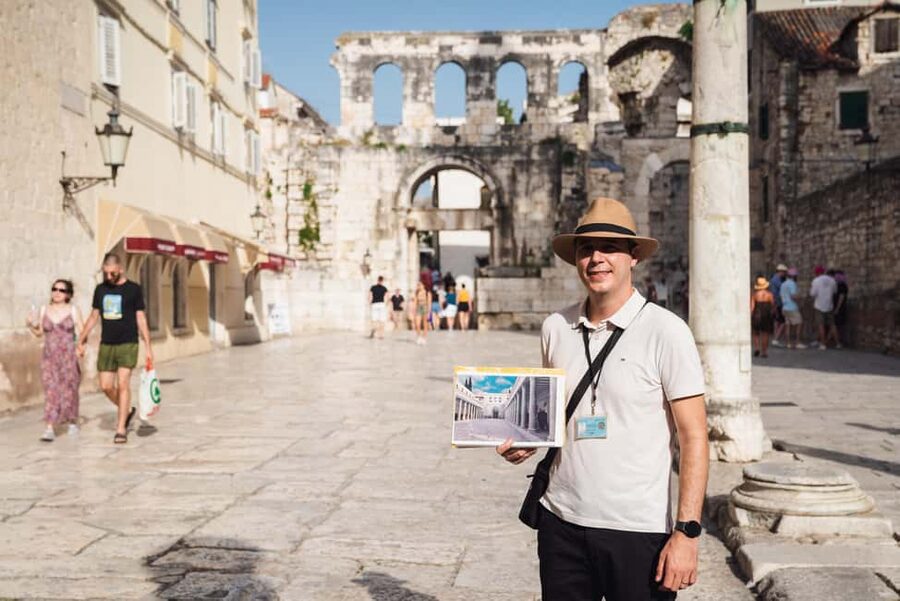
Many Palace tours focus on Roman Emperor Diocletian, then stop once the basic facts have been delivered. This one tries to explain how a Roman imperial residence became the center of a living Croatian city.
That change is the key idea. Split’s Old Town is not a museum sealed behind a fence. People live, work, shop, and walk through spaces first designed for an emperor. Roman walls support later homes. Medieval streets cut across older foundations. Venetian influence appears in the city’s later buildings and public spaces.
Toni’s background suits this kind of tour. He is not simply there to point at a column and give its date. His teaching experience helps him arrange the story in a clear order, moving from the oldest parts of Split toward the present. You get the broad story first, then the details make more sense.
I also like that the tour leaves room for discussion. If you want to ask about Croatia’s recent past, the development of Split, or how a particular building changed over time, Toni is prepared to go beyond the standard Roman material. That flexibility has been one of the strongest parts of the experience for many people who booked it.
More Walking Tours in Split
- Split: Old Town and Diocletian Palace Walking Tour
★ 4.9 · 4,727 reviews - Walking Tour of Split and Diocletian’s Palace
★ 5.0 · 2,588 reviews - Krka Waterfalls tour with Trogir Walking tour and Krka panoramic boat cruise
★ 5.0 · 1,659 reviews
Starting beside the Riva at the Bronze Gate
The meeting point is the Bronze Gate, also called the Brass Gate, at Obala Hrvatskog narodnog preporoda 22. It sits on the seafront side of Diocletian’s Palace, just off Split’s Riva promenade.
Give yourself enough time to find the Riva first. Once you are on the promenade, walk toward the southern seaside entrance of the Palace. The address is useful if you are using a map, but the simplest approach is to locate the waterfront and look for the gate leading into the Palace.
Beginning here is practical. The Riva gives you a clear sense of where the Palace sits in relation to the modern city. You start with the harbor and present-day Split, then pass through the Bronze Gate into the older core.
The tour runs in English and takes place rain or shine. Bring drinking water, especially in warm weather. One useful tip is to choose an early time slot if you have a choice. The Palace can become much busier as the day progresses, and an earlier start may make it easier to hear and move through narrow areas.
The Bronze Gate and Diocletian’s Cellars
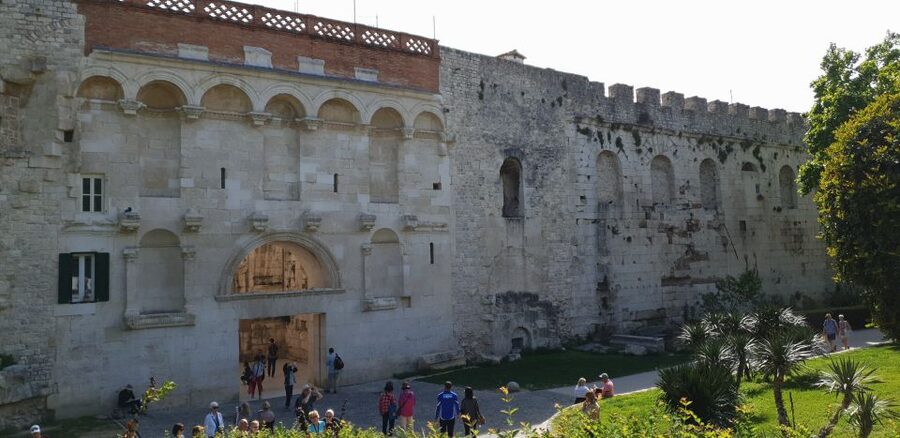
The Bronze Gate is a modest entrance compared with the grander gates on the north and east sides of the Palace. That is part of its appeal. It leads from the waterfront into the lower level of the complex and gives you a sense of how the Palace connected to the sea.
From here, you pass by Diocletian’s Cellars. The lower halls are among the most useful places for understanding the Palace’s original plan. Their structure helps show how the upper imperial residence was supported and arranged.
The cellar section is not presented as a long museum visit. The route passes through it for about ten minutes, with a short pause for questions. Since no paid site is entered, this is best understood as an orientation to the Palace rather than a full archaeological visit.
That distinction matters. If you want a tour centered on interior museum displays, this may feel limited. If you want to understand the Palace layout before walking through the open-air streets above, the cellar passage gives you a useful start.
One hour inside Diocletian’s Palace
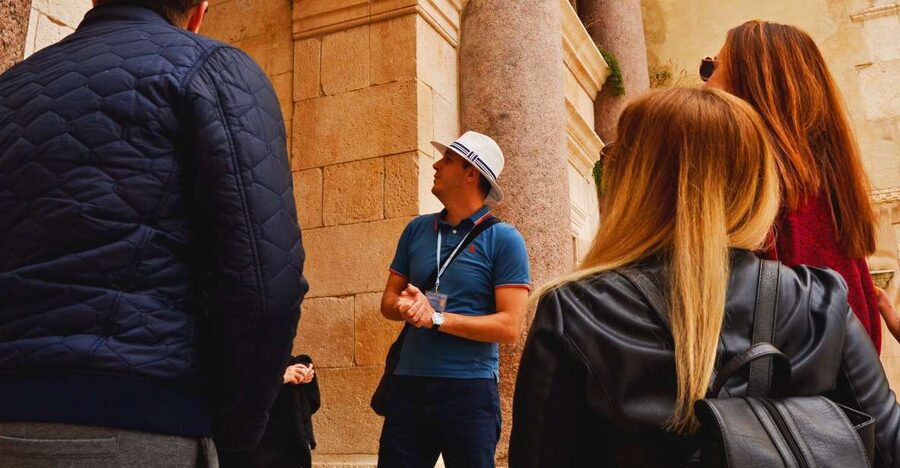
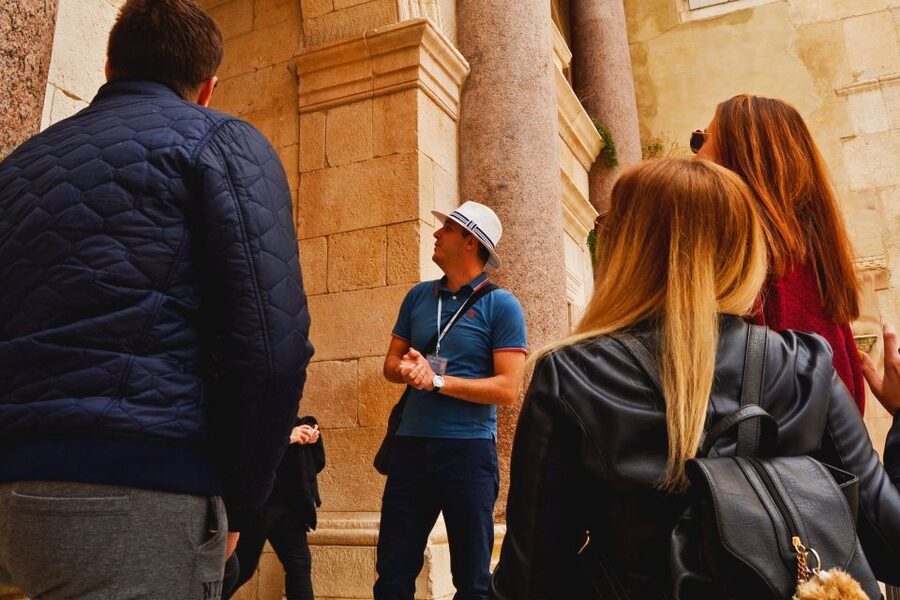
The main part of the walk takes about an hour and explores the Palace itself. This is where the tour’s central idea becomes clear: Split is built in layers.
You move through the remains of Diocletian’s private residence and later medieval houses. These buildings were not placed beside the Palace as separate attractions. They were built into and around it, turning the imperial complex into a city quarter.
I find the 3D reconstructions especially useful here. Ancient ruins can be hard to read when you see only broken walls, partial doorways, and scattered columns. A visual reconstruction gives you a working picture of the original form, then you can compare that image with what remains in front of you.
The images are presented as part of the guiding, not as a separate digital show. Toni has used printed computer-generated images to show how key parts of the Palace may have appeared in Roman times. This adds a visual aid without taking attention away from the actual stones.
The wording may be cautious when the evidence is uncertain, which is a good sign. Ancient buildings often leave historians with unanswered questions. A useful guide should separate what is known from what is estimated, rather than turn every gap into a confident story.
Still Split, at a slower pace:
- Split: Krka Waterfalls Trip with Boat Cruise and Swimming
★ 4.8 · 10,519 reviews - From Split: Krka Waterfalls, Food & Wine Tasting Tour
★ 5.0 · 9,326 reviews - Blue cave, Mamma Mia and Hvar, 5 islands speedboat tour
★ 5.0 · 7,150 reviews - From Split: Krka Waterfalls, Food & Wine Tasting Tour
★ 4.9 · 6,598 reviews
Peristyle, the Palace’s grand central space
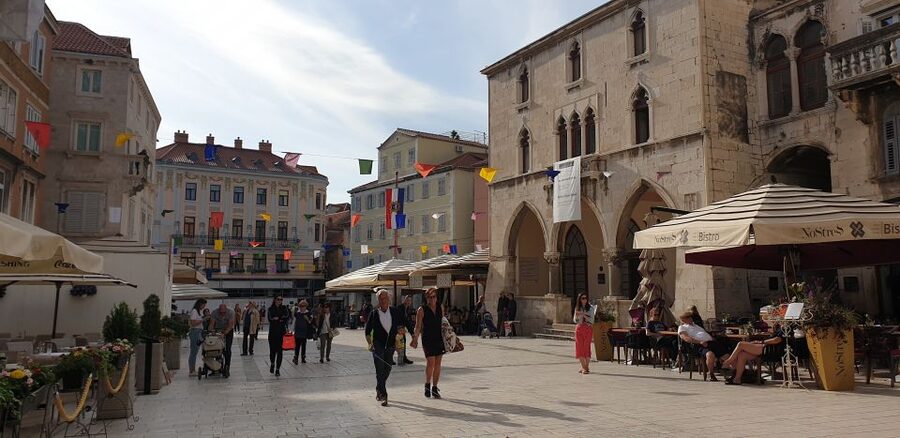
Peristyle is the most dramatic stop on the route. This preserved Roman square is the ceremonial heart of the Palace and one of the places where the scale of Diocletian’s project is easiest to grasp.
Here, you can look toward the Mausoleum of Diocletian, the Temple of Jupiter, and the Vestibule. The square brings together several major parts of the imperial complex, so Toni can explain how they related to one another rather than treating each monument as an isolated object.
The stop lasts about ten minutes, but the surrounding material is also covered during the longer Palace section. Expect to pause, look closely, and ask questions rather than simply take a photograph and move on.
Peristyle can be crowded. This is one reason the early-start advice is practical. The square is visually impressive, but a large crowd can make it harder to hear a guide or examine the details. Toni has also been praised for seeking shade and quieter areas when possible, though no route can remove the crowds entirely.
Vestibule, Triklinij, and the imperial private world

The Vestibule receives a short guided stop of about five minutes. Its round form and strong architectural presence help explain the transition between the public and private parts of the imperial residence.
The following stop, Triklinij, also takes about five minutes. Here, the focus turns toward the private side of Palace life. The point is not merely that Diocletian lived here, but that the Palace was designed around different levels of access, ceremony, and domestic use.
These brief stops work best when you already understand the larger plan. Toni’s earlier explanation of the Palace helps you see why a particular room or passage mattered. Without that framework, ancient names can blur together.
The pace is one of the tour’s strengths. You cover a lot in less than two hours, but the walk is not presented as a race. The guide’s teaching background appears to help him decide which facts matter most and when to stop for questions.
Saint Domnius Cathedral and Jupiter’s Temple
The route passes by the Cathedral of Saint Domnius and Jupiter’s Temple, with roughly five minutes devoted to each. You do not enter paid sites or museums, so these are exterior explanations rather than full interior visits.
Saint Domnius Cathedral is important because it occupies the former Mausoleum of Diocletian. That change says a great deal about how the Palace evolved after the emperor’s time. A Roman imperial structure became part of a Christian city, and later generations adapted it rather than simply abandoning it.
Jupiter’s Temple offers another view of Roman religious planning. Even a short stop can help you understand how sacred buildings fitted into the Palace’s design. If you want extended time inside the cathedral or temple, you will need to arrange that separately.
The tour’s value here comes from context. You are not just told what a building is called. You are shown how its role changed as Split moved through different periods.
Silver Gate, Golden Gate, and the medieval city
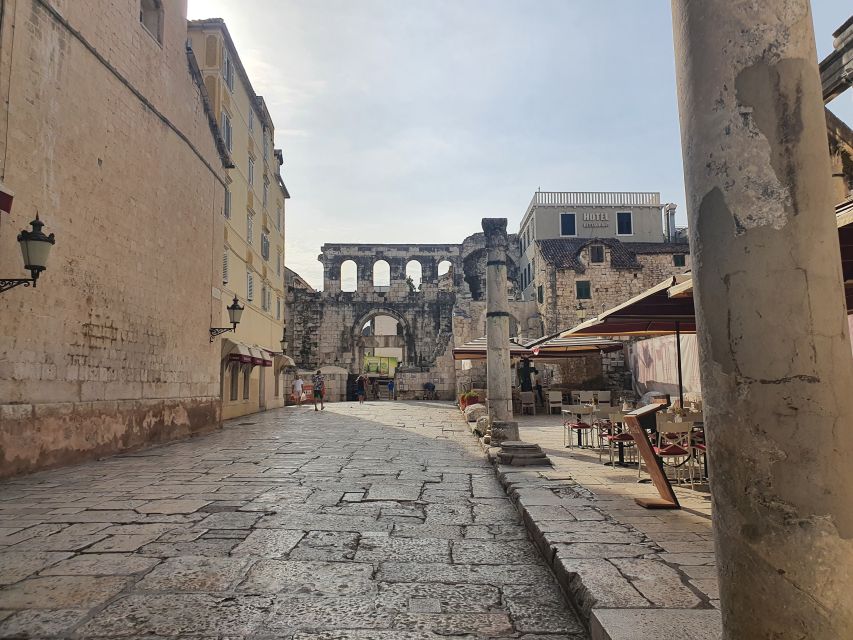
The Silver Gate receives a short guided stop of about three minutes. It is one of the Palace entrances and helps complete the picture of the defensive and ceremonial layout.
The walk then continues toward the Golden Gate, the finish point. Along the north wall, you can see the statue of Bishop Gregory of Nin before reaching the Piazza Square area and the northern exit of the Palace.
The Golden Gate is a fitting end because it shifts the focus toward Split’s medieval and Venetian past. You leave the Roman core while still surrounded by the later city that grew from it. This is where the tour’s timeline moves most clearly from imperial Rome into the long life of Split as an urban center.
Ending at the Golden Gate is also useful for the rest of your day. You are already on the north side of the Old Town, with the Palace route behind you and more of central Split within walking distance. The tour does not include a transfer back to the Riva, but Split’s compact historic center makes the return straightforward.
What Toni adds as a Split local
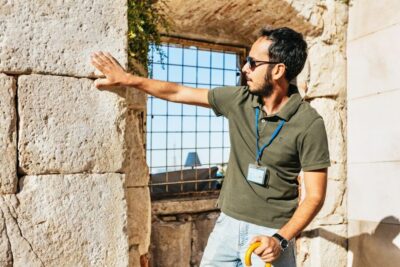
Toni’s local connection is more than a line in the description. He was born in Split and has lived there all his life, so he can connect the Palace to the city beyond its Roman walls.
His former students are now missing out on his classroom stories, but you benefit from that teaching experience for 110 minutes. He explains clearly, keeps the group involved, and adjusts when questions take the discussion in a useful direction.
His approach also includes modern Split. You can expect the main story to focus on Roman, medieval, and Venetian periods, but questions about Croatia’s more recent past are welcome. That wider frame helps you see the Palace as part of a continuing city, not just an ancient monument.
The tone appears to be friendly and spirited rather than stiff. Toni has been praised for humor, patience, clear explanations, and care with the pace. He has also offered visitors suggestions about what to see before or after the tour, which can help if this is your first few hours in Split.
Is $33 a fair price?
At $33 per person, the tour costs more than some basic walks through Split. The price makes sense if you value a specialist guide, a structured historical story, and visual material that helps explain the ruins.
You are not paying for admission to the cathedral, temple, cellars, or museums. That keeps the arrangement simple, but it also means you should not compare this directly with a tour that includes several ticketed interiors.
I would see the price as payment for interpretation rather than access. The Palace is free to walk through in many areas, but it is not always easy to understand what you are seeing. Toni’s master’s degree, teaching experience, local knowledge, and custom 3D images give you a stronger framework for exploring the city on your own afterward.
The value is highest for first-time visitors who want the history explained in a logical order. It may be less attractive if you already have a strong background in Diocletian’s Palace or want a short, casual introduction with little historical detail.
Who should book this tour?
I would recommend it to:
- First-time visitors to Split who want to understand the Old Town quickly
- People interested in Roman architecture and the reuse of old buildings
- Families with older children who enjoy stories and visual aids
- Visitors who prefer questions and conversation to a fixed speech
- Anyone who wants local background on Split as well as ancient history
The tour can suit a 12-year-old who enjoys history, according to one family’s experience, but children who dislike standing and listening may find 110 minutes demanding. The route is on foot, rain or shine, and it is not suitable for wheelchair users.
You should also bring water and prepare for sun or rain. The guide may find shade where possible, but the weather still shapes the experience.
Should you book the Magister of History tour?
Book it if you want Diocletian’s Palace explained as a living city with Roman foundations, medieval additions, Venetian influence, and a modern Croatian identity.
I would choose this tour early in a Split stay. It gives you a useful map of the Old Town and makes later wandering more rewarding because you know what the walls, gates, squares, and reused buildings are telling you.
Skip it if your main goal is entering paid monuments, spending long periods inside museums, or taking a quick photo-focused walk. For everyone else, $33 is a sensible spend for a clear, personal, and visually supported introduction to Split.
FAQ
How long does the walking tour last?
The tour lasts 110 minutes.
What is the price per person?
The price is $33 per person.
Where does the tour begin?
It begins at the Bronze Gate, also called the Brass Gate, at Obala Hrvatskog narodnog preporoda 22 beside Split’s Riva promenade.
Where does the tour finish?
The tour finishes at the Golden Gate of Diocletian’s Palace.
What language is the tour conducted in?
The live tour is conducted in English.
Who leads the tour?
The guide is Toni Šare, a Split-born local historian with a master’s degree in history and experience as a history teacher.
Does the tour enter paid sites or museums?
No. Paid sites and museums are not entered. Walking through Diocletian’s Palace itself does not require admission.
Are food and drinks included?
No. Food and drinks are not included. You should bring drinks with you.
Does the tour operate in bad weather?
Yes. The tour takes place rain or shine.
Is the tour suitable for wheelchair users?
No. The experience is not suitable for wheelchair users. It is also not suitable for people over 95 years old.
More History Tours in Split
- Walking Tour of Split with a ‘Magister’ of History
★ 5.0 · 1,122 reviews - Split Walking Tour with Professor of History
★ 5.0 · 926 reviews - Split: History and Heritage Walking Tour
★ 4.9 · 650 reviews - Split History and Gastro Small-Group Tour with Food and Drinks
★ 5.0 · 375 reviews
Just added around Split
- Slatine – Island Hopping Excursion (Trogir/Blue Lagoon/Shipwreck)★ 4.0 · 24 reviews
- Krka Waterfalls & Primošten from Trogir, Seget, Čiovo & Kaštela★ 5.0 · 18 reviews
- Island Hopping Boat Excursion with Lunch (Trogir,Blue Lagoon, Šolta)★ 3.5 · 6 reviews
- From Trogir, Seget, Okrug: Krka Waterfalls & Šibenik Culture Tour★ 5.0 · 10 reviews
- From Split & Trogir: ATV Quad Tour on Island Čiovo★ 5.0 · 21 reviews
- Split: Blue Lagoon Boat Trip with Lunch, Wine and Snorkeling★ 5.0 · 3 reviews
- Split Sunset Stand Up Paddle Tour★ 5.0 · 16 reviews
- Split: Sunset Guided Kayaking Tour★ 4.8 · 71 reviews
Walking Tours, compared.
Walking Tour of Split and Diocletian’s Palace
Read our review →


Krka Waterfalls tour with Trogir Walking tour and Krka panoramic boat cruise
Read our review →
City Walls Early Morning or Sunset Walking Tour
Read our review →Browse the lists this tour appears in