
Reviewed · WALKING TOURS
Split Walking Tour: History, Legends & Tales
Ancient Rome still runs Split. This 90-minute walk uses Diocletian’s Palace as a starting point, then follows the city’s medieval streets, lively squares, legends, and local stories. I like the small group of no more than 12 and the way the route connects famous ruins with everyday Split. I also like that guide Lucija adds food, gelato, bar, and sightseeing suggestions that can shape the rest of your stay. The main drawback is simple: you do not enter museums or paid sights, so this is an orientation walk rather than a full archaeological tour.
At $30.17 per person, the price is fair if you want a smart introduction before exploring on your own. The route is short enough for a hot morning or a port-day schedule, though the palace streets and old-town squares can be busy and uneven. The tour has a 5 out of 5 rating from 60 reviews, with 100% of customers recommending it.
In This Review
- Key points to know before booking
- Why this 90-minute walk works well in Split
- Starting at Riva Harbor with a city lesson
- Beneath the palace in the Substructures
- The Vestibule and Diocletian’s southern apartments
- The Peristyle and its ancient Egyptian sphinx
- The Golden Gate and Gregory of Nin’s lucky toe
- People’s Square beyond the western walls
- Fruit’s Square, Venetian defenses, and Baroque style
- Returning to Riva with useful local advice
- Is $30.17 good value?
- Who should book this Split walk?
- Should you book it?
- FAQ
- How long does the Split Walking Tour last?
- Where does the tour begin?
- Where does the tour end?
- What language is the tour offered in?
- How large is the group?
- Is the tour suitable for most people?
- Are admission tickets included?
- Is the tour suitable for cruise passengers?
- Can I cancel for a full refund?
- What happens if the weather is poor?
Key points to know before booking
- A compact route through Split’s main historic core: You visit Riva Harbor, the Palace substructures, the Vestibule, the Peristyle, the Golden Gate, People’s Square, and Fruit’s Square.
- A guide-led story of Diocletian’s Palace: The focus is not only on dates and ruins, but also on legends, daily life, architecture, and the way modern Split grew around the palace.
- The 3,500-year-old sphinx at the Peristyle: This Egyptian monument gives the Roman setting an unexpected link to an even older civilization.
- Local advice from Lucija: Her restaurant, pasticada, bar, gelato, and day-trip suggestions are a useful bonus after the walking route ends.
- A good cruise-day option: The meeting point is easy to find from the harbor, and the tour returns to Riva.
- No admission fees are included: You see the exterior and public areas, but you do not enter museums or paid attractions.
Why this 90-minute walk works well in Split
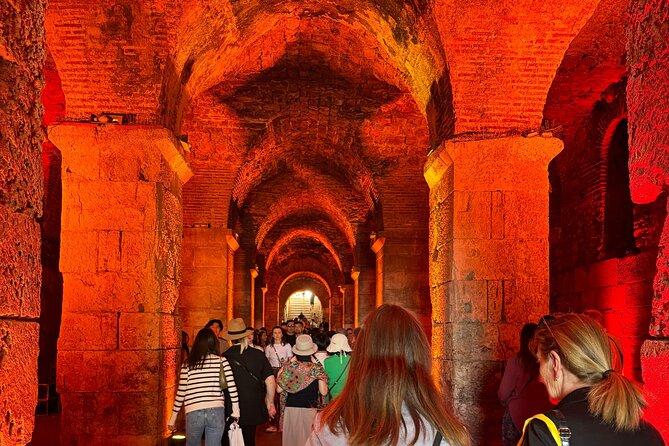
Split is not a city you understand by checking off isolated monuments. Its old center is a living part of the ancient palace, with homes, shops, cafés, churches, and narrow lanes set inside Roman walls. A guide helps you see how those layers fit together.
That is the real value of this experience. You are not simply led from one photo stop to another. You are given a framework for the city. Afterward, the stone streets make more sense, and you can return to the places that caught your interest.
The route lasts about an hour and a half. That is long enough to cover the principal sights without turning into an exhausting history lecture. It is also short enough to fit into a morning before lunch, a day of independent sightseeing, or a shore excursion from a cruise ship.
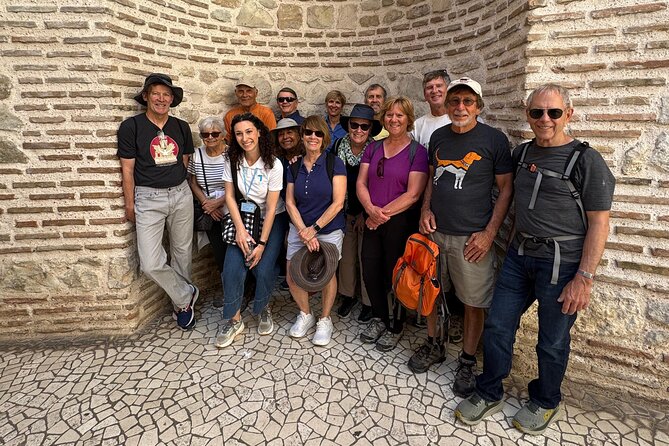
The group limit is 12 people, although some departures may be much smaller. Several bookings have worked out as nearly private walks, which gives you more time to ask questions. The guide’s style is described as informal, patient, personable, and conversational, a useful mix in a city where a long list of Roman dates could otherwise become tiring.
More Walking Tours in Split
- Split: Old Town and Diocletian Palace Walking Tour
★ 4.9 · 4,727 reviews - Walking Tour of Split and Diocletian’s Palace
★ 5.0 · 2,588 reviews - Krka Waterfalls tour with Trogir Walking tour and Krka panoramic boat cruise
★ 5.0 · 1,659 reviews
Starting at Riva Harbor with a city lesson
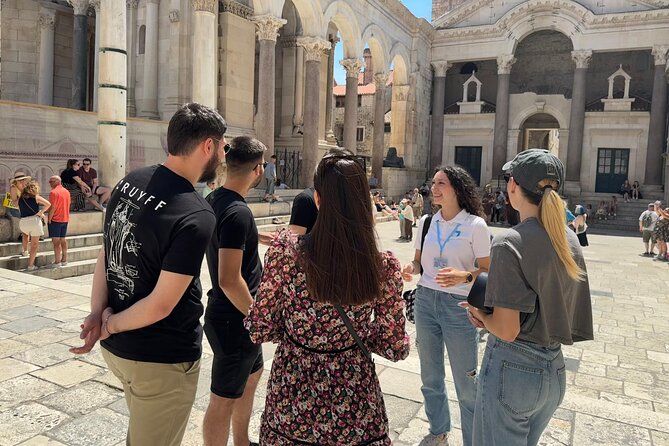
The tour begins at Obala Hrvatskog narodnog preporoda 22, along Riva Harbor, Split’s main waterfront promenade. This is a practical starting point because it is easy to locate and gives you an immediate view of the city’s relationship with the sea.
The opening stop lasts about 15 minutes. You look at a model of Split while the guide introduces Emperor Diocletian, his palace, and the wider story of the city. That model matters. From street level, the palace can seem like a maze of unrelated walls and alleys. Seeing its original plan first helps you understand the scale and purpose of the complex.
This is also where you begin to grasp that Diocletian’s Palace was not merely a grand residence. It was a fortified complex, a retirement home, and a carefully planned Roman center. The introduction gives you the basic map before you enter the old streets.
I would choose a morning departure if possible. One past booking specifically praised the cooler, quieter feel of a morning walk. The tour can also work well for cruise passengers because it starts and ends on Riva, close to the main waterfront area.
Beneath the palace in the Substructures
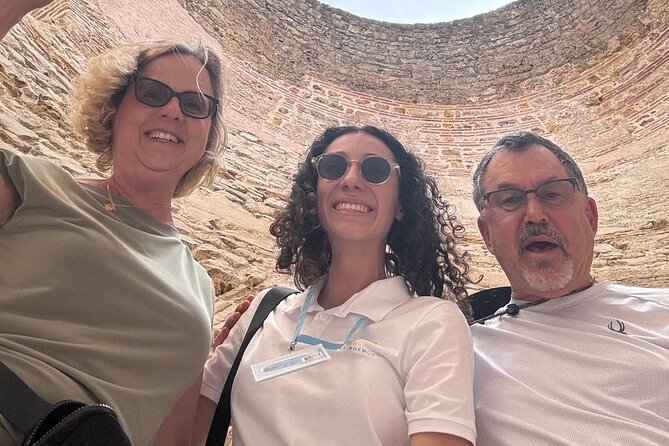
From Riva, you pass into the Substructures of Diocletian’s Palace. This section takes about 10 minutes and presents one of Split’s clearest glimpses of the original Roman plan.
The Substructures are a network of underground rooms and corridors that supported the apartments above. In practical terms, they are the palace’s foundation. In historical terms, they preserve the layout of spaces that would otherwise be much harder to understand.
The guide points out the Roman engineering behind the structure and helps you picture how the rooms related to the emperor’s apartments. The underground setting also gives the tour a change of mood after the open waterfront.
Keep your expectations clear here. You pass through the Substructures, but no admission ticket is included and the tour does not enter paid museums or attractions. If you want an extended visit to the underground complex, you will need to arrange that separately. For a short introduction, though, this stop gives you the essential idea.
The Vestibule and Diocletian’s southern apartments

The route continues through the southern part of the Palace toward the Vestibule. This walk takes about 10 minutes and covers the area where Diocletian’s apartments, dining hall, and gardens once stood.
The Vestibule was the grand entrance hall to the imperial apartments. Even without spending a long time inside, the space helps you understand the formal approach to the emperor’s private quarters. The guide connects the building to the Triclinium, or dining hall, and to the gardens that once softened the palace’s military appearance.
This section is useful because it moves beyond the familiar image of Roman columns. You get a sense of how the palace functioned as a home, court, and ceremonial setting. The emperor’s retirement was not a quiet move to a country cottage. It was a carefully designed residence on a powerful coastal site.
The walk between stops is part of the experience. You are moving through the southern section rather than standing in front of one monument for a long explanation. That keeps the pace active, though anyone seeking detailed architectural measurements or a museum-style lecture may want a longer specialist tour.
Still Split, at a slower pace:
- Split: Krka Waterfalls Trip with Boat Cruise and Swimming
★ 4.8 · 10,519 reviews - From Split: Krka Waterfalls, Food & Wine Tasting Tour
★ 5.0 · 9,326 reviews - Blue cave, Mamma Mia and Hvar, 5 islands speedboat tour
★ 5.0 · 7,150 reviews - From Split: Krka Waterfalls, Food & Wine Tasting Tour
★ 4.9 · 6,598 reviews
The Peristyle and its ancient Egyptian sphinx
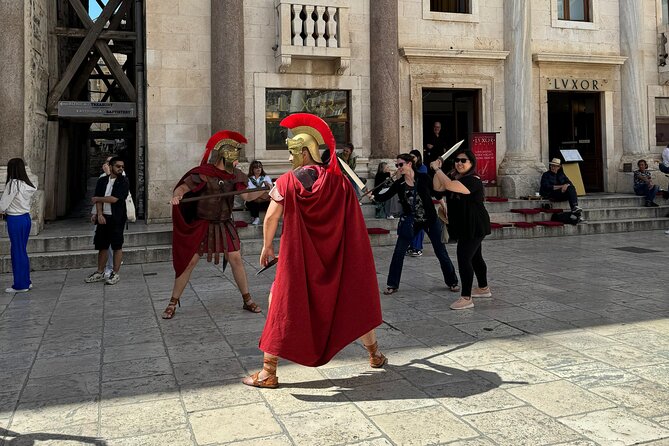
The Peristyle receives the longest stop, about 20 minutes, and rightly so. This is the ceremonial heart of Diocletian’s Palace and one of the most memorable open spaces in Split.
The square brings together Roman architecture, later Christian use, and Egyptian sculpture. A 3,500-year-old sphinx watches over the area, a striking survivor from an era far older than Diocletian himself. That detail gives the site extra force. You are not looking at a single period frozen in place, but at several ancient worlds meeting in one square.
The Peristyle is also where the tour’s title, History, Legends & Tales, makes the most sense. The guide explains the setting while adding the stories that help you remember it. Lucija’s style has been praised for being informal, warm, and full of small details rather than rushed facts.
Because this is a public square, the atmosphere can change during the day. You might find it calm during a morning walk or more crowded later on. The tour does not promise exclusive access, so your experience depends partly on the time and day of your visit.
Still, 20 minutes is enough to pause, look up, and understand the layout. I would not rush this stop. The Peristyle is the place to notice the columns, the sphinx, the surrounding stonework, and the way modern life continues around an ancient ceremonial space.
The Golden Gate and Gregory of Nin’s lucky toe

Next comes the Golden Gate, one of the palace’s grand entrances. The gate once welcomed people into the fortified complex and gives you a clear sense of how imposing the palace must have appeared to anyone approaching it.
The stop lasts about 15 minutes and includes the nearby statue of Gregory of Nin. The statue is tied to one of Split’s best-known bits of local folklore: rubbing the large toe is said to bring good luck and help grant wishes.
It is a light moment after the more formal Roman sites, and a good reminder that historic monuments in Split are part of daily life, not sealed away behind glass. You can make your wish, take a photograph, and continue with a better sense of how old and modern Split overlap.
The Golden Gate also helps you read the palace as a defensive structure. The route does not treat the complex as one grand building. Instead, it shows how entrances, ceremonial areas, private rooms, and supporting spaces worked together.
People’s Square beyond the western walls
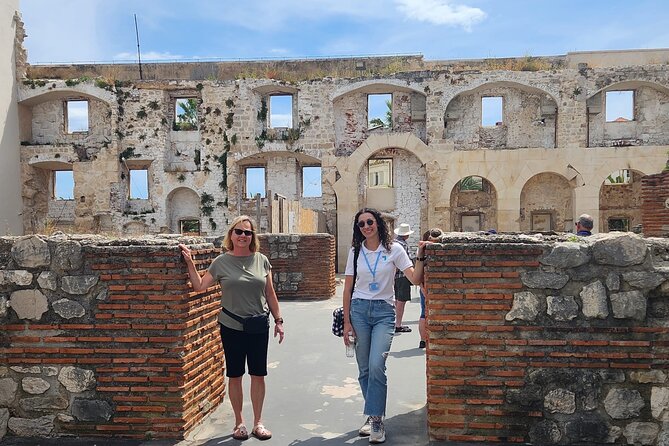
The tour then leaves the palace through the Iron Gate and reaches Narodni Trg, or People’s Square. This is an important shift. The palace was once large enough to contain the city, but as Split’s population grew, new areas developed beyond its walls.
People’s Square was the first major area built outside the palace in the 14th century. It became a gathering place and remains one today. The former 15th-century city hall is one of its key landmarks, while cafés make it a natural place to pause after the tour.
This stop lasts about 10 minutes. The guide’s explanation helps you see that Split’s story did not end with Rome. The medieval city expanded around the imperial complex, adapting old walls and creating new public spaces.
I like this part of the route because it prevents the tour from becoming a palace-only history lesson. You see the change from Roman power center to medieval town, then to the modern city you are walking through now.
Fruit’s Square, Venetian defenses, and Baroque style

The final main stop is Fruit’s Square, known locally as Trg Braće Radić. It is a relatively small square, but it brings together several different pieces of Split’s later history.
The octagonal Venetian tower is the most obvious landmark. It was built in the 15th century as part of the town’s defenses, when Split was still a much smaller place. Across from it is the former Milesi family palace, with a 17th-century Baroque façade considered one of the finest examples of that style in Dalmatia.
The square is also used for fairs and is lined with bars, restaurants, and shops. That mix makes it a pleasant final stop. You are looking at a defensive tower and a grand family residence, but you are also seeing a functioning city square.
The 10-minute visit is enough for an explanation and a look around. You will not get a long art-history treatment of the Baroque façade, but you will learn what to notice. That is the tour’s general approach: identify the important details, explain why they matter, and leave you free to explore further.
Returning to Riva with useful local advice
The route comes back to Riva Harbor, where it began. This makes the walk easy to use as a first activity in Split. You finish near the waterfront, restaurants, cafés, and the city’s main pedestrian areas.
One of the strongest practical benefits is the advice Lucija gives along the way. Her recommendations include local restaurants, bars, gelato stops, and things to do during the rest of your stay. Pasticada was singled out as a food suggestion, so anyone interested in trying a traditional local dish should make a note of it.
The guide has also handled families well, responding to questions from four children during one small-group walk. That suggests the tour can suit mixed-age groups, especially when children enjoy stories, legends, and visual landmarks more than long formal explanations.
You should still expect a walking tour, not a children’s activity program. Most people can participate, service animals are allowed, and the experience is near public transportation, but the provided information does not specify seating, route surfaces, or restrooms. If mobility is a concern, ask the operator before booking.
Is $30.17 good value?
At $30.17, this is not the cheapest way to wander around Split, but it is a reasonable price for a licensed guide and a focused introduction to the city’s core.
You are paying for context. Without a guide, you can see the Peristyle, Golden Gate, and squares, but you may miss how the palace was organized, why the city grew beyond its walls, and how Roman, medieval, Venetian, and modern Split connect.
The price is especially sensible if this is your first visit or if you have only one day in town. It can prevent you from spending your limited time wandering without a plan. Cruise passengers may also save money compared with a ship-organized excursion, while still getting a structured walk close to the port area.
The value is lower for someone who already knows Diocletian’s Palace well or wants interior access to museums and paid archaeological sites. Since admission is not included, budget separately if you want to return to the Substructures or visit other attractions on your own.
Who should book this Split walk?
I would recommend it to first-time visitors who want the main story quickly and clearly. It is also a good match for solo visitors, couples, families, and small groups who prefer a conversational guide to a large crowd.
The tour suits you especially well if you want:
- A short introduction before independent sightseeing
- Roman and medieval history in one walk
- Local food and gelato suggestions
- A small group with room for questions
- A route that begins and ends at Riva
- A cruise-friendly activity lasting about 90 minutes
I would choose a different experience if your priority is entering museums, spending a long time underground, or studying Roman architecture in technical detail. This walk shows you the public face of Split and gives you a useful map of the city. It does not replace a full archaeological visit.
The free cancellation policy allows you to cancel up to 24 hours before the start time for a full refund. Changes made within 24 hours are not accepted, and poor weather can lead to a new date or a full refund. The tour is offered in English and requires good weather.
Should you book it?
Yes, if you want a lively first look at Split rather than a long specialist lecture. The route covers the city’s essential historic points, the group stays small, and Lucija’s local suggestions add value after the formal sightseeing ends.
Book it near the start of your stay, ideally in the morning. That gives you a cooler walk, a clearer introduction to the palace, and time to use the restaurant, pasticada, gelato, and sightseeing advice afterward.
Skip it only if you already know Split well or need paid-site entry included. For most first visits, $30.17 buys a useful sense of place, a practical route, and stories that make the stonework easier to read.
FAQ
How long does the Split Walking Tour last?
The tour lasts approximately 1 hour and 30 minutes.
Where does the tour begin?
It begins at Obala Hrvatskog narodnog preporoda 22, 21000 Split, Croatia, along Riva Harbor.
Where does the tour end?
The tour ends back at the meeting point at Riva Harbor.
What language is the tour offered in?
The tour is offered in English.
How large is the group?
The maximum group size is 12 people.
Is the tour suitable for most people?
Yes. The provided information states that most people can participate.
Are admission tickets included?
No. Admission tickets are not included, and the tour does not enter museums or paid sites.
Is the tour suitable for cruise passengers?
Yes. The meeting point is easy to find for cruise passengers, and the route begins and ends at Riva Harbor.
Can I cancel for a full refund?
You can cancel up to 24 hours before the experience begins for a full refund. Cancellations made less than 24 hours before the start time are not refunded.
What happens if the weather is poor?
The experience requires good weather. If it is canceled because of poor weather, you will be offered a different date or a full refund.
More History Tours in Split
- Walking Tour of Split with a ‘Magister’ of History
★ 5.0 · 1,122 reviews - Split Walking Tour with Professor of History
★ 5.0 · 926 reviews - Split: History and Heritage Walking Tour
★ 4.9 · 650 reviews - Split History and Gastro Small-Group Tour with Food and Drinks
★ 5.0 · 375 reviews
Just added around Split
- Walking Tour Split★ 4.7 · 61 reviews
- Unique vintage Tomos moped tour Split – Back to the ’80s★ 4.8 · 17 reviews
- Trogir: White Lagoon, Maslinica & Blue Lagoon Speedboat Tour★ 4.8 · 11 reviews
- Essential Diocletian’s Palace Tour for First-Time Visitors★ 4.8 · 19 reviews
- Split: Trogir Open Top Bus Trip + Free Split Walking Tour★ 4.1 · 17 reviews
- Trogir; Private walking tour of higlights of Trogir★ 4.7 · 3 reviews
- Trogir: Old Town Guided Walking Tour★ 4.6 · 76 reviews
- TROGIR: Blue Lagoon & 3 Islands Half-day Speedboat tour★ 4.6 · 28 reviews
Walking Tours, compared.
Walking Tour of Split and Diocletian’s Palace
Read our review →


Krka Waterfalls tour with Trogir Walking tour and Krka panoramic boat cruise
Read our review →
City Walls Early Morning or Sunset Walking Tour
Read our review →Browse the lists this tour appears in