
Reviewed · OLD TOWN TOURS
SPLIT-PRIVATE Walking Tour of Diocletian’s Palace & Old Town
Split’s ancient palace is still alive. This private walk combines Roman ruins with medieval streets, and guide Joško is praised for making complicated history clear, funny, and easy to remember. I like the personal format for families and small groups, plus the chance to ask questions and adjust the pace. The main drawback is that the advertised two hours may feel short, especially if you want much more time in the Old Town or inside the paid sites.
You meet and finish on Split’s Riva promenade, then walk through the palace, markets, squares, gates, and old streets. The tour is a strong first look at Split, but remember that the €10 cellar admission is extra, as are the optional Cathedral of Saint Domnius and Temple of Jupiter visits.
In This Review
- Key points to know before booking
- Why Split’s palace makes such a good walking tour
- Starting on the Riva and entering the palace
- The Vestibulum and the emperor’s private world
- The Diocletian Palace Substructures and the extra €10
- The Cathedral of Saint Domnius and Temple of Jupiter
- Medieval Old Split, with squares and markets
- The Golden Gate and Grgur Ninski
- How the guide shapes the experience
- Price, group size, and overall value
- Timing, walking comfort, and what to bring
- Who should book this Split walking tour?
- Should you book the private palace and Old Town walk?
- FAQ
- Where does the tour start?
- Where does the tour finish?
- How long is the tour?
- Is this a private tour?
- What language is offered?
- Is admission to the palace cellars included?
- Can I enter the Cathedral of Saint Domnius?
- Can I enter the Temple of Jupiter?
- Are gratuities included?
- What happens if bad weather cancels the tour?
Key points to know before booking
- The palace is part of modern Split: You walk through streets where homes, cafés, shops, and ancient Roman walls share the same blocks.
- Joško is the guide name most often praised: His storytelling, humor, local knowledge, and ability to explain long stretches of history are the tour’s biggest strengths.
- The private format matters: Your group alone participates, with a maximum of 12 people and room for questions or small changes.
- The cellars cost extra: Entry to Diocletian’s Palace Substructures, also called the cellars, is not included and costs €10 per person.
- Several stops are viewed from outside: Cathedral of Saint Domnius and the Temple of Jupiter have optional entry fees of €3.50 and €1.50 per person.
- This is history first, sightseeing second: You will see many important places, but the guide’s explanations are the heart of the experience.
Why Split’s palace makes such a good walking tour
Diocletian’s Palace is not an isolated monument waiting behind a fence. It forms the core of Split’s Old Town, and daily life continues inside its Roman framework. That makes the tour more interesting than a simple walk past ruins.
The palace was built in AD 305 as the retirement residence of Roman Emperor Diocletian. Over the centuries, the structure changed, was reused, and became part of the medieval city. You see Roman columns beside later stonework, narrow lanes running through former imperial spaces, and homes built into walls that are more than 1,700 years old.
I especially like this setting because the guide can explain history in the exact place where it happened. The Peristyle is not just a square on a map. The Golden Gate is not simply an attractive entrance. Each space tells you something about how the emperor wanted to be seen and how later residents adapted the palace for their own needs.
The site is also recognized as a UNESCO World Heritage Site. That label matters, but you do not need an academic background to enjoy the walk. The strongest part of this experience is the translation of a large subject into manageable stories.
More Old Town Tours in Split
- Split: Old Town and Diocletian Palace Walking Tour
★ 4.9 · 4,727 reviews - Split: Diocletian Palace & Old Town Guided Walking Tour
★ 4.7 · 882 reviews - Diocletian’s Palace and Old Town SMALL GROUP Walking Tour
★ 5.0 · 502 reviews
Starting on the Riva and entering the palace
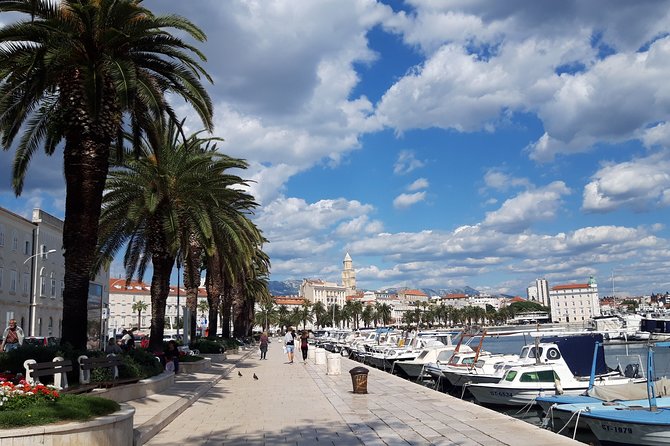
The tour begins at Obala Hrvatskog narodnog preporoda 22, along the Main Riva Promenade. This waterfront meeting point is practical because the walk starts and ends in the same place, and the area is near public transportation.
From the Riva, you move toward the palace and its major public spaces. The guide’s job here is to give you a sense of Split’s layout before the narrow lanes begin. That orientation is useful if you are staying in town for several days, since the palace and Old Town can initially feel like a maze.
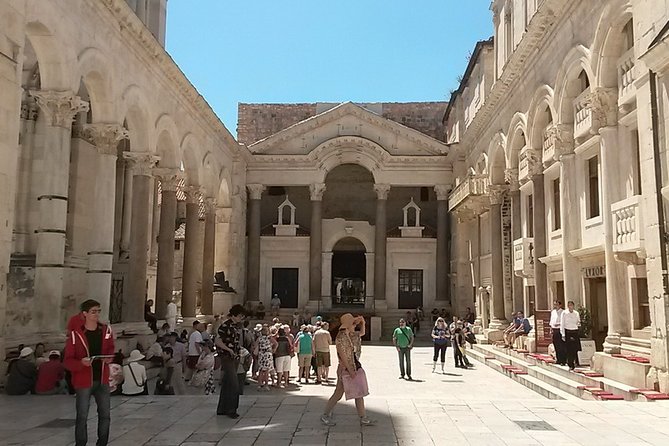
The route includes the Peristyle, the former imperial square and the symbolic center of the palace. This is one of the most important moments of the walk. You can picture it as the ceremonial heart of Diocletian’s residence, where architecture and power worked together.
The planned visit to the palace receives about 25 minutes, while the Peristyle and Vestibulum are listed as shorter stops. In practice, the guide may spend more or less time depending on questions, crowd levels, and your interests.
The Vestibulum and the emperor’s private world
The Vestibulum was the main entrance to Diocletian’s private residence. It helps explain the division between public ceremony and the emperor’s personal quarters.
A short stop here can add useful context to the larger palace plan. Instead of seeing disconnected columns and walls, you begin to understand how the complex was organized. The tour is not just about identifying stones. It explains how a Roman ruler designed a home that also communicated status, authority, and control.
This is where Joško’s style seems particularly effective. Several descriptions praise his ability to set historical events in context, then bring the details back to the physical place around you. That approach is helpful in Split, where every few steps can represent a different period.
The Diocletian Palace Substructures and the extra €10
The cellars are listed as the best-preserved part of the palace. Entry is not included in the tour price and costs €10 per person.
This extra charge is worth considering before you book. If you want the fullest understanding of the palace, the substructures are important because they show the original layout more clearly than many upper sections. They also help you understand how the palace was supported and arranged beneath the emperor’s residence.
There is one practical point to keep in mind: the cellars are a major part of the experience, but the overall tour is still described as a walking tour of the palace and Old Town. One account notes that much of the visit takes place below the palace. If you are expecting a broad sightseeing circuit through every corner of central Split, you may want to ask the guide how much time will be spent underground.
The published schedule gives the substructures 20 minutes. That is enough for an introduction, but not for a slow, detailed museum visit. Add extra time if you want to linger or take in the space at a relaxed pace.
More Walking Tours in Split
- Walking Tour of Split and Diocletian’s Palace
★ 5.0 · 2,588 reviews - Krka Waterfalls tour with Trogir Walking tour and Krka panoramic boat cruise
★ 5.0 · 1,659 reviews - Split & Diocletian’s Palace Walking Tour
★ 5.0 · 1,125 reviews - Walking Tour of Split with a ‘Magister’ of History
★ 5.0 · 1,122 reviews
The Cathedral of Saint Domnius and Temple of Jupiter
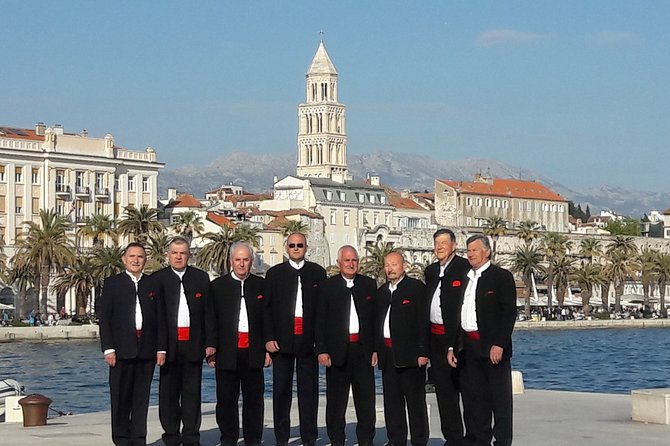
The Cathedral of Saint Domnius is viewed from the outside, with an optional interior visit for €3.50 per person. The cathedral occupies an especially striking position because it developed from Diocletian’s mausoleum.
The tour does not include the admission fee, so bring this small additional amount if you want to enter. The outside explanation may be enough for some people, especially if you are keeping the walk within two hours. Those interested in religious architecture or the way Roman buildings were reused will likely prefer to go inside.
The Temple of Jupiter is another optional interior stop. Entry costs €1.50 per person, while the outside visit is included. This was once a temple to the chief Roman god and now forms part of the layered Old Town.
These stops show why Split is so unusual. Roman imperial buildings were not abandoned and left untouched. They were absorbed into later life. The guide can connect the Roman purpose of each structure with its later use, helping you see the city as a place that kept changing rather than a frozen archaeological site.
Medieval Old Split, with squares and markets
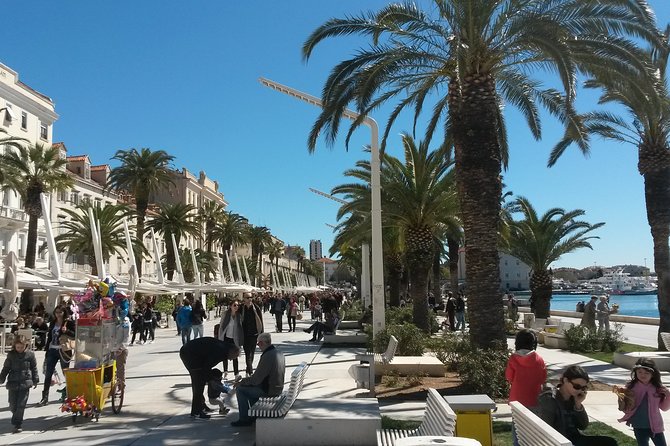
The Old Town portion lasts about 25 minutes in the planned schedule. You visit several small but important public spaces, including Fruit’s Square, Narodni Trg, and the area around the City Clock.
Fruit’s Square, officially Trg Brace Radic, occupies the site of a former green market. It also features a statue of Marko Marulić, known as the father of Croatian literature. This is a good example of how the tour moves beyond emperors and ancient stones to include Croatian cultural identity.
Narodni Trg, or People’s Square, is described as the largest and liveliest piazza in the Old Town. It gives you a useful contrast with the enclosed palace spaces. Here, the focus shifts toward civic life, local meeting places, and the everyday character of central Split.
The 500-year-old 24-hour City Clock adds another memorable detail. It is the kind of small feature you could easily miss without a guide. That is one of the practical benefits of a private walking tour: you are not limited to the most obvious monuments.
One person who took the tour wanted more time walking through the Old Town because the day was pleasant. That is a fair criticism to keep in mind. The schedule includes many stops, so some are brief, often only five minutes. If you prefer to wander slowly, browse shops, or pause for photographs, tell your guide early.
The Golden Gate and Grgur Ninski
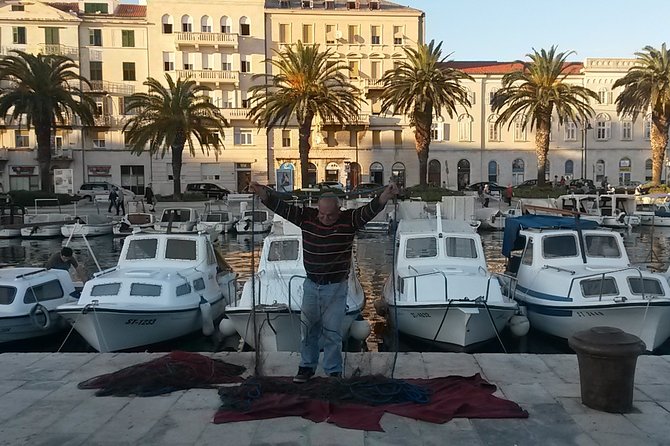
The Golden Gate is the main and most beautiful entrance to Diocletian’s Palace. It offers a chance to understand how people originally approached the imperial complex and how the palace connected with the wider city.
Nearby, you encounter the statue of Grgur Ninski. The guide explains why this historical figure is important in Croatia. The stop is brief, but it adds a national and local layer to a tour that might otherwise remain focused on Rome.
These smaller stops are useful for getting your bearings. The palace can seem like a collection of grand names at first. Connecting the Golden Gate, the statue, the squares, and the clock gives you a mental map you can use later when exploring alone.
Joško’s ability to point out additional sites is another plus. Several accounts describe him as flexible and willing to show things beyond the basic route. That does not mean every booking will receive the same extra time, but a private format gives you a better chance to ask.
How the guide shapes the experience
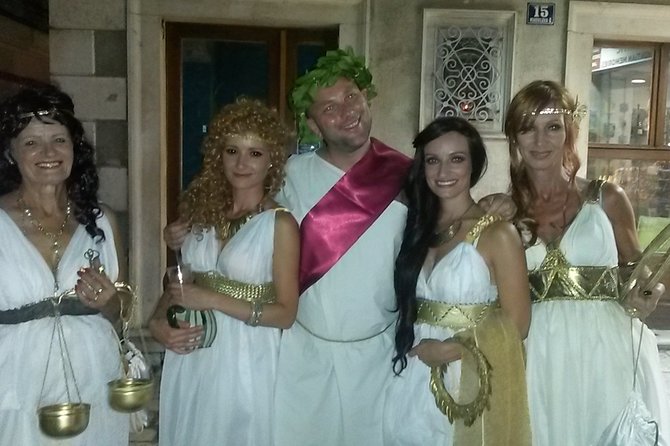
The strongest praise goes to the guides, especially Joško, whose name also appears in forms such as Josko, Josic, Joska, Jocko, and Joseph. Descriptions consistently focus on his humor, clear explanations, pride in Split, and ability to hold the attention of adults, teenagers, and children.
That last point matters. Roman history can become a wall of dates and names. Here, the guide appears to use stories, small facts, and jokes to make the material easier to remember. One family said children aged 12 and 14 stayed interested throughout the walk.
You should also expect a personal conversation rather than a fixed lecture. The private group can ask questions, and the guide can explain subjects at the level you prefer. A history teacher described the pace and organization as particularly strong, while another person appreciated the guide’s advice about other places to visit during the stay.
Communication before the tour has also been praised. One booking included help with arrangements, and another was rescheduled after rain. That is useful in Split, where weather can affect an outdoor walking experience.
If requesting a specific guide is possible when you book, Joško is the name to ask for. Still, do not assume that a named guide is guaranteed unless the provider confirms it.
Price, group size, and overall value
The price is $240 per group of up to 12 people. That means the value changes sharply depending on the size of your party.
For one or two people, it is a substantial price for about two hours, especially once you add the €10 cellar ticket and any optional admissions. For a family or group of six to 12, the per-person cost becomes much more reasonable. You are paying for a private licensed resident guide and a custom-designed itinerary, not just admission to a monument.
The private format is the main reason to consider the price. You do not share the guide with a large public group, and you can ask questions without worrying about slowing everyone else down. Families, friends, cruise passengers, and people who want a focused introduction to Split may find this worthwhile.
The tour has a five-star rating from 467 reviews and is recommended by 100 percent of participants. Those figures suggest very strong satisfaction, especially with the guide’s delivery and historical explanations. They do not remove the need to match the tour with your own interests.
If you want a quiet, slow photo walk, this may feel too information-heavy. If you want to understand why Split looks the way it does, the price is easier to justify.
Timing, walking comfort, and what to bring
The advertised duration is approximately two hours. The itinerary covers many locations, and at least one account refers to a longer three-hour experience. Plan some flexibility rather than scheduling a tight connection immediately afterward.
The route is on foot through the palace and Old Town. Most participants can take part, but the experience is still a city walk with frequent stops and some time in the palace cellars. Comfortable shoes are sensible, and a water bottle is useful in warm weather.
Admission fees are separate:
- Diocletian’s Palace Substructures: €10 per person
- Cathedral of Saint Domnius interior: €3.50 per person
- Temple of Jupiter interior: €1.50 per person
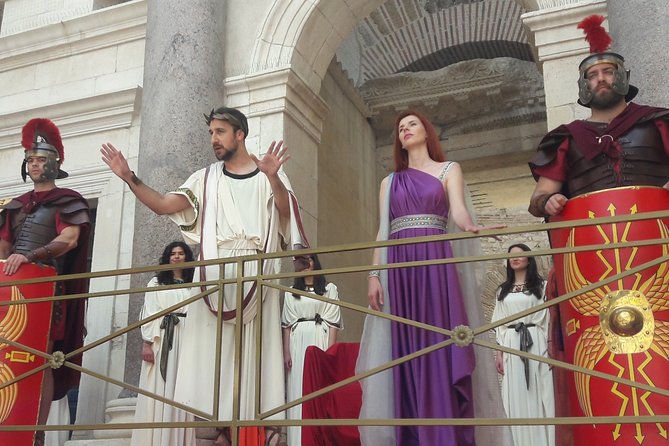
Gratuities for the guide are not included. The tour does not include a costumed theatre show or a similar performance, so book it for live explanation and local perspective rather than staged entertainment.
Who should book this Split walking tour?
I would choose this tour for a first visit to Split, especially if you want the city explained before exploring independently. It suits history fans, families, and small groups who prefer asking questions over listening silently in a large crowd.
It also works well for people who want a local guide’s perspective. The most memorable descriptions focus not only on Diocletian, but also on what the palace has meant to residents of Split across many centuries.
You may want a different experience if your priority is extensive Old Town wandering, shopping time, or a long visit inside each paid attraction. The route includes many stops, but several are brief. You can improve the fit by telling the guide what matters most before the walk begins.
Should you book the private palace and Old Town walk?
Book it if you want a clear, entertaining introduction to Split’s layered past and value a private guide who can answer questions. The palace, Peristyle, Golden Gate, cellars, cathedral, squares, and markets give you a useful framework for the rest of your stay.
Skip it if you mainly want unstructured wandering or a low-cost group tour. For a larger family or group, the $240 price is easier to defend. For two people, compare the cost with your interest in personal attention and historical detail.
For the best experience, ask about the guide, confirm how much time will be spent in the cellars, and decide in advance which optional entrances you want. With those expectations clear, this is a strong way to get your first feel for Split.
FAQ
Where does the tour start?
The tour starts at Obala Hrvatskog narodnog preporoda 22, 21000 Split, Croatia, on the Main Riva Promenade.
Where does the tour finish?
The activity ends back at the meeting point on the Riva.
How long is the tour?
The advertised duration is approximately two hours. One description of the experience refers to three hours, so you should allow some flexibility.
Is this a private tour?
Yes. Only your group participates, with up to 12 people per group.
What language is offered?
The tour is offered in English.
Is admission to the palace cellars included?
No. Entry to the Museum of Diocletian’s Cellars costs €10 per person and is paid separately.
Can I enter the Cathedral of Saint Domnius?
The cathedral is seen from outside. Interior entry is optional and costs €3.50 per person.
Can I enter the Temple of Jupiter?
The temple is visited from outside as part of the walk. Interior entry is optional and costs €1.50 per person.
Are gratuities included?
No. Gratuities for the guide are not included.
What happens if bad weather cancels the tour?
If poor weather causes cancellation, you will be offered another date or a full refund. You can also cancel for a full refund up to 24 hours before the experience begins.
Just added around Split
- Slatine – Island Hopping Excursion (Trogir/Blue Lagoon/Shipwreck)★ 4.0 · 24 reviews
- Krka Waterfalls & Primošten from Trogir, Seget, Čiovo & Kaštela★ 5.0 · 18 reviews
- Island Hopping Boat Excursion with Lunch (Trogir,Blue Lagoon, Šolta)★ 3.5 · 6 reviews
- From Trogir, Seget, Okrug: Krka Waterfalls & Šibenik Culture Tour★ 5.0 · 10 reviews
- From Split & Trogir: ATV Quad Tour on Island Čiovo★ 5.0 · 21 reviews
- Split: Blue Lagoon Boat Trip with Lunch, Wine and Snorkeling★ 5.0 · 3 reviews
- Split Sunset Stand Up Paddle Tour★ 5.0 · 16 reviews
- Split: Sunset Guided Kayaking Tour★ 4.8 · 71 reviews
Old Town Tours, compared.
Plitvice Lakes with Boat Ride and Zadar Old Town Tour
Read our review →
Plitvice Lakes with Boat Ride & Zadar Old town tour
Read our review →
Dubrovnik Combo: Old Town & Ancient City Walls
Read our review →
Browse the lists this tour appears in