
Reviewed · WALKING TOURS
Split: Private Walking Tour in the Historical Town Center
Split’s old town is a Roman palace turned neighborhood. This private walk makes Diocletian’s Palace the starting point for understanding Split, then follows the city through medieval, Venetian, French, Austro-Hungarian, and Yugoslav periods. I like the private format, which keeps the pace flexible and makes it easy to ask questions. I also like that the route covers both the palace core and the later town outside its walls.
The main consideration is price. At $153 per group of up to 15, it can be good value for a family or small group, but expensive for one or two people. The entrance fee for the Palace Substructures is extra, and the route is not suitable for wheelchair users.
Guide Sanja, also spelled Sanya in some booking information, receives especially strong praise for her clear French and excellent English. I would take this tour early in a Split stay, since it gives you a useful map of the old town and helps you choose what deserves a second look.
In This Review
- Key points to know before booking
- Why this private walk is a smart first look at Split
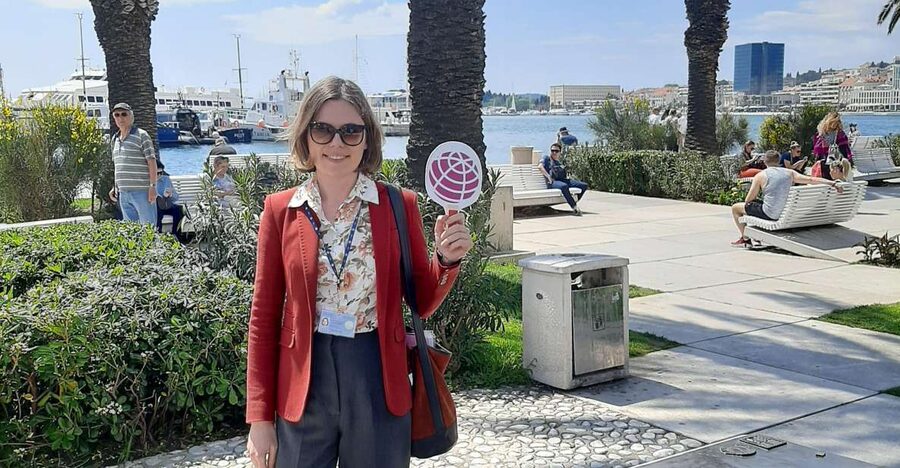
- Meeting the guide on the Riva promenade
- Diocletian’s Palace, a city inside a palace
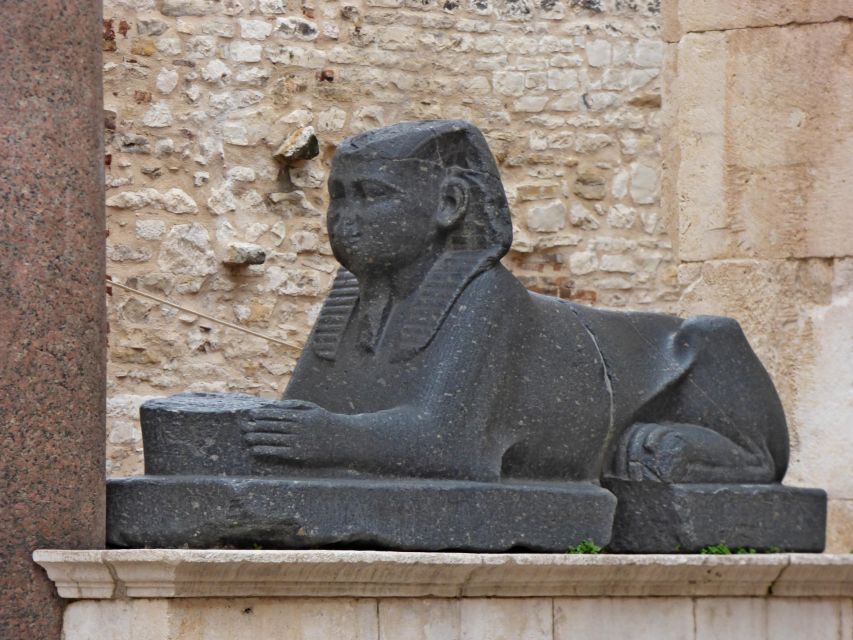
- Peristil and the Cathedral of Saint Domnius
- Jupiter’s Temple and the Palace gates
- The Substructures, the tour’s optional-cost highlight
- Pjaca, Fruit Square, and the town beyond the walls
- Ending on the Riva by the sea
- How the $153 group price works
- Who should book this Split walking tour?
- Practical details before you go
- Should you book it?
- FAQ
- Where does the Split walking tour begin?
- Where does the tour end?
- How long does the tour last?
- Is the tour private?
- Which languages are available?
- Is the entrance fee to the Palace Substructures included?
- Is the tour suitable for wheelchair users?
- Can I cancel and receive a full refund?
Key points to know before booking
- The tour begins at Split’s bronze city model: Meet on the Riva promenade, directly by the south entrance to Diocletian’s Palace.
- You see both sides of old Split: The route covers the Roman palace and the medieval town that grew beyond it.
- The Substructures cost extra: The basement level is part of the visit, but its entrance fee is not included.
- Sanja is praised for languages and clear explanations: Tours are offered in English, Italian, French, and Spanish.
- The private group format matters: Your group can ask questions without competing with a large crowd.
- The full walk lasts 105 minutes: It is long enough for orientation, but short enough to fit into a busy day.
Why this private walk is a smart first look at Split
Split can be confusing at first. Roman walls form the skeleton of the old town, but medieval homes, church buildings, Venetian squares, and later public spaces fill the gaps. You may walk through a narrow stone passage and suddenly find yourself in a grand Roman courtyard, then turn another corner into a square shaped by a completely different period.
That mix is the reason I find a guided introduction useful here. A standard sightseeing walk might show you the major sights, but this tour connects them. You learn why people still live inside the palace, how the town grew beyond its original walls, and how different rulers left their mark.
The private format is the biggest practical advantage. With up to 15 people in your own group, you can ask about architecture, local customs, food, or places to return to later. A smaller group also makes it easier to hear the guide in narrow lanes and busy squares.
The 105-minute length is well judged for an opening tour. You will not cover every museum or side street, but you will get the basic structure of the historic center. I would not choose it as your only cultural activity in Split. I would choose it as the framework for exploring the city on your own afterward.
More Walking Tours in Split
- Split: Old Town and Diocletian Palace Walking Tour
★ 4.9 · 4,727 reviews - Walking Tour of Split and Diocletian’s Palace
★ 5.0 · 2,588 reviews - Krka Waterfalls tour with Trogir Walking tour and Krka panoramic boat cruise
★ 5.0 · 1,659 reviews
Meeting the guide on the Riva promenade
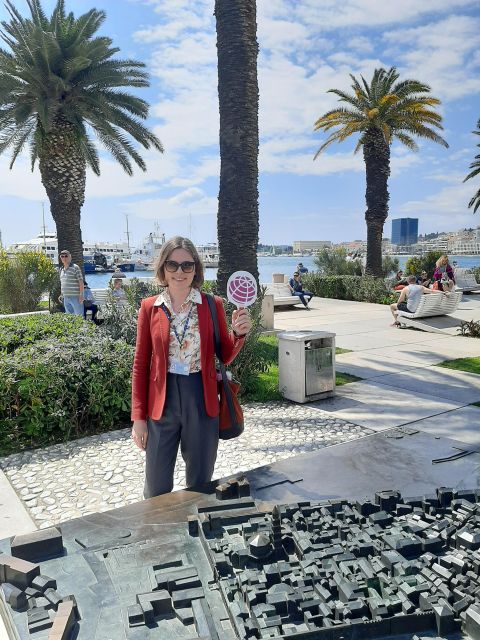
The tour starts beside the bronze model of Split’s historic core on the Riva promenade. The model is in front of the south entrance to Diocletian’s Palace, by the sea, so it should be a practical meeting point if you know to look for it.
This location is useful because the Riva gives you an immediate sense of Split’s setting. The waterfront is open and easy to identify, while the palace entrance leads straight into the compact old town. Arrive with comfortable walking shoes and a little time to find the model, especially if you are coming from a ferry, bus, or hotel in an unfamiliar part of town.
The guide is a licensed local professional with a master’s degree. Sanja is repeatedly praised for her command of French and English, her friendly manner, and her ability to explain Split’s past in a way that makes sense. If language is important to your group, confirm your preferred language when booking. Available languages are English, Italian, French, and Spanish.
Diocletian’s Palace, a city inside a palace
The first major section focuses on Diocletian’s Palace, built in the fourth century for the Roman emperor Diocletian. Calling it a palace can give the wrong impression. This is not simply an isolated imperial residence with empty courtyards. The old town developed inside and around the palace walls, and daily life still takes place among its ancient foundations.
You walk through a remarkable mixture of Roman remains and later homes. Medieval buildings were fitted into the old structure, noble families shaped parts of the town, and narrow lanes formed where the original Roman plan met later needs. The appeal is not only the age of the stone. It is the way the old and ordinary occupy the same space.
A guide helps you read details that are easy to miss. A wall may be Roman in origin but altered over many centuries. A doorway may belong to a later home built into an imperial setting. Sanja’s explanations are especially useful here because she connects architecture with the changing political life of Split.
The Palace section lasts about 30 minutes, giving you a strong introduction before the route moves through the most important spaces.
Peristil and the Cathedral of Saint Domnius
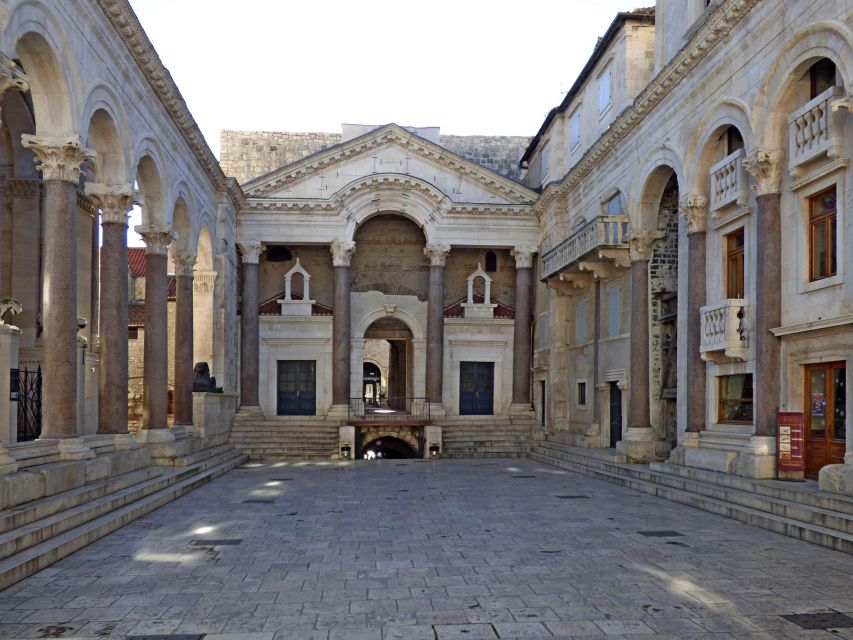
Peristil is the central ceremonial square of the palace. It is one of the places where the Roman purpose of the complex becomes easiest to understand. Your guide explains the square and its role while you walk and look around for about 10 minutes.
Peristil is also a good place to notice how Split works as a living town. Roman columns and stone paving share space with later religious buildings and everyday movement. The square can feel like a stage, but it is also a passageway used to reach other parts of the old center.
The next stop is the Cathedral of Saint Domnius, originally connected with Diocletian’s mausoleum. The tour includes a guided sightseeing visit and a pass by, rather than a detailed interior visit. That distinction matters if you want to explore the cathedral inside. The route gives you the historical and architectural setting, but you should not expect a full cathedral tour.
The juxtaposition is one of the most striking parts of Split. An imperial mausoleum later became a Christian cathedral, showing how the city reused older structures instead of clearing them away. You get a direct lesson in how political and religious change can alter a building without erasing its earlier form.
Still Split, at a slower pace:
- Split: Krka Waterfalls Trip with Boat Cruise and Swimming
★ 4.8 · 10,519 reviews - From Split: Krka Waterfalls, Food & Wine Tasting Tour
★ 5.0 · 9,326 reviews - Blue cave, Mamma Mia and Hvar, 5 islands speedboat tour
★ 5.0 · 7,150 reviews - From Split: Krka Waterfalls, Food & Wine Tasting Tour
★ 4.9 · 6,598 reviews
Jupiter’s Temple and the Palace gates
The walk continues to Jupiter’s Temple, now associated with the Baptistery. This is an external visit, with no entrance fee included or required for the tour stop. Your guide explains the site from outside, so this portion works best for understanding the Roman religious layout and the later Christian use of the building.
The tour also introduces the Palace walls and four gates, including the Golden Gate. These entrances were not just practical openings. They helped organize access to the imperial complex and connected it with the wider area around the palace.
The Golden Gate stop lasts about 10 minutes. It is a good point to consider scale. Once you see the gates as part of a complete fortified complex, the old town feels less like a random cluster of ruins and more like a planned Roman center that later generations adapted.
The route also touches on medieval noble houses and the former Jewish quarter. Split’s old town is not only a collection of famous monuments. Its smaller corners reveal how different communities lived within the restricted space of the palace. The former Jewish ghetto and its still-active synagogue add an important social layer to the walk, though the supplied schedule does not promise an interior synagogue visit.
The Substructures, the tour’s optional-cost highlight
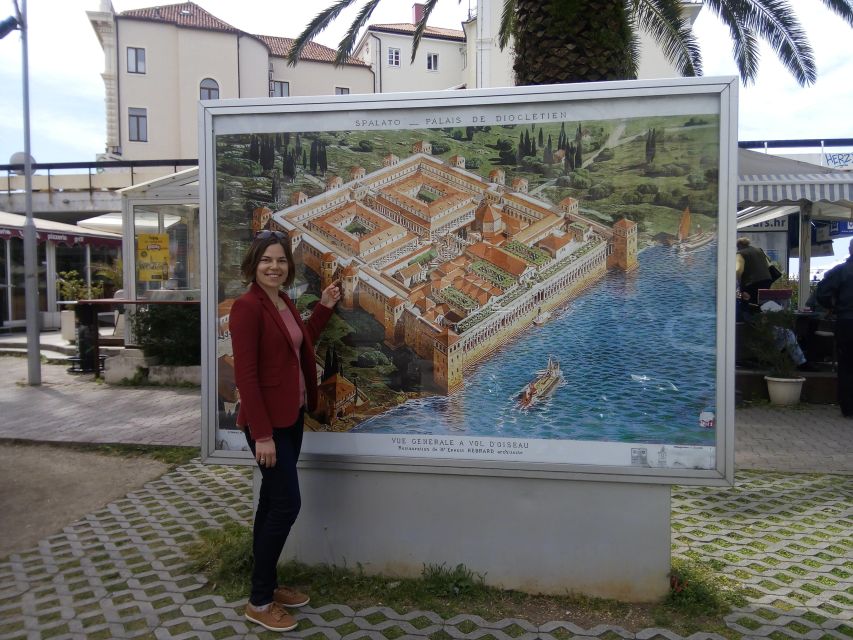
The Palace Substructures, also called the Basements, are the only listed stop with an additional entrance fee. That cost is not included in the $153 group price, so check the current fee when planning your budget.
The Substructures matter because they show how the upper palace was supported and organized. They also help you picture the original Roman layout from below. The guide takes you into this basement level as part of the palace visit, making it the clearest opportunity to see a substantial Roman interior rather than only streets and exterior walls.
I would consider paying the extra fee, especially if this is your first visit to Split or if Roman architecture interests you. If you are watching every kuna, euro, or dollar, the outdoor route still covers many major sights, but skipping the Substructures removes one of the most distinctive parts of the palace experience.
The entrance fee is the clearest extra expense on the tour. Ask about it before starting so you are not surprised when the group reaches the entrance.
Pjaca, Fruit Square, and the town beyond the walls
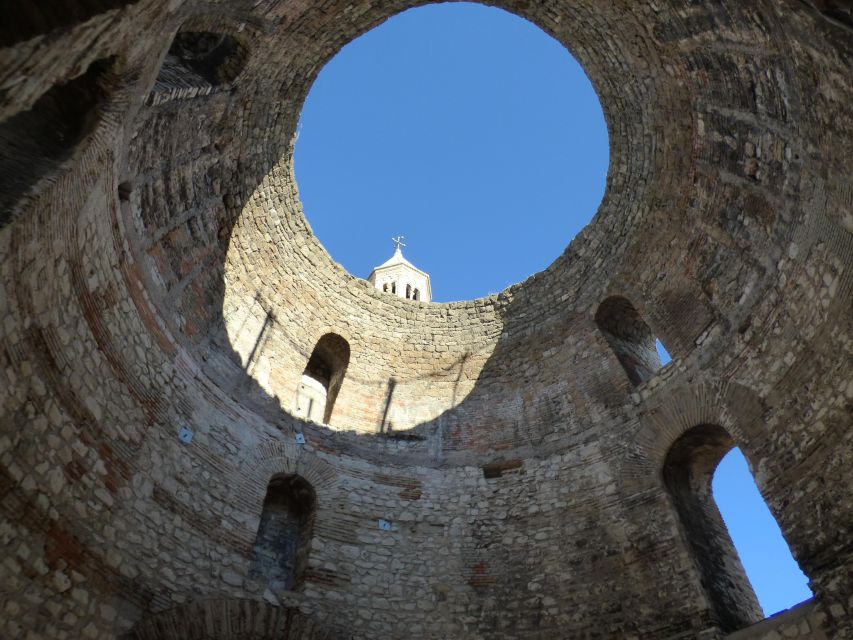
After the palace, the tour moves into the medieval neighborhood outside its original walls. This change is important. You see how Split expanded from an imperial compound into a town with its own public squares, commercial spaces, and political life.
People’s Square, often called Pjaca, is the first major square in this part of the route. The stop lasts around 15 minutes. It offers a useful contrast with Peristil. Peristil reflects Roman imperial planning, while Pjaca belongs more to the public and civic life of the later town.
Fruit Square follows for about 10 minutes. Its name comes from the former market held there, and the square is one of the places where the later town feels more open than the narrow palace lanes. The route uses these squares to explain how Split changed under Venetian, French, Austro-Hungarian, and Yugoslav rule.
This historical sequence is one of the tour’s strongest features. You do not get a single, simplified story about Split. You learn how different governments shaped public spaces, buildings, and local life. The guide’s explanations can help you notice why one square feels different from another, even though both are only a short walk apart.
The former Jewish neighborhood and active synagogue also fit into this broader story. They remind you that the old center was home to communities with different backgrounds, not just a backdrop for Roman remains.
Ending on the Riva by the sea
The tour finishes back on the Riva promenade, close to where you started. The final 10 minutes provide a chance to connect the old town with the waterfront and to ask for suggestions for the rest of your stay.
This ending is practical. You are not left in an obscure lane, and you can continue along the promenade, return into the palace, or use the guide’s advice to plan your next stop. Since the tour is designed to give you tips for your own exploration, I would save a few questions for the final part.
Ask which areas deserve more time, which buildings require separate admission, and what parts of the old town are easiest to explore without a guide. The information is most useful when you turn it into a plan for the next day.
How the $153 group price works
The listed price is $153 for a private group of up to 15 people. For a full group, that works out to about $10.20 per person before the Substructures entrance fee. For a small group of four, the cost is about $38.25 per person, and for two people it is $76.50 each.
That makes the tour best suited to families, friends, cruise companions, or any group that values a private guide. If you are traveling alone or as a couple, you need to decide how much personal attention and flexibility are worth to you.
A large shared tour may cost less per person, but it can be harder to hear explanations and ask questions. Here, the money pays for a private group, a licensed local guide, a focused route, and a useful orientation to the old center. It does not cover the Substructures, and it does not provide a full interior tour of every religious or historic building.
I see the price as fair for a medium or large group. For one or two people, I would book it only if you strongly prefer private guiding or have limited time in Split.
Who should book this Split walking tour?
I would recommend it to you if:
- You have only a short time in Split and want the main sights explained in order.
- You are staying inside or near Diocletian’s Palace and want to understand your surroundings.
- You prefer asking questions rather than following a fixed large-group commentary.
- You care about the changes brought by Roman, Venetian, French, Austro-Hungarian, and Yugoslav rule.
- You want a local guide to suggest how to continue exploring afterward.
- Your group needs a French, Italian, Spanish, or English tour.
It is less suitable if you use a wheelchair, since the activity is specifically not suitable for wheelchair users. It may also disappoint you if you want long interior visits, museum time, or a slow photography walk. The route is active and focused on seeing many key places in 105 minutes.
The tour works particularly well on your first full day. Stephen from Canada found that Sanja’s explanations helped his group appreciate the rest of its stay, while Robert from Australia used the walk early in his visit to decide which parts of Split deserved more time. That is exactly how I would use it: as a clear first chapter, not the entire book.
Practical details before you go
You should plan for continuous walking through historic streets, squares, and palace passages. Wear shoes with good support, since old-town paving can be uneven, though the supplied details do not specify the exact walking surface throughout the route.
The meeting point is the bronze model of the historic core on the Riva, in front of the Palace’s south entrance. The tour returns to that same general location, which makes it easy to continue sightseeing afterward.
Free cancellation is available up to 24 hours before the tour for a full refund, and you can reserve now and pay later. Starting times vary, so check availability for your date.
Should you book it?
Book this tour if you want Split explained by a local guide rather than reduced to a list of Roman ruins. Sanja’s strong language skills, clear delivery, and friendly answers are major reasons to choose it, especially for French-speaking groups.
The best value comes with three or more people, since the $153 fee covers the group rather than each person. Add the Substructures fee to your budget, and remember that the walk is not wheelchair accessible.
For a first visit, I think this is a smart, efficient introduction to Split. You see the Palace, Peristil, Saint Domnius, Jupiter’s Temple, the Golden Gate, Pjaca, Fruit Square, and the Riva, while also learning how the town changed under several rulers. If that sounds like the kind of orientation you need, book it early in your stay.
FAQ
Where does the Split walking tour begin?
It begins beside the bronze model of Split’s historic core on the Riva promenade by the sea, in front of the south entrance to Diocletian’s Palace.
Where does the tour end?
The tour ends on the Riva promenade, by the sea, at the same general area as the starting point.
How long does the tour last?
The walking tour lasts 105 minutes, or about 1 hour and 45 minutes.
Is the tour private?
Yes. It is a private group tour for up to 15 people.
Which languages are available?
The tour is available in English, Italian, French, and Spanish.
Is the entrance fee to the Palace Substructures included?
No. The entrance fee for Diocletian’s Palace Substructures, also called the Basements, is not included.
Is the tour suitable for wheelchair users?
No. The activity is listed as not suitable for wheelchair users.
Can I cancel and receive a full refund?
Yes. You can cancel up to 24 hours in advance for a full refund. You can also reserve now and pay later.
More History Tours in Split
- Walking Tour of Split with a ‘Magister’ of History
★ 5.0 · 1,122 reviews - Split Walking Tour with Professor of History
★ 5.0 · 926 reviews - Split: History and Heritage Walking Tour
★ 4.9 · 650 reviews - Split History and Gastro Small-Group Tour with Food and Drinks
★ 5.0 · 375 reviews
Just added around Split
- Slatine – Island Hopping Excursion (Trogir/Blue Lagoon/Shipwreck)★ 4.0 · 24 reviews
- Krka Waterfalls & Primošten from Trogir, Seget, Čiovo & Kaštela★ 5.0 · 18 reviews
- Island Hopping Boat Excursion with Lunch (Trogir,Blue Lagoon, Šolta)★ 3.5 · 6 reviews
- From Trogir, Seget, Okrug: Krka Waterfalls & Šibenik Culture Tour★ 5.0 · 10 reviews
- From Split & Trogir: ATV Quad Tour on Island Čiovo★ 5.0 · 21 reviews
- Split: Blue Lagoon Boat Trip with Lunch, Wine and Snorkeling★ 5.0 · 3 reviews
- Split Sunset Stand Up Paddle Tour★ 5.0 · 16 reviews
- Split: Sunset Guided Kayaking Tour★ 4.8 · 71 reviews
Walking Tours, compared.
Walking Tour of Split and Diocletian’s Palace
Read our review →

Krka Waterfalls tour with Trogir Walking tour and Krka panoramic boat cruise
Read our review →
City Walls Early Morning or Sunset Walking Tour
Read our review →Browse the lists this tour appears in