

Reviewed · OLD TOWN TOURS
Split Palace & Old Town -Private walking tour- Entrance included
Split rewards slow walking and sharp eyes. This private tour links the Riva, Diocletian’s Palace, and Split’s medieval streets in one well-paced route, with three key entrance fees included. I like the private format, which lets your group ask questions and adjust the pace, and I like the way the tour moves beyond the palace into working parts of town, including the fish market and Marmontova Street. The main drawback is the price: at $203.95 per person, it is a serious spend for a two-and-a-half-hour walk.
The guide can be Dana or Jana, both praised for making the past easy to follow and for offering useful ideas after the tour. Jana is also noted for helping with directions. You should book early, since this experience is often reserved about 73 days ahead, and keep in mind that church services, special events, or poor weather can change the route.
In This Review
- Key points at a glance
- Why Split’s old center works so well on foot
- Starting on the Riva and entering the palace
- Diocletian’s Cellars and the palace below ground
- The Peristyle, Temple of Jupiter, and Vestibule
- Cathedral of Saint Domnius and the story of a changed monument
- The Golden Gate and the road toward Salona
- Old Split, People’s Square, and Fruit’s Square
- The fish market and Marmontova Street
- Ending at Prokurative beside the cafés
- Is $203.95 per person good value?
- Timing, access, and small practical details
- Who should book this private Split walk?
- Should you book Split Palace and Old Town?
- FAQ
- How long does the Split Palace and Old Town tour last?
- What is the price of the tour?
- Is this a private tour?
- Which entrance fees are included?
- Where does the tour start and end?
- Can the tour change because of weather or events?
Key points at a glance
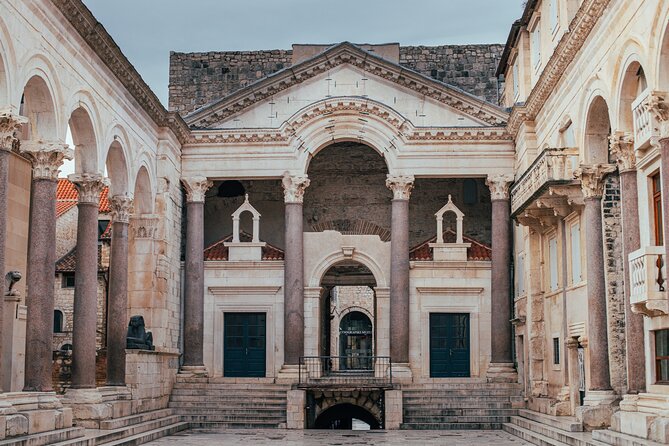
- Roman ruins still form the city center: Diocletian’s Palace is not an isolated monument. Modern Split grew through and around its ancient walls.
- Three paid sights are included: The palace cellars, Cathedral of Saint Domnius, and Temple of Jupiter are covered when open.
- A genuinely private walk: Only your group takes part, which gives you room for questions and possible adjustments.
- The route covers more than imperial Rome: You continue to People’s Square, Fruit’s Square, the fish market, Marmontova Street, and Prokurative.
- The tour ends in a useful spot: Republic Square has cafés and restaurants, making it easy to continue your afternoon.
- Expect city walking, not a bus tour: The route lasts about 2 hours 30 minutes and uses the old town’s streets, gates, squares, and palace passages.
Why Split’s old center works so well on foot
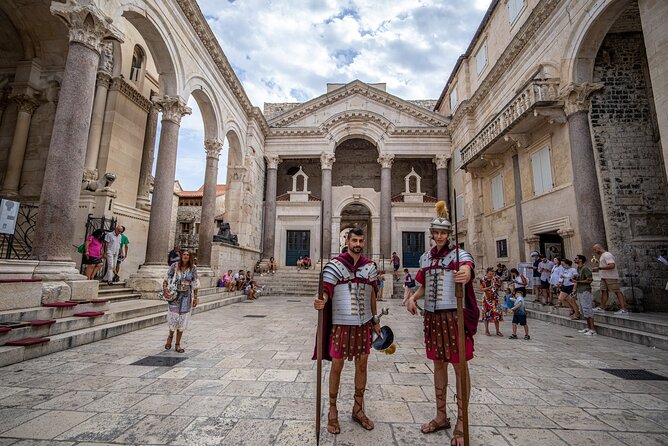
Split’s great advantage is its compact center. The Roman palace is not simply a ruin waiting behind a fence. Its stone walls, gates, courtyards, and passageways are part of the living city.
That makes a guided walk useful. Without context, you can see a column, a narrow lane, or a medieval house and move on. With a guide, those pieces begin to show how an emperor’s retirement palace became the core of a later town.
This route starts on the Riva, Split’s waterfront promenade, then heads into the palace before continuing through the medieval and Venetian parts of the old town. I like that order. You first get a broad sense of the city, then see the Roman structure, and finally watch Split change as you walk west.
The duration is long enough for real explanation but short enough to fit around a cruise stop or a day of independent sightseeing. You should still wear comfortable shoes. The route includes old streets, palace interiors, and cellar passages, and the tour is built around walking rather than sitting.
More Old Town Tours in Split
- Split: Old Town and Diocletian Palace Walking Tour
★ 4.9 · 4,727 reviews - Split: Diocletian Palace & Old Town Guided Walking Tour
★ 4.7 · 882 reviews - Diocletian’s Palace and Old Town SMALL GROUP Walking Tour
★ 5.0 · 502 reviews
Starting on the Riva and entering the palace
The meeting point is beside the model of Split’s historical core at Obala Hrvatskog narodnog preporoda 23. That is a sensible place to begin because the model gives you a quick visual frame for the city before you enter it.
The first ten minutes on the Riva are used for general information about Split and an outline of the walk. This short introduction matters. You can look across the waterfront and understand that the palace sits at the heart of the city rather than somewhere removed from daily life.
From there, you move toward Diocletian’s Palace. The palace complex was built more than 1,700 years ago, and its scale is easier to understand once you see how much of the present old town occupies the site.
The tour description allows for a visit to the palace basement, the cathedral interior, and the Temple of Jupiter if the spaces are open and no service or event is taking place. Those admissions are included. That is a useful saving, but access is not guaranteed at every departure, so you should treat the interior visits as conditional rather than promised in every circumstance.
Diocletian’s Cellars and the palace below ground
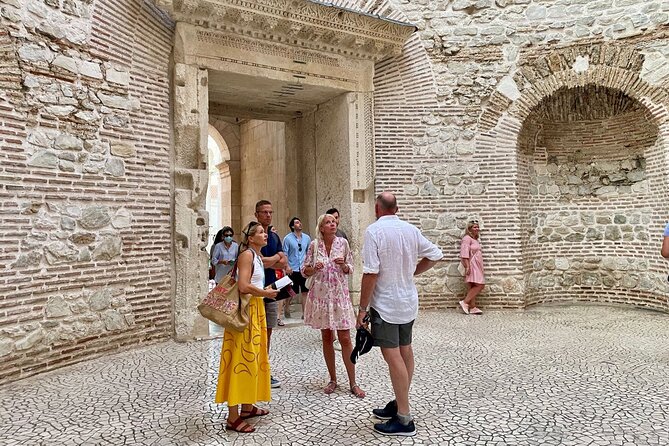
The cellars are entered through the South Gate. They are among the clearest places to grasp the palace’s size and layout because the underground structure is particularly well preserved.
You spend about 15 minutes here, with the entrance included. The cellars give the palace a solid physical scale. Above ground, later buildings can make the Roman plan hard to read. Below ground, the preserved spaces help you picture the foundation and the original reach of the complex.
This is also one of the best points for questions. A private guide can explain what you are seeing at a pace that suits your group, rather than moving with a large crowd.
The cellar visit appears in the route both as part of the initial palace visit and as its own dedicated stop. In practical terms, you should expect the basement to receive focused attention, not just a quick look while passing through.
The Peristyle, Temple of Jupiter, and Vestibule
The Peristyle is the palace’s central ceremonial area. In Diocletian’s day, it served as a sacred meeting place where the emperor presented himself to his subjects and accepted worship as the son of Jupiter.
The scheduled stop is about ten minutes and has no separate admission charge. This is a place where the guide’s explanation adds real value, since the stones alone do not tell you how the space worked as imperial theater.
Next comes the Temple of Jupiter, now used as a baptistery. Its carved ceiling is especially notable because its design influenced Renaissance architects in Dalmatia. You spend about ten minutes here, and admission is included when the site is open.
The building’s change from pagan temple to Christian baptistery is one of the clearest examples of Split’s layered past. The structure did not vanish when religious practice changed. It was given a new role.
The Vestibule was the entrance area to Diocletian’s private chambers. It is another short stop, around ten minutes, but it helps separate the emperor’s public world from his private quarters. I appreciate that the route includes this transition rather than focusing only on the grand ceremonial spaces.
More Walking Tours in Split
- Walking Tour of Split and Diocletian’s Palace
★ 5.0 · 2,588 reviews - Krka Waterfalls tour with Trogir Walking tour and Krka panoramic boat cruise
★ 5.0 · 1,659 reviews - Split & Diocletian’s Palace Walking Tour
★ 5.0 · 1,125 reviews - Walking Tour of Split with a ‘Magister’ of History
★ 5.0 · 1,122 reviews
Cathedral of Saint Domnius and the story of a changed monument
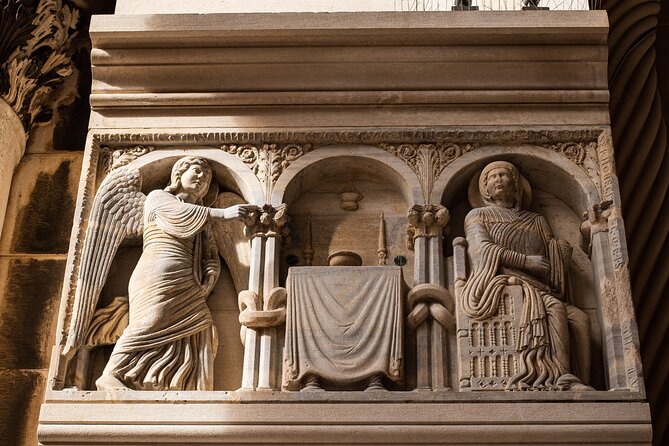
Split Cathedral occupies what was once Diocletian’s mausoleum. During the Christianization of the city, the pagan mausoleum became a Christian cathedral, while the emperor’s coffin and remains disappeared.
You spend about 15 minutes inside when services and other events permit, and the entrance fee is included. This is not just a church stop added to fill time. It is a direct example of how Split reused the palace instead of leaving it as a dead Roman monument.
The change in purpose is worth keeping in mind as you look at the cathedral. The site began as a monument to an emperor who had himself worshipped, then became a Christian place of worship. That shift gives the building a story that reaches across several eras in a very small space.
A church service may prevent entry or require a change to the program. You should dress and behave appropriately for a working religious site, even though the building is also a major historic attraction.
The Golden Gate and the road toward Salona
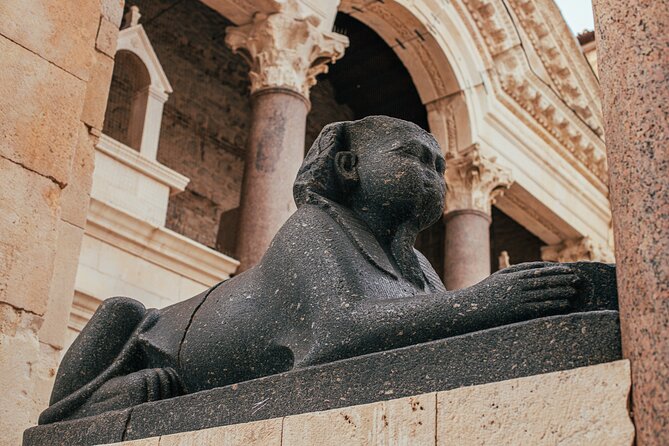
The Golden Gate, or North Gate, was the most important entrance in Roman times. From here, the road led toward Salona, the capital of the Roman province.
The stop lasts about ten minutes and is free to enter. It gives you a chance to think about the palace as a planned imperial residence with roads, gates, and connections to the wider Roman world.
The gate also marks a shift in the walk. After the Roman core, you continue along the palace walls toward the medieval center. This change is one of the tour’s strongest features because you do not need to imagine separate historical zones. You walk from one into the next.
The route is not a collection of disconnected attractions. The streets between the stops show how the city developed outward from the palace.
Old Split, People’s Square, and Fruit’s Square
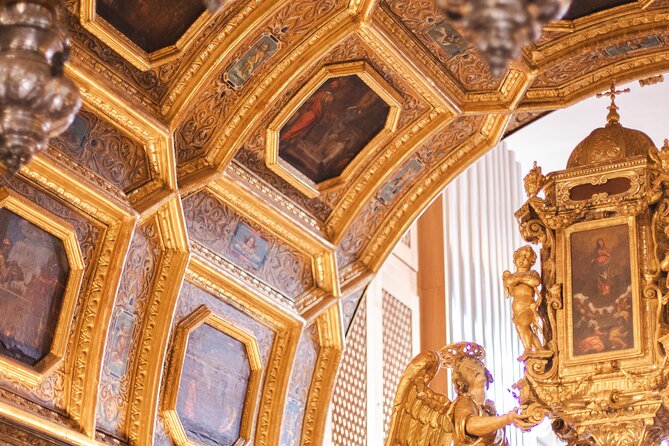
From the Golden Gate, the walk continues along the palace walls and into the actual center of Old Split. The medieval town developed west of the palace, and the route follows that growth toward Narodni Trg, also called People’s Square.
People’s Square has served as the city’s center since the Middle Ages. You see old Venetian palaces and the former city hall, built in a neo-Gothic style. The scheduled stop is brief, about five minutes, but the square is an important part of understanding Split after the Roman period.
You then continue to Fruit’s Square, or Trg Braće Radić. It was once a fruit market and now includes a monument to Marko Marulić, one of Split’s important Renaissance writers.
These stops add balance. If you only see the palace, you can leave with the impression that Split is mainly Roman. The medieval square and Venetian buildings show a city that continued to change long after Diocletian’s time.
The free public squares are also where you get a sense of present-day Split. Cafés, shops, and local movement occupy spaces that once served very different civic purposes.
The fish market and Marmontova Street
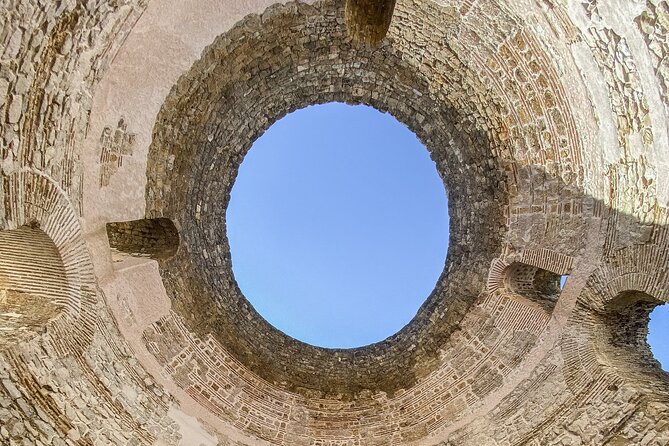
The fish market is one of the more unusual stops. It is presented as an attraction in its own right, with sulfur baths next door.
The sulfur smell is said to keep flies away from the market. Diocletian also understood that sulfur baths could offer relief for rheumatism and other illnesses. This is a small detail, but it brings the palace story into contact with ordinary concerns such as food, bathing, and health.
You spend about ten minutes here without an admission charge. The market gives the route a more everyday feel than the grand palace spaces. It is a useful reminder that the center is not only a display of monuments.
Marmontova Street follows for another ten minutes. It is a pedestrian shopping street built by the French during Napoleon’s rule in the early 19th century. The street adds yet another layer to the walk, connecting Roman, medieval, Venetian, and French periods within a compact area.
I like this part of the route because it keeps the tour from becoming a single-era history lesson. Split’s identity comes from its changes, and Marmontova makes that clear.
Ending at Prokurative beside the cafés
The walk ends at Republic Square, known as Prokurative. Its design recalls St. Mark’s Square in Venice, and cafés and restaurants line the area.
This is a practical end point. You can stop for a drink, find a meal, or continue exploring without having to return to the starting place. The tour does not end back at the Riva, so plan your next activity from Prokurative rather than assuming you will finish at the waterfront.
The final setting also fits the route’s wider theme. You begin with the waterfront and Roman palace, then finish in a later urban square shaped by Venetian influence. The tour gives you a clear east-to-west story through Split’s old center.
Is $203.95 per person good value?
At $203.95 per person, this is not a bargain walk. The price needs to be judged against what you receive: a private guide for your group, about 2 hours 30 minutes of explanation, an English-language tour, and admission to the cellars, Temple of Jupiter, and Cathedral of Saint Domnius when they are open.
The private format is the main value. If you want to ask about Roman architecture, the city’s later development, or practical directions for the rest of your day, you can do that without trying to catch a guide’s attention in a large group.
The price is harder to justify if you only want a quick introduction or prefer to explore at your own pace. Split’s old center is walkable, and many of the outdoor stops are free. You are paying mainly for interpretation, structure, access to included interiors, and the ability to keep the experience focused on your group.
The tour may suit you best if you have limited time, care about historical context, or want an organized first look before exploring alone. It is also a good fit for a group that values personal attention. Dana received praise for making the history memorable, while Jana was praised for her command of the subject, friendly approach, directions, and suggestions for what to see afterward.
Timing, access, and small practical details
The tour is offered in English and uses a mobile ticket. It starts at the historical-core model on the Riva and ends at Prokurative. Public transportation is nearby, and service animals are allowed.
Most people can participate, and the tour can be adapted for special needs if you tell the provider in advance. Since this is an old-town walking route, you should share any needs before booking rather than waiting until the start.
The program can change if a church service or event blocks access to an attraction. Poor weather can also cause cancellation, in which case you are offered another date or a full refund.
Free cancellation is available up to 24 hours before the start time. Inside that window, the payment is not refunded, and changes are not accepted. Since the experience is often booked well ahead, planning early makes sense, but check the local start time when managing the cancellation deadline.
Who should book this private Split walk?
I would choose this tour for a first visit to Split, especially if I wanted the palace explained rather than simply photographed. The route gives you the Roman core, later city squares, a market, a French-era street, and a strong finishing point.
It is also well suited to people who enjoy asking questions. Dana and Jana are both associated with warm, useful guiding, and Jana’s help with directions could be handy if you want to keep sightseeing afterward.
I would think twice if you dislike walking, want a low-cost group tour, or need a guaranteed visit inside every paid attraction. The cathedral, Temple of Jupiter, and cellars depend on opening conditions, services, and events.
Should you book Split Palace and Old Town?
Book it if you want a private, organized introduction to Split that connects the Roman palace with the city that grew around it. The included admissions and personal guide help explain the $203.95 price, particularly for a group that will make good use of the private format.
Skip it if you mainly want free outdoor sights or prefer to set your own pace. For everyone else, the route is strong because it does not stop at Diocletian’s Palace. It carries you through the cellars, cathedral, gates, medieval squares, fish market, Marmontova Street, and Prokurative, giving you a useful picture of Split as a city built one era on top of another.
FAQ
How long does the Split Palace and Old Town tour last?
The tour lasts approximately 2 hours 30 minutes.
What is the price of the tour?
The listed price is $203.95 per person.
Is this a private tour?
Yes. Only your group participates in the activity.
Which entrance fees are included?
Admission to the palace cellars, the Temple of Jupiter, and the interior of the Cathedral of Saint Domnius is included when those attractions are open and available.
Where does the tour start and end?
The tour starts at the model of Split’s historical core, Obala Hrvatskog narodnog preporoda 23, and ends at Republic Square, also called Prokurative.
Can the tour change because of weather or events?
Yes. Church services or events may prevent access to some sights and require a small change to the program. Poor weather can lead to cancellation, with an alternative date or a full refund offered.
Just added around Split
- Walking Tour Split★ 4.7 · 61 reviews
- Unique vintage Tomos moped tour Split – Back to the ’80s★ 4.8 · 17 reviews
- Trogir: White Lagoon, Maslinica & Blue Lagoon Speedboat Tour★ 4.8 · 11 reviews
- Essential Diocletian’s Palace Tour for First-Time Visitors★ 4.8 · 19 reviews
- Split: Trogir Open Top Bus Trip + Free Split Walking Tour★ 4.1 · 17 reviews
- Trogir; Private walking tour of higlights of Trogir★ 4.7 · 3 reviews
- Trogir: Old Town Guided Walking Tour★ 4.6 · 76 reviews
- TROGIR: Blue Lagoon & 3 Islands Half-day Speedboat tour★ 4.6 · 28 reviews
Old Town Tours, compared.


Plitvice Lakes with Boat Ride and Zadar Old Town Tour
Read our review →
Plitvice Lakes with Boat Ride & Zadar Old town tour
Read our review →
Dubrovnik Combo: Old Town & Ancient City Walls
Read our review →
Browse the lists this tour appears in