

Reviewed · OLD TOWN TOURS
Split: Old Town and Diocletian’s Palace Walking Tour
Ancient Rome still shapes daily life here. This one-hour walking tour links Split’s old town with Diocletian’s Palace, a 1,700-year-old Roman complex that is now part of the modern city. You’ll walk through squares, streets, churches, and palace remains while a local English-speaking guide explains how Split grew around this remarkable site.
I like the compact route and the chance to see major sights such as Peristyle Square and the underground cellars without spending half a day on a formal history lesson. At $18 per person, it can be a sensible first look at Split, though the short duration leaves little time for questions or lingering at each stop. One serious concern is reliability: a booking was reported as having no guide appear at the appointed time, with no compensation received.
In This Review
- Key points to know before you book
- Why Diocletian’s Palace makes a good first stop
- Meeting near the red SPLIT sign
- Walking into Peristyle Square
- Below ground in the palace cellars
- St. Jupiter’s Temple and the Roman religious world
- St. Duje Cathedral and Domnius
- St. Francis Church and the old town streets
- What one hour really gives you
- The reliability question you should take seriously
- Who will get the most from this walk
- Practical advice for a smoother visit
- Should you book the Split Palace walk?
- FAQ
- Where does the tour start?
- How do I identify the guide?
- How long does the tour last?
- What language is the tour offered in?
- What sights are included?
- Does the tour include hotel pickup and drop-off?
- Where does the tour finish?
- Can I cancel for a full refund?
Key points to know before you book

- A 1,700-year-old palace still forms the center of Split: This is not a distant ruin. You walk through an ancient complex that has become part of the living city.
- The route covers Peristyle Square, the cellars, St. Jupiter’s Temple, and St. Duje Cathedral: You get a useful overview of the palace’s main landmarks in a short period.
- The tour lasts one hour: That makes it easy to fit around a port call, but you should not expect a slow, detailed archaeological visit.
- The meeting point is easy to identify: Look for the large red SPLIT sign at Trg Braće Radić near the port. The guide should carry a My Special Tour sign.
- The tour is offered in English: No hotel transport is included, and the tour returns to its starting point.
- Booking flexibility is good, but meeting arrangements matter: You can reserve and pay later, and cancel up to 24 hours ahead for a full refund. Still, confirm the meeting details before setting out.
Why Diocletian’s Palace makes a good first stop

Split is unusual because its oldest monument is not tucked behind a fence. Diocletian’s Palace became the framework for the city around it. As you walk, you are not simply moving from one isolated Roman ruin to another. You are passing through streets and squares shaped by an imperial residence that still affects the city’s layout.
The palace dates back roughly 1,700 years, to the period of the Roman Emperor Diocletian. That age gives the tour its main appeal. You can look at a column, a stone arch, or a passageway and then see modern Split carrying on around it.
I find this kind of setting more useful than a stand-alone museum when you have limited time. The guide can connect the stones to the streets you are actually walking through. You get a sense of scale and place, not just a list of dates.
The trade-off is that the palace is large and layered with centuries of changes. A one-hour walk can introduce the main points, but it cannot explain every period in equal detail. If Roman architecture is your main interest, you may want extra time afterward to explore independently.
More Old Town Tours in Split
- Split: Old Town and Diocletian Palace Walking Tour
★ 4.9 · 4,727 reviews - Split: Diocletian Palace & Old Town Guided Walking Tour
★ 4.7 · 882 reviews - Diocletian’s Palace and Old Town SMALL GROUP Walking Tour
★ 5.0 · 502 reviews
Meeting near the red SPLIT sign
The tour begins at Trg Braće Radić, close to Split’s port. The stated meeting marker is a large red SPLIT sign. The guide is expected to hold a sign marked My Special Tour.
That detail matters in a busy port area. Split’s old center has many small lanes and open spaces, so a clear sign can save you from wandering around looking for a guide. Arrive with enough time to locate the sign rather than assuming you can find it at the last second.
The tour ends back at the same meeting point. This is useful if you are visiting Split as part of a port stop, since you finish where you began and can then continue into the old town, return to your ship, or make your own plans.
No hotel pickup or drop-off is included. You are responsible for reaching the meeting point yourself, so check your route before booking. The experience is built as a walking tour, not a door-to-door excursion.
Walking into Peristyle Square
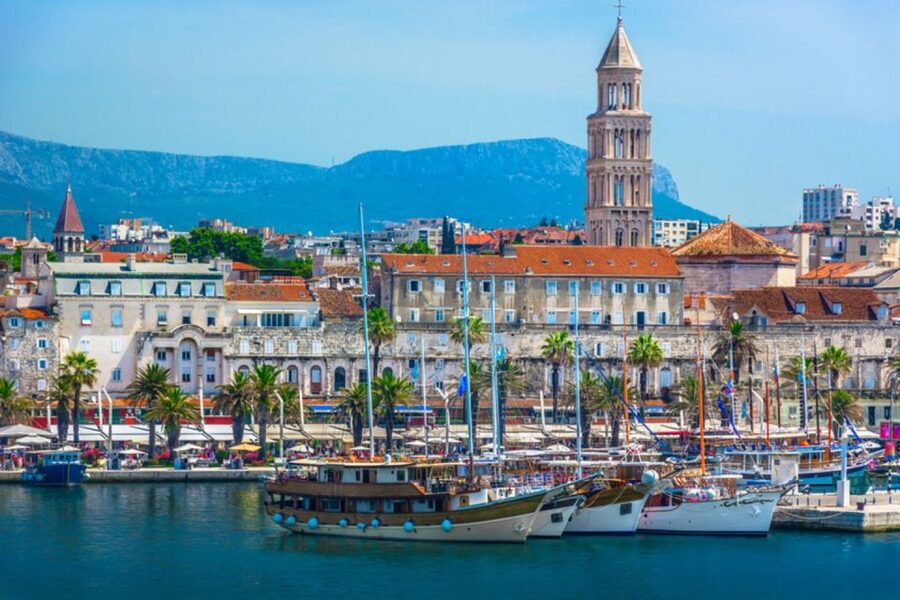
Peristyle Square is one of the route’s key moments. It gives you a broad look at the palace’s formal Roman character, with monumental stonework and a strong sense of ceremony. This is the place where the imperial side of Diocletian’s residence becomes easiest to understand.
A guide adds value here by explaining how the square functioned within the palace. Without context, you might see an attractive stone plaza and move on. With a clear explanation, the space becomes part of a larger plan tied to the emperor, public ritual, and the palace’s original purpose.
The square also helps you understand the contrast that defines Split. Ancient walls and columns meet later buildings and everyday city life. You may hear ordinary street activity while standing in a space designed for Roman power. That mix is one of the most memorable features of the walk.
Because the tour moves on a fixed schedule, you should not expect extended time for photographs or quiet observation. If you spot a detail you want to study, note it and return after the tour.
Below ground in the palace cellars
The underground cellars are another important stop. They help you picture the palace’s original layout because the lower level reflects the arrangement of rooms above it. Even a short visit gives you a more practical understanding of how the complex was built.
This is where the palace feels most like an archaeological site. Above ground, modern Split can make the Roman structure hard to read. Below ground, the surviving passages and masonry make the old plan easier to follow.
The cellars are especially useful for visitors who want more than a quick look at grand façades. They show the working side of the palace and help explain how the building supported the imperial residence above.
The route description does not promise a long cellar visit, so keep your expectations measured. The guide will likely use the stop to orient you rather than provide a full archaeological lecture. If you enjoy architectural detail, ask a question while you are there, since the tour’s one-hour limit makes timing important.
More Walking Tours in Split
- Walking Tour of Split and Diocletian’s Palace
★ 5.0 · 2,588 reviews - Krka Waterfalls tour with Trogir Walking tour and Krka panoramic boat cruise
★ 5.0 · 1,659 reviews - Split & Diocletian’s Palace Walking Tour
★ 5.0 · 1,125 reviews - Walking Tour of Split with a ‘Magister’ of History
★ 5.0 · 1,122 reviews
St. Jupiter’s Temple and the Roman religious world
The Temple of St. Jupiter adds another layer to the walk. It connects the palace to Roman religion and the emperor’s public identity. The name also points to the changes that took place after the Roman period, as older structures gained new uses and meanings.
A stop here is valuable because it moves the tour beyond walls and streets. You begin to see how the palace served political, residential, and religious purposes. The guide can help place the temple within that wider setting.
Do not expect the visit to feel like a separate temple excursion. It is one part of a connected walking route, and the guide must keep moving to cover the other landmarks. Still, it gives you a useful pause from the larger open spaces and palace corridors.
St. Duje Cathedral and Domnius
The Cathedral of St. Duje, also called the Cathedral of Domnius, is one of the tour’s central religious landmarks. Its presence inside the former palace shows how Split’s identity changed over time. A building created for an emperor later became part of a Christian city.
That layered use is the real lesson here. You are not seeing Roman history, medieval history, and modern life in separate boxes. They overlap in the same compact center. The tour gives you a framework for noticing those changes as you continue walking.
The cathedral stop should suit you if you like history that is visible in buildings. You can see how later generations reused an earlier site rather than abandoning it. The supplied details do not specify whether interior admission is included, so you should treat this as a guided stop on the walking route, not assume a separate cathedral entry.
St. Francis Church and the old town streets

The walk also includes St. Francis Church and the streets of Split’s old town. These stops broaden the experience beyond the palace itself. You get a look at the city’s later religious and urban character while still remaining close to the ancient core.
This is where the tour earns its title as an old town and palace walk. The palace is the anchor, but the surrounding lanes show how people have adapted the area over many centuries. You are encouraged to notice the relationship between the major Roman remains and the smaller city spaces around them.
The old town portion is likely most useful at the start of your time in Split. After the tour, you should have a better sense of where the central sights are and how they fit together. You can then revisit the places that caught your attention without a guide setting the pace.
What one hour really gives you
One hour is both the tour’s strength and its limit. It is short enough for a port visit, a busy day, or a first orientation before lunch. At $18, you are paying for a focused introduction rather than an extended specialist tour.
I consider that a fair price if you want the main landmarks explained and prefer not to read your way through the old town alone. The cost is modest compared with a longer guided excursion, and the central meeting point keeps the experience simple.
The value drops if you expect a detailed account of every building or plenty of free time. The route includes several major stops, so the guide has to keep the group moving. You may leave with a solid outline of Split’s past, but you will need to explore further for deeper detail.
The tour is conducted in English. That makes it suitable for English-speaking visitors who want live explanations as they walk. No other language is listed, so check before booking if you need a different language.
The reliability question you should take seriously
There is one important warning attached to this experience. A booking was reported as having no guide appear at the scheduled time, and the customer said no compensation was received. That is not a minor inconvenience, especially if you have only a few hours in Split or are working around a ship departure.
I would confirm the meeting point and start time shortly before the tour. Keep the provider’s contact information available, and do not leave your schedule too tight afterward. The official instructions are clear about the red SPLIT sign and the My Special Tour sign, so use both markers when you arrive.
The flexible booking terms are helpful. You can reserve your place and pay later, and cancellation up to 24 hours in advance qualifies for a full refund. Those terms reduce financial risk, but they do not remove the practical risk of a missed appointment.
Who will get the most from this walk
This tour suits you best if you want a quick introduction to Split before exploring on your own. It is also a good fit for a short port visit, since the route begins and ends near the port and covers the city’s main historic center on foot.
You may like it if you prefer a local guide to explain the essentials without committing to a long excursion. The route includes the palace, old town, churches, temple, cathedral, and cellars, so it offers a useful first pass through the city.
You should think twice if you want a slow photographic walk, extensive time inside each landmark, or a highly detailed archaeological study. One hour is simply not enough for that. The reported no-show also means you should plan with care and avoid booking it as the only activity in a tightly timed schedule.
Practical advice for a smoother visit
Wear comfortable shoes. The experience takes place on foot through old streets and palace areas, and the route includes several different types of historic spaces.
Arrive early at Trg Braće Radić and look specifically for the large red SPLIT sign. Then look for the guide’s My Special Tour sign. This is more reliable than waiting in a general port area.
Keep the tour’s purpose in mind: it is an introduction. Listen for the explanations that help you understand the palace’s layout, then return to the places you want to see in greater detail after the group walk ends.
If you are visiting by ship, leave room between the tour and your required return time. The activity is scheduled for one hour, but a little spare time is sensible whenever your day depends on a fixed departure.
Should you book the Split Palace walk?
Book it if you want an affordable, compact orientation to Split’s old town and Diocletian’s Palace. The strongest part is the route itself: Peristyle Square, the cellars, St. Jupiter’s Temple, St. Duje Cathedral, St. Francis Church, and the surrounding streets give you a useful snapshot of the city’s long past.
At $18, the tour offers good value for a first look, especially if you are short on time. Just keep expectations realistic. You are buying one hour of guided context, not a full archaeological study, and you should take the no-show report seriously by confirming the meeting details and keeping your schedule flexible.
FAQ
Where does the tour start?
It starts at Trg Braće Radić near Split’s port, in front of the large red SPLIT sign.
How do I identify the guide?
The guide should have a sign marked My Special Tour.
How long does the tour last?
The guided walking tour lasts one hour.
What language is the tour offered in?
The tour is offered in English.
What sights are included?
The route includes Split’s old town, Diocletian’s Palace, Peristyle Square, the underground cellars, St. Jupiter’s Temple, the Cathedral of St. Duje, the Cathedral of Domnius, and St. Francis Church.
Does the tour include hotel pickup and drop-off?
No. Hotel pickup and drop-off are not included.
Where does the tour finish?
The activity ends back at the starting meeting point.
Can I cancel for a full refund?
Yes. You can cancel up to 24 hours in advance for a full refund.
Just added around Split
- Slatine – Island Hopping Excursion (Trogir/Blue Lagoon/Shipwreck)★ 4.0 · 24 reviews
- Krka Waterfalls & Primošten from Trogir, Seget, Čiovo & Kaštela★ 5.0 · 18 reviews
- Island Hopping Boat Excursion with Lunch (Trogir,Blue Lagoon, Šolta)★ 3.5 · 6 reviews
- From Trogir, Seget, Okrug: Krka Waterfalls & Šibenik Culture Tour★ 5.0 · 10 reviews
- From Split & Trogir: ATV Quad Tour on Island Čiovo★ 5.0 · 21 reviews
- Split: Blue Lagoon Boat Trip with Lunch, Wine and Snorkeling★ 5.0 · 3 reviews
- Split Sunset Stand Up Paddle Tour★ 5.0 · 16 reviews
- Split: Sunset Guided Kayaking Tour★ 4.8 · 71 reviews
Old Town Tours, compared.


Plitvice Lakes with Boat Ride and Zadar Old Town Tour
Read our review →
Plitvice Lakes with Boat Ride & Zadar Old town tour
Read our review →
Dubrovnik Combo: Old Town & Ancient City Walls
Read our review →
Browse the lists this tour appears in