
Reviewed · WALKING TOURS
Split & Diocletian Palace Historical Walking Tour
Roman streets still shape modern Split. This 90-minute walk brings you through Diocletian’s Palace, from the grand Peristyle to the Golden Gate, while an English-speaking guide explains how an emperor’s retirement home became the center of a living city. I especially like the small-group option for up to five people and the choice of morning or afternoon departures. The main concern is value: several major sights are viewed from outside, and admission fees are not included.
I also like the route’s range. You get palace courtyards, underground foundations, the Riva waterfront, Venetian-era corners, statues, and religious buildings in one compact outing. But the experience depends heavily on the guide’s voice and presentation. One recent tour had a guide who spoke too softly and often faced away from the group, making it hard to follow.
In This Review
- Key points at a glance
- Why Diocletian’s Palace is the right place to start in Split
- The Peristyle: Split’s grand Roman starting point
- Palace substructures: the clearest look at the building below
- Riva Harbor and the palace’s south wall
- Fruit’s Square and Split’s Venetian layer
- The ancient temple, Vestibule, and Triklinij
- Grgur Ninski and the Golden Gate
- What the 90-minute pace feels like
- Is $156.17 a fair price?
- Who should book this Split walking tour?
- Should you book it?
- FAQ
- How long does the Split and Diocletian Palace tour last?
- Where does the tour begin?
- Where does the tour end?
- Is the tour offered in English?
- What group sizes are available?
- Are admissions included?
- Can I cancel for a full refund?
Key points at a glance
- A compact route through Split’s Roman core: The tour covers the Peristyle, palace substructures, Vestibule, Triklinij, Golden Gate, and more in about 90 minutes.
- Choose a maximum-five small group: This is the better pick if you want more room for questions and a closer connection with the guide.
- The palace is still part of daily life: You are not walking through an isolated archaeological park. Streets, squares, harbor views, and later buildings all share the same space.
- Several important sights are explained from outside: Entrance fees are not included, including the paid portion of the substructures.
- Morning and afternoon departures help with planning: You can fit the walk around other Split plans, though an evening start may offer a pleasant way to get your bearings.
- The guide makes or breaks the tour: The best feedback praises lively facts and stories, while one poor experience focused on low volume and weak delivery.
Why Diocletian’s Palace is the right place to start in Split
Diocletian’s Palace is not simply one monument surrounded by modern Split. It is the old city center, with homes, shops, cafés, churches, museums, and narrow passageways filling spaces first planned for the Roman emperor Diocletian.
That makes a guided walk useful. On your own, you can admire the stonework and take photos, but it is easy to miss how the palace was organized. The Peristyle led toward major sections of the complex, while the southern side opened toward the sea. The emperor’s private quarters, religious buildings, gates, and service areas all had different roles.
The tour begins on Peristil ulica, at the Peristyle. It ends back at the meeting point, so you are not left trying to find your way across town after the walk. The route is short in time but broad in subject, which suits you if you want an introduction before exploring Split independently.
I would not treat this as a full museum visit. Think of it as a guided orientation through the city’s Roman framework, with later Venetian and medieval layers added along the way.
More Walking Tours in Split
- Split: Old Town and Diocletian Palace Walking Tour
★ 4.9 · 4,727 reviews - Walking Tour of Split and Diocletian’s Palace
★ 5.0 · 2,588 reviews - Krka Waterfalls tour with Trogir Walking tour and Krka panoramic boat cruise
★ 5.0 · 1,659 reviews
The Peristyle: Split’s grand Roman starting point
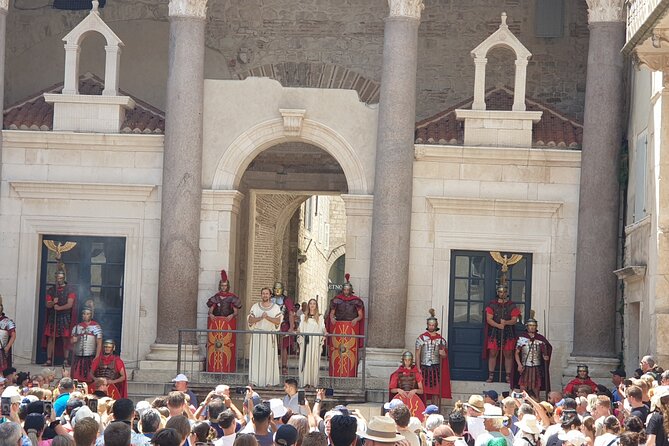
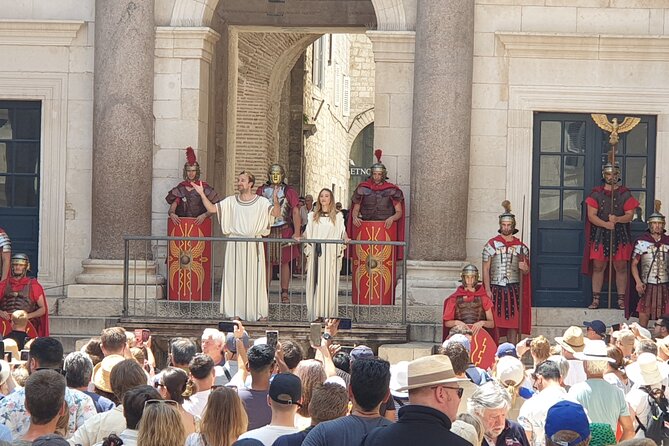
The Peristyle is the central square of Diocletian’s Palace and the natural place to begin. From here, you can reach many of the palace’s main sections, so the guide can explain the basic layout before leading you into the surrounding spaces.
You get about 15 minutes here. That is enough time to look closely at the square, hear how it connected the emperor’s quarters with the rest of the palace, and take photographs from a strong central viewpoint.
The Peristyle is also where the tour’s mix of ancient and later history becomes clear. Roman construction provides the foundation, but the square has been used and altered over many centuries. I like this opening because it gives you a simple mental map. Without one, the palace can feel like a maze of attractive stone alleys.
Expect the square to be a talking point rather than a long archaeological lecture. The tour has many stops to cover, so your guide must keep the explanation focused.
Palace substructures: the clearest look at the building below
The substructures are one of the most useful stops for understanding how Diocletian’s Palace was built. The central hallway and foundation areas show the practical side of the project, supporting the rooms and courtyards above.
You spend about 10 minutes here. The guide explains the construction of the palace and how these lower spaces were used over time. That second point matters because the substructures are not only engineering remains. They also show how parts of the palace changed function as Split grew around them.
There is an important limitation. This walk uses the central hallway and substructure areas, but it does not include the museum section. You can visit that portion afterward, but its admission is separate. If you want a detailed look at the full underground complex, budget extra time and money beyond the tour.
This is one of the places where the tour’s value depends on your expectations. If you want an overview of the foundations and their purpose, the stop is helpful. If you expect a complete underground museum visit, you may find the experience too brief.
Riva Harbor and the palace’s south wall
The route then reaches Riva Harbor, Split’s well-known waterfront promenade. Here, the guide connects the modern harbor with the palace’s southern wall and explains how the city faced the sea.
You spend about 10 minutes on this part of the route, with another Riva stop listed near the end for about 15 minutes. The repeated waterfront focus suggests that the harbor is used to explain two related subjects: the palace’s original seaside position and the later role of Riva as a public city promenade.
I like this part because it prevents the tour from becoming a purely inland Roman walk. Split’s relationship with the water is central to its identity, and the south wall helps you see the palace as a fortified residence with a maritime edge.
Near the later Riva stop, you can also see a bronze model of Diocletian’s Palace. That model should help you understand the full shape of the complex, especially after walking through only a small portion of it. The waterfront also gives you a natural photo stop, although the itinerary does not promise a long break.
Still Split, at a slower pace:
- Split: Krka Waterfalls Trip with Boat Cruise and Swimming
★ 4.8 · 10,519 reviews - From Split: Krka Waterfalls, Food & Wine Tasting Tour
★ 5.0 · 9,326 reviews - Blue cave, Mamma Mia and Hvar, 5 islands speedboat tour
★ 5.0 · 7,150 reviews - From Split: Krka Waterfalls, Food & Wine Tasting Tour
★ 4.9 · 6,598 reviews
Fruit’s Square and Split’s Venetian layer
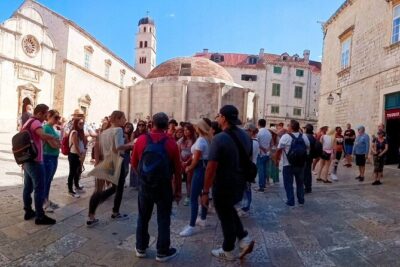
Fruit’s Square, or Trg Braće Radić, adds a later chapter to the route. You see an old Venetian citadel and a sculpture of Marko Marulić, an important Croatian literary figure.
The stop lasts about five minutes, so expect a quick explanation rather than a detailed visit. Still, it is a useful reminder that Split is not only Roman. Venetian influence, medieval development, and later civic life all occupy the same compact center.
This is the kind of stop I appreciate on a first walk. You begin to see how the palace became a city rather than remaining a sealed imperial compound. The short time also keeps the tour moving, but you may want to return later if you are interested in the square or the sculpture.
The itinerary also points out a 15th-century Venetian palace that now houses the Museum of the City. The tour appears to identify it as part of the historic center, but it does not include a museum visit. Consider noting its location so you can return independently.
The ancient temple, Vestibule, and Triklinij
The walk includes the last remaining ancient Roman temple within the palace. The itinerary does not name the temple, so you should view this as a brief historical stop rather than a promise of an extended interior visit.
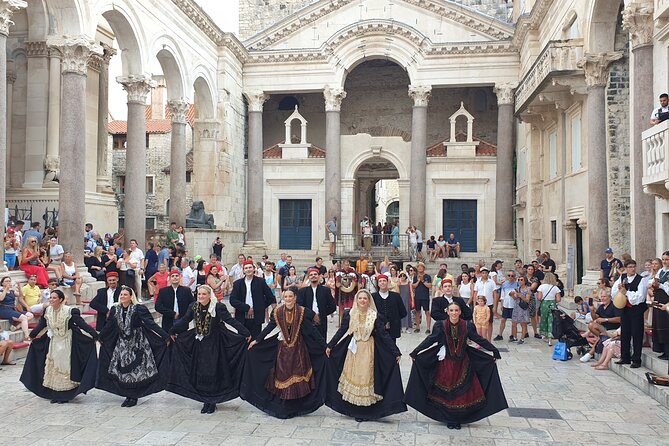
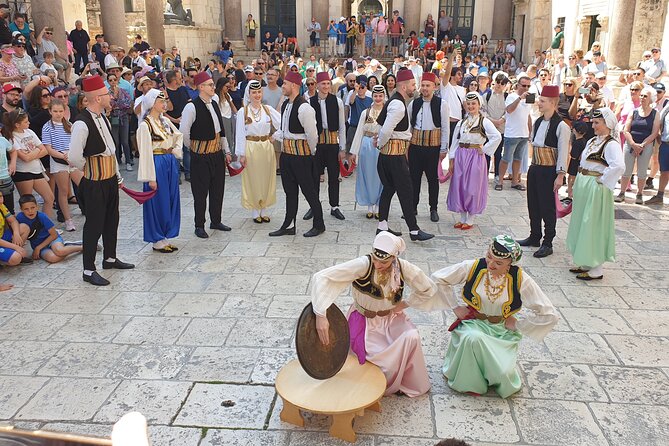
The Vestibule follows as one of the more memorable architectural spaces. This was the entrance hall to Diocletian’s personal quarters, and you get about five minutes to hear about its design and use. There is also a chance of hearing traditional Dalmatian singing, though that is presented as a possibility, not a guaranteed performance.
That distinction matters. You should not book the tour solely for the singing. If it happens, it can add a distinctly local touch to the Roman setting. If it does not, the Vestibule remains a strong stop because it marks the transition into the emperor’s private area.
Triklinij shows the remains and partial reconstruction of Diocletian’s personal walkway and dining hall. Again, the visit lasts about five minutes. It is enough to understand the purpose of the space and see how little of the original private complex remains intact.
The guide also points out the cathedral located in Diocletian’s mausoleum. This is one of the palace’s most striking changes in function: an imperial burial building became a Christian cathedral. The tour introduces that story, but it does not say that cathedral admission is included. Ask your guide about current entry arrangements if you want to go inside afterward.
Grgur Ninski and the Golden Gate
The Grgur Ninski statue, created by Croatian sculptor Ivan Meštrović, receives about 15 minutes. It stands in front of the palace’s north gate and represents Gregory of Nin, a major figure in Croatian religious and language history.
This is a good pause because the statue connects national identity with the city’s Roman setting. Your guide explains Gregory’s importance and the meaning attached to the figure. The stop also offers a clear sense of how Split uses public art to tell its story beyond ancient Rome.
The Golden Gate is the main northern entrance to Diocletian’s Palace. You spend about 10 minutes learning how the gate functioned and seeing the nearby Gregory of Nin statue. The itinerary lists admission as not included, so you should expect an exterior explanation rather than a paid interior attraction.
The gate is one of the route’s best orientation points. After seeing the Peristyle, southern waterfront, and private quarters, you can understand how the palace was connected to the wider city through its entrances. Take your photos here, but keep an eye on the guide. The walk moves through active public streets, and it is easy to fall behind while framing the perfect shot.
What the 90-minute pace feels like
An hour and a half is a sensible length for a first look at Split’s historic center. You get enough time to see the main landmarks without committing half a day to a single walking tour.
The tradeoff is pace. Several stops last only five minutes, while the longer sections at the Peristyle, Grgur Ninski statue, and Riva carry more of the tour’s explanation. You will see many places, but you will not linger at every one.
I would choose the small group of up to five whenever the price difference is reasonable for your party. A small group gives you a better chance to ask questions and hear the guide in busy areas. The regular option can include up to 20 people, and a group that size may make soft speaking especially frustrating.
The tour is offered in English, with morning and afternoon times. One strong use of the schedule is an evening walk, which can help you get oriented before returning to explore the palace on your own. The experience is also suitable for most people, and service animals are allowed. The meeting point is near public transportation.
Is $156.17 a fair price?
At $156.17 per person, this is not a bargain-priced city walk. The value depends on whether that figure buys the small-group format you want and how much you value having a guide connect the Roman, medieval, Venetian, and modern parts of Split.
The regular group option is capped at 20 people, while the small-group version has a maximum of five. If you are traveling with a small party and want a more personal explanation, the smaller format is easier to justify. If you mainly need a quick introduction and are comfortable in a larger group, the cost may feel high for 90 minutes.
You should also account for extra admissions. The museum section of the substructures is not included, and the Golden Gate and Riva entries are marked as not included. The tour is therefore best viewed as a guided exterior and orientation walk, not a package covering every paid attraction.
The strongest value comes from the interpretation. A good guide can turn a series of stones, gates, and courtyards into a story you can follow. A guide who speaks too quietly can make the same route feel thin. The available rating is 4.9 from 29 ratings, with 93 percent recommending the experience, but the less favorable feedback gives you a practical warning: stand close, listen carefully, and consider the small-group option.
Who should book this Split walking tour?
I would recommend it to a first-time visitor who wants to understand the shape of Split before exploring alone. It suits you if you like Roman sites but also want to see how later Croatian, Venetian, and Christian history altered the palace.
It is also a good fit if you have limited time. The route reaches the Peristyle, substructures, Riva, Fruit’s Square, Vestibule, Triklinij, Golden Gate, and major statues in one session. You can then return to the cathedral, museum, or paid substructure areas that interest you most.
I would be more cautious if you want long museum visits, extensive archaeological detail, or guaranteed traditional singing. Those are not what this format promises. The walk gives you a broad introduction, with several sights viewed briefly or from outside.
Before booking, check which group type you are selecting and note the extra admission costs. Free cancellation is available if you cancel at least 24 hours before the start time. Changes or cancellations made inside that window are not accepted for a refund, and the tour requires a minimum number of participants.
Should you book it?
Book this tour if you want a short, wide-ranging introduction to Split and can choose the maximum-five group. The route is well planned, the Peristyle and substructures provide a strong Roman foundation, and the Riva, Fruit’s Square, Gregory of Nin statue, and Golden Gate show how much later city life grew around the palace.
Skip it if you expect every major interior to be included or if $156.17 feels too steep for a 90-minute walk with separate admissions. In that case, you may get better value by exploring the free exterior spaces on your own and paying only for the museum or cathedral visits you truly want.
For most first visits, I see this as a useful orientation rather than a complete palace experience. Choose the smallest group available, stay close to the guide, and save time afterward for the interiors the walk only introduces.
FAQ
How long does the Split and Diocletian Palace tour last?
The walking tour lasts approximately 1 hour and 30 minutes.
Where does the tour begin?
It begins at Peristil ulica, Peristil ul., 21000 Split, Croatia.
Where does the tour end?
The activity ends back at the meeting point.
Is the tour offered in English?
Yes. The tour is offered in English.
What group sizes are available?
You can choose a small group with a maximum of five people or a regular group with a maximum of 20 people. The overall activity limit is 20 participants.
Are admissions included?
The guide and walking tour are included, but some admissions are not. The museum section of the palace substructures is not visited, and the Golden Gate and Riva entries are marked as not included.
Can I cancel for a full refund?
Yes, if you cancel at least 24 hours before the experience start time. Cancellations or changes made less than 24 hours before the start time are not accepted for a refund.
More History Tours in Split
- Walking Tour of Split with a ‘Magister’ of History
★ 5.0 · 1,122 reviews - Split Walking Tour with Professor of History
★ 5.0 · 926 reviews - Split: History and Heritage Walking Tour
★ 4.9 · 650 reviews - Split History and Gastro Small-Group Tour with Food and Drinks
★ 5.0 · 375 reviews
Just added around Split
- Walking Tour Split★ 4.7 · 61 reviews
- Unique vintage Tomos moped tour Split – Back to the ’80s★ 4.8 · 17 reviews
- Trogir: White Lagoon, Maslinica & Blue Lagoon Speedboat Tour★ 4.8 · 11 reviews
- Essential Diocletian’s Palace Tour for First-Time Visitors★ 4.8 · 19 reviews
- Split: Trogir Open Top Bus Trip + Free Split Walking Tour★ 4.1 · 17 reviews
- Trogir; Private walking tour of higlights of Trogir★ 4.7 · 3 reviews
- Trogir: Old Town Guided Walking Tour★ 4.6 · 76 reviews
- TROGIR: Blue Lagoon & 3 Islands Half-day Speedboat tour★ 4.6 · 28 reviews
Walking Tours, compared.
Walking Tour of Split and Diocletian’s Palace
Read our review →


Krka Waterfalls tour with Trogir Walking tour and Krka panoramic boat cruise
Read our review →
City Walls Early Morning or Sunset Walking Tour
Read our review →Browse the lists this tour appears in