
Reviewed · HISTORICAL TOURS
Private History tour – small group
Split reveals itself one stone at a time. This private walk makes the old city easier to understand, pairing Roman architecture with the later Christian and medieval changes that shaped modern Split. I like the small-group format, and I like that your guide, Ivan Fistanić, has a Master’s Degree in History.
The route covers the Golden Gate, Peristyle, Cathedral of Saint Domnius, Temple of Jupiter, Vestibulum, Riva Harbor, Fruit Square, Pjaca, and the Gregory of Nin statue. The main consideration is timing: with nine stops packed into roughly 90 minutes to two hours, some places receive a short explanation rather than a long visit, and the cathedral and Temple of Jupiter are viewed from outside.
In This Review
- Key points
- Why this short Split walk works
- Meeting at the Golden Gate and Riva
- The Peristyle, the palace’s grand central space
- The cathedral and Temple of Jupiter
- The Vestibulum and the emperor’s private side
- Fruit Square and Pjaca: the medieval city outside the palace
- Gregory of Nin and the good-luck toe
- What the $238.28 group price really means
- Timing, pace, and practical limits
- Who should book this private Split tour?
- Should you book it?
- FAQ
- How long does the private history tour last?
- How many people can join the private tour?
- Where does the tour start?
- Where does the tour finish?
- Is admission to the cathedral included?
- Is admission to the Temple of Jupiter included?
- Can I cancel for a full refund?
Key points
- A private group of up to 10: You get a personal tour without sharing the walk with a large crowd.
- A history-focused guide: Ivan Fistanić brings formal history training and answers questions along the way.
- Diocletian’s Palace at the center: Roman gates, imperial spaces, temples, and later Christian buildings all appear on the route.
- More than a palace tour: Riva Harbor, Fruit Square, Pjaca, and Gregory of Nin show how Split grew beyond the Roman walls.
- Good value for a full group: The $238.28 price covers the group, making the per-person cost more reasonable when shared by several people.
- Flexible planning: You receive a mobile ticket, meet centrally, and can cancel free of charge up to 24 hours before departure.
Why this short Split walk works
Split is not a city where the main sights sit neatly in separate museum buildings. Much of the old center is built into and around Diocletian’s Palace, with shops, homes, cafés, churches, squares, and passageways occupying the ancient structure. Without context, you can easily see the stones but miss the story.
This tour gives you that story in a compact format. You move from the Roman entrance at the Golden Gate to the palace’s central square, then into spaces that explain imperial life, religious change, and the medieval city that grew around the palace.
I especially like the private setup. Your group alone takes part, with a maximum of 10 people, so you can ask about details that catch your eye. That matters in Split, where the most useful questions often come from small things: a reused column, a Christian symbol on a Roman building, or the way a medieval square sits just outside the palace wall.
Ivan’s history background is another strong point. One of the most positive comments about the experience praised him for explaining both the palace and Split, not just pointing out monuments. A separate French-language booking described the walk as detailed and off the usual path, with Ivan responding carefully to many questions. That makes this a good fit if you want interpretation rather than a quick parade of photo stops.
More history tours in Split:
- Walking Tour of Split with a ‘Magister’ of History
★ 5.0 · 1,122 reviews - Split Walking Tour with Professor of History
★ 5.0 · 926 reviews - Split: History and Heritage Walking Tour
★ 4.9 · 650 reviews
Meeting at the Golden Gate and Riva
The listed meeting point is Ul. kralja Tomislava 15 in central Split, and the tour ends back at the meeting point. The area is near public transportation, so it is a practical starting place if you are staying in the city or arriving without a car.
The route includes Riva Harbor, Split’s main waterfront promenade. The harbor is not just a pretty place to begin or end a walk. It helps you understand the relationship between the palace and the sea, while the southern wall of Diocletian’s Palace can be seen clearly from the waterfront.
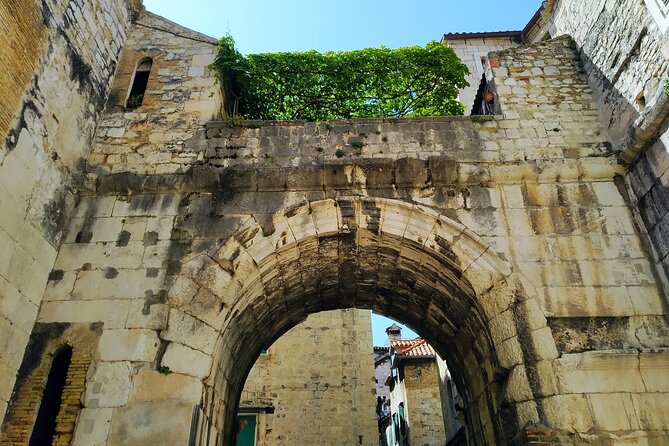
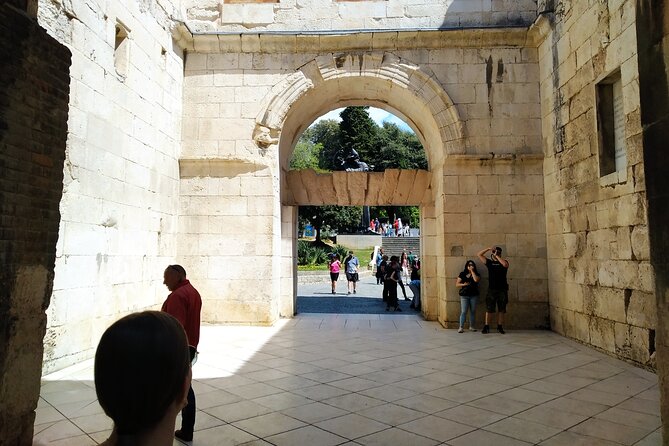
The Golden Gate is the main northern entrance to the palace and one of four major Roman gates. Its direction was important: the road led toward Salona, the capital of the Roman province of Dalmatia and the birthplace of Emperor Diocletian.
You also see the Gregory of Nin statue near the gate. The pairing is useful because it places Roman Split beside one of the city’s best-known Croatian monuments. The stop is scheduled for about 15 minutes, enough for an introduction and some photographs, though not a long architectural study.
The Peristyle, the palace’s grand central space
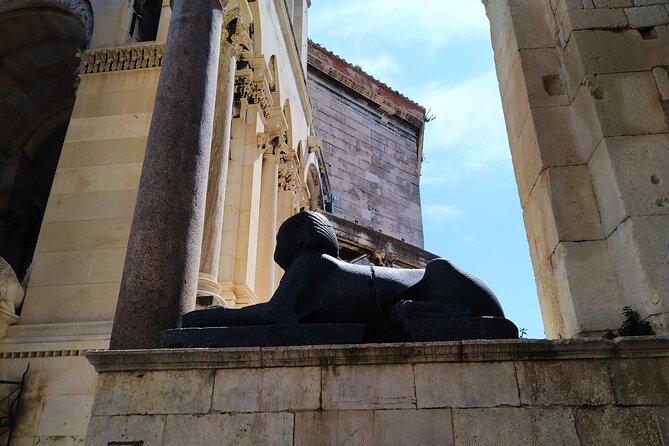
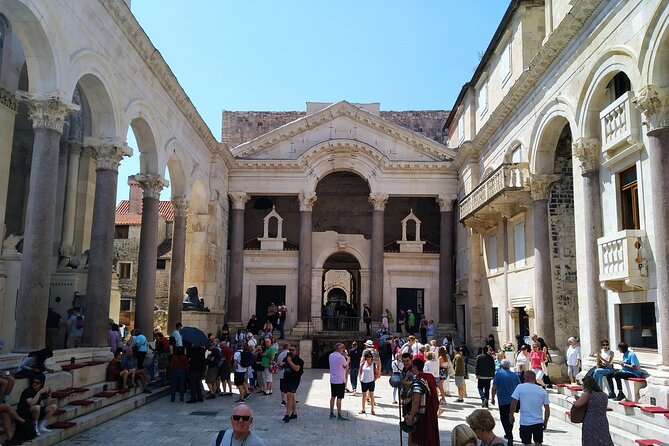
The Peristyle is the visual heart of Diocletian’s Palace. Monumental arcades frame the open square, which once served as the imperial center and was oriented toward the emperor’s loggia.
This is the point where the scale of the palace becomes clear. You are not looking at a single Roman ruin surrounded by modern streets. You are standing in a surviving urban space that has continued to serve different purposes over many centuries.
The guide explains how the buildings changed as Christianity spread and how daily life shifted inside the former imperial complex. That transition is one of the most useful parts of the tour because it prevents you from seeing Roman and medieval Split as separate worlds. The city developed by reusing what was already there.
The tour allows around 15 minutes here. That is enough to hear the main story, study the columns and arcades, and ask a few questions. If you want extensive time for photographs, a quiet look at every architectural detail, or a slower discussion of Roman urban design, you may find the schedule brisk.
The cathedral and Temple of Jupiter
From the Peristyle, you cannot miss the Cathedral of Saint Domnius. The building is one of the best-preserved Roman structures in Split and remains in use today. The unusual part of its story is that a Roman imperial mausoleum became a Christian cathedral, giving you a clear example of how the city adapted its old buildings rather than discarding them.
You do not enter the cathedral on this experience. Ivan explains its important features from outside, including the story and major details you need to understand the building. That keeps the walk moving, but it also means you should not book this tour expecting interior access or time to climb, inspect, or worship inside.
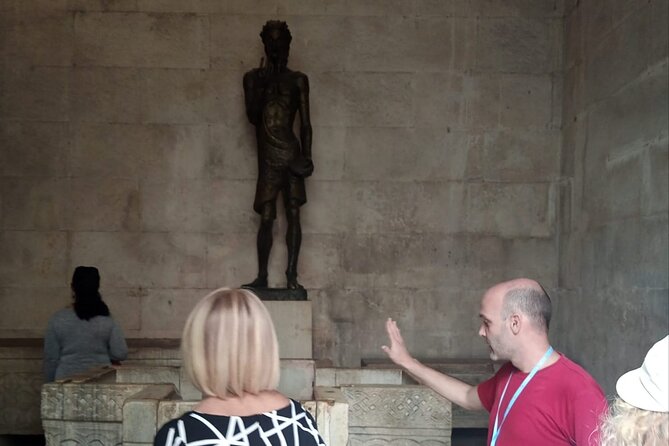
The nearby Temple of Jupiter adds another layer. It was built to honor Jupiter, the Roman sky and thunder god, and to reinforce the emperor’s connection with the divine. During the Middle Ages, it was converted into a baptistery dedicated to Saint John the Baptist.
The temple is one of the best-preserved late Roman temples in the world, but admission is not included. The tour treats it as an exterior stop, with about 10 minutes for the explanation. If you want to enter, check the admission arrangements separately before or after the walk.
Together, the cathedral and temple show the changing use of sacred buildings in Split. One began as part of an imperial complex and became a cathedral. The other changed from a Roman temple into a Christian baptistery. Those changes are far more interesting when you hear them while looking at the actual buildings.
A few more Split trips worth comparing
- Split: Krka Waterfalls Trip with Boat Cruise and Swimming
★ 4.8 · 10,519 reviews - From Split: Krka Waterfalls, Food & Wine Tasting Tour
★ 5.0 · 9,326 reviews - Blue cave, Mamma Mia and Hvar, 5 islands speedboat tour
★ 5.0 · 7,150 reviews - From Split: Krka Waterfalls, Food & Wine Tasting Tour
★ 4.9 · 6,598 reviews
The Vestibulum and the emperor’s private side
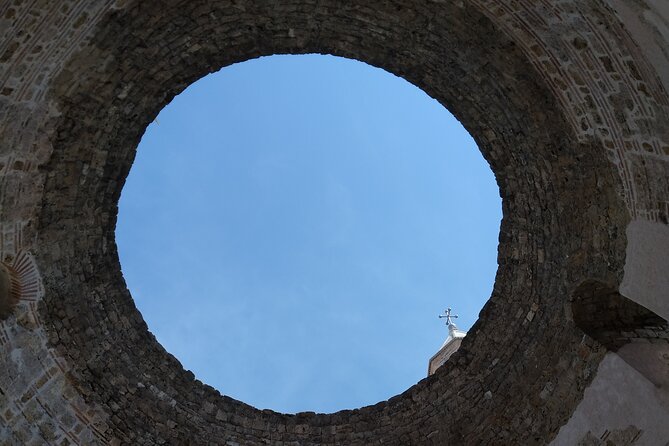
The Vestibulum was the entrance area leading toward Diocletian’s private chambers. Its design reflected its importance, and the guide explains what it looked like and how it functioned.
This is a smaller, more enclosed part of the palace experience. After the open Peristyle, the Vestibulum helps you think about movement through the imperial residence: public ceremonial space outside, more private rooms beyond.
From here, the tour also checks the Triclinium. The supplied details do not promise a long visit inside the private chambers, so expect a concise explanation rather than a full reconstruction of palace life. Still, this stop is valuable because it shifts attention away from the most photographed square and toward how the emperor’s residence was arranged.
The stop lasts about 10 minutes and has no separate admission charge listed. Comfortable shoes are sensible because the route moves through the old town on foot, where surfaces and passageways can vary.
Fruit Square and Pjaca: the medieval city outside the palace
Fruit Square, or Trg Braće Radić, is one of the most picturesque squares outside Diocletian’s Palace. Its name recalls the fruit market once held there, while the surrounding buildings show Split’s later Venetian and medieval character.
The square is dominated by the remains of a 15th-century Venetian fort. You also hear about the important monument in the center and the other notable structures around the square. The 20-minute allocation makes this one of the longer stops, which is helpful because it gives you time to look around rather than simply receive a quick label.
Pjaca sits outside the western wall of the palace, in front of the old Town Hall. It has served as Split’s main city square since medieval times, and the 14th-century Town Hall remains one of its key features.
These two squares are important additions to a palace walk. They show that Split is not only a Roman site preserved under modern life. The city kept growing, trading, governing, and gathering in spaces beside the palace walls.
You also get a practical sense of how close the city’s eras are to one another. A Roman wall, a Venetian fort, a medieval town hall, and modern public life can appear within a short walk. That compact arrangement is one reason a local guide adds real value here.
Gregory of Nin and the good-luck toe
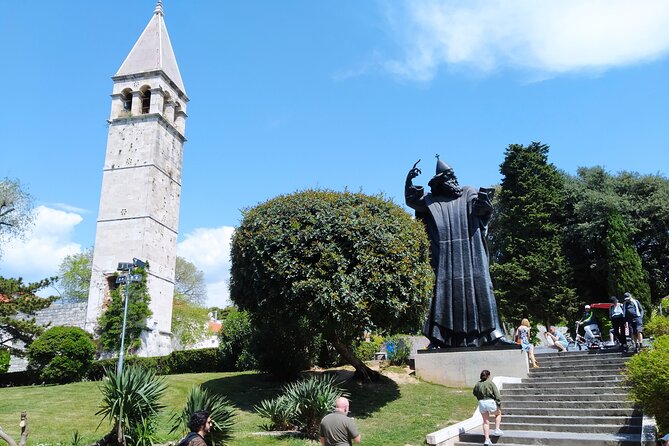
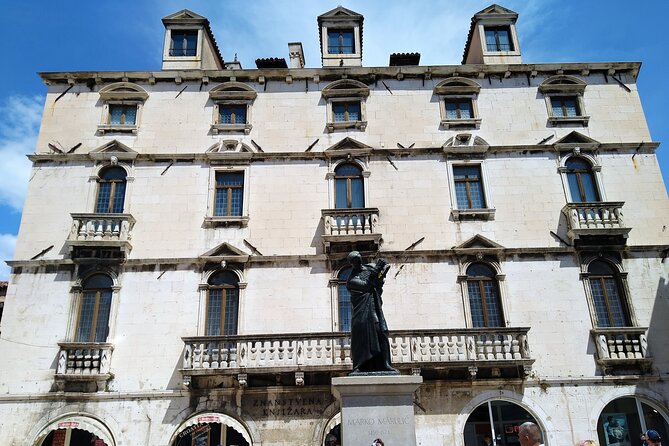
The Gregory of Nin statue is one of Split’s easiest landmarks to recognize. It honors Gregory of Nin, a historic religious figure, and was created by Ivan Meštrović, one of Croatia’s most famous sculptors.
The standard local custom is simple: rub the statue’s toe for good luck. The toe is now highly polished from all that attention, making this both a lighthearted stop and a chance to hear about Croatian history and sculpture.
The statue is near the Golden Gate, so it connects naturally with the beginning of the route. The guide explains Gregory of Nin, the reason the monument is important, and Meštrović’s role in creating it.
This stop is scheduled for about 10 minutes. It is a good final moment because it brings the tour back to a recognizable symbol of modern Croatian identity after the Roman and medieval material that came before.
What the $238.28 group price really means
The price is $238.28 for the group, with up to 10 participants. That is not a bargain for one person, but the calculation changes quickly when you share it.
For two people, the cost is about $119 per person. For four, it is about $60 each, and for a full group of 10, it is about $24 per person. The private format becomes much better value for a family, a group of friends, or several couples traveling together.
You are paying for a private guide rather than a large public walk, and the guide’s formal history training strengthens the value for people who want more than basic orientation. The tour also covers a broad area in a short time, including the palace interior zones and the squares outside it.
The price does not include admission to the cathedral or Temple of Jupiter, and the tour does not include entry inside the cathedral. Since the walk is designed mainly as an exterior and historical introduction, those omissions are worth keeping in mind when planning your day.
Timing, pace, and practical limits
The duration is approximately 90 minutes to two hours. The difference likely depends on the pace of your group, questions, and the flow of the old town.
Nine stops are included, with several scheduled for 10 minutes and a few receiving 15 to 20 minutes. You should expect a focused introduction rather than a slow archaeological study. I would choose this tour early in your Split visit, then return later to the places that deserve more time.
A mobile ticket keeps the start simple. The central meeting point and nearby public transportation are also helpful, particularly if you are using public transit or walking from another part of Split.
The activity requires good weather. If poor weather causes cancellation, you are offered another date or a full refund. You can cancel for a full refund up to 24 hours before the start time, but changes or cancellations made inside that window are not accepted.
Who should book this private Split tour?
I would recommend it to first-time visitors who want to understand Split quickly. It is also a good choice for history-minded couples, families, and small groups who prefer to ask questions without a large crowd.
The tour suits people who want a clear explanation of how Roman, Christian, Venetian, and modern Split fit together. Ivan’s ability to respond to many questions is especially useful if your group enjoys conversation rather than a fixed speech.
You should consider another plan if you want extensive indoor access, a long visit at the cathedral, or a leisurely pace at every monument. You should also compare the cost carefully if you are only one person or a pair, since the fixed group price is much more attractive when divided among several participants.
The experience also has a personal touch beyond standard sightseeing. It has been used as a birthday present, with Catherine thanking Ivan while mentioning Pascal’s birthday. That detail suggests the private format can work well for a special occasion, especially when the group wants a meaningful shared activity instead of a rushed attraction visit.
Should you book it?
Book this tour if you want a focused, private introduction to Split led by a guide with formal history training. It offers strong value for groups of four or more, and the route gives you both Diocletian’s Palace and the later city beyond its walls.
Skip it if your priority is entering every major building or spending an hour at one monument. For most visitors, though, the blend of Roman sites, Christian reuse, medieval squares, and local landmarks makes this a useful first walk through Split.
FAQ
How long does the private history tour last?
The tour lasts approximately 1 hour and 30 minutes to 2 hours.
How many people can join the private tour?
Up to 10 people can participate in the private group.
Where does the tour start?
The listed meeting point is Ul. kralja Tomislava 15, 21000 Split, Croatia.
Where does the tour finish?
The activity ends back at the meeting point.
Is admission to the cathedral included?
No. The tour does not enter the Cathedral of Saint Domnius, and admission is not included.
Is admission to the Temple of Jupiter included?
No. Admission to the Temple of Jupiter is not included, and the stop is handled as part of the walking tour.
Can I cancel for a full refund?
Yes. You can cancel at least 24 hours before the experience start time for a full refund. Cancellations or changes made less than 24 hours before the start time are not accepted.
Just added around Split
- Walking Tour Split★ 4.7 · 61 reviews
- Unique vintage Tomos moped tour Split – Back to the ’80s★ 4.8 · 17 reviews
- Trogir: White Lagoon, Maslinica & Blue Lagoon Speedboat Tour★ 4.8 · 11 reviews
- Essential Diocletian’s Palace Tour for First-Time Visitors★ 4.8 · 19 reviews
- Split: Trogir Open Top Bus Trip + Free Split Walking Tour★ 4.1 · 17 reviews
- Trogir; Private walking tour of higlights of Trogir★ 4.7 · 3 reviews
- Trogir: Old Town Guided Walking Tour★ 4.6 · 76 reviews
- TROGIR: Blue Lagoon & 3 Islands Half-day Speedboat tour★ 4.6 · 28 reviews
Historical Tours, compared.
Walking Tour of Split with a ‘Magister’ of History
Read our review →
Split History and Gastro Small-Group Tour with Food and Drinks
Read our review →
PREMIUM Emperor’s Walking Tour for History Lovers + Museum
Read our review →Browse the lists this tour appears in