
Reviewed · WALKING TOURS
Private History Split Walking Tour in Spanish
Ancient stone, living city. This private Spanish-language walk makes Split’s Roman core easier to understand, especially when you hear how Diocletian rose from obscurity to become Rome’s most powerful man. I like the one-group format, which lets you ask questions, and I like the guide’s attentive Spanish, praised for clear explanations and patience.
The tour also covers more than the palace’s postcard sights. You’ll connect Roman temples, medieval gates, Venetian defenses, Jewish heritage, Croatian literature, and the Riva waterfront in about 90 minutes. The main caution is the high steps, and no admission tickets or gratuities are included, although the listed stops themselves are free.
In This Review
- Key points to know before you book
- Why this private Split tour works well
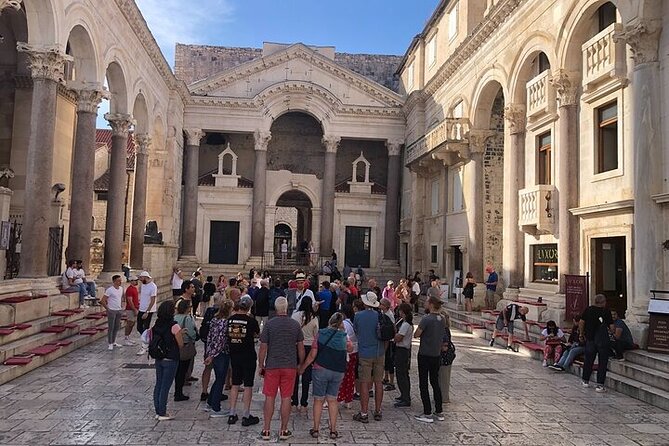
- Beginning at the Peristyle, the palace’s central stage
- Jupiter’s Temple and Diocletian’s divine family
- The substructures reveal how the palace was built
- The Golden Gate and Gregory of Nin
- The Riva connects the palace to the sea
- Fruit’s Square and the Venetian chapter
- Split’s synagogue and the city’s Jewish history
- The Vestibule and the sound of Dalmatia
- What the guide’s Spanish is like
- Is $63.05 per person a fair price?
- Timing, meeting point, and physical effort
- Who should book this Spanish walking tour?
- Should you book it?
- FAQ
- How long does the Private History Split Walking Tour in Spanish last?
- Is this a private tour?
- Where does the tour start?
- Where does the tour end?
- Are admission tickets included?
- Can I cancel for a full refund?
Key points to know before you book
- Private Spanish-language tour: Your group has its own guide, with time for questions and a more personal pace.
- Roman Split in 90 minutes: The route links the Peristyle, palace basements, Golden Gate, Vestibule, and other central sights.
- History beyond Diocletian: You’ll hear about Gregory of Nin, Marko Marulić, Split’s Jewish community, and the Venetian period.
- Strong guest approval: The experience has a 4.9 rating, with 97 percent recommending it.
- No museum entry included: The palace substructures are visited, but the museum section is not part of the tour.
- Watch the stairs: The experience is not recommended if high steps are difficult for you.
Why this private Split tour works well
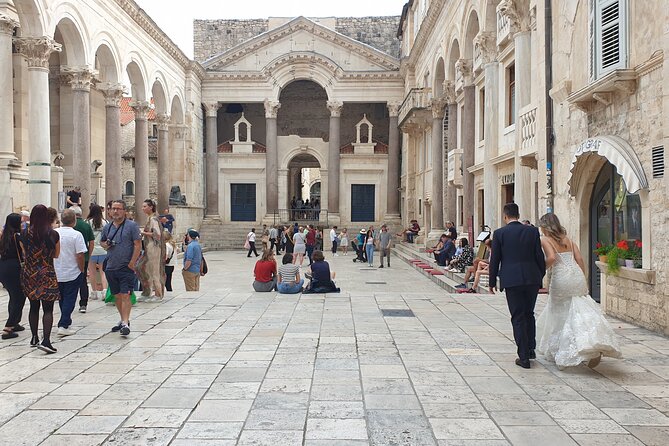
Split can look confusing at first. Roman walls form the backbone of the old center, but homes, shops, cafés, churches, and streets now occupy much of the former palace. Without context, you may see fine stonework without understanding how an emperor’s retirement residence became the heart of a modern Croatian city.
This walk gives you that framework. The guide leads you through the major points of Diocletian’s Palace and then adds the later layers that shaped Split. That makes the experience more useful than a quick photo stop at the Peristyle.
I especially like the private arrangement. Only your group participates, so you can ask about the emperor, local traditions, architecture, or anything that catches your eye. A Spanish-speaking guide also removes the strain of translating historical details while walking.
The 90-minute length is practical. You get a strong introduction without giving up half a day. It works well near the start of a Split visit, when you want to learn the layout before exploring alone.
The main limitation is pace. Eight stops in roughly an hour and a half means some subjects receive only a short explanation. If you want long museum visits, detailed architectural study, or extensive time inside every building, this tour will feel like an introduction rather than a full archaeological visit.
More Walking Tours in Split
- Split: Old Town and Diocletian Palace Walking Tour
★ 4.9 · 4,727 reviews - Walking Tour of Split and Diocletian’s Palace
★ 5.0 · 2,588 reviews - Krka Waterfalls tour with Trogir Walking tour and Krka panoramic boat cruise
★ 5.0 · 1,659 reviews
Beginning at the Peristyle, the palace’s central stage
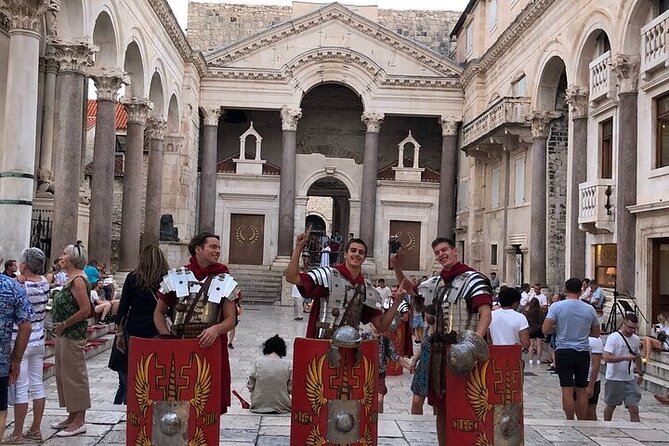
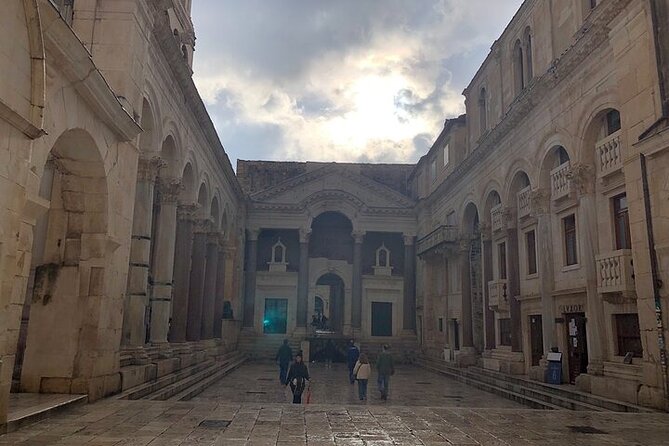
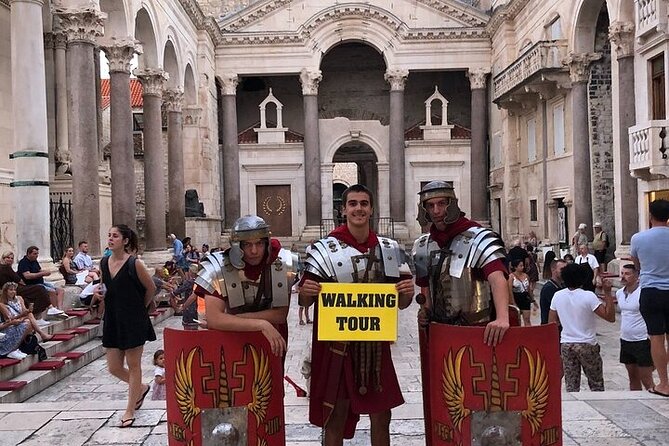
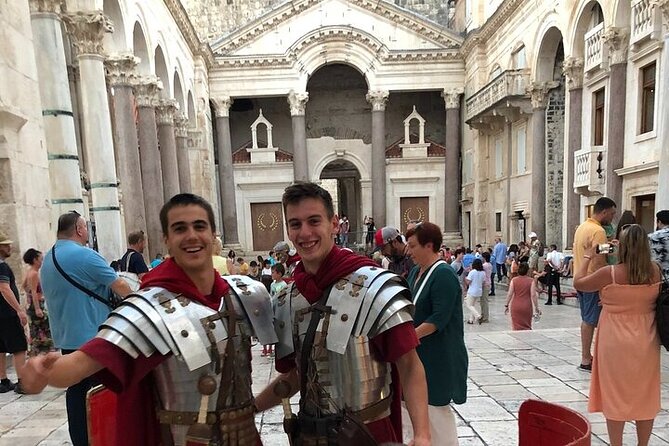
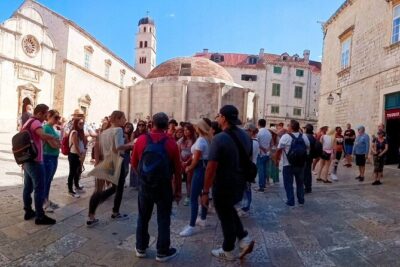
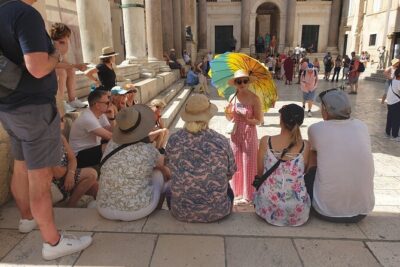
The meeting point is Peristil ulica, at the Peristyle, the main square of Diocletian’s Palace. This is an excellent starting place because the square connects to many other parts of the palace and gives you an immediate sense of the site’s scale.
You’ll spend about 15 minutes here. The guide explains the square’s role and sets up the larger story of Diocletian, who moved from a relatively ordinary background to the top of the Roman world.
That personal rise is one of the tour’s strongest story lines. Roman emperors can blur into a parade of names and dates, but the guide’s focus on Diocletian’s climb to power gives the history a clear human shape. You begin with the man, then see the residence he built for his later years.
The Peristyle is also where the tour can explain how the palace functioned as more than a house. It was an imperial complex with ceremonial spaces, religious buildings, defensive walls, and routes connecting the emperor’s quarters to the sea.
Jupiter’s Temple and Diocletian’s divine family
Near the central palace area, you learn about the Roman temple of Jupiter. Diocletian regarded Jupiter as his divine father, so this stop helps explain the religious message behind his rule.
The point is not simply that Romans worshipped many gods. The connection between Diocletian and Jupiter shows how imperial authority was presented as something supported by the heavens. It gives meaning to the temple beyond its columns and stone.
The supplied timing does not list a separate duration for this portion, so expect it to be a short explanation linked to the Peristyle area. That is useful if you want context without stopping for a long lecture.
The substructures reveal how the palace was built
The route then goes through Diocletian’s Palace substructures for about 10 minutes. These lower chambers help you understand the construction of the palace and how the spaces were used across different periods.
This is one of the better practical stops because the substructures make the palace’s upper plan easier to read. Once you see the lower supports and rooms, the palace feels less like a collection of disconnected streets and more like a planned imperial complex.
There is an important boundary here. The tour does not include the museum section of the substructures. You can visit that part after the walk, but any admission cost is not included in the tour price.
That arrangement keeps the walking tour moving, but it also means you should budget extra time if you want a fuller look at the underground remains. If archaeology is your main interest, ask the guide where the tour portion ends so you can continue independently.
The itinerary lists the substructures again near the end, suggesting the route returns to this area or covers the same general complex from another direction. Do not expect two separate museum visits. The stated plan clearly excludes the museum portion.
Still Split, at a slower pace:
- Split: Krka Waterfalls Trip with Boat Cruise and Swimming
★ 4.8 · 10,519 reviews - From Split: Krka Waterfalls, Food & Wine Tasting Tour
★ 5.0 · 9,326 reviews - Blue cave, Mamma Mia and Hvar, 5 islands speedboat tour
★ 5.0 · 7,150 reviews - From Split: Krka Waterfalls, Food & Wine Tasting Tour
★ 4.9 · 6,598 reviews
The Golden Gate and Gregory of Nin
The Golden Gate is the palace’s main entrance and another 10-minute stop. Here, the guide explains the gate and introduces the statue of Gregory of Nin, an important figure in Croatian history and language.
This is a welcome change from Roman imperial history. You move from Diocletian’s world into the story of Croatian identity, with language and national memory taking center stage.
The statue gives you a memorable landmark for later wandering. The guide’s explanation helps you see why a figure connected to Croatian language and history matters in a city whose earliest major monuments were built under Rome.
The Golden Gate also makes the palace easier to navigate. After the tour, you’ll know one of the key entrances and can use it as a reference point when returning to the old center.
The Riva connects the palace to the sea
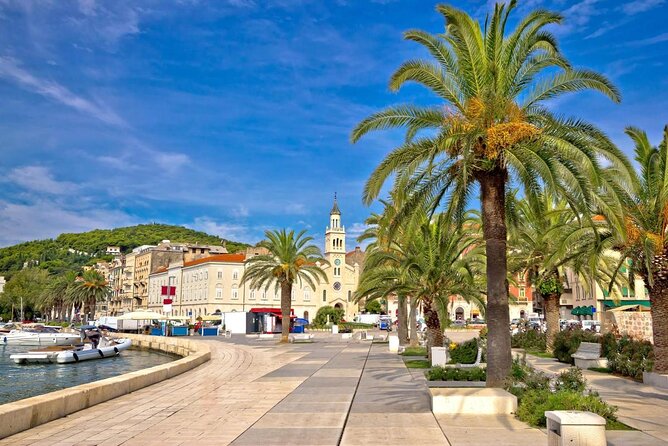
The walk continues to Riva Harbor for about 15 minutes. This part gives you a change of scenery from enclosed stone lanes and palace walls.
You’ll see a bronze model of Diocletian’s Palace and hear about the history of the Riva promenade. The model is especially useful because it lets you view the palace as a whole rather than from inside its narrow streets.
I like this stop for its sense of proportion. The palace can feel like a maze when you are walking through it. At the harbor, you can step back and understand its relationship to the waterfront and to Split’s wider urban life.
The Riva also shows how the city is not simply an archaeological site. It is a working public space and a place where the old palace meets present-day Split. The tour uses the promenade to connect ancient planning with the city you see now.
Fruit’s Square and the Venetian chapter
Fruit’s Square, officially Trg Braće Radić, receives about 10 minutes. Here, you learn about a 15th-century Venetian citadel and the importance of Marko Marulić, often called the father of Croatian literature.
This stop broadens the timeline again. You are no longer focused only on the Roman emperor or the palace walls. Venetian influence and Croatian literary history show how Split’s identity developed long after Diocletian.
The square is a useful place to pause because it brings together several eras in one compact setting. The citadel points to the city’s defensive past, while Marulić connects the location to Croatian culture and writing.
Ten minutes is enough for a clear introduction, but not for a detailed study of the citadel or Marulić’s work. If his story interests you, note the name and explore further after the tour.
Split’s synagogue and the city’s Jewish history
The route passes by Split’s 16th-century synagogue for about 10 minutes. The guide explains the history of the Jewish people in the city.
This is a valuable inclusion because it adds a community story that can be missed when a visit focuses only on Roman monuments and grand public buildings. You get a reminder that Split’s past includes religious and cultural communities living within the old city.
The synagogue stop is listed without an included admission ticket. Since the route says you pass by the synagogue, treat this as an exterior explanation rather than an arranged indoor visit.
That distinction matters. If you are hoping to enter, ask before booking or at the start of the walk. The tour’s stated plan supports learning about the site, not guaranteed admission.
The Vestibule and the sound of Dalmatia
The Vestibule of Diocletian’s Palace is a short, five-minute stop. This was the emperor’s vestibule, and the guide explains its history.
The space is also associated with traditional Dalmatian singing. You may hear this style during the visit, but it is presented as a possibility, not a promised performance. Keep expectations flexible.
Even with only five minutes, the Vestibule can be memorable because its shape and acoustics make it feel different from the open Peristyle. The guide’s explanation gives you a reason to notice the space rather than simply pass through it.
For many people, this is the moment when architecture and local culture meet. You have heard about Roman power, then moved through later Croatian and Venetian history, and now encounter a regional musical tradition inside an imperial structure.
What the guide’s Spanish is like
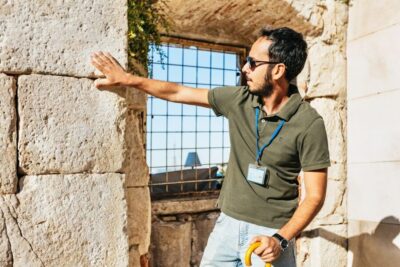
The available feedback is especially positive about the guide’s manner. One Spanish-speaking guest described the guide as attentive, clear, and willing to answer questions, adding that the guide’s Spanish was quite good.
That is the most useful detail for Spanish speakers deciding if this experience will feel comfortable. The guide is not simply delivering a memorized speech and moving on. The description emphasizes education, strong knowledge of the palace area, and attention to questions.
No guide name is provided, so I cannot promise a particular person. Guide quality can vary by assignment, but the experience has a strong overall rating of 4.9 from 31 reviews, and 97 percent recommend it.
A private tour also gives you a better chance to clarify words or ask for a slower explanation. That can matter when discussing Roman titles, Croatian names, or the history of Split’s Jewish community.
Is $63.05 per person a fair price?
At $63.05 per person, this is not the cheapest way to see Split’s old center. The value depends heavily on your group size and your interest in guided history.
For a small private group, the price buys more than a basic route. You receive a Spanish-language guide, a focused explanation of the major palace sights, and the freedom to ask questions without waiting for a large group to catch up.
The price is easier to justify if you are visiting Split for a short time, want a clear orientation, or prefer a private guide in Spanish. It is less appealing if you are comfortable reading about the palace yourself and mainly want to stroll and take photographs.
There are no admission tickets included, and gratuities are extra. The listed stops are described as free, but the museum portion of the substructures is not part of the tour, so plan for a separate visit if you want it.
Group discounts are available. Since the activity is private, compare the total cost for your party rather than looking only at the per-person figure. A larger group may find the price more reasonable than a solo participant.
The tour is commonly booked about 115 days ahead. That suggests you should reserve early if your dates are fixed, especially if you need a Spanish-language guide.
Timing, meeting point, and physical effort
The tour starts at the Peristyle on Peristil ulica, 21000 Split. The end is at Diocletian’s Palace, not far from the starting point, and the guide can take you back to the Peristyle if you ask.
That makes the walk easy to pair with more exploring afterward. You can continue into the palace, visit the substructures museum independently, or return toward the square without arranging transport.
The experience is near public transportation, and service animals are allowed. Most people can participate, but high steps are a stated concern.
Take that warning seriously. This is a walking tour through an old palace complex, not a flat promenade-only outing. If you have trouble with high steps, contact the provider before booking and ask if the route can be adjusted.
Confirmation arrives within 48 hours of booking, subject to availability. You can cancel for a full refund up to 24 hours before the start time. Changes or cancellations inside that 24-hour window are not accepted, and the activity may be canceled if its minimum number is not reached.
Who should book this Spanish walking tour?
I would choose this tour if you want a private introduction to Split and prefer to learn in Spanish. It suits couples, families, and small groups who value questions, personal attention, and a route that includes both famous landmarks and less obvious chapters of city history.
It is also a good fit for a first visit. The Peristyle, Golden Gate, Riva, Fruit’s Square, Vestibule, and palace substructures give you a workable mental map of the old center.
You may want something else if you need extensive museum time, detailed architectural measurements, or a longer archaeological tour. The 90-minute schedule covers a lot, but it moves briskly and does not include the museum section of the substructures.
Should you book it?
Book this tour if Spanish guidance, private attention, and a clear historical overview matter more to you than the lowest possible price. The high rating, strong praise for the guide’s Spanish and patience, and broad route make it a useful way to begin exploring Split.
Skip it if you plan to wander independently, dislike short stop times, or have difficulty with high steps. For everyone else, the tour offers a sensible introduction to the palace, with enough Roman history to explain the stones and enough later history to show that Split is much more than an ancient monument.
FAQ
How long does the Private History Split Walking Tour in Spanish last?
The tour lasts approximately 1 hour and 30 minutes.
Is this a private tour?
Yes. Only your group participates in the activity.
Where does the tour start?
It starts at Peristil ulica, at the Peristyle of Diocletian’s Palace in Split.
Where does the tour end?
It ends at Diocletian’s Palace, not far from the starting point. The guide can take you back to the Peristyle if you ask.
Are admission tickets included?
No admission tickets are included. The tour visits the palace substructures but does not include the museum section, which you can visit afterward.
Can I cancel for a full refund?
Yes. You must cancel at least 24 hours before the experience’s start time for a full refund. Cancellations or changes made less than 24 hours in advance are not accepted.
More History Tours in Split
- Walking Tour of Split with a ‘Magister’ of History
★ 5.0 · 1,122 reviews - Split Walking Tour with Professor of History
★ 5.0 · 926 reviews - Split: History and Heritage Walking Tour
★ 4.9 · 650 reviews - Split History and Gastro Small-Group Tour with Food and Drinks
★ 5.0 · 375 reviews
Just added around Split
- Walking Tour Split★ 4.7 · 61 reviews
- Unique vintage Tomos moped tour Split – Back to the ’80s★ 4.8 · 17 reviews
- Essential Diocletian’s Palace Tour for First-Time Visitors★ 4.8 · 19 reviews
- Trogir: White Lagoon, Maslinica & Blue Lagoon Speedboat Tour★ 4.8 · 11 reviews
- Split: Trogir Open Top Bus Trip + Free Split Walking Tour★ 4.1 · 17 reviews
- Trogir; Private walking tour of higlights of Trogir★ 4.7 · 3 reviews
- Trogir: Old Town Guided Walking Tour★ 4.6 · 76 reviews
- TROGIR: Blue Lagoon & 3 Islands Half-day Speedboat tour★ 4.6 · 28 reviews
Walking Tours, compared.
Walking Tour of Split and Diocletian’s Palace
Read our review →

Krka Waterfalls tour with Trogir Walking tour and Krka panoramic boat cruise
Read our review →
City Walls Early Morning or Sunset Walking Tour
Read our review →Browse the lists this tour appears in