
Reviewed · WALKING TOURS
Private History Split Walking Tour in Italian – Small group
Split tells its story in stone. This 90-minute Italian walking tour makes the old center easier to read, from Diocletian’s imperial square to the Riva waterfront and the city’s Jewish quarter. I like the private format, which keeps the pace focused on your group, and I like the strong Italian guiding, praised in particular by past participants who named Maria and Doris. The main drawback is simple: the route includes high steps and does not include the museum section of the palace substructures.
This is a good first look at Split if you want history without spending half a day on your feet. The price is $69.39 per person, so it offers better value for a couple or small family group than for one person booking alone. You also need to keep an eye on the clock, since the tour covers seven stops in about an hour and a half.
In This Review
- Key points to know before booking
- Why this 90-minute Split walk works
- Meeting at the Peristyle, the palace’s great stage
- The Vestibule and the chance of Dalmatian singing
- Inside the palace substructures
- The Golden Gate and Gregory of Nin
- Riva Harbor and the city beyond the walls
- Fruit’s Square and the Venetian chapter
- Passing Split’s 16th-century synagogue
- The Italian guiding makes the difference
- Price, group size, and overall value
- Who should book this walking tour
- FAQ
- Where does the tour begin and end?
- How long does the walking tour last?
- Is this a private tour?
- Is the tour conducted in Italian?
- Is the substructure museum included?
- What happens if I need to cancel?
- Should you book it?
Key points to know before booking
- The tour begins and ends at the Peristyle, the central square inside Diocletian’s Palace.
- Italian is the focus, with guides such as Maria and Doris praised for clear explanations and engaging delivery.
- You see both the palace and medieval Split, including the Golden Gate, Riva, Fruit’s Square, and the synagogue.
- The substructures are part of the walk, but the museum section is not included.
- The route is private, so only your own booking group takes part.
- High steps may be difficult, while service animals are allowed and public transportation is nearby.
Why this 90-minute Split walk works
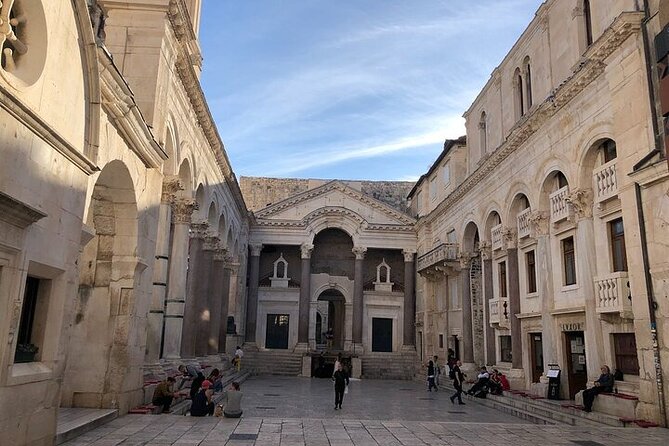
Diocletian’s Palace is not a fenced-off ruin sitting apart from modern life. It is the core of Split, with homes, shops, narrow lanes, cafés, and working streets built into and around the Roman structure. That can be confusing at first. You may walk through an ordinary-looking passage and miss the fact that it once served an emperor.
A good guide gives those stones a purpose. This tour is designed to explain how Diocletian rose from an obscure beginning to become one of the most powerful men in the ancient world, then connect his palace to later Venetian, Croatian, and Jewish chapters of Split’s story.
I especially like the balance between major sights and smaller historical details. The Peristyle and Golden Gate are essential, but Fruit’s Square and the synagogue add local texture. You are not only looking at Roman walls. You are also learning how the city changed around them.
The 90-minute length is useful for a first orientation. You get enough context to explore on your own afterward, without committing to a long walking program. The tradeoff is that each stop receives only a few minutes. This is a guided overview, not a slow archaeological study.
More Walking Tours in Split
- Split: Old Town and Diocletian Palace Walking Tour
★ 4.9 · 4,727 reviews - Walking Tour of Split and Diocletian’s Palace
★ 5.0 · 2,588 reviews - Krka Waterfalls tour with Trogir Walking tour and Krka panoramic boat cruise
★ 5.0 · 1,659 reviews
Meeting at the Peristyle, the palace’s great stage
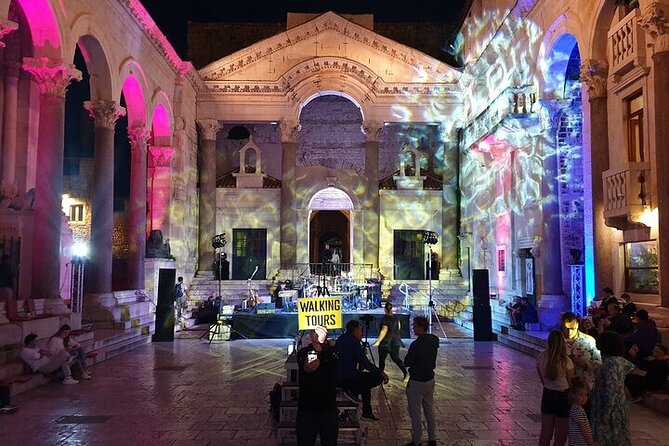
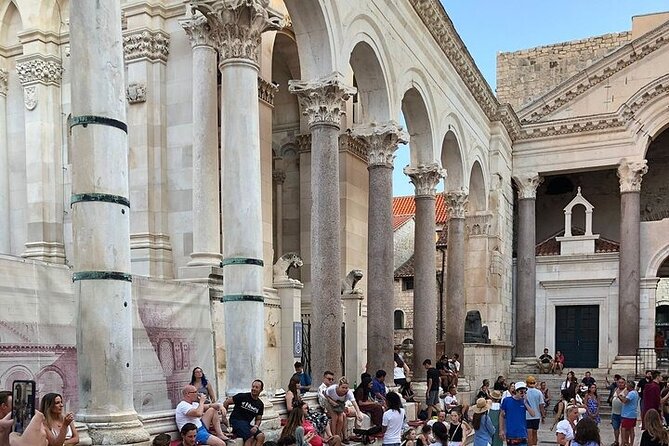
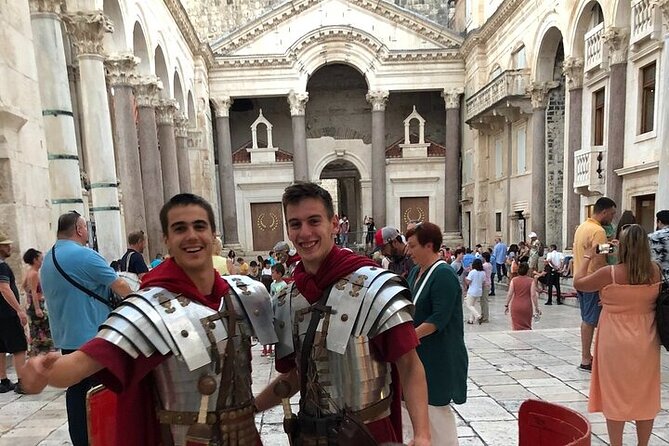
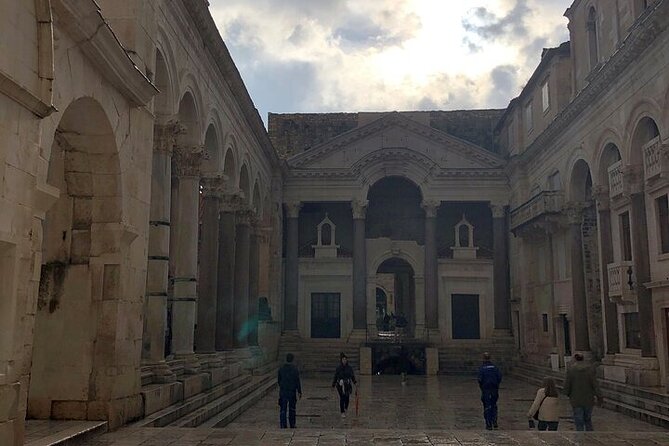
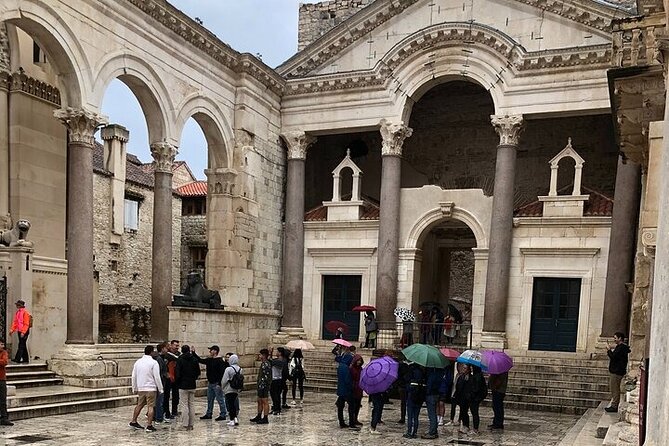
The tour starts on Peristil ulica, at the Peristyle of Diocletian’s Palace. This is the central square and the best possible place to begin because many routes through the palace lead from here.
The Peristyle helps you understand the palace plan. It was not simply a private home for a retired ruler. It was a large imperial complex with ceremonial spaces, entrances, religious buildings, service areas, and living quarters. From this square, your guide can explain how the palace worked and why Split grew inside it.
Allow yourself a little extra time to find the meeting point. The address is given as Peristil ulica, 21000 Split, and the tour ends back at this same meeting point. That return is convenient if you want to continue exploring the palace, visit the substructure museum, or head toward the waterfront afterward.
The square also sets the tone for the tour. You are standing in a place where Roman imperial ceremony, later Christian use, and modern city life meet. The stop lasts about 15 minutes, making it the longest single palace-focused introduction on the route.
The Vestibule and the chance of Dalmatian singing
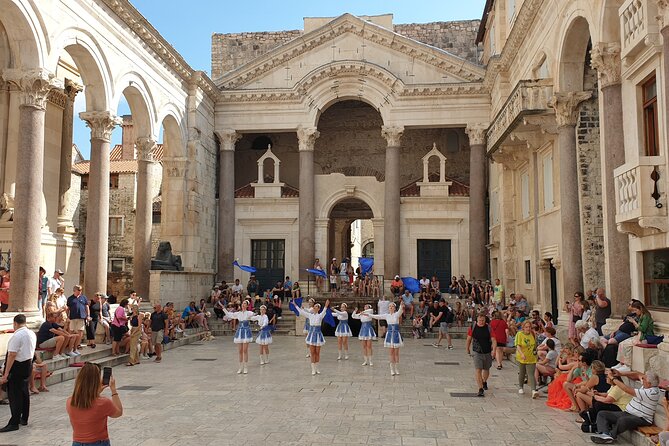
From the Peristyle, the group visits the Vestibule, the former entrance space associated with Emperor Diocletian. This stop lasts about five minutes, so expect a short explanation rather than an extended visit.
The Vestibule is valuable because it shows the formal side of the palace. It was part of the approach to the emperor’s apartments and helped create a grand transition from the public complex to the ruler’s private area.
There is also the possibility of hearing traditional Dalmatian singing. The wording matters: it may happen, but it is not guaranteed. If it does, the sound gives the place a local connection that stonework alone cannot provide. It is a pleasant extra, not something you should book the tour solely to hear.
Inside the palace substructures
The substructures provide one of the clearest ways to understand the palace above. You pass through the lower level while learning about its construction and how these spaces were used over time.
This part of the tour lasts about 10 minutes. That is enough to explain the function of the lower rooms and show how they relate to the upper palace, but not enough for a full museum visit.
One practical point is easy to miss: the museum portion of the substructures is not included. You can visit it after the tour, but that requires separate time and any applicable admission arrangements. If the palace’s archaeology is your main interest, plan to return rather than assume the guided walk covers every underground exhibit.
I like this division because it keeps the walking tour moving. You receive the architectural context first, then you can decide if you want a more detailed museum visit. If your schedule is tight, the included walk still gives you a useful look below the modern streets.
Still Split, at a slower pace:
- Split: Krka Waterfalls Trip with Boat Cruise and Swimming
★ 4.8 · 10,519 reviews - From Split: Krka Waterfalls, Food & Wine Tasting Tour
★ 5.0 · 9,326 reviews - Blue cave, Mamma Mia and Hvar, 5 islands speedboat tour
★ 5.0 · 7,150 reviews - From Split: Krka Waterfalls, Food & Wine Tasting Tour
★ 4.9 · 6,598 reviews
The Golden Gate and Gregory of Nin
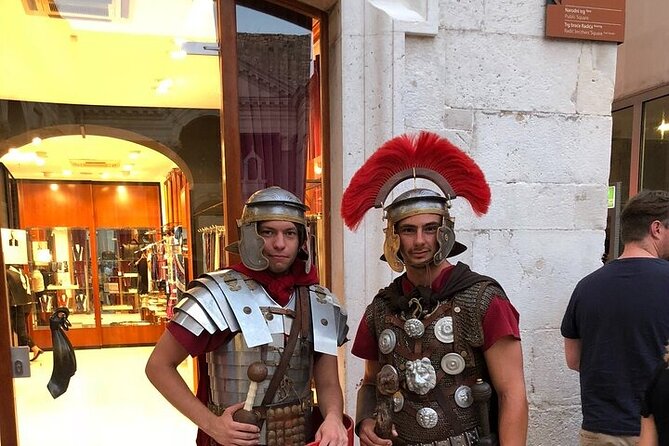
The Golden Gate is the main entrance to Diocletian’s Palace and one of the route’s most recognizable stops. The guide explains the gate, then introduces the statue of Gregory of Nin and his importance to Croatian history and language.
This is where the tour moves beyond Roman Split. Gregory of Nin was a medieval bishop associated with the use of the Croatian language in church services. His statue has become one of the city’s familiar landmarks, and the guide’s explanation helps you see why it matters rather than treating it as another monument to photograph.
The stop lasts about 10 minutes. That gives you time to understand the historical shift from imperial Rome to medieval Croatia. It also gives you a chance to notice how the old gate still functions as part of the city’s daily routes.
If you are using this tour to get your bearings, the Golden Gate is especially helpful. It marks one side of the palace and helps you understand how the ancient complex fits into modern Split.
Riva Harbor and the city beyond the walls
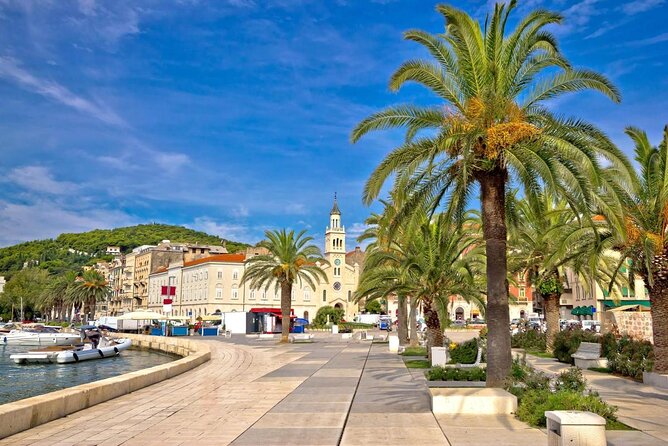
The walk then reaches Riva Harbor, Split’s well-known waterfront promenade. Here you see a bronze model of Diocletian’s Palace and hear about the history of the Riva.
The model is a useful touch. After walking through tight lanes and enclosed palace spaces, you can view the whole complex in a more organized form. It gives you a clearer sense of the palace’s shape and position in relation to the harbor.
This stop lasts about 15 minutes, tying the ancient palace to Split’s public waterfront. The Riva is not only a place for a stroll. It also helps explain why Split developed as a port city and why the palace remains connected to everyday urban life.
I would use this part of the tour to ask practical questions about the area you want to visit later. The route returns to the starting point, but the harbor stop gives you a good sense of where the old center meets the broader city.
Fruit’s Square and the Venetian chapter
Fruit’s Square, officially Trg Braće Radić, brings in a later period. The guide explains the 15th-century Venetian citadel and the importance of Marko Marulić, often described as the father of Croatian literature.
This is one of the tour’s best choices because it prevents the visit from becoming only a Roman history lesson. Split’s identity was shaped over many centuries, and the Venetian presence is part of that story.
Marko Marulić adds a cultural angle. You are not only seeing a fortress or an old square. You are learning about a major Croatian literary figure and how language and writing helped shape national culture.
The stop takes about 10 minutes. That is enough for a clear introduction, though anyone interested in Marulić or Venetian military architecture may want to explore further independently.
Passing Split’s 16th-century synagogue
The final listed stop is the Split Synagogue. The route passes by the 16th-century building and explains the history of the Jewish community in Split.
This is a brief but important inclusion. It shows that the city’s past cannot be reduced to emperors, fortifications, and grand public squares. A synagogue in the old center points to the religious and commercial communities that helped form urban life.
The synagogue stop lasts about 10 minutes. Admission is not included, and the description presents this as a pass-by visit rather than a guaranteed interior tour. If entering the synagogue is important to you, confirm the arrangements before booking.
I appreciate the stop because it adds a human scale to the walk. You hear about a community and its place in Split, not just about buildings that survived.
The Italian guiding makes the difference
The strongest praise for this experience centers on the guides’ preparation, kindness, and ability to explain the city in Italian. Maria is specifically praised for her help with Split’s history, while Doris is repeatedly described as professional, prepared, interesting, and clear.
The wording of the feedback also points to a certain style. The guides are described as funny, captivating, and able to share stories and secrets of the city. Another recurring point is that the guide appears to love Split, and that enthusiasm comes through in the way local curiosities are explained.
That matters on a short tour. With only 90 minutes, you need a guide who can choose useful details and keep the walk moving. A dry list of dates would make the palace harder to remember. The strongest comments suggest that the guides make the material easier to follow.
The guide assigned to your tour may not be Maria or Doris, so you should not book on the assumption that a particular person is guaranteed. Still, the repeated praise for Italian delivery and personal warmth is a good sign for anyone who wants more than a basic translation of an English tour.
Price, group size, and overall value
At $69.39 per person, this is not the cheapest way to see Split. The value depends heavily on how many people are in your booking. Because this is a private activity, only your group participates. That can make the cost reasonable for two or more people who want a focused Italian-language walk and the freedom to ask questions.
The price includes the guide, but not gratuities. The listed stops themselves have no admission charge, although the synagogue does not include admission and the substructure museum is outside the tour. In practical terms, you are paying for the guide’s organization, language skills, explanations, and ability to connect the sights.
For one person, the price is harder to justify unless Italian guiding is a high priority. For a couple, family, or small group, the private format is more attractive. Group discounts may also improve the calculation, so check the final total before deciding.
The tour is offered daily between 9:00 a.m. and 8:00 p.m. during the stated operating period. Confirmation is sent within 48 hours, subject to availability. Free cancellation is available up to 24 hours before the start time. After that point, the amount paid is not refunded, and changes are not accepted. The activity also requires a minimum number of participants, so a cancellation for that reason may result in another date or a full refund.
Who should book this walking tour
I would recommend this experience to Italian-speaking couples, families, and small groups who want a short introduction to Split’s central sights. It suits people who enjoy history but do not want a long lecture or a full-day program.
It is also a good first activity after arriving in Split. The route gives you a mental map of the palace, harbor, main gate, and nearby squares. Afterward, you can return to the places that caught your interest.
You should think twice if you have trouble with high steps. The tour is on foot and includes historic spaces where the surfaces and access may not be as easy as in a modern museum. Most people can participate, and service animals are allowed. The meeting point is near public transportation.
The tour is less suitable if you want a long visit inside the substructures museum, a guaranteed musical performance, or an extended synagogue visit. Those are not the main purpose of this walk.
FAQ
Where does the tour begin and end?
It begins at Peristil ulica, Peristil ul., 21000 Split, Croatia, at the Peristyle of Diocletian’s Palace. The activity ends back at the same meeting point.
How long does the walking tour last?
The tour lasts approximately one hour and 30 minutes.
Is this a private tour?
Yes. Only your own group participates in the activity.
Is the tour conducted in Italian?
Yes. The experience is designed as an Italian-language history walking tour.
Is the substructure museum included?
No. The tour visits the palace substructures but does not include the museum section. You can visit that museum after the tour.
What happens if I need to cancel?
You can receive a full refund if you cancel at least 24 hours before the experience start time. Cancellations or changes made less than 24 hours before the start time are not refunded or accepted.
Should you book it?
Book this tour if you want an Italian-speaking guide, a private group setting, and a well-paced introduction to Split’s Roman, medieval, Venetian, literary, and Jewish history. The strongest reason to choose it is the guiding. Maria and Doris receive especially warm praise for clear, engaging explanations, but the individual guide is not guaranteed.
The tour offers good value for a couple or small group that wants context before exploring alone. It is less compelling for a solo visitor on a tight budget, or for anyone seeking detailed museum time. Wear comfortable shoes, be ready for high steps, and leave room in your schedule to return to the substructures museum if the archaeology catches your interest.
More History Tours in Split
- Walking Tour of Split with a ‘Magister’ of History
★ 5.0 · 1,122 reviews - Split Walking Tour with Professor of History
★ 5.0 · 926 reviews - Split: History and Heritage Walking Tour
★ 4.9 · 650 reviews - Split History and Gastro Small-Group Tour with Food and Drinks
★ 5.0 · 375 reviews
Just added around Split
- Walking Tour Split★ 4.7 · 61 reviews
- Unique vintage Tomos moped tour Split – Back to the ’80s★ 4.8 · 17 reviews
- Trogir: White Lagoon, Maslinica & Blue Lagoon Speedboat Tour★ 4.8 · 11 reviews
- Essential Diocletian’s Palace Tour for First-Time Visitors★ 4.8 · 19 reviews
- Split: Trogir Open Top Bus Trip + Free Split Walking Tour★ 4.1 · 17 reviews
- Trogir; Private walking tour of higlights of Trogir★ 4.7 · 3 reviews
- Trogir: Old Town Guided Walking Tour★ 4.6 · 76 reviews
- TROGIR: Blue Lagoon & 3 Islands Half-day Speedboat tour★ 4.6 · 28 reviews
Walking Tours, compared.
Walking Tour of Split and Diocletian’s Palace
Read our review →

Krka Waterfalls tour with Trogir Walking tour and Krka panoramic boat cruise
Read our review →
City Walls Early Morning or Sunset Walking Tour
Read our review →Browse the lists this tour appears in