
Reviewed · WALKING TOURS
Private History and Trivia Walking Tour by a Local Guide
Split reveals itself one stone at a time. This private walking tour packs the city’s Roman, medieval, and modern stories into about 1 hour 45 minutes, with a local guide leading you through Diocletian’s Palace and the old town. I especially like the route’s strong mix of major sights and smaller details, including narrow streets, noble family palaces, and old city gates. I also like the chance to ask questions as you go, rather than simply follow a script.
The main drawback is the brisk pace. You visit many places, but most stops last only three to ten minutes, and the price of $53.95 per person is easier to justify for a couple or small private group than for someone who wants long interior visits.
In This Review
- The essential points before you book
- Why this is a smart first look at Split
- Starting on the Riva beside the palace wall
- Entering through the Bronze Gate and palace substructures
- The Peristyle, cathedral, and Temple of Jupiter
- Fruit’s Square and Split’s later growth
- Piazza, noble palaces, and the old City Hall
- Iron Gate, old palaces, and the City Museum
- The Golden Gate and Grgur Ninski
- Ending on Marmontova Street
- What $53.95 buys you
- Who will enjoy this walk most
- Practical details that affect your day
- Should you book the Split history and trivia walk?
- FAQ
- How long does the walking tour last?
- What is the price?
- Is the tour private?
- Which languages are available?
- Where does the tour begin?
- What places are included on the route?
- Can I cancel for a full refund?
The essential points before you book
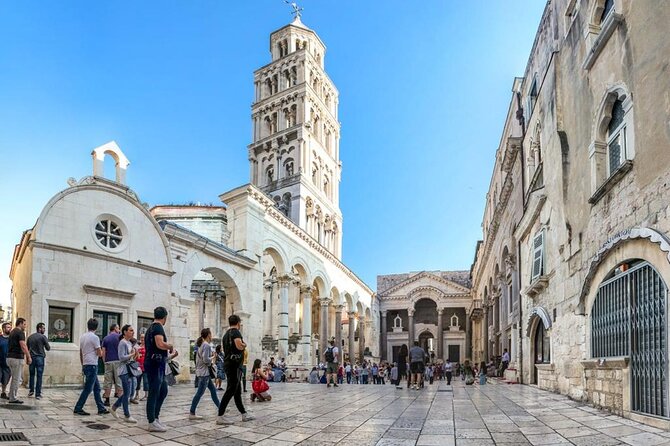
- Roman Split in a short walk: Cover Diocletian’s Palace, its substructures, the Peristyle, the Cathedral of Saint Domnius, the Temple of Jupiter, and the Golden Gate.
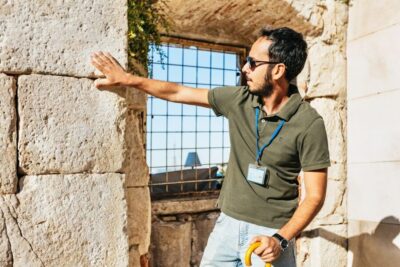
- A local guide named Ivan: Ivan is praised for his humor, friendly manner, strong command of history, and ability to answer detailed questions in English, French, Italian, and other listed languages.
- A useful first look at the city: The route helps you understand how Roman Split grew into a medieval and modern town.
- Small, private format: Only your group takes part, with a maximum group size of 15 people.
- Good for families: Children aged 5, 7, and 12 were successfully included in past tours, helped by the guide’s stories and approachable style.
- A walking-only route: You reach narrow streets and palace spaces that buses cannot enter, but comfortable shoes are important.
Why this is a smart first look at Split
Split can feel confusing at first. The old city is not arranged like a neat museum district. Ancient walls form the bones of the center, homes and shops occupy former palace rooms, and busy squares sit beside fragments from Roman times.
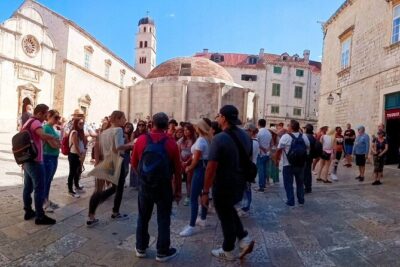
That is why I see this tour as a useful orientation walk. You begin on the Riva promenade, enter the palace through the Bronze Gate, cross the Peristyle, pass the cathedral and Temple of Jupiter, and continue through several historic squares and gates. By the end, you have a basic map in your head and a better sense of what deserves a longer visit later.
The route also gives you more than a list of dates. The guide explains how Diocletian’s mausoleum became a cathedral, how a Roman temple became a Christian baptistery, and how noble families shaped the later town. Those changes are the real story of Split: old buildings were not sealed away. They were reused, altered, and folded into daily life.
I particularly value the local angle. The guide shares customs, practical city advice, and small anecdotes alongside the standard history. Ivan receives especially strong praise for being warm, humorous, and willing to answer questions in depth. That matters on a short tour, because a good explanation can make even a five-minute stop worthwhile.
More Walking Tours in Split
- Split: Old Town and Diocletian Palace Walking Tour
★ 4.9 · 4,727 reviews - Walking Tour of Split and Diocletian’s Palace
★ 5.0 · 2,588 reviews - Krka Waterfalls tour with Trogir Walking tour and Krka panoramic boat cruise
★ 5.0 · 1,659 reviews
Starting on the Riva beside the palace wall
The meeting point is at Obala Hrvatskog narodnog preporoda 22, on the Riva harbor promenade. This is a practical place to start because you immediately see the southern wall of Diocletian’s Palace, Split harbor, and the eastern and western stretches of the waterfront.
Your guide uses the first ten minutes to explain the setting. The Riva is not just a pleasant place for a coffee. It helps you understand the palace’s position beside the sea and why the waterfront remains central to Split’s identity.
This opening is free, with no admission ticket required. It also gives you a chance to settle into the pace before entering the tighter streets of the old center.
Entering through the Bronze Gate and palace substructures
From the waterfront, you enter the palace through the southern Bronze Gate. The walk then continues into the substructures, where the guide explains how these lower spaces were used through different periods.
The substructures are useful because they show the palace’s original plan from below. They also help explain why the upper streets feel so unusual. Split’s old center was built over the Roman palace, so ancient foundations and later homes share the same footprint.
The scheduled stop here is about eight minutes. That is enough for an overview, but not a long exploration of every chamber. If you want to spend more time below ground, ask the guide for advice on returning later and checking what admission options are available. Personal expenses are not included in the tour price.
The Peristyle, cathedral, and Temple of Jupiter
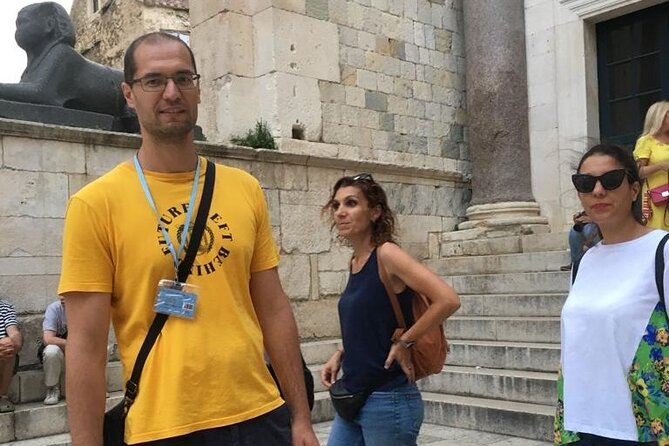
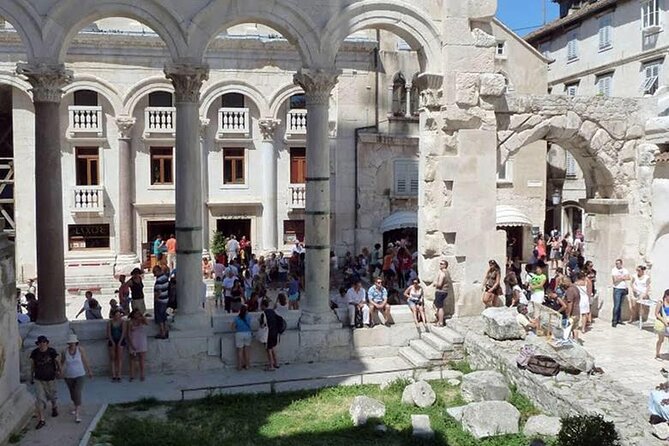
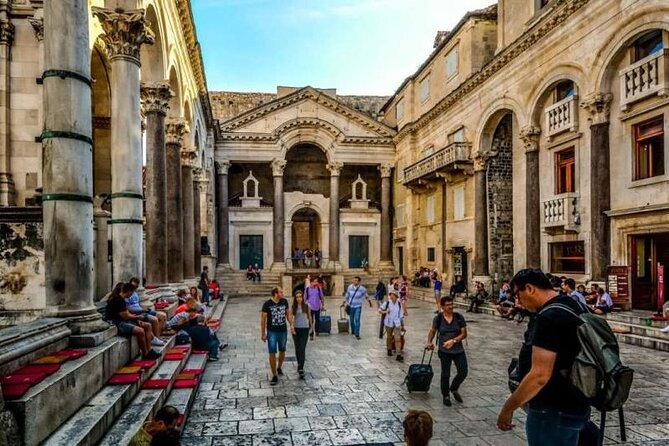
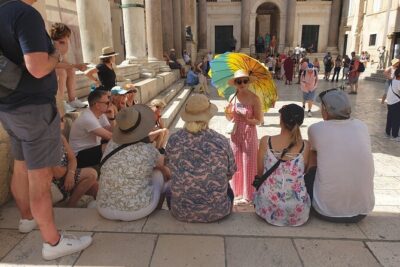
The Peristyle is the center of the palace route and receives about ten minutes. This ancient square is where the Roman plan becomes easiest to read. The guide explains its historical and cultural role, giving you context before you move on to the nearby religious buildings.
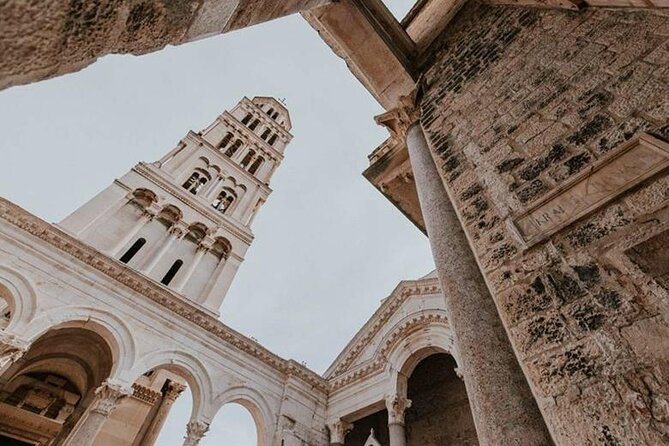
The Cathedral of Saint Domnius receives a shorter stop of about five minutes. The key point is its unusual transformation. The building began as the mausoleum of Emperor Diocletian and later became a cathedral. The guide also covers the construction style of the cathedral and its adjacent bell tower.
That explanation is more useful than simply hearing that the cathedral is old. You learn to look for the tension between the building’s original Roman purpose and its later Christian use.
Next comes the Temple of Jupiter, also in the palace area. The stop lasts about five minutes, focusing on how the temple became a baptistery as Christianity spread inside the palace walls. The sphinx in front adds another layer to the story and gives you a striking visual detail to remember.
I like this part of the tour because three stops connect naturally. The palace was not abandoned after Roman rule. It changed purpose, and those changes are visible within a very small area.
Still Split, at a slower pace:
- Split: Krka Waterfalls Trip with Boat Cruise and Swimming
★ 4.8 · 10,519 reviews - From Split: Krka Waterfalls, Food & Wine Tasting Tour
★ 5.0 · 9,326 reviews - Blue cave, Mamma Mia and Hvar, 5 islands speedboat tour
★ 5.0 · 7,150 reviews - From Split: Krka Waterfalls, Food & Wine Tasting Tour
★ 4.9 · 6,598 reviews
Fruit’s Square and Split’s later growth
You leave the Peristyle through the narrow street known as Pusti me Proć, described as the narrowest street in Split. Even a quick walk through a tight passage like this helps you see how different the old center feels from a conventional Roman ruin site.
Fruit’s Square, or Trg Brace Radic, is the next main stop and lasts around seven minutes. Here the focus shifts from the emperor’s palace to the development of Split as a town. The guide discusses periods when growth was limited and how the city changed beyond the original Roman walls.
You also pass the statue of Marko Marulić, regarded as the father of Croatian literature. Behind it is the 17th-century Milesi family palace. These details give the square a human scale. You are no longer looking only at imperial architecture. You are also seeing the homes and public spaces connected with Split’s later social history.
The short timing means you should expect explanation rather than a formal visit inside each building. Still, this is one of the places where a local guide can add value by pointing out details you might otherwise walk past.
Piazza, noble palaces, and the old City Hall
Narodni trg, commonly called Piazza, is the main square in Split and receives about ten minutes. The guide explains how it developed into the town’s central square as Split expanded beyond the palace.
This stop brings together several later buildings. You pass the old City Hall and palaces once owned by noble families. The route also identifies a palace at the eastern end of the square belonging to a noble family from Korčula, along with other aristocratic residences.
I find this part important because it prevents the tour from becoming only a Roman history lesson. Diocletian’s Palace gets most of the attention in Split, but the city continued to grow around and through it. Piazza helps you see the transition from imperial center to medieval and later civic town.
The walk is also a good place to ask about local customs or areas you want to explore after the tour. The guide’s role here is not just to point at facades. It is to explain how the square functioned as the town expanded.
Iron Gate, old palaces, and the City Museum
The route continues to Zeljezna Vrata, the Iron Gate. The gate has been used for different activities over time, and the guide explains its changing role. You also pass more aristocratic buildings, including a palace connected with the wealthy Cindro family from the 17th century and another associated with the Italian Augubio family from the 15th century.
This stretch rewards close attention. You may not remember every family name, but the repeated palaces show how wealthy households left their mark on the city’s streets.
The City Museum of Split is located in Papalic Palace. The scheduled stop here is only about three minutes, so you should not expect a museum visit during the tour. Instead, the guide points out the building and explains its importance.
There is also a connection to Game of Thrones. A bloody scene takes place in front of Papalic Palace, giving fans a small piece of screen history alongside the older layers of the city. If that interests you, this is a good moment to ask the guide for more local filming information, although the tour remains primarily historical.
The Golden Gate and Grgur Ninski
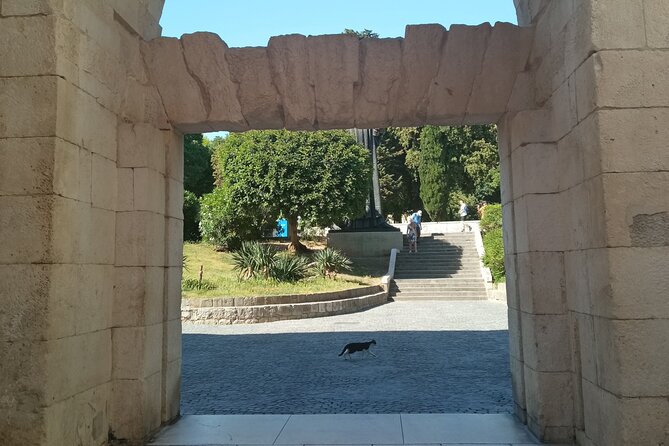
The Golden Gate is the northern entrance to Diocletian’s Palace and one of the most impressive exterior sights on the route. The guide discusses its design and the Roman building skill behind it. You have about seven minutes here, enough to appreciate the decoration and understand why this gate is often treated as the palace’s grandest entrance.
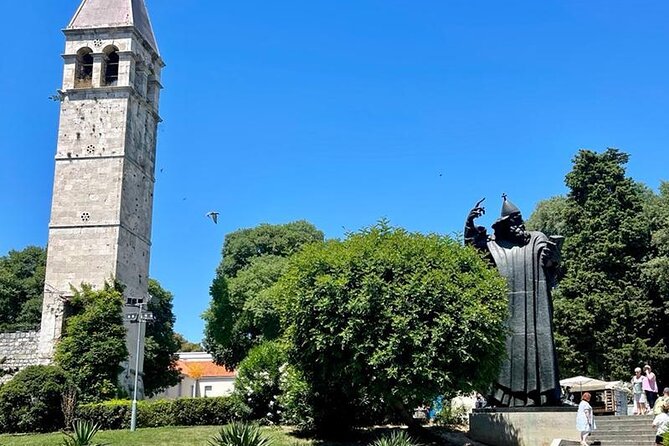
Opposite the gate is the large statue of Grgur Ninski, or Bishop Gregory of Nin, created by Croatian sculptor Ivan Meštrović. The stop lasts about five minutes. The guide explains the bishop’s importance and gives you context for the statue’s place in Croatian culture.
This is one of the easiest places to add a small local tradition to your own visit. The statue is famous, and its toe is polished by people touching it. The supplied tour details do not promise a specific ritual explanation, so ask your guide if you want to know more while you are there.
Beside the statue, you see the Bell Tower of Saint Arnir, the chapel of Saint Arnir, and remains of an early Christian church. Another five-minute explanation links the buildings to the religious and architectural changes already discussed at the cathedral and Temple of Jupiter.
Ending on Marmontova Street
The final stop is at the top of Marmontova Ulica, with about eight minutes overlooking the Croatian National Theater and the Monastery and Church of Our Lady of Health.
The guide covers the history of the short-lived French period in Split. This gives the tour a later chapter after its Roman, medieval, and noble-family sections. It also helps you see that Split’s story did not stop with Diocletian or the Venetian era.
The route description says the walk finishes here, while the booking details state that the activity ends back at the meeting point. Since those details do not match perfectly, I would confirm the exact end point before booking, especially if you have a timed ferry, restaurant reservation, or other appointment.
What $53.95 buys you
At $53.95 per person, this is not the cheapest way to see Split. The value depends on how much you want from the guide.
You are paying for a private experience, a licensed local guide, a carefully arranged route, and the ability to ask questions. The fee also covers several languages: English, French, German, Spanish, and Italian. For a couple, family, or small group that wants direct attention, the price can make sense.
Group discounts are available, which may improve the value for a larger party. The maximum group size is 15, but the activity is private, meaning only your own group participates. You do not share the guide with an unrelated crowd.
The tour does not include personal expenses or entry tickets. Most stops are viewed from the outside, and the listed admission cost for the stops is free. I would think of this as a guided orientation walk rather than a package that includes every interior attraction.
The fact that it is often reserved about 91 days ahead suggests that you should not leave it until the last minute if your schedule is fixed. The operating hours supplied for the current booking period, June 29, 2022 through September 18, 2026, are Monday through Friday from 8:00 a.m. to 1:30 p.m. Confirm the available start time for your date before you pay.
Who will enjoy this walk most
I would choose this tour if you want a fast, structured introduction to Split and prefer to learn from a local rather than read signs on your own.
It is a good fit for:
- First-time visitors with limited time
- Couples who want a private guide
- Families with children
- People interested in Roman and Croatian history
- Anyone who wants practical advice for exploring more of Split
- French, German, Spanish, Italian, or English speakers
The family feedback is particularly useful. Children aged 5 and 7 were included successfully, and another family found the tour suitable for a 12-year-old. That does not mean every child will love 1 hour 45 minutes of history, but Ivan’s humor and friendly manner appear to help.
I would be more cautious if you want a slow photographic walk, extensive museum time, or long visits inside the cathedral and palace substructures. The route covers a lot, and the short stops keep it moving.
Practical details that affect your day
The tour begins on the Riva at the stated meeting point, near public transportation. You should arrive ready to walk on old streets and through narrow passages. Most people can participate, and service animals are allowed.
The guide speaks the language selected at booking, with English, French, German, Spanish, and Italian listed as options. Ivan is specifically praised for fluent French and Italian as well as his English delivery, along with his patience when answering questions.
The cancellation policy is straightforward. You receive a full refund if you cancel at least 24 hours before the start time. Cancellations or changes made within 24 hours are not refunded or accepted, and the cut-off follows local Split time.
I would also keep your schedule slightly flexible at the end. The route description finishes at Marmontova Street, but the formal end point says the activity returns to the meeting point. That is a small detail, yet it matters when you are planning transport or a fixed appointment.
Should you book the Split history and trivia walk?
Book it if you want a private, lively introduction to Split and value explanations more than long interior visits. Ivan’s friendly style, humor, language ability, and willingness to answer questions are major strengths, and the route covers an impressive number of important places in less than two hours.
The best value comes when you use the walk as a starting point. Listen for the places you want to revisit, ask for local suggestions, and return later to spend more time in the substructures, cathedral, museum, or palace squares.
Skip it if you already know Split well or want an unhurried, single-site visit. For everyone else, especially first-time visitors with a tight schedule, this is a practical way to get oriented and understand why Split feels less like a ruin and more like a living city built inside an ancient palace.
FAQ
How long does the walking tour last?
The tour lasts approximately 1 hour and 45 minutes.
What is the price?
The listed price is $53.95 per person. Group discounts are available.
Is the tour private?
Yes. Only your group participates, with a maximum group size of 15 people.
Which languages are available?
The included licensed guide may speak English, French, German, Spanish, or Italian.
Where does the tour begin?
The meeting point is Obala Hrvatskog narodnog preporoda 22, 21000 Split, Croatia, on the Riva harbor promenade.
What places are included on the route?
The route includes the Riva, Diocletian’s Palace substructures, the Peristyle, Cathedral of Saint Domnius, Temple of Jupiter, Fruit’s Square, Narodni trg, the Iron Gate, City Museum of Split, Golden Gate, Grgur Ninski Statue, Bell Tower of Saint Arnir, and Marmontova Street.
Can I cancel for a full refund?
Yes. You can cancel at least 24 hours before the experience start time for a full refund. Cancellations or changes made less than 24 hours before the start time are not refunded or accepted.
More History Tours in Split
- Walking Tour of Split with a ‘Magister’ of History
★ 5.0 · 1,122 reviews - Split Walking Tour with Professor of History
★ 5.0 · 926 reviews - Split: History and Heritage Walking Tour
★ 4.9 · 650 reviews - Split History and Gastro Small-Group Tour with Food and Drinks
★ 5.0 · 375 reviews
Just added around Split
- Walking Tour Split★ 4.7 · 61 reviews
- Unique vintage Tomos moped tour Split – Back to the ’80s★ 4.8 · 17 reviews
- Trogir: White Lagoon, Maslinica & Blue Lagoon Speedboat Tour★ 4.8 · 11 reviews
- Essential Diocletian’s Palace Tour for First-Time Visitors★ 4.8 · 19 reviews
- Split: Trogir Open Top Bus Trip + Free Split Walking Tour★ 4.1 · 17 reviews
- Trogir; Private walking tour of higlights of Trogir★ 4.7 · 3 reviews
- Trogir: Old Town Guided Walking Tour★ 4.6 · 76 reviews
- TROGIR: Blue Lagoon & 3 Islands Half-day Speedboat tour★ 4.6 · 28 reviews
Walking Tours, compared.
Walking Tour of Split and Diocletian’s Palace
Read our review →

Krka Waterfalls tour with Trogir Walking tour and Krka panoramic boat cruise
Read our review →
City Walls Early Morning or Sunset Walking Tour
Read our review →Browse the lists this tour appears in