
Reviewed · WALKING TOURS
History Split Walking Tour in German – Small group
A Roman palace still works as a neighborhood. This German-language walking tour gives you a clear introduction to Split through Diocletian’s Palace, with well-prepared guides and a compact route that connects Roman, medieval, Venetian, and modern stories. I like the focus on major sights, and I especially like that the guide welcomes questions instead of racing through a fixed script.
The tour also includes the palace substructures, the Golden Gate, Riva Harbor, Fruit’s Square, and Split’s old synagogue. The main drawback is the $165.08 per-person price for about 90 minutes, which feels high unless you value German-language guiding, a small group, and a strong historical overview.
In This Review
- Key points at a glance
- Why Diocletian’s Palace makes a good first tour
- Meeting at the Peristyle, Split’s grand Roman stage
- The Vestibule and the sound of Dalmatia
- Going below ground in the palace substructures
- The Golden Gate and Gregory of Nin
- Riva Harbor and Split’s changing waterfront
- Fruit’s Square and the Venetian chapter
- Passing Split Synagogue
- The guide style: serious history without a stiff lecture
- Price, length, and what you receive
- Practical advice before you go
- Who should book the German Split walking tour?
- FAQ
- How long does the History Split Walking Tour last?
- What language is the tour conducted in?
- Where does the tour begin?
- Where does the tour finish?
- Is admission to the palace substructures museum included?
- Can I cancel for a full refund?
- Should you book it?
Key points at a glance
- German-language history tour: Learn how Diocletian rose from an unknown soldier to one of the Roman world’s most powerful rulers.
- Seven central stops: The route covers the Peristyle, Vestibule, substructures, Golden Gate, Riva, Fruit’s Square, and Split Synagogue.
- Small-group format: The group can include up to 20 people, allowing some room for questions and conversation.
- Guides praised for humor and clarity: Antonella, Josip, and Marko are named in past comments, with special praise for their storytelling and answers.
- A useful first activity in Split: The tour finishes close to its starting point, making it easy to continue exploring on your own.
- Watch your footing: High steps may be difficult for some people, and the 90-minute route involves standing and walking.
Why Diocletian’s Palace makes a good first tour
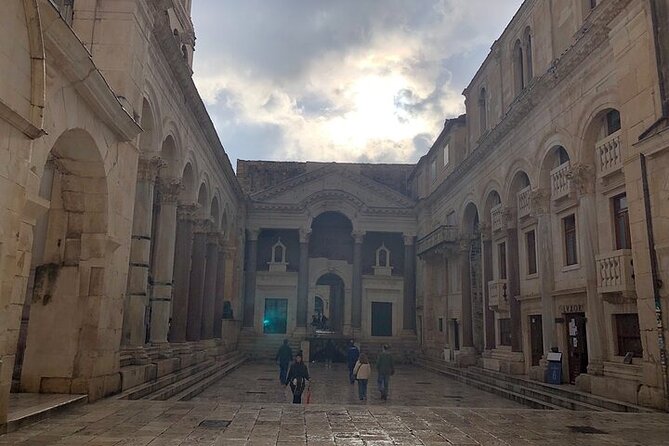
Split’s old center is not a single archaeological site behind a fence. Diocletian’s Palace is woven into the living city. Homes, shops, lanes, cafés, churches, and public squares occupy spaces first planned for a Roman emperor. That can make the place confusing at first, especially when ancient walls seem to disappear into later buildings.
A guide helps you read those layers. Instead of seeing a collection of attractive stone streets, you begin to understand how the palace was laid out, where the emperor’s private and public worlds met, and how later residents adapted the complex over many centuries.
The tour also gives you a useful story arc. You start at the palace center, move through its ceremonial spaces and underground foundations, then step into the wider old town. At the end, you have seen both the Roman core and the later city that grew around it.
This is not a museum-heavy experience. You will not visit the museum section of the substructures during the walk, although you can return afterward. That choice keeps the tour moving, but it also means you should visit the museum separately if you want a closer look at displayed objects and archaeological material.
More Walking Tours in Split
- Split: Old Town and Diocletian Palace Walking Tour
★ 4.9 · 4,727 reviews - Walking Tour of Split and Diocletian’s Palace
★ 5.0 · 2,588 reviews - Krka Waterfalls tour with Trogir Walking tour and Krka panoramic boat cruise
★ 5.0 · 1,659 reviews
Meeting at the Peristyle, Split’s grand Roman stage
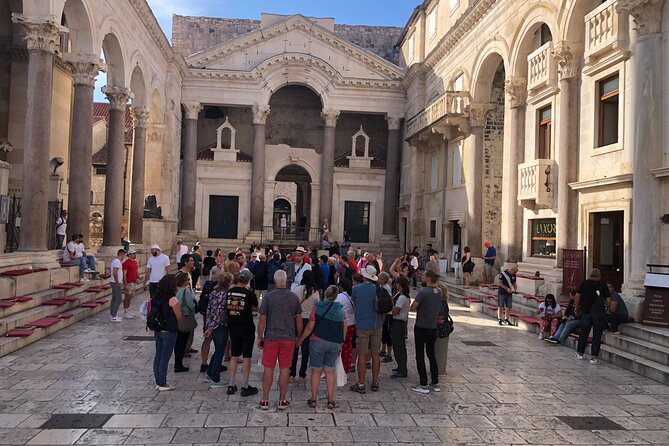
The meeting point is on Peristil ulica, at the Peristyle, the central square of Diocletian’s Palace. This is a practical place to begin because so many routes through the palace lead from here.
The Peristyle was designed as a formal approach to the emperor’s apartments and mausoleum. Its scale and stonework make more sense once a guide explains the political purpose behind the space. This was not simply a pretty courtyard. It was a stage for power, ceremony, and controlled access to the emperor.
The guide spends about 15 minutes here. That is enough time to establish the palace plan and explain why this square matters before moving into the tighter lanes. I like this opening because it gives you a mental map early, something you will need once the route leaves the broad central space.
Expect some uneven surfaces and normal old-town foot traffic. The palace is an active part of Split, not a quiet ruin, so the experience depends partly on your ability to listen in a public square.
The Vestibule and the sound of Dalmatia
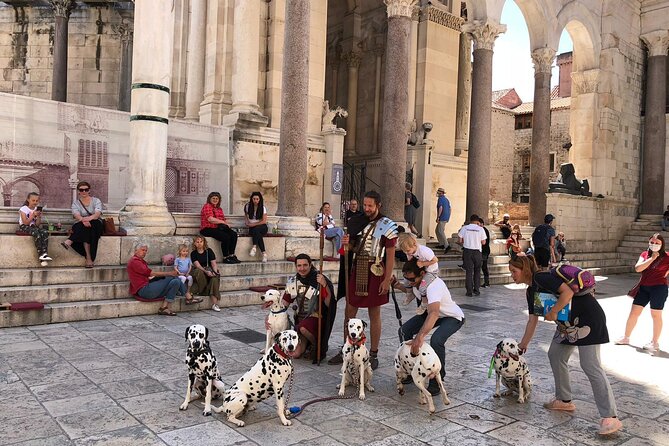
The next stop is the Vestibule, a circular entrance space connected with Diocletian’s imperial residence. The stop lasts about five minutes, but it offers a sharp change from the open Peristyle.
The Vestibule’s shape and acoustics make it a memorable place to pause. You may hear traditional Dalmatian singing there, an appealing link between the ancient setting and local culture. The information provided does not promise a performance every time, so treat it as a possibility rather than a scheduled feature.
This brief stop works best as part of the larger route. It is not meant to provide a long architectural lecture. Instead, it helps you picture how visitors once moved toward the emperor’s private quarters.
The guide’s style matters here. Several German-language comments describe the tours as lively, friendly, and entertaining, with room for questions. Antonella receives particular praise for humor and clear explanations, while Josip is noted for answering all kinds of questions. Those details suggest a good fit if you prefer conversation over a dry list of dates.
Going below ground in the palace substructures
The substructures are one of the most useful parts of the tour. Their layout reflects the rooms above, so they help explain the palace’s original plan. Your guide discusses how they were built and how their function changed over time.
The underground area also gives you a different view of the palace’s survival. Instead of only looking at decorated façades, you see the construction logic beneath them. The cellars help connect the grand imperial project with the practical work needed to support it.
You spend about 10 minutes here and do not enter the museum portion. That limit is worth noting. If you want a longer archaeological visit, plan time after the walking tour to explore the museum area on your own.
For many people, this is the point where the palace becomes easier to understand. Above ground, later buildings can hide the Roman structure. Below ground, the original arrangement is easier to trace.
Still Split, at a slower pace:
- Split: Krka Waterfalls Trip with Boat Cruise and Swimming
★ 4.8 · 10,519 reviews - From Split: Krka Waterfalls, Food & Wine Tasting Tour
★ 5.0 · 9,326 reviews - Blue cave, Mamma Mia and Hvar, 5 islands speedboat tour
★ 5.0 · 7,150 reviews - From Split: Krka Waterfalls, Food & Wine Tasting Tour
★ 4.9 · 6,598 reviews
The Golden Gate and Gregory of Nin
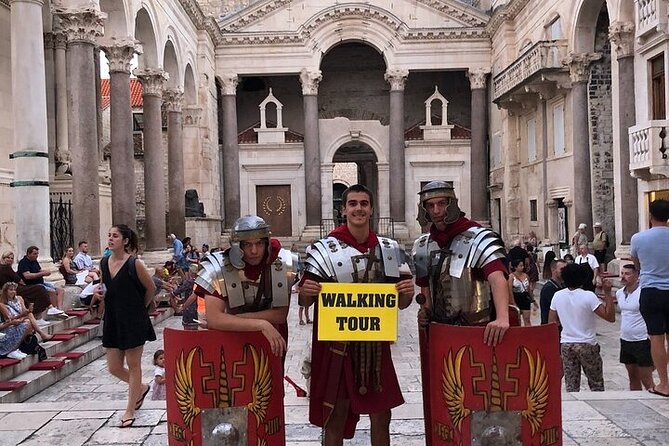
The Golden Gate was the palace’s main entrance and one of its most important public faces. The guide explains its role and then introduces the statue of Gregory of Nin nearby.
Gregory of Nin is tied to Croatian language and cultural identity, making this stop a useful shift from imperial Roman history to Croatian national history. You are not only looking at an old gate. You are also learning how later generations chose figures and symbols to express their own identity.
The stop lasts about 10 minutes. That is enough for a focused explanation, though you should not expect a full treatment of Croatian political and cultural history. The tour’s goal is to give you the key connection, then keep moving.
This is also a good place to ask questions. The strongest comments about the guides repeatedly point to their willingness to handle questions beyond the basic route. If something about the language, statue, or city’s later development catches your attention, this is the kind of tour where asking is encouraged.
Riva Harbor and Split’s changing waterfront
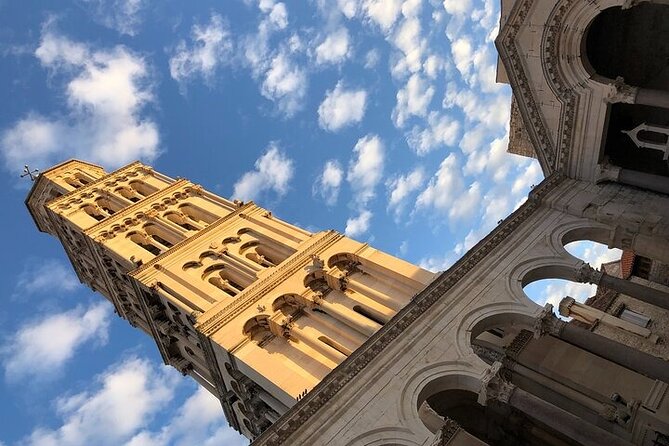
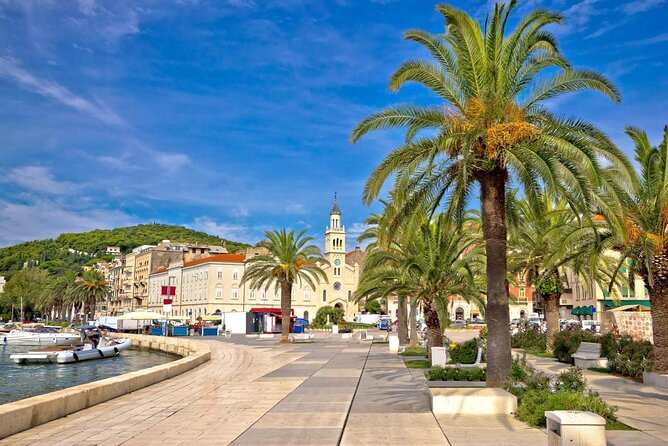
From the palace, the route reaches Riva Harbor, the broad waterfront promenade. You see a bronze model of Diocletian’s Palace and hear about the history of the Riva.
The model is especially useful because it gives you a view of the whole complex. After walking through narrow passages and separate rooms, you can step back and see how the palace related to the waterfront and the wider city.
The Riva stop takes about 15 minutes, one of the longer pauses on the route. It gives the guide time to explain how Split changed beyond the Roman walls and how the waterfront became part of the city’s public life.
I like this stop for practical reasons, too. It helps you orient yourself. Afterward, you can better judge where the palace ends, where the modern waterfront begins, and how to plan the rest of your day.
The route is still a walking tour, not a scenic cruise or a dedicated harbor excursion. The value here comes from context, not from a long period devoted to views.
Fruit’s Square and the Venetian chapter
Fruit’s Square, also called Trg Braće Radić, brings you into a later period of Split’s story. Here, the guide discusses a 15th-century Venetian citadel and the importance of Marko Marulić, often described as the father of Croatian literature.
This stop shows why a palace tour should not stop with Diocletian. Split’s identity was shaped by several powers and cultures, and the old town contains those layers close together. The Venetian fortification and the literary legacy of Marulić make the city feel less like a preserved Roman monument and more like a place that kept changing.
You spend about 10 minutes here. The explanation is likely to be an introduction rather than a detailed study of Venetian rule or Croatian literature. Still, it adds breadth to the tour and gives you names and subjects to explore later.
The square is also a good example of the tour’s balance. You get Roman architecture, medieval and Venetian history, and Croatian cultural references in a single short walk.
Passing Split Synagogue
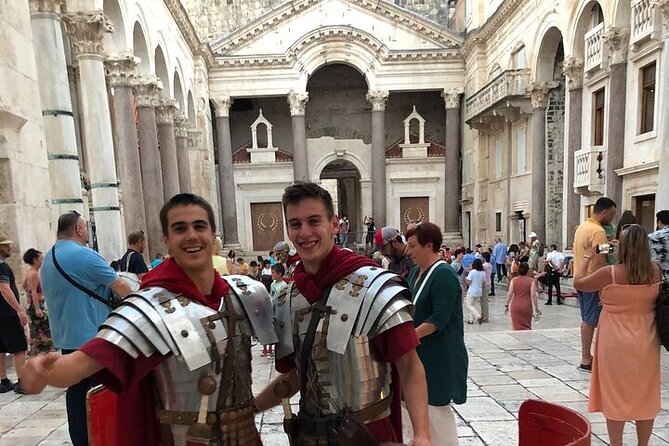
The final listed stop is Split Synagogue, a 16th-century synagogue. The guide explains the history of the Jewish community in Split as you pass by.
This is a brief but important addition. It reminds you that the city’s past includes religious and cultural communities beyond the best-known Roman and Venetian chapters. Because the stop is a pass-by rather than a synagogue visit, you should not expect an interior tour or museum-style presentation.
The time listed is about 10 minutes, and admission is not included. The supplied information does not state an admission fee or confirm that entry is part of the experience, so plan on viewing the site from the route unless your guide tells you otherwise.
I value this stop because it widens the story without adding a separate detour. It is a small part of the walk, but it helps prevent Split’s history from being reduced to emperors, soldiers, and stone walls.
The guide style: serious history without a stiff lecture
The clearest pattern in the feedback is praise for the guides. Antonella is described as intelligent, enthusiastic, entertaining, and quick with a sense of humor. Josip is praised for friendly answers and strong German-language old-town guiding. Marko is remembered as a history teacher who told interesting stories about the palace.
You should not assume that every departure will have the same guide. Still, these comments give you a useful picture of the guiding style associated with Ancient Tours: informed, approachable, and open to questions.
The German-language format is the main reason to choose this experience over a cheaper general walking tour. Good translation is not just about changing words from one language to another. It affects jokes, historical terms, names, and the ease with which you can ask a follow-up question.
The tour is limited to a maximum of 20 people. That is small enough to remain manageable in the palace’s narrow passages, though it is not a private tour. If the group reaches the maximum, you may still be standing with a crowd at the most popular stops.
Price, length, and what you receive
The listed price is $165.08 per person. For a tour lasting about 90 minutes, that is a serious cost. You are paying for a German-language guide, a small-group setting, and an organized explanation of several major sights. You are not paying for entrance to the museum section of the substructures, and gratuities are not included.
At this price, the tour makes the most sense for someone who places high value on German-language instruction or wants a compact, guided introduction at the beginning of a Split stay. It is harder to justify if you are comfortable exploring independently and mainly want to see the palace’s exterior spaces.
The listed stop times add up to about 75 minutes, while the full activity is approximately 90 minutes. The extra time likely allows for walking between stops, transitions, and questions, but the exact pace can vary.
Group discounts are available, which may improve the cost for people booking together. The tour is also booked an average of 44 days ahead, so early planning is sensible if your dates are fixed.
Practical advice before you go
Wear shoes that handle old stone streets and high steps. The activity is not recommended for people who have trouble with high steps, and the palace’s historic setting means the route may not feel smooth or level.
The meeting point is at the Peristyle, and the tour ends in Diocletian’s Palace not far from the starting place. Ask the guide to take you back to the Peristyle if you need help returning.
You can reach the area using public transportation, and service animals are allowed. Most people can participate, but the steps remain the main physical concern.
Plan your next activity nearby. Since the route finishes close to where it begins, you can continue with the museum section of the substructures, revisit a favorite square, or explore the old town without losing time on a long transfer.
Free cancellation is available if you cancel at least 24 hours before the local start time. Cancellations or changes made within 24 hours are not accepted for a refund. The tour also requires a minimum number of participants, and if that minimum is not reached, you will be offered another date or experience, or a full refund.
Who should book the German Split walking tour?
I would choose this tour if you want the city’s main historical layers explained in German and prefer a guide who can answer questions. It suits first-time visitors who want a firm orientation before exploring the palace independently.
It also works well for a group of friends or family members, especially if a group discount applies. The route is short enough to fit into a busy day, but it covers more than just the emperor’s palace.
I would hesitate if your priority is low cost, a long archaeological visit, or private attention. The price is high for the duration, the group can reach 20 people, and the substructures museum is not included.
FAQ
How long does the History Split Walking Tour last?
The tour lasts approximately 1 hour and 30 minutes.
What language is the tour conducted in?
This experience is conducted in German.
Where does the tour begin?
The meeting point is Peristil ulica at the Peristyle of Diocletian’s Palace in Split.
Where does the tour finish?
It ends in Diocletian’s Palace, not far from the starting point. You can ask the guide to take you back to the Peristyle.
Is admission to the palace substructures museum included?
No. The tour visits the substructures but does not include the museum section. You can visit that part after the tour.
Can I cancel for a full refund?
Yes. You can cancel at least 24 hours before the experience’s start time for a full refund. Cancellations or changes made less than 24 hours before the start time are not refunded or accepted.
Should you book it?
Book this tour if the German-language guide is important to you and you want Split’s Roman, Venetian, Croatian, and Jewish history tied together in one short route. The repeated praise for Antonella, Josip, and Marko suggests a warm guiding style, with humor and time for questions.
Skip it if $165.08 feels out of proportion to 90 minutes or if you are happy using your own guidebook. For the right audience, this is a useful first look at Split, especially when you want the palace to feel like a city with many chapters, not just an impressive Roman courtyard.
More History Tours in Split
- Walking Tour of Split with a ‘Magister’ of History
★ 5.0 · 1,122 reviews - Split Walking Tour with Professor of History
★ 5.0 · 926 reviews - Split: History and Heritage Walking Tour
★ 4.9 · 650 reviews - Split History and Gastro Small-Group Tour with Food and Drinks
★ 5.0 · 375 reviews
Just added around Split
- Walking Tour Split★ 4.7 · 61 reviews
- Unique vintage Tomos moped tour Split – Back to the ’80s★ 4.8 · 17 reviews
- Trogir: White Lagoon, Maslinica & Blue Lagoon Speedboat Tour★ 4.8 · 11 reviews
- Essential Diocletian’s Palace Tour for First-Time Visitors★ 4.8 · 19 reviews
- Split: Trogir Open Top Bus Trip + Free Split Walking Tour★ 4.1 · 17 reviews
- Trogir; Private walking tour of higlights of Trogir★ 4.7 · 3 reviews
- Trogir: Old Town Guided Walking Tour★ 4.6 · 76 reviews
- TROGIR: Blue Lagoon & 3 Islands Half-day Speedboat tour★ 4.6 · 28 reviews
Walking Tours, compared.
Walking Tour of Split and Diocletian’s Palace
Read our review →


Krka Waterfalls tour with Trogir Walking tour and Krka panoramic boat cruise
Read our review →
City Walls Early Morning or Sunset Walking Tour
Read our review →Browse the lists this tour appears in