
Reviewed · WALKING TOURS
History Split Walking Tour in French -Small group
Split keeps its best stories behind stone walls. This French-language walking tour makes Diocletian’s Palace easier to read, from the emperor’s central square to the old harbor and Jewish quarter. I especially like the French-speaking guides, praised for clear explanations and strong command of local history, and the route’s broad coverage of Split’s old center. The main point to weigh is the group size, which can reach 30 people, so small group may feel less intimate at full capacity.
The tour is listed at $69.14 per person and lasts about 90 minutes, though some outings have run beyond two hours. That extra time can be welcome if you enjoy questions and detail, but it may matter if you have a ship departure, dinner booking, or a tight sightseeing plan.
- Diocletian’s Palace in French: Learn the story of Diocletian, who rose from obscurity to become one of the Roman world’s most powerful rulers.
- Seven central stops: The route links the Peristyle, Vestibule, palace substructures, Golden Gate, Riva, Fruit Square, and Split Synagogue.
- Strong guide quality: Antonela, Irene, and other French-speaking guides receive praise for warmth, clear storytelling, and the ability to handle questions.
- A history lesson with local character: The tour may include traditional Dalmatian singing in the Vestibule and covers figures such as Gregory of Nin and Marko Marulić.
- Mostly outdoor sightseeing: Admission is free at the listed stops, but the museum section of the palace substructures is not part of the tour.
- Easy cancellation terms: You can receive a full refund if you cancel at least 24 hours before the start time.
In This Review
- Why Diocletian’s Palace Needs a Guide
- Starting at the Peristyle, Split’s Roman Heart
- The Vestibule and a Possible Dalmatian Song
- Palace Substructures Without the Museum Visit
- The Golden Gate and Gregory of Nin
- Riva Harbor and Split’s Seaside Front Door
- Fruit Square, Venetian Defense, and Croatian Literature
- The Split Synagogue and a Less Familiar Chapter
- French Guides Who Make the Difference
- Timing, Group Size, and Walking Conditions
- Is $69.14 a Fair Price?
- Who Should Book This French Walking Tour?
- Final Verdict: A Smart First Walk in Split
- FAQ
- Where does the tour begin?
- Where does the tour end?
- How long does the tour last?
- Is the tour conducted in French?
- What places are included on the route?
- Is admission to the palace substructures museum included?
- Can I cancel for a full refund?
Why Diocletian’s Palace Needs a Guide
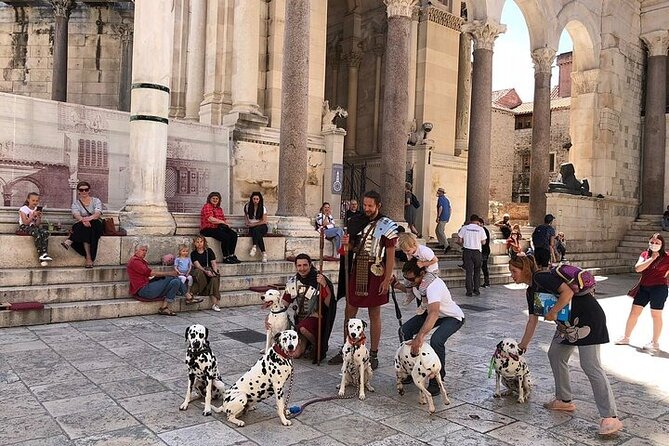
At first glance, Split’s old center can seem like a maze of Roman stone, medieval homes, shops, cafés, and narrow lanes. That mix is part of the fun, but it also makes the palace hard to understand without a map or a good narrator.
Diocletian’s Palace is not simply a preserved Roman monument sitting apart from daily life. It forms the core of Split’s historic center, with people living and working inside and around its ancient walls. The Peristyle serves as the natural starting point because it connects to much of the palace complex.
I like this route because it does not focus on one grand square and then stop. It follows the palace outward, then brings in the harbor, Venetian-era defenses, Croatian literature, and Split’s Jewish past. You get a better sense of how the city changed over many centuries.
The guide also frames Diocletian as a person, not just a name carved into a textbook. The tour explains how he went from an obscure beginning to the highest level of Roman power. That human angle gives the stones a purpose. You start to see the palace as the retirement home and political statement of an emperor who wanted his final residence to carry real authority.
Starting at the Peristyle, Split’s Roman Heart
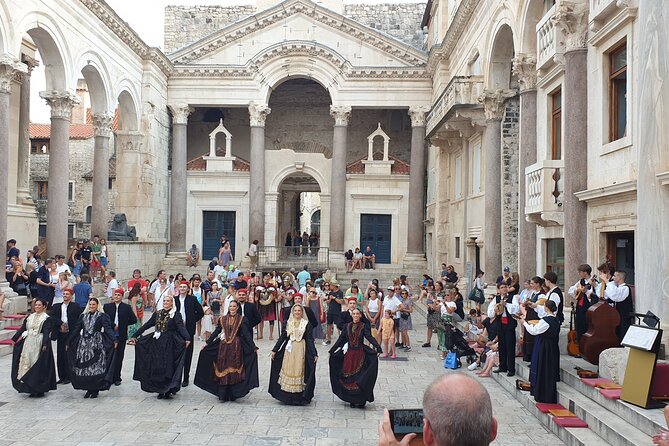
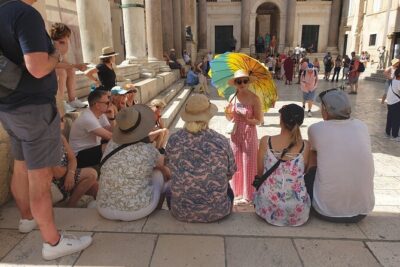
The meeting point is on Peristil ulica, at the Peristyle, the palace’s central square. This is a sensible place to begin because several key routes meet here, and the square gives you an immediate visual lesson in Roman power.
The stop lasts about 15 minutes. Expect the guide to explain how the Peristyle worked as a ceremonial space and how it connects with other parts of the palace. Even without entering a ticketed attraction, you get useful context before moving into the smaller spaces.
The square also helps you understand the palace’s unusual scale. It was not designed as a single hall or temple. It was a working imperial complex with entrances, private areas, service spaces, and ceremonial routes. A guide can point out those relationships far more clearly than a quick walk-through on your own.
This is also the place to settle into the French-language format. Several guides, including Antonela and Irene, have been singled out for friendly, engaging presentations. One French-speaking guide was described as a former diplomat, scholar, and enthusiast, which gives you a good idea of the tour’s intended tone: serious about history, but not stiff.
More Walking Tours in Split
- Split: Old Town and Diocletian Palace Walking Tour
★ 4.9 · 4,727 reviews - Walking Tour of Split and Diocletian’s Palace
★ 5.0 · 2,588 reviews - Krka Waterfalls tour with Trogir Walking tour and Krka panoramic boat cruise
★ 5.0 · 1,659 reviews
The Vestibule and a Possible Dalmatian Song
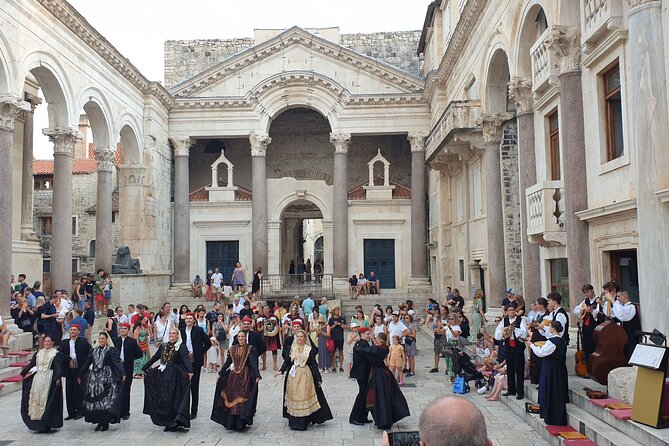
From the Peristyle, the group visits the Vestibule, a rounded entrance space associated with Emperor Diocletian. The stop is brief, about five minutes, but it adds a touch of local culture to the Roman setting.
The guide explains the Vestibule’s past and its place within the palace. You might also hear traditional Dalmatian singing here. The possibility is not guaranteed, so treat it as a pleasant extra rather than a promised performance.
This stop shows why a live guide helps. A round stone chamber can be easy to photograph and just as easy to forget. A few well-placed details about its function and age make it part of the palace’s larger plan.
Because this area can involve steps and uneven historic surfaces, watch your footing. The experience is not recommended for people who have trouble with high steps. Most people can participate, but this is not a completely flat city walk.
Palace Substructures Without the Museum Visit
The substructures provide one of the most useful stops on the route. You pass below the palace and learn how these lower spaces were built and how their purpose changed over time. The visit lasts about 10 minutes.
The substructures matter because they mirror the layout above. They help explain how the palace was constructed and offer a practical look at the engineering behind the upper rooms and courtyards. Instead of seeing only polished columns and grand entrances, you get a sense of the foundations that kept the complex working.
There is an important limit here. The tour does not include the museum section of the substructures. You may visit that part after the walking tour, but it is separate from this experience. If underground archaeology is your main reason for coming to Split, plan extra time and check the separate admission arrangements on the day.
For a 90-minute outing, this short stop is well judged. It gives you the basic story without allowing one interior area to swallow the whole walk.
The Golden Gate and Gregory of Nin
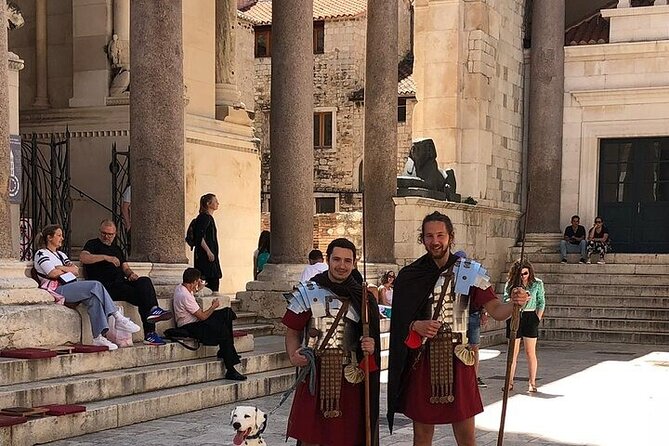
The Golden Gate is the palace’s main entrance and another major stop, lasting about 10 minutes. Here the guide connects the Roman gate with Gregory of Nin, whose statue stands nearby.
The statue is important not only as a monument but also as a way into Croatian language and national identity. The guide explains Gregory’s importance to Croatian history and language, giving the stop more weight than a quick photo opportunity.
This part of the route works well for families because it links something visible and memorable with a story that can be told in plain terms. Several families have found the tour engaging, and children may enjoy the scale of the gate and the statue while adults pick up the historical detail.
The Golden Gate also reinforces the layered character of Split. Roman structures remain part of the city’s present-day streets, rather than being sealed away behind a single entrance. You are still walking through a functioning center, even as the guide takes you back many centuries.
Still Split, at a slower pace:
- Split: Krka Waterfalls Trip with Boat Cruise and Swimming
★ 4.8 · 10,519 reviews - From Split: Krka Waterfalls, Food & Wine Tasting Tour
★ 5.0 · 9,326 reviews - Blue cave, Mamma Mia and Hvar, 5 islands speedboat tour
★ 5.0 · 7,150 reviews - From Split: Krka Waterfalls, Food & Wine Tasting Tour
★ 4.9 · 6,598 reviews
Riva Harbor and Split’s Seaside Front Door
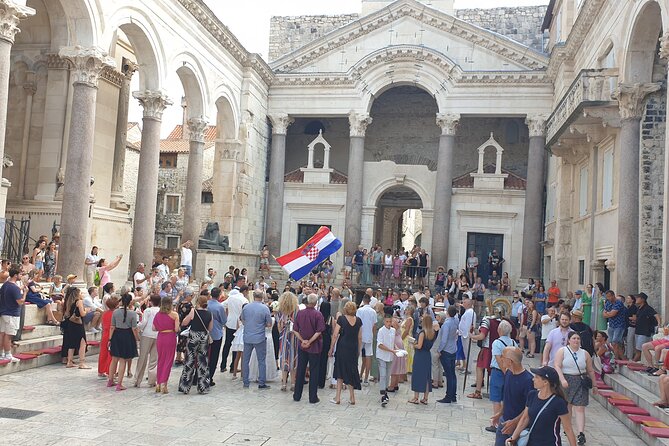
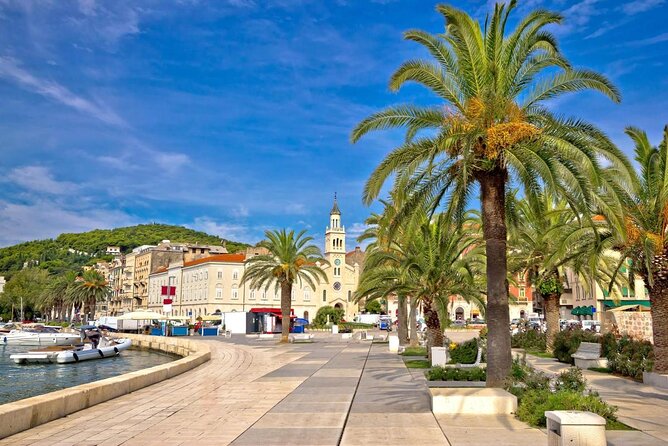
The walk continues to Riva Harbor for about 15 minutes. This section gives you a change of view after the enclosed lanes of the palace.
A bronze model of Diocletian’s Palace helps you see the whole complex at once. That is useful because the palace can be confusing when you encounter it one courtyard and alley at a time. The model offers a quick reset: you can connect the parts you have already seen and understand their position beside the water.
The guide also explains the story of Split’s Riva promenade. This is not simply a scenic pause. It shows how the waterfront became part of the city’s public face and how Split relates to the sea.
I like this stop for pacing. A walking tour that stays inside the palace for the full 90 minutes could feel enclosed, especially in warm weather. The Riva gives you air, a broader view, and a chance to listen without staring upward at stonework the whole time.
Fruit Square, Venetian Defense, and Croatian Literature
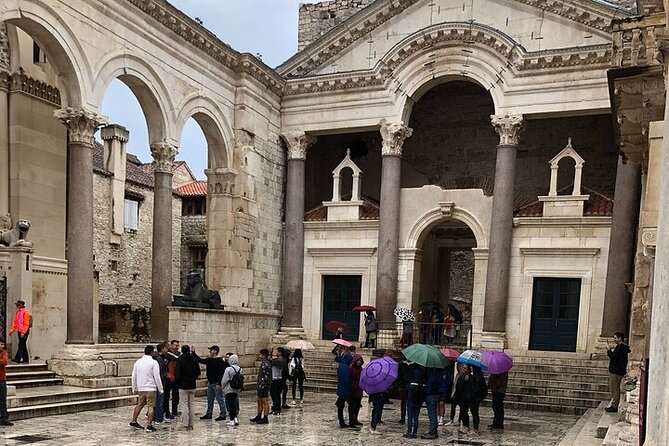
Fruit Square, officially Trg Braće Radić, receives about 10 minutes. Here you learn about a 15th-century Venetian citadel and the role of Marko Marulić, often called the father of Croatian literature.
This stop broadens the tour beyond Roman imperial history. Venice, local defense, and Croatian writing all become part of Split’s story. That variety is one reason I would choose this tour early in a visit. You are not just collecting palace facts. You are getting a compact guide to the forces that shaped the old center.
Marko Marulić gives the guide a chance to explain Croatian culture through a specific person rather than a vague overview. If you are interested in literature, language, or national identity, this may be one of the more rewarding moments of the walk.
The square is also a useful reminder that Split’s old center was never frozen in the Roman period. Later rulers adapted the city, added defenses, and gave its streets new meanings.
The Split Synagogue and a Less Familiar Chapter
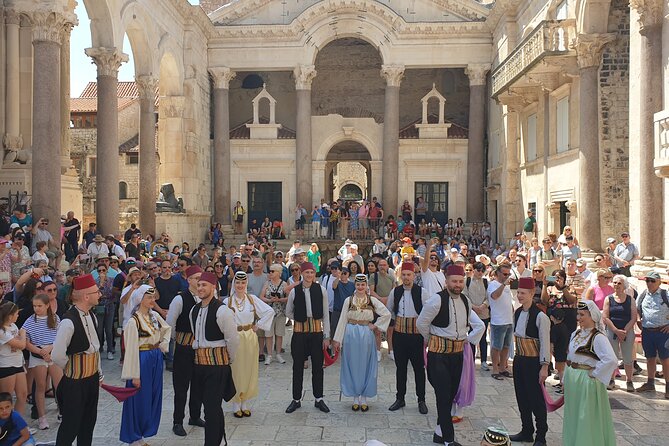
The final listed stop is the Split Synagogue, where the guide discusses the Jewish community’s place in the city. The visit lasts about 10 minutes, and the synagogue is noted as dating to the 16th century.
This is a quieter subject than the emperor, palace gates, and harbor promenade, but it adds needed balance. A city’s past is not only made of rulers and monuments. It also includes communities whose presence may be less visible in the stonework.
The stop is a pass-by rather than a clearly described interior visit. Admission is not included, so do not assume that the tour fee covers entry. The route ends back at the meeting point after this part of the walk.
Because the experience covers the synagogue near the end, you may want to make a note of any questions while the earlier details are still fresh. The guide’s ability to answer unusual questions has been praised, and this is a good subject for a thoughtful follow-up.
French Guides Who Make the Difference
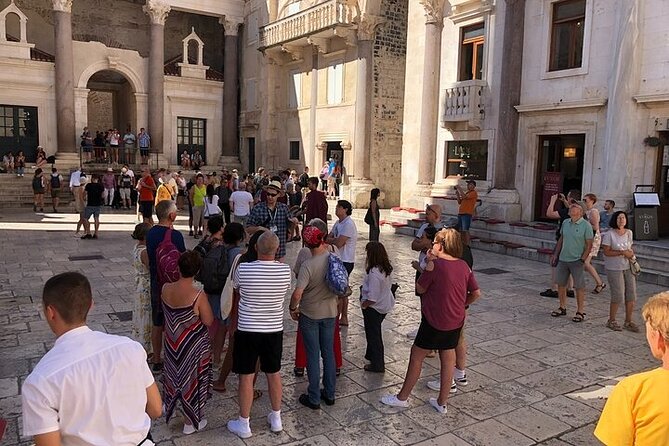
The strongest part of this experience is the guiding. Antonela is described as friendly, funny, informative, and highly engaging. Irene is praised for creating an enjoyable visit for adults and children. Other French-speaking guides have been noted for fluent French, enthusiasm, and the ability to explain complex subjects clearly.
That matters in Split because the palace does not always explain itself. You need someone to connect the emperor with the building, the building with the modern city, and the modern city with Croatian culture.
The French delivery is especially important if you understand history better in French than English. Several comments highlight guides who spoke French perfectly or remarkably well. The tone also seems flexible, with room for questions rather than a hurried recitation.
Still, guide quality can vary from one departure to another because the named guides are not guaranteed. The available feedback is exceptionally positive, with a five-star rating and 100 percent recommendation shown for the experience, but those numbers do not remove the normal uncertainty of group tours.
Timing, Group Size, and Walking Conditions
The stated duration is about one hour and 30 minutes. In practice, the tour can run closer to two hours when the guide takes questions or expands on the history.
I would allow at least two hours in your day. That gives you room for a longer explanation without forcing you to leave early. If you need a strict finish time, tell the guide at the start and keep an eye on the clock.
The maximum group size is 30 people. That is smaller than a large city sightseeing crowd, but it is not a private tour. At full capacity, you may need to stand close to hear, and personal questions may take longer. The advertised small-group approach should be understood as a more controlled group format, not a one-to-one experience.
Wear sensible shoes. The route is on foot through historic streets and includes high steps or uneven surfaces. Service animals are allowed, and the meeting point is near public transportation. Most people can take part, but anyone with significant difficulty on steps should choose a flatter activity.
Is $69.14 a Fair Price?
At $69.14 per person, the value rests mainly on the guide rather than paid admission. The listed stops have free admission, and the tour does not include the museum section of the palace substructures or gratuities.
I think the price is easier to justify if you want a French-language explanation and prefer a structured introduction to Split. You are paying for the route, the historical connections, and the chance to ask questions without having to piece together the palace alone.
The value is less clear if you only want to see the main square and Golden Gate. You can walk through several public areas without a ticket, and the tour does not include every paid interior. In that case, the fee may feel high unless the French guide and historical detail are central to your plans.
One separate account describes buying a ticket from a woman near the tourist office for around 20 euros. That may refer to a different sales channel, date, or tour arrangement, so I would rely on the current price shown when booking rather than assume all departures cost the same. Group discounts may also affect the final amount.
Who Should Book This French Walking Tour?
I would recommend it to French-speaking couples, families, and first-time visitors who want the old center explained in a clear order. Families may appreciate the short stops and the way the guide turns emperors, statues, gates, and writers into connected stories.
It also suits anyone who wants more than Roman architecture. The route includes Dalmatian music, Croatian language, Venetian defenses, the Riva, and Split’s Jewish past. That range gives you useful background for exploring on your own afterward.
You may want a different option if you need a private group, guaranteed museum entry, a fully accessible route, or a firm 90-minute finish. The 30-person maximum is reasonable but not truly intimate, and the walk can stretch past its advertised time.
Book early if the French departure is important to your schedule. Confirmation is sent within 48 hours and depends on availability. Free cancellation is available up to 24 hours before the start time, while cancellations or changes inside that window are not refunded. The activity also requires a minimum number of participants, and if it is canceled for that reason, you are offered another date, another experience, or a full refund.
Final Verdict: A Smart First Walk in Split
I would book this tour if you want Split’s old center to make sense in French. The guide quality is the main attraction, and the repeated praise for Antonela, Irene, and other French-speaking presenters suggests that the experience is built around lively explanation rather than dry facts.
The route covers enough ground to give you a useful first picture of the city, from the Peristyle and palace foundations to the Riva, Venetian fortifications, Croatian literature, and the synagogue. Just allow extra time, expect some steps, and remember that the substructure museum is not included.
For a first morning or afternoon in Split, this is a practical way to get your bearings and learn what you are looking at. If you prefer to wander alone, the price may not suit you. If you want history, context, and a fluent French guide, it is a strong choice.
FAQ
Where does the tour begin?
The tour begins at Peristil ulica, at the Peristyle of Diocletian’s Palace in Split.
Where does the tour end?
The activity ends back at the meeting point.
How long does the tour last?
The listed duration is approximately one hour and 30 minutes. Some departures have lasted more than two hours.
Is the tour conducted in French?
Yes. The tour is offered in French, and the guides are described as fluent French speakers.
What places are included on the route?
The route includes the Peristyle, Vestibule, palace substructures, Golden Gate, Riva Harbor, Fruit Square, and Split Synagogue.
Is admission to the palace substructures museum included?
No. The tour visits the substructures but does not include the museum section. You can visit the museum separately after the tour.
Can I cancel for a full refund?
Yes. You must cancel at least 24 hours before the experience starts to receive a full refund. Changes or cancellations made less than 24 hours before the start time are not accepted for a refund.
More History Tours in Split
- Walking Tour of Split with a ‘Magister’ of History
★ 5.0 · 1,122 reviews - Split Walking Tour with Professor of History
★ 5.0 · 926 reviews - Split: History and Heritage Walking Tour
★ 4.9 · 650 reviews - Split History and Gastro Small-Group Tour with Food and Drinks
★ 5.0 · 375 reviews
Just added around Split
- Walking Tour Split★ 4.7 · 61 reviews
- Unique vintage Tomos moped tour Split – Back to the ’80s★ 4.8 · 17 reviews
- Trogir: White Lagoon, Maslinica & Blue Lagoon Speedboat Tour★ 4.8 · 11 reviews
- Essential Diocletian’s Palace Tour for First-Time Visitors★ 4.8 · 19 reviews
- Split: Trogir Open Top Bus Trip + Free Split Walking Tour★ 4.1 · 17 reviews
- Trogir; Private walking tour of higlights of Trogir★ 4.7 · 3 reviews
- Trogir: Old Town Guided Walking Tour★ 4.6 · 76 reviews
- TROGIR: Blue Lagoon & 3 Islands Half-day Speedboat tour★ 4.6 · 28 reviews
Walking Tours, compared.
Walking Tour of Split and Diocletian’s Palace
Read our review →


Krka Waterfalls tour with Trogir Walking tour and Krka panoramic boat cruise
Read our review →
City Walls Early Morning or Sunset Walking Tour
Read our review →Browse the lists this tour appears in