
Reviewed · WALKING TOURS
History & Cultural Walking Tour of Split and Diocletian’s Palace
Split reveals its past one stone at a time. This 90-minute walking tour brings you through Diocletian’s Palace, the Golden Gate, Riva Harbor, and several smaller historic corners that are easy to miss on your own. I like the small maximum of 15 people, and I like that the tour mixes Roman remains with Croatian culture, Venetian influence, Jewish history, and local music. The possible drawback is the pace: you cover several sites in a short time, and the tour is not ideal if high steps are difficult.
At $22.98 per person, this is a sensible first look at Split, especially if you have only a day or two in town. Guides such as Darko, Ante, and Ivana have been praised for clear English, humor, thoughtful answers, and a warm way of bringing the city’s past to life. An early start can also mean fewer crowds around the palace.
In This Review
- Five reasons to consider this Split walking tour
- Why Split is best understood on foot
- Peristyle: the palace’s grand central square
- The Vestibule and the sound of Dalmatia
- The palace substructures and the practical side of Roman design
- The Golden Gate and Gregory of Nin
- Riva Harbor and Split’s seafront identity
- Fruit’s Square, Venetian defenses, and Marko Marulić
- The Split Synagogue and the city’s Jewish story
- Guides, group size, and the tone of the walk
- What the $22.98 price delivers
- Timing, walking conditions, and practical planning
- Who will get the most from this walk?
- Should you book the Split history and culture tour?
- FAQ
- Where does the tour begin?
- Where does the tour end?
- How long does the tour last?
- What language is the tour offered in?
- How many people can join the tour?
- Is admission to Diocletian’s Palace included?
- Can I visit the substructures museum afterward?
- Does the tour include a visit inside the Split Synagogue?
- Is the tour suitable for people with mobility concerns?
- Can I cancel for a full refund?
Five reasons to consider this Split walking tour
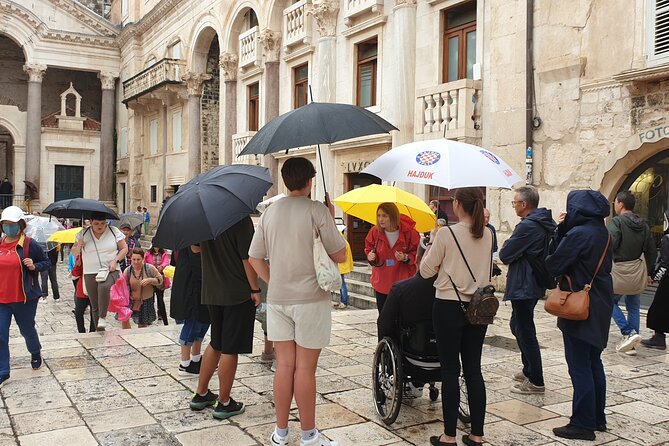
- You enter the Peristyle first, the central square that helps you understand how Diocletian’s Palace fits together.
- You hear more than Roman history, with stories about Croatian language, literature, Jewish life, Venetian rule, and traditional Dalmatian singing.
- The small group size matters, with no more than 15 people and sometimes only three or four on an early tour.
- You see the palace from several angles, including its ceremonial center, underground substructures, main gate, and seafront setting.
- The tour is a useful orientation, giving you clear ideas about which places to explore on your own afterward.
Why Split is best understood on foot
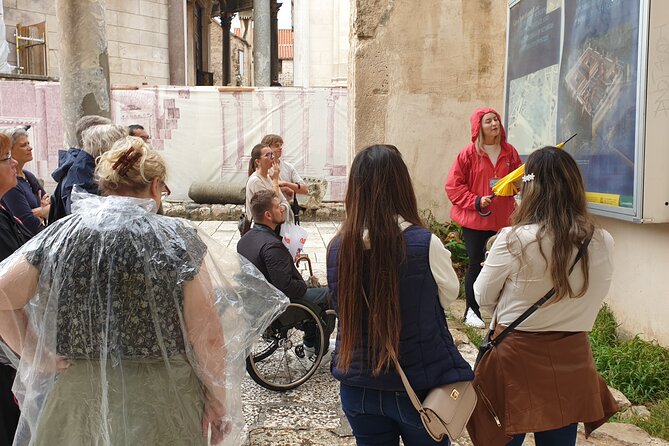
Split’s old center is not a single isolated monument. It is a working part of the city, with homes, cafés, shops, streets, and daily life built into the remains of an imperial palace. That can be confusing at first. A guide helps you see how the pieces connect.
The route begins at Peristil, also spelled Peristyle, and returns to the same meeting point. That makes the tour easy to fit into a day of sightseeing. You can take it early, use it to get your bearings, and then return to the palace sites that deserve more time.
I particularly like the balance between major sights and smaller stops. You get the famous Roman architecture, but you also hear about Marko Marulić, a 16th-century synagogue, and a Venetian citadel. Split feels more like a real city when those layers are included.
More Walking Tours in Split
- Split: Old Town and Diocletian Palace Walking Tour
★ 4.9 · 4,727 reviews - Walking Tour of Split and Diocletian’s Palace
★ 5.0 · 2,588 reviews - Krka Waterfalls tour with Trogir Walking tour and Krka panoramic boat cruise
★ 5.0 · 1,659 reviews
Peristyle: the palace’s grand central square
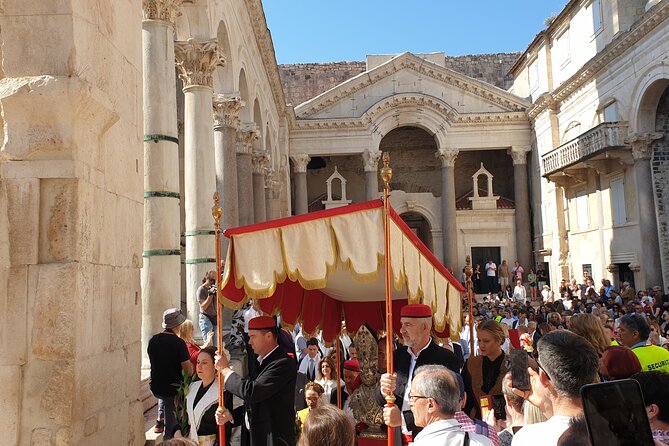
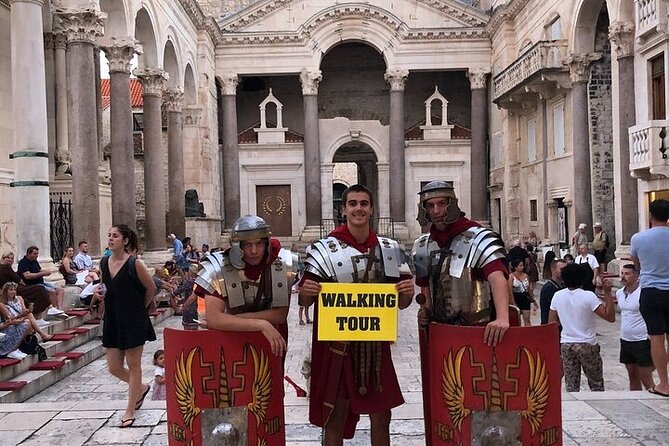
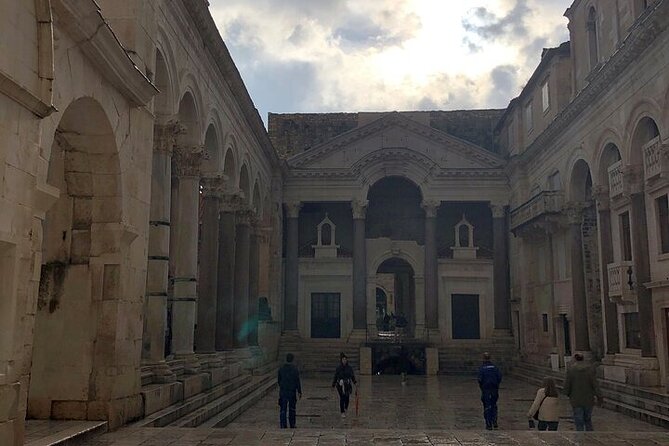
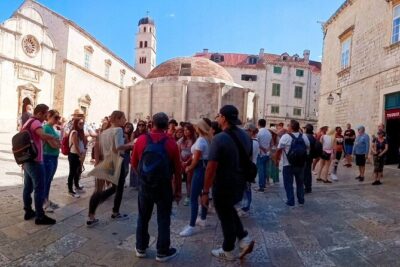
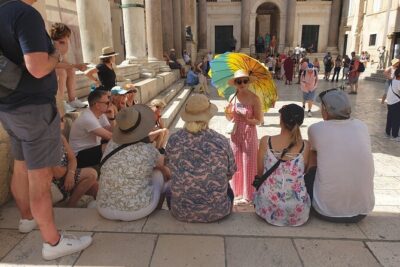
The Peristyle is the natural starting point. It was the central square of Diocletian’s Palace and still works as the main reference point for finding the palace’s other areas.
Your guide spends about 15 minutes here, explaining the square and its role in the palace plan. This is where the scale of Diocletian’s project begins to make sense. Instead of seeing scattered columns and old walls, you start to understand the palace as an organized imperial complex.
The stop is free, so there is no separate admission cost built into the tour. The main challenge is that the square can be busy, and the hard surfaces offer little comfort if you are standing for long periods. Still, it is the right place to begin because nearly every later stop connects back to this central space.
A guide can also help you notice the contrast between the original Roman purpose and the way the square functions today. That shift, from imperial center to public meeting place, is one of Split’s most interesting themes.
The Vestibule and the sound of Dalmatia
The Vestibule is a short stop, around five minutes, but it adds a human touch to the stonework. This was the entrance area associated with Emperor Diocletian, and the guide explains its purpose and past.
You might also hear traditional Dalmatian singing here. The possibility of klapa singing is a welcome change from a tour made entirely of dates, rulers, and architecture. It connects the old palace to a living local culture.
Because the stop is brief, do not expect a full music performance every time. But the setting gives the singing extra character when it happens. The rounded space and stone surfaces create a memorable atmosphere without requiring a long pause.
The palace substructures and the practical side of Roman design
The substructures show the practical engineering behind the palace. You spend about 10 minutes learning how they were built and how their purpose changed over the centuries.
One important detail: this tour does not include the museum section of the substructures. You can visit that part separately after the walk, but you should not expect a museum visit as part of the 90-minute route.
That distinction is useful when planning your day. The guided stop gives you context and a look at the underground spaces, while a later museum visit would allow more time for displays and objects. If you want a detailed archaeological visit, plan for that separately.
The substructures also help explain the palace above. They are not simply dark corridors beneath a famous monument. Their layout helps show how the upper buildings were supported and arranged. This is one of the places where a short explanation can save you from seeing only old stone without understanding its function.
Still Split, at a slower pace:
- Split: Krka Waterfalls Trip with Boat Cruise and Swimming
★ 4.8 · 10,519 reviews - From Split: Krka Waterfalls, Food & Wine Tasting Tour
★ 5.0 · 9,326 reviews - Blue cave, Mamma Mia and Hvar, 5 islands speedboat tour
★ 5.0 · 7,150 reviews - From Split: Krka Waterfalls, Food & Wine Tasting Tour
★ 4.9 · 6,598 reviews
The Golden Gate and Gregory of Nin
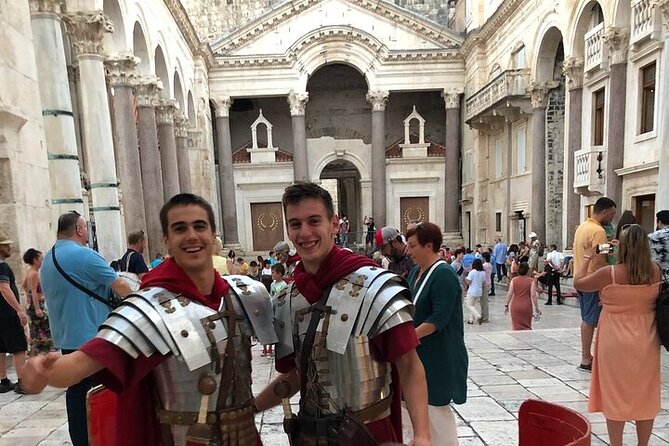
The Golden Gate was the palace’s main entrance, and the tour spends about 10 minutes here. It is one of the strongest stops for understanding how people entered and moved through the imperial complex.
You also see the statue of Gregory of Nin and learn why he matters to Croatian history and language. This takes the tour beyond the Roman era and into the story of Croatian identity.
The Golden Gate is a good place to pause and ask questions. One of the strongest features of this experience is the guide’s interaction with the group. Ivana, for example, used questions and answers to help people retain the information, rather than simply delivering a long speech.
That style makes a difference. You are more likely to remember a story connected to a gate, a statue, or a language than a list of dates. The approach also works well for people who enjoy history but do not want a lecture.
Riva Harbor and Split’s seafront identity
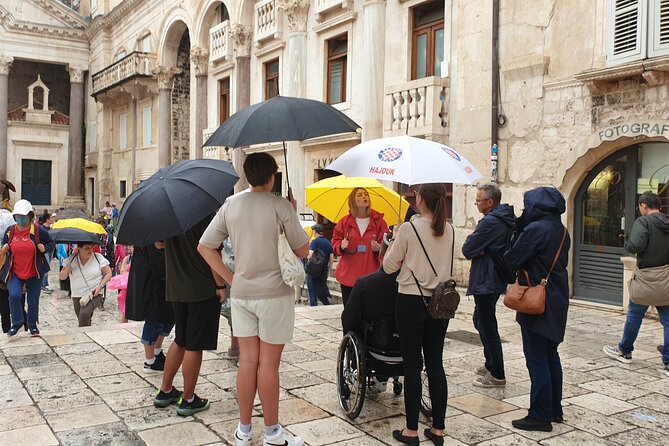
After the palace interior, the route heads toward Riva Harbor. The stop lasts about 15 minutes and includes a bronze model of Diocletian’s Palace.
That model is especially useful because you can look at the whole complex at once. After walking through separate spaces, you get a clearer sense of the palace’s size and structure. The guide also explains the history of Riva, Split’s well-known waterfront promenade.
Riva gives the tour a change of mood. The palace can feel enclosed and stone-heavy, while the harbor opens the view and shows how central the waterfront is to the city. I like this contrast because it keeps the walk from becoming a sequence of similar courtyards.
You should also treat this stop as a chance to connect ancient Split with modern Split. The city’s identity is not only Roman. Its seafront, public spaces, and everyday movement are part of the experience too.
Fruit’s Square, Venetian defenses, and Marko Marulić
Fruit’s Square, known as Trg Brace Radic, adds another period to the story. Here you learn about a 15th-century Venetian citadel and the importance of Marko Marulić, often called the father of Croatian literature.
This is a compact stop of about 10 minutes, but it gives the tour good range. You move from imperial Rome to medieval and Venetian Split, then into Croatian literary history.
The square is also a reminder that Split’s old center is not just an archaeological site. Its spaces were reused and reshaped by different powers and generations. You may appreciate the palace more once you see how later history grew around it rather than simply replacing it.
For people with a strong interest in literature or national history, this may be one of the most rewarding moments. For everyone else, it is still a useful introduction to a major Croatian cultural figure.
The Split Synagogue and the city’s Jewish story
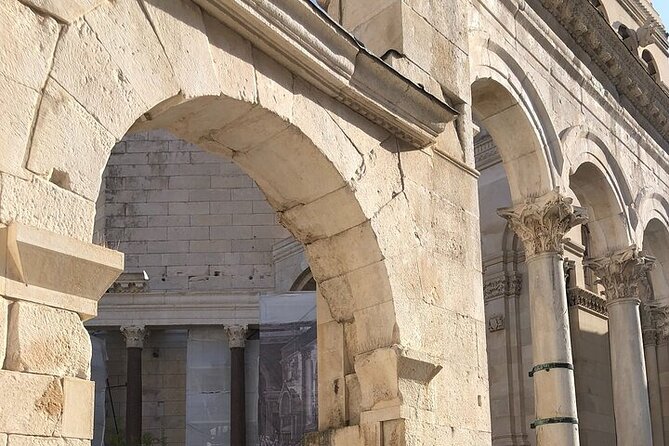
The final listed stop is the Split Synagogue, a 16th-century building connected to the city’s Jewish community. The tour passes by the synagogue and explains the history of Jewish life in Split.
No admission is included, and the route does not present this as a long interior visit. Its value is the reminder that the city’s past includes communities and traditions beyond the dominant Roman and Christian narratives.
I appreciate this inclusion because it broadens the walk. You are not left with the impression that Split’s story began and ended with Diocletian. The stop is short, but it encourages you to look more closely at the people who shaped the old city over time.
Guides, group size, and the tone of the walk
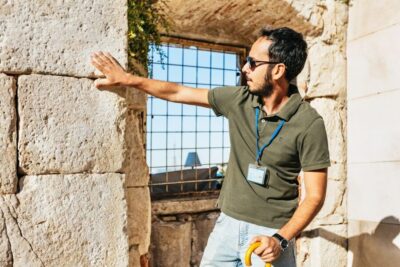
The tour is offered in English and is led by an educated guide with strong knowledge of the palace and surrounding sites. The guide names associated with especially warm and engaging tours include Darko, Ante, also introduced as Anthony in American English, and Ivana.
The tone seems to be one of the main strengths. You can expect clear explanations, humor, questions, and practical suggestions for places to explore later. One early 9 a.m. walk had only three people and extended to nearly three hours because the guide spent extra time on historic details. That longer length should not be treated as guaranteed, but it shows how a small group can create room for conversation.
The advertised duration is about 1 hour and 30 minutes. Plan around that time, but allow some flexibility if your guide is answering questions or adding detail. A smaller group is especially useful here because several stops are compact, and a large crowd would make it harder to hear or gather around the guide.
The maximum group size is 15. That is not a private tour, but it is small enough to feel personal compared with a large walking group.
What the $22.98 price delivers
At $22.98 per person, the tour offers a low-cost way to put Split’s center into context. The price covers the guided walk, but not gratuities or the museum portion of the palace substructures.
The value comes from interpretation rather than admission tickets. Most of the listed stops are viewed from public areas, so you are paying for the guide’s explanation, route planning, historical connections, and help noticing details.
I think the price works best for a first morning or first evening in Split. You can learn the basic layout, then decide which sites deserve separate visits. It is less suitable if you want long museum time, extensive interior access, or a slow architectural study of every room.
The tour also makes sense for people arriving with limited time. If you have only a couple of days, a focused walk can prevent you from spending your first hours wandering without a clear idea of what you are seeing.
Timing, walking conditions, and practical planning
The tour begins at Peristil ulica, at Peristil in Split, and ends back at the same meeting point. It is near public transportation, and confirmation is provided when you book.
You should wear comfortable shoes and be ready for uneven historic surfaces. The activity is not recommended for people who have trouble with high steps. Most people can participate, and service animals are allowed.
An early start is worth considering. The 9 a.m. departure described by one participant offered a quieter experience, with fewer people around the palace. That can make it easier to hear the guide and take in the Peristyle before the day becomes busier.
The tour requires a minimum number of people to operate. If that minimum is not reached and the activity is canceled, you are offered another date or experience, or a full refund. You can cancel for a full refund up to 24 hours before the start time. Changes or cancellations inside that 24-hour window are not accepted.
Who will get the most from this walk?
I would recommend this tour to you if you want a clear introduction to Split without spending half a day on a formal museum program. It suits couples, families, solo visitors, and small groups who enjoy history but also want local culture and city life included.
It is particularly helpful if you are visiting Split for the first time. The route links the palace to the harbor, Venetian influence, Croatian literature, and Jewish heritage, giving you a usable framework for the rest of your stay.
History specialists may appreciate the guide’s depth, but you should keep the format in mind. The advertised walk lasts about 90 minutes, so it cannot cover every archaeological detail. The substructures museum is not included, and the synagogue is viewed from the route rather than treated as a full interior visit.
People who dislike steps or have difficulty walking on old surfaces should choose carefully. The route is a walking experience through a historic center, not a fully level sightseeing circuit.
Should you book the Split history and culture tour?
Yes, if you want an affordable and well-paced introduction to Split’s old center. The small group limit, strong English-language guiding, useful range of historic periods, and chance of hearing Dalmatian singing give it more character than a basic palace orientation.
Book it early in your stay, ideally in the morning, so you can use the guide’s suggestions afterward. I would skip it only if you already know Split well or want a longer archaeological visit with museum access. For most first-time visitors, $22.98 is a fair price for a focused walk that helps the city make sense.
FAQ
Where does the tour begin?
The tour begins at Peristil ulica, at Peristil in Split, Croatia.
Where does the tour end?
The activity ends back at the meeting point.
How long does the tour last?
The advertised duration is approximately 1 hour and 30 minutes.
What language is the tour offered in?
The tour is offered in English.
How many people can join the tour?
The maximum group size is 15 people.
Is admission to Diocletian’s Palace included?
The listed tour stops have no separate admission ticket included or required. The museum part of the palace substructures is not visited during the tour.
Can I visit the substructures museum afterward?
Yes. The tour does not include the museum section, but you can visit it after the walk.
Does the tour include a visit inside the Split Synagogue?
The route passes by the 16th-century synagogue and explains its history. Admission is not included.
Is the tour suitable for people with mobility concerns?
Most people can participate, but the activity is not recommended for people who have difficulty with high steps.
Can I cancel for a full refund?
Yes. You can cancel at least 24 hours before the start time for a full refund. Changes or cancellations made less than 24 hours before the start time are not accepted.
More History Tours in Split
- Walking Tour of Split with a ‘Magister’ of History
★ 5.0 · 1,122 reviews - Split Walking Tour with Professor of History
★ 5.0 · 926 reviews - Split: History and Heritage Walking Tour
★ 4.9 · 650 reviews - Split History and Gastro Small-Group Tour with Food and Drinks
★ 5.0 · 375 reviews
Just added around Split
- Walking Tour Split★ 4.7 · 61 reviews
- Unique vintage Tomos moped tour Split – Back to the ’80s★ 4.8 · 17 reviews
- Trogir: White Lagoon, Maslinica & Blue Lagoon Speedboat Tour★ 4.8 · 11 reviews
- Essential Diocletian’s Palace Tour for First-Time Visitors★ 4.8 · 19 reviews
- Split: Trogir Open Top Bus Trip + Free Split Walking Tour★ 4.1 · 17 reviews
- Trogir; Private walking tour of higlights of Trogir★ 4.7 · 3 reviews
- Trogir: Old Town Guided Walking Tour★ 4.6 · 76 reviews
- TROGIR: Blue Lagoon & 3 Islands Half-day Speedboat tour★ 4.6 · 28 reviews
Walking Tours, compared.
Walking Tour of Split and Diocletian’s Palace
Read our review →


Krka Waterfalls tour with Trogir Walking tour and Krka panoramic boat cruise
Read our review →
City Walls Early Morning or Sunset Walking Tour
Read our review →Browse the lists this tour appears in