
Reviewed · WALKING TOURS
Split: Private Walking Tour with Diocletian’s Palace
Split’s old center is a living Roman palace. This private walking tour makes the city easier to read, pairing Diocletian’s Palace with medieval lanes, Gothic palaces, lively squares, and the waterfront. I like the personal format, which lets you set the pace and ask questions as they come up. I also like that guides such as Slavko, who was born and raised in Split, can add local recommendations alongside the history.
The main consideration is the walking surface and heat. You will spend the tour outdoors on old stone streets, and the experience is not suitable for wheelchair users. The short route takes about 90 minutes, while a longer version can run up to five hours, so check the available starting time and length carefully.
In This Review
- Key points to know before booking
- Why a private walk helps in Split
- Meeting the guide at the Golden Gate
- A quick look at the Game of Thrones Museum
- People’s Square and the old city’s public life
- Fruit Square and the city’s changing styles
- Riva Harbor and the waterfront pause
- Diocletian’s Cellars and the Roman foundation
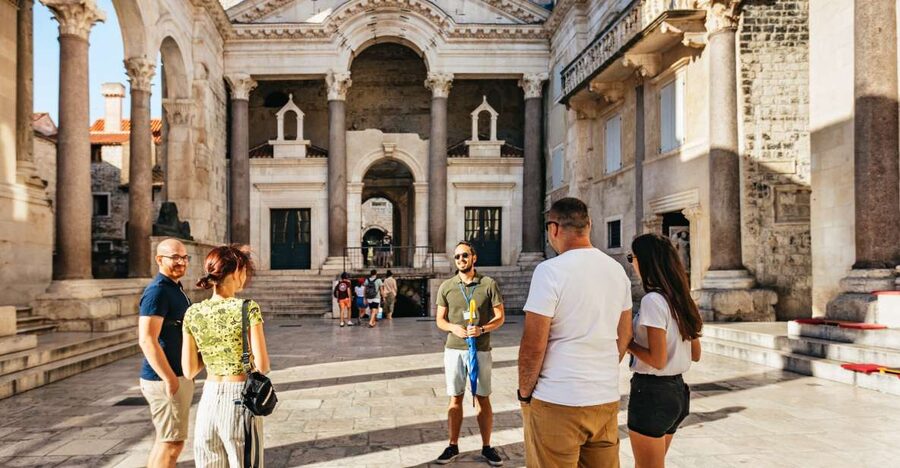
- Peristil, the palace’s grand central space
- Cathedral of Saint Domnius and Diocletian’s unusual legacy
- Vestibul and the return through the palace
- The stories and guide style make the difference
- Price, timing, and who gets the best value
- Is this Split tour right for you?
- FAQ
- Where does the Split private walking tour begin?
- Where does the tour finish?
- How long does the private walking tour last?
- How much does the tour cost?
- Is this a private tour?
- Which languages are available?
- What sights are included?
- Is the Cathedral of Saint Domnius part of the tour?
- What should I bring?
- Is the tour suitable for wheelchair users?
- Can I cancel for a full refund?
- Do I have to pay when I book?
Key points to know before booking
- The palace is still part of the city: Diocletian’s Palace is not an isolated ruin. Homes, shops, cafés, churches, and streets occupy the old Roman complex.
- Your guide can adjust the route: The private format suits families, couples, and small groups with different interests or walking speeds.
- Several eras appear in one short walk: Roman, medieval, Renaissance, Baroque, Gothic, and Romanesque buildings all appear within the center of Split.
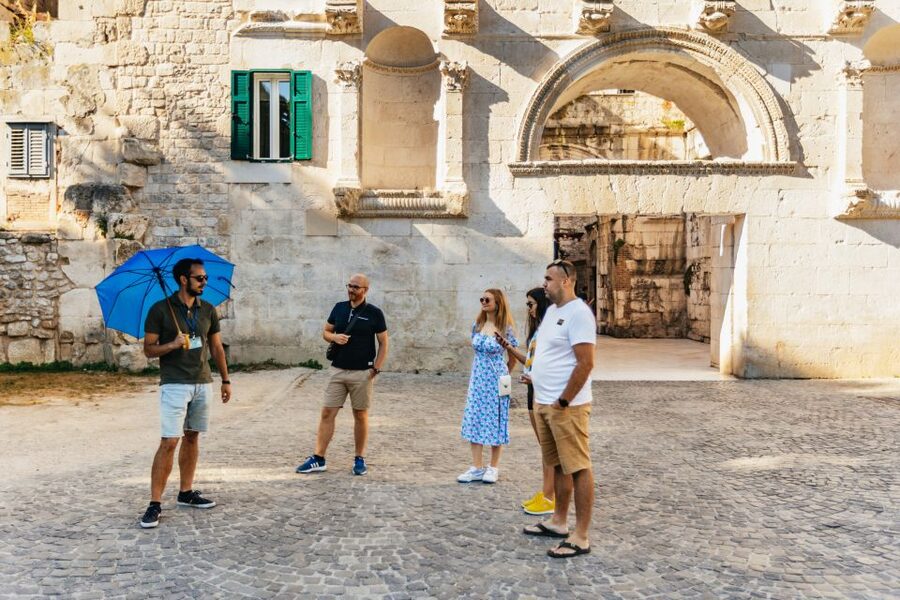
- The meeting point is easy to identify: Look for your guide with a blue umbrella at the Golden Gate, the palace’s north entrance.
- The guides receive strong praise: Vinka, Slavko, and Antonia are specifically praised for warmth, local insight, patience, and enthusiasm.
- The price works best for two people: At $117 per group of up to two, this is a private experience rather than a budget group walk.
Why a private walk helps in Split
Split can feel confusing at first. Roman walls blend into later houses, narrow passages lead into open squares, and the old palace is not simply a building you enter and leave. It is the center of modern Split.
That is where a private guide earns the fee. You are not just following a flag through the streets. You can stop to ask why a medieval church sits inside a Roman imperial complex, how the palace changed over the centuries, or which parts of the center are still used by local residents.
The flexible length is useful. A 90-minute version covers the major sights at a brisk but manageable pace. A longer booking, lasting up to five hours, gives you more time for questions, extra streets, and a slower look at the architecture. The exact route depends on your interests and the time selected.
The private group format also helps if your party includes children or teenagers. One French-language booking praised Antonia for keeping the tour accessible to teenagers, which is a good sign for families who do not want a lecture aimed only at adults.
More Walking Tours in Split
- Split: Old Town and Diocletian Palace Walking Tour
★ 4.9 · 4,727 reviews - Walking Tour of Split and Diocletian’s Palace
★ 5.0 · 2,588 reviews - Krka Waterfalls tour with Trogir Walking tour and Krka panoramic boat cruise
★ 5.0 · 1,659 reviews
Meeting the guide at the Golden Gate
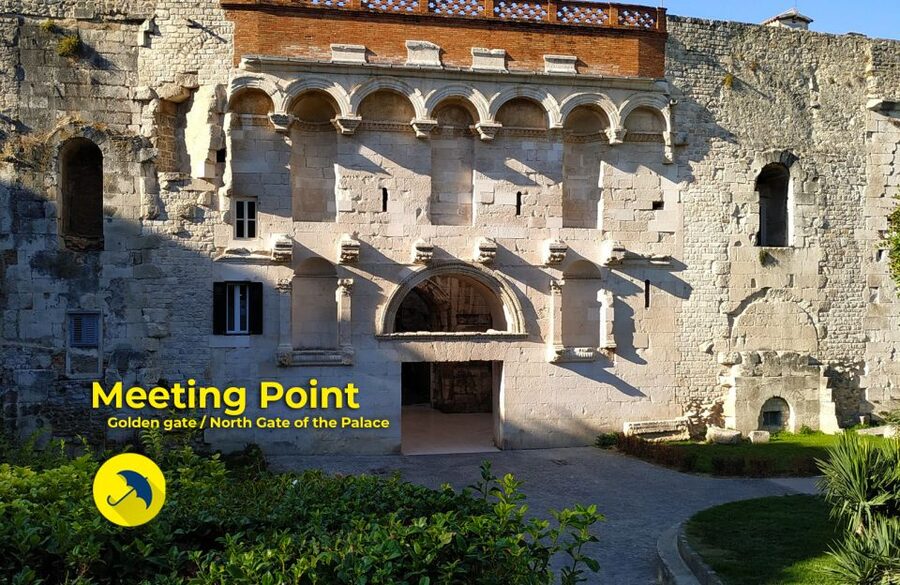
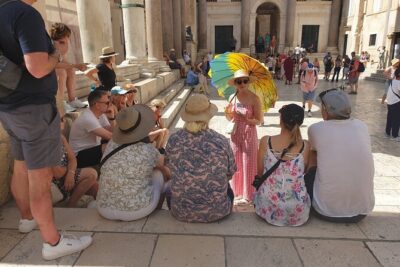
Your walk begins at the Golden Gate, the north entrance to Diocletian’s Palace. Look for the guide carrying a blue umbrella. This detail matters because the center can be crowded, and the palace has several major entrances.
The Golden Gate is more than a convenient meeting place. It introduces the scale and power of the Roman complex. From here, the guide can help you understand how the palace was arranged and how later generations altered its original purpose.
The short stop here lasts about 10 minutes. That is enough for an orientation and an explanation of the gate before moving into the maze of streets. Wear shoes with a firm sole. The route uses old stone paving, and comfort matters more than fashion in Split.
A quick look at the Game of Thrones Museum
The next stop is the Game of Thrones Museum, with about five minutes set aside for a guided look. This is a brief stop, not the main purpose of the tour, so you should treat it as a pop-culture note rather than a full museum visit.
Its value is mostly in connecting Split with the screen locations that helped put the city on more recent tourist maps. If you are a fan, the stop adds a little fun. If ancient and medieval history are your main interests, you will probably appreciate that the visit is short.
The guide can keep the focus on the city itself rather than letting the television connection take over. That balance is helpful in Split, where the real streets have plenty to offer without a fictional storyline.
People’s Square and the old city’s public life
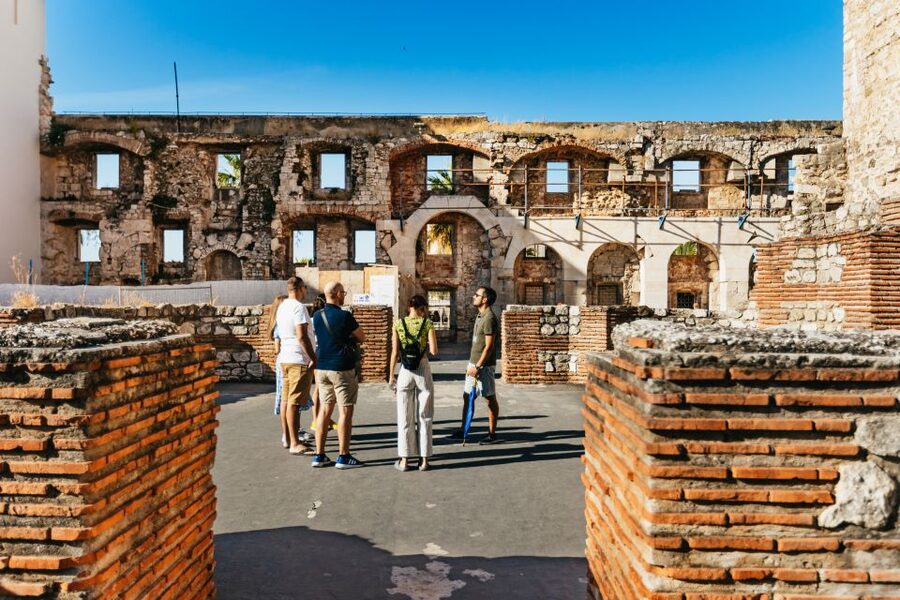
People’s Square, known in Croatian as Pjaca, gives you a look at Split beyond the Roman palace. The guided stop lasts around 10 minutes and brings together later architecture and public life.
Here, the story shifts from emperor to town. The square helps show how Split grew after the Roman period, with medieval and later buildings occupying spaces shaped by the older city. Look for the mix of architectural styles rather than expecting one neat historical period.
A private guide can point out details that are easy to miss when you pass through on your own. You might find yourself comparing the scale of the Roman work with the more intimate proportions of the later buildings.
Still Split, at a slower pace:
- Split: Krka Waterfalls Trip with Boat Cruise and Swimming
★ 4.8 · 10,519 reviews - From Split: Krka Waterfalls, Food & Wine Tasting Tour
★ 5.0 · 9,326 reviews - Blue cave, Mamma Mia and Hvar, 5 islands speedboat tour
★ 5.0 · 7,150 reviews - From Split: Krka Waterfalls, Food & Wine Tasting Tour
★ 4.9 · 6,598 reviews
Fruit Square and the city’s changing styles
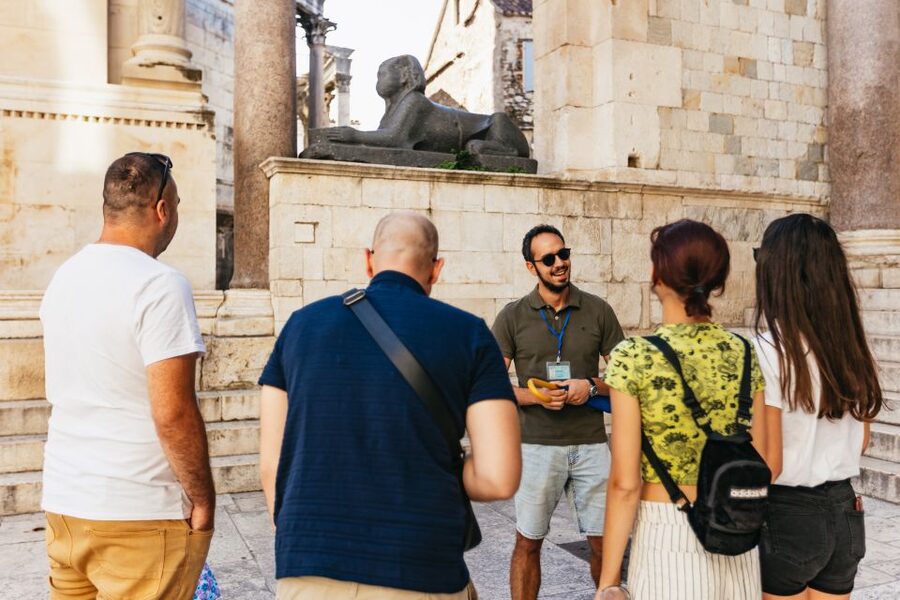
Fruit Square is another 10-minute stop. Its name reflects the market activity once associated with the area, and it offers a useful contrast with the grander Roman monuments.
This part of the walk is good for seeing how Split’s center developed as a working town. Renaissance and Baroque elements appear alongside older structures, and the square helps you notice the city’s changing tastes and needs.
I like this part of the route because it keeps the tour from becoming only a parade of ancient stones. Split’s appeal comes from layers. Roman walls, medieval defenses, Gothic palaces, and later public buildings all share the same compact center.
Riva Harbor and the waterfront pause
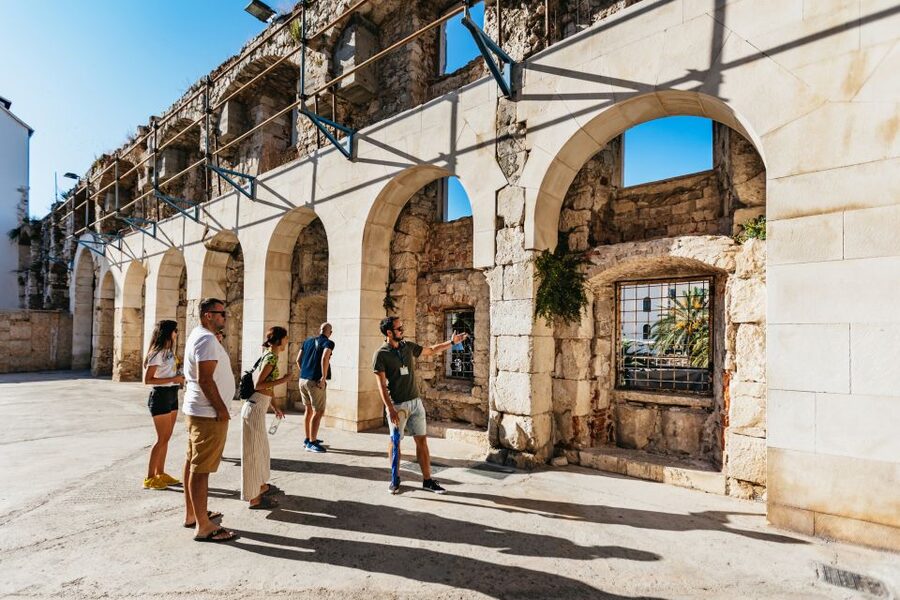
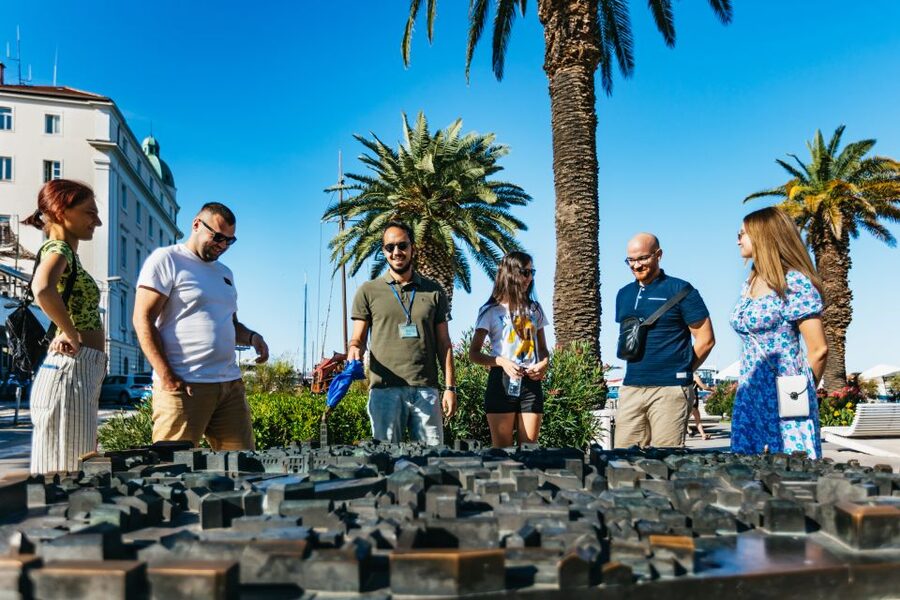
The walk then reaches Riva, Split’s broad waterfront promenade. The guided stop is about 10 minutes, giving you a chance to see the city from a more open setting.
Riva is a useful pause between the tight lanes of the old center and the enclosed spaces inside the palace. It also gives your guide a chance to explain how the waterfront fits into daily life in Split. The promenade over Riva Harbor is one of the city’s most recognizable public spaces.
Do not expect a long rest break unless your guide adjusts the route for you. The stated stop is short, and the tour continues into the palace complex. If you are walking in summer, sunglasses, a sun hat, and water are sensible choices. Comfortable shoes are specifically recommended.
Diocletian’s Cellars and the Roman foundation
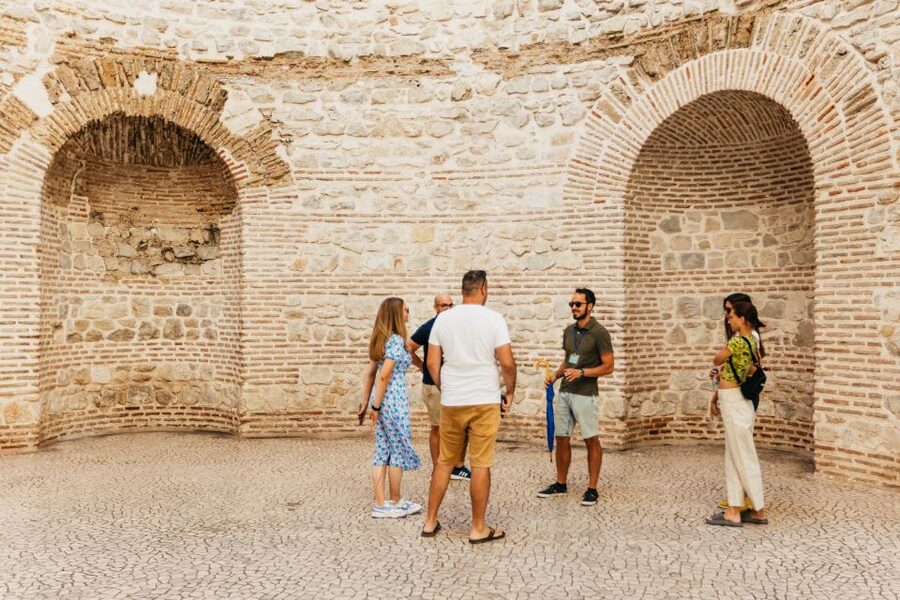
The Diocletian’s Cellars stop lasts about 15 minutes, making it one of the longer scheduled sections. These underground spaces are important because they help you understand the palace’s original design.
The cellars supported the upper level of the palace and preserved the shape of the Roman plan beneath later construction. They also make the palace easier to picture. Instead of seeing scattered walls and isolated columns, you begin to understand the palace as a planned imperial residence.
This is where a guide’s explanation adds real value. On your own, the underground rooms can look like a series of stone chambers. With context, they become part of a larger structure built for the Roman emperor Diocletian.
The stop is also practical for visitors who want a stronger sense of place. The palace is not just a collection of monuments. It was a working complex with entrances, service areas, ceremonial spaces, and private areas.
Peristil, the palace’s grand central space
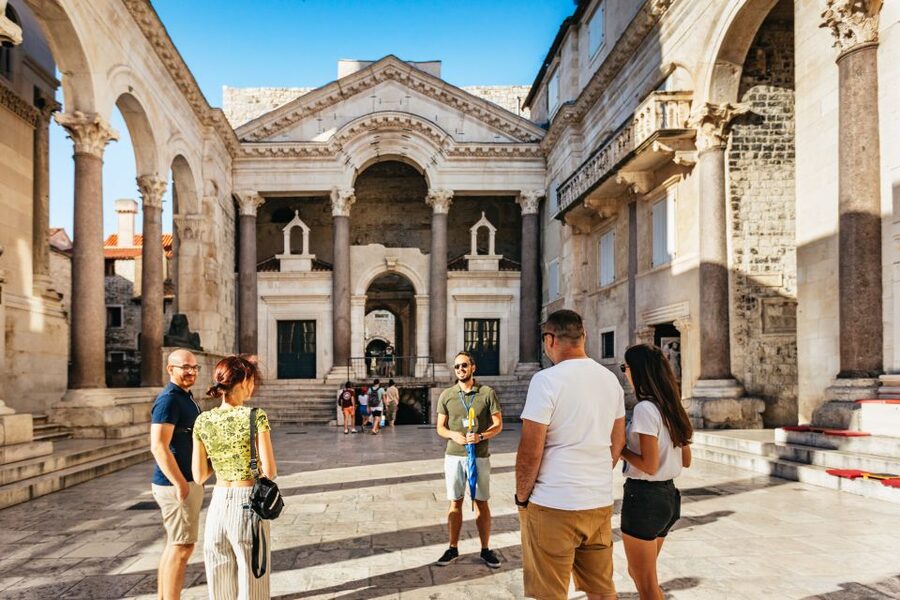
Peristil receives about 10 minutes of guided attention. This is the ceremonial heart of Diocletian’s Palace and one of the most striking places on the route.
The open square shows the palace at its most formal. Columns and stone surfaces create a clear sense of Roman power, while later buildings press closely around the ancient space. The contrast is part of the experience. You are not viewing Rome from a safe distance. You are standing in a place where old and new construction have been joined for centuries.
The guide can explain how the area functioned and why it mattered to the emperor’s residence. This is a good place to ask questions, especially if you want to understand the difference between a Roman palace and a Roman temple complex.
Because Peristil is one of the best-known points in the center, it may be busy. A private guide can help you focus on the architecture and may adjust the pace if the square is crowded. The ability to avoid simply stopping wherever a large group stops is one of the stronger practical benefits of booking privately.
Cathedral of Saint Domnius and Diocletian’s unusual legacy

The Cathedral of Saint Domnius, or St Duje, is scheduled for about 10 minutes. It is one of the most unusual sights in Split because the building began as Diocletian’s mausoleum.
Diocletian died in 311 AD and was buried here. The building later became a cathedral, dedicated to Saint Domnius. That change tells you a great deal about Split’s past: the structure survived, but its meaning changed as the city’s religion and political life changed.
The cathedral is often described as one of the best-preserved ancient Roman buildings still standing. Your guide can connect the Roman structure with the later Christian use, helping you see both periods at once.
Ten minutes is enough for an explanation and a look at the exterior or main features included in the walk. If you want a longer visit inside, ask about extending the tour or selecting a longer version when booking. The supplied route does not promise a lengthy interior visit, so keep your expectations realistic.
Vestibul and the return through the palace
The Vestibul is the final major stop before returning to the Golden Gate, with about 10 minutes set aside. It served as a formal entrance area within the palace and is known for its distinctive circular form.
This stop helps tie the route together. You have already seen the outer gate, underground foundation, central ceremonial space, and former mausoleum. The Vestibul shows another part of the palace’s movement and design.
The tour then returns to the Golden Gate. That makes the experience easy to fit into a day of sightseeing because you finish where you began, in the center of Split rather than at an unfamiliar edge of town.
The stories and guide style make the difference
The strongest praise for this experience focuses on the guides rather than on the route alone. Vinka is described as excellent and professional. Slavko is praised for being born and raised in Split, offering a local point of view, and giving useful recommendations after explaining the city’s past.
Antonia is also singled out for her patience. She took time to answer questions and showed clear enthusiasm for Split’s architecture, palace, and unusual place in history. These details matter because a private walking tour depends heavily on the person leading it.
You should still remember that guide assignments can vary. The available guide may be Vinka, Slavko, Antonia, or another member of the local team, and the experience can differ slightly in tone. The language choices are English, German, Spanish, and French.
The overall rating is 5 out of 5 from 30 reviews, with praise centered on professional service, personal attention, local recommendations, and the ability to keep the experience engaging for different ages.
Price, timing, and who gets the best value
The listed price is $117 for a private group of up to two people. For a solo visitor, that is a fairly high cost for a walking tour. For two people, the price becomes easier to justify because you are paying for a private guide rather than two places in a large group.
The value improves if you care about questions, flexible pacing, or a customized route. It is also useful for a first visit, when the palace can be hard to understand without a map or explanation.
The scheduled route adds up to roughly 100 minutes, while the activity offers durations from 90 minutes to five hours. That difference suggests the guide can tailor the experience, but you should check the chosen option rather than assume every booking includes a half-day walk.
Free cancellation is available up to 24 hours before the tour for a full refund, and you can reserve now and pay later. Those terms are useful if your Split schedule may change.
The tour is not suitable for wheelchair users. The old streets, steps, and historic surfaces make accessibility a serious consideration, not a minor footnote.
Is this Split tour right for you?
Book this tour if you want the palace explained rather than simply photographed. It is a strong choice for couples, families, first-time visitors, and small groups who prefer a conversation with a guide over a fixed large-group route.
I would especially consider it if you want local advice from someone such as Slavko, or if your group includes teenagers who may need a guide willing to adjust the presentation. The private setting also works well if one person wants architecture, another wants Roman history, and someone else mainly wants to understand modern Split.
Skip it if you prefer to wander alone, already know the palace well, or want a low-cost group tour. You may also want to choose the shorter option if you have limited time, or confirm a longer booking if the cathedral and palace interiors are your main goals.
For most visitors, the best reason to book is simple: Split’s old center is far easier to appreciate when someone shows you how the Roman palace, medieval town, and modern city fit together.
FAQ
Where does the Split private walking tour begin?
The tour begins at the Golden Gate, the north gate of Diocletian’s Palace in Split. Look for a guide with a blue umbrella.
Where does the tour finish?
The walk returns to the Golden Gate, where it began.
How long does the private walking tour last?
Available durations range from 90 minutes to five hours. The scheduled route includes stops totaling about 100 minutes, so check the available option when selecting your time.
How much does the tour cost?
The listed price is $117 per private group of up to two people.
Is this a private tour?
Yes. The tour is for a private group, with a personal local guide and a route that can be adjusted to your interests and pace.
Which languages are available?
Live guiding is available in English, German, Spanish, and French.
What sights are included?
The route includes the Golden Gate, Game of Thrones Museum, People’s Square, Fruit Square, Riva, Diocletian’s Cellars, Peristil, the Cathedral of Saint Domnius, and the Vestibul.
Is the Cathedral of Saint Domnius part of the tour?
Yes. The Cathedral of Saint Domnius is included as a guided stop of about 10 minutes.
What should I bring?
Bring comfortable shoes, sunglasses, and a sun hat. The tour is outdoors and takes place on historic streets.
Is the tour suitable for wheelchair users?
No. The activity is listed as not suitable for wheelchair users.
Can I cancel for a full refund?
Yes. You can cancel up to 24 hours in advance for a full refund.
Do I have to pay when I book?
No. The reserve-now, pay-later option lets you book without paying immediately.
Just added around Split
- Slatine – Island Hopping Excursion (Trogir/Blue Lagoon/Shipwreck)★ 4.0 · 24 reviews
- Krka Waterfalls & Primošten from Trogir, Seget, Čiovo & Kaštela★ 5.0 · 18 reviews
- Island Hopping Boat Excursion with Lunch (Trogir,Blue Lagoon, Šolta)★ 3.5 · 6 reviews
- From Trogir, Seget, Okrug: Krka Waterfalls & Šibenik Culture Tour★ 5.0 · 10 reviews
- From Split & Trogir: ATV Quad Tour on Island Čiovo★ 5.0 · 21 reviews
- Split: Blue Lagoon Boat Trip with Lunch, Wine and Snorkeling★ 5.0 · 3 reviews
- Split Sunset Stand Up Paddle Tour★ 5.0 · 16 reviews
- Split: Sunset Guided Kayaking Tour★ 4.8 · 71 reviews
Walking Tours, compared.
Walking Tour of Split and Diocletian’s Palace
Read our review →


Krka Waterfalls tour with Trogir Walking tour and Krka panoramic boat cruise
Read our review →
City Walls Early Morning or Sunset Walking Tour
Read our review →Browse the lists this tour appears in