
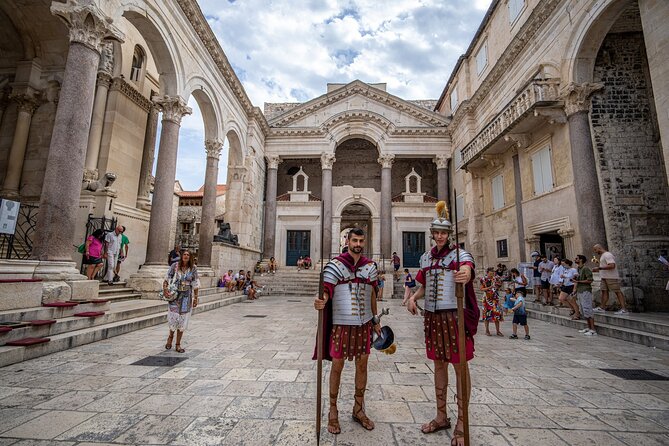
Reviewed · WALKING TOURS
Split Private Walking Tour for Families with kids from 5-17 years
History gets better when kids have a mission. This private Split tour turns Diocletian’s Palace into a Roman puzzle, with tasks, measurements, treasure hunting, and a chocolate tasting woven into the walk. I like the hands-on approach and the chance to explore with only your own group. I also like that the guide adjusts the tone for children and teens, instead of delivering a long adult lecture. The main drawback is the price: $358.87 for up to six people is reasonable for a full family group, but costly for just two or three.
The tour lasts about two and a half hours and stays in central Split. You meet at Obala Hrvatskog narodnog preporoda 23, near the Riva, then finish back at the same meeting point. I would choose this for families who want context, structure, and a private guide, but not for anyone hoping to cover Split quickly or spend most of the time inside museums.
In This Review
- Key points to know before booking
- Why Diocletian’s Palace works so well for families
- Starting at the Riva and entering the Roman palace
- The palace cellars and the scale of Diocletian’s home
- Cathedral of Saint Domnius and the old imperial mausoleum
- The Peristyle, where the emperor performed power
- Silver Gate, Triklinij, and the sounds of palace life
- Vestibulum and the Temple of Jupiter
- Measuring Split’s smallest street
- Pjaca and the 24-digit clock
- Bajamontijeva Street and the Golden Gate
- What the private format is worth
- Age range, walking demands, and weather
- Who should book this Split family tour?
- Should you book the Split private family tour?
- FAQ
- How long does the Split family walking tour last?
- Where does the tour begin?
- Where does the tour end?
- What ages is the tour designed for?
- Is the tour private?
- What language is offered?
- Is chocolate included?
- Is soda or pop included?
- What happens if bad weather cancels the tour?
Key points to know before booking
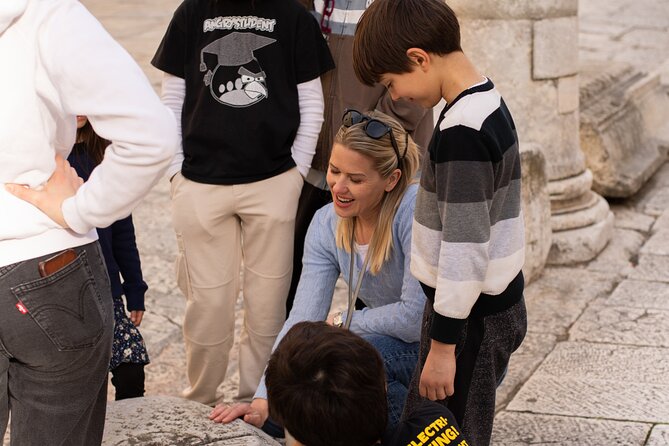
- Roman history becomes a game: Children solve tasks, count columns, measure a narrow street, identify symbols, and follow clues through the palace.
- The private format matters: Only your group participates, so the guide can keep the pace suitable for children from roughly ages 5 to 17.
- The tour covers central Split well: You see the Riva, palace substructures, cathedral, Peristyle, gates, squares, temples, and small streets.
- A sweet reward is included: Chocolate tasting is part of the experience, while soda and other pop are not included.
- Guide Dana made a strong impression: One family said she kept a 4-year-old engaged while also giving the adults useful information, ending with gelato.
- Plan around the weather: The activity requires good weather, with a different date or full refund offered if poor conditions cancel it.
Why Diocletian’s Palace works so well for families
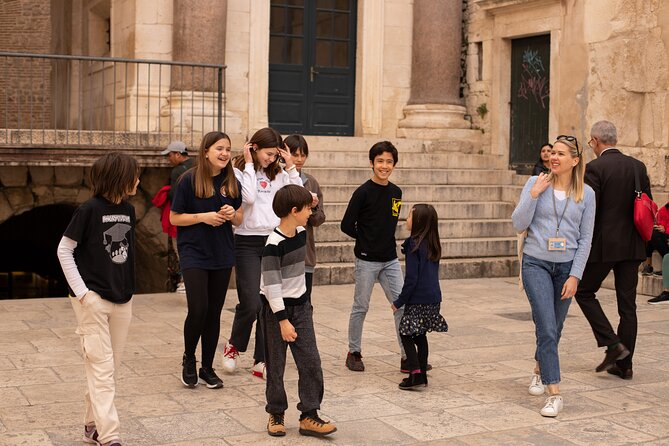
Split’s old center is not a separate archaeological park sitting outside modern life. The Roman palace forms the core of the city, with homes, cafés, shops, churches, and narrow lanes inside and around its ancient walls. That makes a walking tour here feel more like a treasure hunt through a living town than a visit to a single monument.
The family format gives children something to do with the information. Instead of only hearing that Emperor Diocletian lived here about 1,700 years ago, your group may be asked to put pieces together, count columns, test an echo, or look for a particular sign. Those small jobs help young minds stay connected to the place.
I particularly like the range of ages the tour aims to serve. A 5-year-old needs movement and simple challenges. A teenager may want stranger details, political stories, and architectural clues. A private guide can shift between those levels more easily than a large group guide can.
The tour description is built around both education and play. That does not mean every child will love every minute. A child who dislikes walking or old buildings may still tire during two and a half hours. The good news is that the route includes changes of scenery, from the sea to underground spaces, broad squares, gates, and tiny lanes.
More Walking Tours in Split
- Split: Old Town and Diocletian Palace Walking Tour
★ 4.9 · 4,727 reviews - Walking Tour of Split and Diocletian’s Palace
★ 5.0 · 2,588 reviews - Krka Waterfalls tour with Trogir Walking tour and Krka panoramic boat cruise
★ 5.0 · 1,659 reviews
Starting at the Riva and entering the Roman palace
The meeting point is at Obala Hrvatskog narodnog preporoda 23, beside Split’s Riva harbor. The Riva is the city’s seafront promenade, lined with palm trees and open views across the water. It is a useful starting place because the harbor gives your family room to gather before moving into the tighter streets of the palace.
The short Riva stop lasts about 10 minutes. You can expect a quick pause to notice the sea air, the breeze, and the contrast between the open waterfront and the enclosed Roman center. This is not a major sightseeing visit by itself, but it helps children get their bearings.
From there, the tour turns toward Diocletian’s Palace. The main palace section lasts about an hour, with admission included for that stop. The guide frames the site through the life of the emperor and the people who lived in and around his imperial residence.
For adults, this opening can answer a basic question: why does so much of Split feel Roman? For children, the palace becomes a setting for tasks and clues. You may be asked to assemble pieces of a story or search for a sweet specialty from Split. The chocolate tasting included with the tour gives the route a clear reward, although soda and pop are extra.
The palace cellars and the scale of Diocletian’s home
The substructures beneath Diocletian’s Palace are among the most useful places for understanding the building’s size. The tour allows about 10 minutes here. You see the large underground spaces and get a sense of how carefully the palace was built.
This stop works well for children because underground rooms naturally feel different from sunny squares and streets. It also gives your guide a chance to explain that the palace was not a small holiday villa. It was a substantial imperial complex, built on a scale that still shapes Split today.
The supplied details list this stop as free of an additional admission charge. Since the palace area has different sections and rules, I would still pay attention to the guide’s instructions on the day. The important point for budgeting is that the main palace stop includes admission, while the Peristyle is specifically listed as not included.
Cathedral of Saint Domnius and the old imperial mausoleum
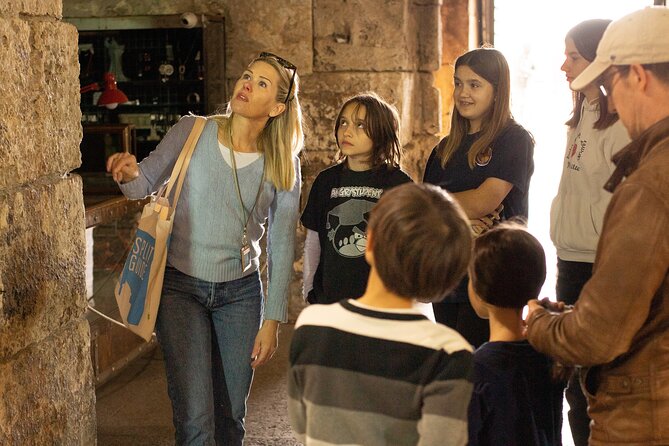
The Cathedral of Saint Domnius gets only about five minutes on this route, so do not expect a full cathedral visit. The focus is a compact story about Diocletian’s mausoleum and the later religious use of the building.
The guide asks children to think about the coffin that once stood at the center of the cathedral. The building began as the emperor’s mausoleum, then became a Christian cathedral. The tour also points to the cathedral’s connection with Saint Domnius, a famous saint still associated with the site.
This is a good example of how the tour links different periods without turning the walk into a classroom lesson. One structure carries both imperial Roman and Christian meaning. For adults, that shift is an important part of Split’s story. For younger children, the question about the building’s protector gives them a simple point to remember.
Because the stop is short, families wanting detailed religious art, architecture, or tower access should plan separate time. Here, the cathedral is one clue in a larger route rather than the main event.
Still Split, at a slower pace:
- Split: Krka Waterfalls Trip with Boat Cruise and Swimming
★ 4.8 · 10,519 reviews - From Split: Krka Waterfalls, Food & Wine Tasting Tour
★ 5.0 · 9,326 reviews - Blue cave, Mamma Mia and Hvar, 5 islands speedboat tour
★ 5.0 · 7,150 reviews - From Split: Krka Waterfalls, Food & Wine Tasting Tour
★ 4.9 · 6,598 reviews
The Peristyle, where the emperor performed power
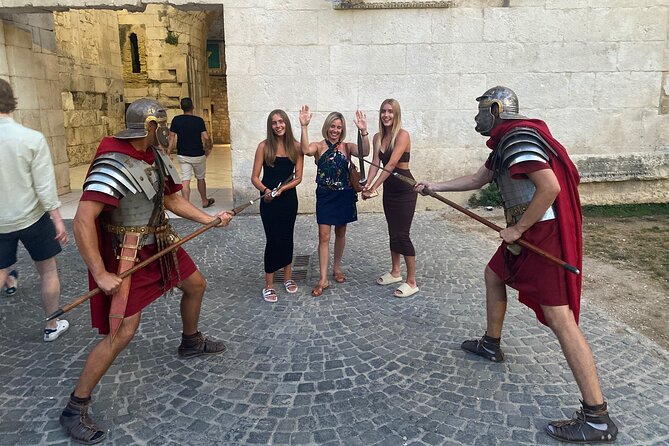
The Peristyle is the symbolic heart of Diocletian’s Palace. This was the main square in the emperor’s time and the entrance to his imperial apartments. The guide explains how Diocletian presented himself there and encouraged people to bow before him.
The story of the emperor declaring himself the son of Jupiter gives children a clear picture of how Roman rulers used ceremony and religion to support power. This is not just a square with old columns. It was a stage, and the emperor knew how to use it.
The guide may ask your family to count the columns. That simple task gives children a reason to look up and study the space rather than hurry through it. I like these small prompts because they work for different ages and require no special background.
The listed time is about 10 minutes. Admission to the Peristyle is not included, so factor that into your budget and expectations. The route still lets you see the square and understand its importance, but you should not assume every paid section of the palace is covered by the tour price.
Silver Gate, Triklinij, and the sounds of palace life
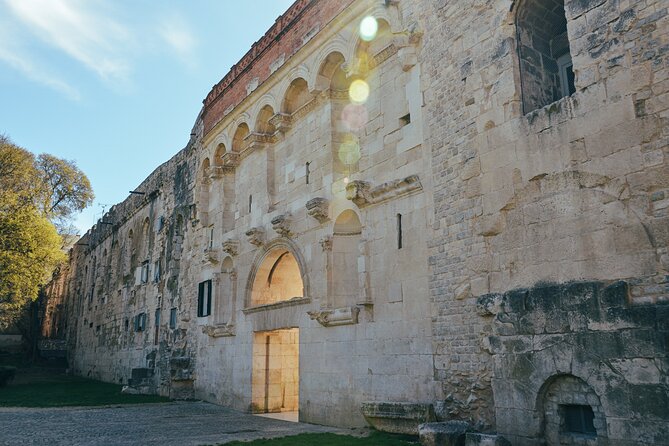
The Eastern, or Silver, Gate marks the former entrance from the east. The tour spends about five minutes here, focusing on its double-gate design and the beginning of the main east-to-west street.
For a child, a gate is easier to understand than an abstract map. The guide can show how people entered the palace and how the main route organized movement through the complex. Looking at the gate’s construction also helps you notice that this was a fortified imperial residence, not only a collection of grand rooms.
Next comes Triklinij, with about 10 minutes devoted to Roman eating habits. This is one of the more playful stops because food gives children a direct way into the past. Your guide asks you to imagine the feasts that took place here centuries ago.
The stop does not promise a recreated meal or a long food program. It is storytelling, followed by the included chocolate tasting elsewhere in the experience. Still, food is a smart bridge between modern family life and ancient customs. Children may forget a date, but they often remember what people ate.
Vestibulum and the Temple of Jupiter
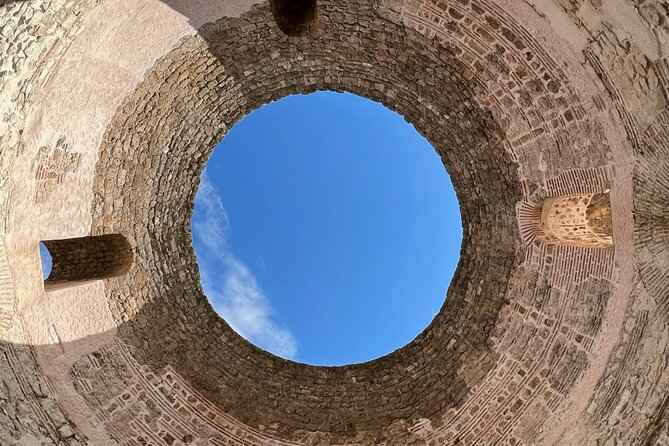
The Vestibulum is an unusual open corridor leading toward the imperial apartment. The stop lasts about five minutes and makes use of the space’s acoustics. The guide invites you to speak or make a sound so your group can hear how your voice carries.
This is exactly the kind of quick activity that keeps a walking tour moving. You are not only looking at stone. You are testing the building with your own voice.
The Temple of Jupiter follows for about 10 minutes. The site once served as a temple and is now a baptistery. That change lets the guide explain how the same place can take on a new religious role over time.
The stop is listed as free of an additional admission charge. It also adds a useful contrast to the Peristyle. There, the emperor displayed power in public. Here, the focus shifts toward worship and later Christian use.
Measuring Split’s smallest street
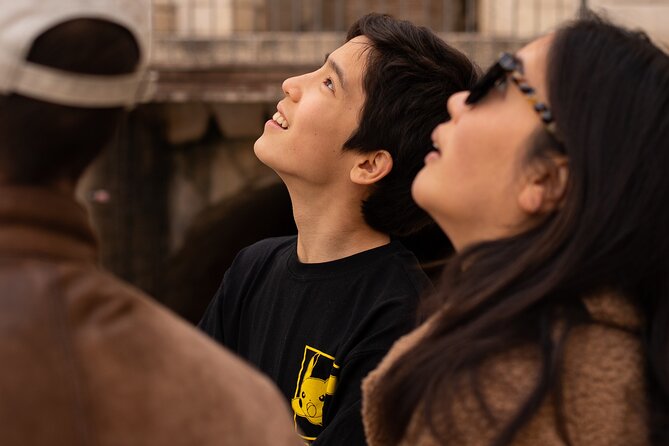
At Kraj Sv. Ivana 1, the guide asks how wide the smallest street in town is and invites your group to measure it. The stop takes about five minutes.
This may sound minor, but it is exactly the sort of detail that can stick with a child. Narrow streets make old cities feel physical. You can see how closely buildings press together and how different the route is from the open Riva or the formal Peristyle.
The tour does not provide a separate entrance fee for this stop. You simply use the street as part of the walk. For parents, it is a welcome change from another explanation of emperors, dates, and architecture.
Pjaca and the 24-digit clock
Narodni Trg, commonly called Pjaca, offers another shift in mood. The square contains buildings from different architectural periods, and the guide points out the unusual clock with 24 digits.
The stop lasts about five minutes. That is enough for a quick look and a question, but not a full architectural lecture. The clock gives children a visual puzzle and gives adults a chance to notice how Split’s later town grew around the older palace.
I like the way this stop broadens the tour beyond the Roman period. Split is not frozen in Diocletian’s era. The square shows later changes layered onto the ancient center.
Bajamontijeva Street and the Golden Gate
Bajamontijeva ulica once formed part of the army area and is now a narrow city street. The guide explains that many things changed in the palace after the Italians arrived, then asks your group to find the symbol of Italy and continue to a fountain for another task.
The stop lasts about five minutes. It is less monumental than the gates and cathedral, but it rewards close looking. You need to notice small details rather than wait for a grand view.
The final major stop is the Golden Gate, with about 10 minutes to examine its unusual construction and the purpose of the double gate. This is a strong finish because the gate brings the tour back to the palace’s defensive design and main entrances.
You get a better sense of how the palace worked as a planned complex: roads, gates, public spaces, religious buildings, imperial rooms, and service areas all fitted together. The guide’s questions give children a reason to compare the Golden Gate with the earlier Silver Gate.
What the private format is worth
The price is $358.87 per group of up to six people. If you fill all six places, that works out to about $59.81 per person. For four people, it is about $89.72 each. For two people, the cost rises to about $179.44 each.
That makes the group size the key value question. I think the tour makes the most financial sense for a family of four to six, especially if you want a guide focused only on your children’s ages and interests. A smaller group pays more, but gains privacy and flexibility.
The guide can make the palace more accessible to a 5-year-old while adding enough detail for a 17-year-old. You also avoid being tied to the pace of strangers. The tour is offered in English and uses a mobile ticket.
The included chocolate tasting adds a pleasant finish, but this is not a food tour. Soda and pop are not included, so bring your own plan for drinks. The experience ends back at the starting point, which makes it easier to continue sightseeing from the Riva afterward.
Age range, walking demands, and weather
The tour is designed for children from 5 to 17, but one direct account describes guide Dana keeping a 4-year-old engaged and finishing with gelato. That suggests the style can work for a younger child, though I would not treat the tour as guaranteed entertainment for every preschooler.
Most people can participate, and service animals are allowed. The meeting point is near public transportation. No special fitness requirement is given, but this is a walking tour lasting about two and a half hours, so you should expect time on your feet and frequent stops in old streets.
The activity requires good weather. If poor weather causes cancellation, you are offered another date or a full refund. You can also cancel up to 24 hours before the start for a full refund. Changes or cancellations inside that 24-hour window are not accepted.
Who should book this Split family tour?
I would book it if you want your children to remember Split as a place where they solved clues, heard echoes, measured streets, and searched for details. The route has enough variety to hold attention, and the private setup gives the guide room to respond to your family.
It is especially suitable for a group of four to six with children in different age brackets. Younger children get movement and treats. Older children get Roman power, architecture, religious change, and questions that ask them to observe.
I would hesitate if your family dislikes guided activities, cannot walk for two and a half hours, or wants a detailed cathedral or museum visit. The many short stops are useful for keeping kids engaged, but adults seeking extended explanations may find some sections brief.
Should you book the Split private family tour?
Yes, if your priority is a friendly, active introduction to Diocletian’s Palace. The strongest feature is not simply the list of sights. It is the way the route turns those sights into small challenges that help children look, listen, and remember.
The price is high for a small party, but fairer for six people sharing the fee. I would book ahead, since the activity is often reserved about 33 days in advance. If you have a full family group and want Split’s Roman center explained without losing your children along the way, this is a strong choice.
FAQ
How long does the Split family walking tour last?
The experience lasts approximately 2 hours and 30 minutes.
Where does the tour begin?
It begins at Obala Hrvatskog narodnog preporoda 23, 21000 Split, Croatia.
Where does the tour end?
The activity ends back at the meeting point.
What ages is the tour designed for?
The tour is designed for families with children from 5 to 17 years old.
Is the tour private?
Yes. Only your group participates, with up to six people included in the group price.
What language is offered?
The tour is offered in English.
Is chocolate included?
Yes. A chocolate tasting is included as a snack.
Is soda or pop included?
No. Soda and pop are not included.
What happens if bad weather cancels the tour?
You are offered a different date or a full refund if the activity is canceled because of poor weather.
Just added around Split
- Walking Tour Split★ 4.7 · 61 reviews
- Unique vintage Tomos moped tour Split – Back to the ’80s★ 4.8 · 17 reviews
- Trogir: White Lagoon, Maslinica & Blue Lagoon Speedboat Tour★ 4.8 · 11 reviews
- Essential Diocletian’s Palace Tour for First-Time Visitors★ 4.8 · 19 reviews
- Split: Trogir Open Top Bus Trip + Free Split Walking Tour★ 4.1 · 17 reviews
- Trogir; Private walking tour of higlights of Trogir★ 4.7 · 3 reviews
- Trogir: Old Town Guided Walking Tour★ 4.6 · 76 reviews
- Trogir: Blue Lagoon, Maslinica, and Solinska Bay Boat Tour★ 4.9 · 88 reviews
Walking Tours, compared.
Walking Tour of Split and Diocletian’s Palace
Read our review →
Krka Waterfalls tour with Trogir Walking tour and Krka panoramic boat cruise
Read our review →
City Walls Early Morning or Sunset Walking Tour
Read our review →Browse the lists this tour appears in