
Reviewed · WALKING TOURS
Split: Guided Walking Tour in English
Split keeps its Roman heart alive. I like this 90-minute walking tour because it turns Diocletian’s Palace from a maze of old stone into a place you can understand, and I like that a local English-speaking guide adds customs, food tips, and everyday context. The $29 price is reasonable for a short orientation, though entrance fees for churches and museums are not included.
You begin and end at the Gray Line office on Obala Hrvatskog Narodnog Preporoda 21, making this an easy first activity in Split. The main consideration is the uneven historic center: this tour is not wheelchair accessible, and children must stay with an adult.
In This Review
- Key points to know before booking
- Why a walking tour makes sense in Split
- Meeting the guide at the waterfront
- Entering a city built around Diocletian’s Palace
- Walking the narrow stone streets
- The Peristyle, the tour’s strongest moment
- Roman remains beside medieval buildings
- How much local culture you will hear
- What the $29 price delivers
- Who will get the most from this tour
- A practical way to plan the rest of your day
- The drawbacks to keep in mind
- Should you book the Split walking tour?
- FAQ
- Where does the Split walking tour begin?
- How long does the tour last?
- Where does the tour finish?
- Is the tour conducted in English?
- Are entrance tickets included?
- Is the tour wheelchair accessible?
- Can I cancel the booking?
Key points to know before booking

- Diocletian’s Palace is still part of daily life: You will see ancient Roman remains alongside medieval buildings and homes that are still occupied.
- The Peristyle is the star stop: This monumental court once led toward the emperor’s private apartments and mausoleum.
- Local guides add more than dates: Guides such as Petra and Gabrijela have been praised for clear explanations, friendly conversation, and practical advice about Split.
- The tour stays in the historic center: There is no transport between stops, so you see the city at walking pace through narrow stone lanes.
- Tickets are separate: Churches and museums cost extra, but the guide can explain where to buy tickets and help you plan a later visit.
- A flexible booking option helps: You can cancel up to 24 hours ahead for a full refund and reserve now while paying later.
Why a walking tour makes sense in Split

Split is not a city where the most important sight sits behind one neat entrance gate. The ancient palace forms the core of the modern city, and its walls, courtyards, streets, shops, homes, and cafés have blended together over centuries.
That can be thrilling, but it can also be confusing. A Roman column may appear beside a medieval wall, while a narrow lane leads to a square that once served an entirely different purpose. I find a guided walk useful here because it gives you the basic map and story before you explore on your own.
This tour focuses on the historic center and lasts 1.5 hours. That is long enough to introduce the major monuments without taking up half your day. You can then return to the places that interest you most, perhaps paying for entry to a church or museum after the guide has explained what you are seeing.
The experience is also small in spirit, even though the precise group size is not stated. One booking once resulted in a private-feeling walk with only three people, which allowed plenty of questions and conversation. You should not count on having a private tour, but the guides appear comfortable engaging directly with their group.
More Walking Tours in Split
- Split: Old Town and Diocletian Palace Walking Tour
★ 4.9 · 4,727 reviews - Walking Tour of Split and Diocletian’s Palace
★ 5.0 · 2,588 reviews - Krka Waterfalls tour with Trogir Walking tour and Krka panoramic boat cruise
★ 5.0 · 1,659 reviews
Meeting the guide at the waterfront
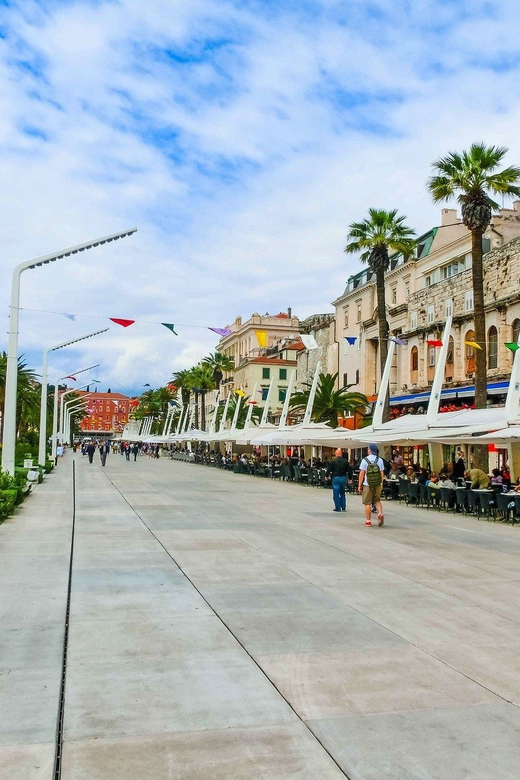
The meeting point is the Gray Line office at Obala Hrvatskog Narodnog Preporoda 21. This address is on Split’s waterfront promenade, a useful place to begin because it puts you close to the old center without asking you to find an obscure alley on your own.
Allow yourself enough time to locate the office and arrive ready to walk. The tour returns to the same address, so you do not need to arrange transport at the end or worry about being left on the far side of town.
The guide leads in English. Several guides have received especially warm praise, including Petra and Gabrijela. Petra was described as friendly, clear, and ready to answer questions about the history of Split and the surrounding region. Gabrijela was also praised for her English, local background, food suggestions, and advice about the city beyond the monuments.
That detail matters. A guide who can explain why a building matters is helpful. A guide who can also point you toward local customs, food, and useful places for the rest of your stay is even more useful.
Entering a city built around Diocletian’s Palace
The central story is the Roman emperor Diocletian and the palace he built in Split. You will hear about the city’s roughly 1,700-year history and how later generations adapted the old imperial complex instead of abandoning it.
Do not picture a single empty palace with polished floors and velvet ropes. The historic area is a working part of Split. People still live inside the palace walls, and medieval additions sit against Roman remains. That mixture is one of the most interesting parts of the tour because it shows how cities change without wiping away their earlier layers.
Your guide helps connect the pieces. Ancient stonework is not just an isolated relic. It belongs to a larger plan that once served an emperor, his household, and his official life. Later buildings altered the area, but the Roman structure continued to shape the city around it.
I especially like this approach for first-time visitors. You are not merely checking off a palace. You are learning why Split developed where it did and how an imperial residence became the framework for an active urban center.
Walking the narrow stone streets
The route takes you through a maze of narrow stone streets. These lanes are part of the experience, not simply the spaces between major sights.
A guided walk helps you notice how the historic center is arranged. Without context, a medieval building may look like another attractive old façade. With a guide, you can begin to separate the Roman foundations from later construction and understand how the city grew around the palace.
The streets also give the tour a local feel. You are walking through places where everyday life continues, rather than visiting a completely preserved site that exists only for sightseeing. The fact that residents still live within the walls gives the old center a practical, lived-in quality.
There is a trade-off. Narrow stone lanes and old surfaces are not ideal for anyone with limited mobility, and the tour is specifically not suitable for wheelchair users. Comfortable walking shoes are a sensible choice, although the supplied information does not specify the exact surface conditions or amount of elevation.
Still Split, at a slower pace:
- Split: Krka Waterfalls Trip with Boat Cruise and Swimming
★ 4.8 · 10,519 reviews - From Split: Krka Waterfalls, Food & Wine Tasting Tour
★ 5.0 · 9,326 reviews - Blue cave, Mamma Mia and Hvar, 5 islands speedboat tour
★ 5.0 · 7,150 reviews - From Split: Krka Waterfalls, Food & Wine Tasting Tour
★ 4.9 · 6,598 reviews
The Peristyle, the tour’s strongest moment
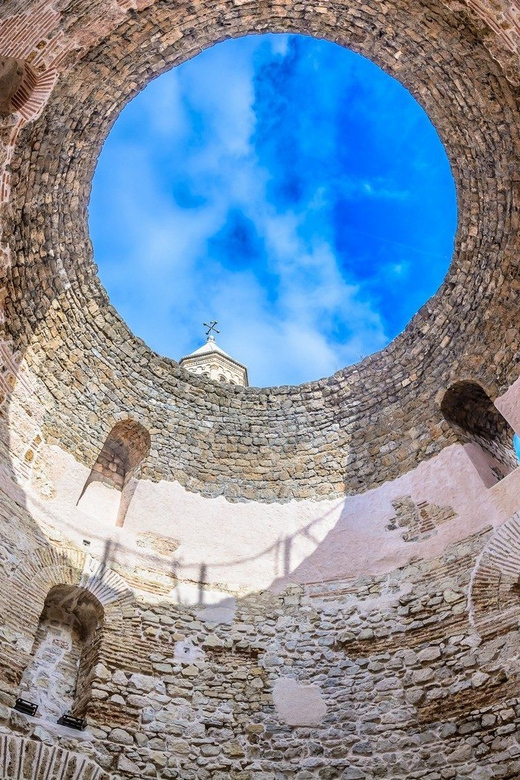
The Peristyle is the clearest architectural highlight described for this walk. This monumental court provided access to Diocletian’s imperial apartments and mausoleum, so it was not a minor decorative space. It was part of the palace’s formal route into the emperor’s world.
A guide can make a large court easier to read. You will learn how it fitted into the palace plan and why its position mattered. The value is not only in seeing grand columns or old stone. It is in understanding the movement from public ceremonial space toward the private and sacred areas of the imperial complex.
The Peristyle also shows why Split works so well as a walking destination. One moment you are in a public square surrounded by visitors and local activity. A few steps later, you are looking at architecture tied to an emperor who shaped the city nearly two thousand years ago.
The tour does not include entry fees to churches or museums. If a particular interior interests you, the guide can tell you where to purchase a ticket. You can return after the walk and explore at your own pace, which is a sensible arrangement for anyone who prefers not to rush through an important interior during a group tour.
Roman remains beside medieval buildings
The tour also covers later medieval extensions. This is essential because Split’s character comes from the contrast between periods, not from Roman remains alone.
You will see how the city continued to grow within and around the palace. Medieval buildings occupy spaces shaped by the Roman plan, and the old walls became part of a later neighborhood. The guide’s job is to explain these connections so you can see the historic center as a sequence of changes rather than a collection of unrelated monuments.
I like tours that leave room for this sort of layered history. Dates alone are easy to forget. The idea that later residents built, adapted, and lived inside the former imperial compound is easier to remember because you can see the result in the streets around you.
The walk also gives you a useful sense of scale. A 90-minute tour cannot cover every corner of Split, but it can show you how the old core fits together. Afterward, you should have a better idea of where to return for more time with the palace, churches, museums, or side streets.
How much local culture you will hear
The tour promises more than Roman architecture. You will hear about local customs and traditions, along with the city’s way of life.
The exact cultural topics can vary by guide and by the questions you ask. That is actually a strength. The most useful part may come when you ask about food, daily life, or what to do after the tour. Gabrijela, for example, was praised for offering food recommendations as well as historical information.
I would use the walk as a conversation, not a lecture. Ask your guide what local habits are worth noticing, which areas deserve another visit, and where you can continue exploring independently. Guides such as Petra and Gabrijela were praised for taking questions, so you should feel free to make the tour fit your interests.
The tour’s high rating, 4.9 from 10 ratings, reflects a consistent pattern in the available comments: friendly guides, clear explanations, and a good introduction to Split’s historic center. The strongest praise is directed at the guides rather than at a special activity or ticketed attraction.
What the $29 price delivers
At $29 per person, this is a modestly priced introduction to Split. You are paying for 90 minutes with an English-speaking local guide, not for museum admission or a long day of sightseeing.
The value depends on how you use the tour. If you want a quick orientation at the start of your stay, the price is easy to justify. You get the major story, a walk through the palace area, and guidance on which paid sights to visit later.
It is less suitable if you want a detailed archaeological tour with lengthy time inside museums or churches. Those admission fees are extra, and the walk itself does not include independent exploration after the guide finishes.
I would think of the price as paying for context. The stones are already in Split, but understanding them is what makes the visit more rewarding. If this tour prevents you from wandering past the Peristyle, medieval additions, or palace walls without knowing what you are seeing, it has done useful work.
Who will get the most from this tour
This walk suits a first visit to Split, especially if you have only a short time in the city. It is also a good choice for anyone who prefers an overview before choosing which monuments to enter.
You will likely appreciate it if you enjoy:
- Roman and medieval history explained in plain English
- Walking through old streets rather than riding between sights
- Asking a local guide about food and customs
- Seeing how a historic site remains part of everyday life
- Keeping the rest of the day free for independent plans
Families can book, but children must be accompanied by an adult. The walk is not suitable for wheelchair users, and unaccompanied minors are not allowed.
The 90-minute length also works well for a busy itinerary. You can take the tour in the morning and still have time for a longer lunch, a museum, or more wandering afterward. Starting times vary, so you need to check availability when booking.
A practical way to plan the rest of your day
I would schedule this tour near the beginning of your time in Split. The route begins and ends at the Gray Line office, so you can use the guide’s suggestions immediately afterward.
If you want to enter a church or museum, listen for the guide’s advice about tickets and location. Since admission is not included, you can decide after seeing the exterior and hearing the explanation. That gives you more control than buying several tickets before you know which places interest you.
Keep the afternoon flexible. The tour is designed to introduce the center, not to provide a full day of indoor visits. You may find that one monument deserves a return visit, while another is satisfying from the outside.
The booking terms are useful for uncertain schedules. You can reserve now and pay later, and cancellation is free up to 24 hours before the activity for a full refund. That flexibility is helpful if your Split plans depend on a cruise schedule, changing weather, or a busy Croatian itinerary.
The drawbacks to keep in mind
The main limitation is the short format. Ninety minutes is enough for a strong introduction, but not enough to cover every part of Split or spend much time inside paid attractions.
The second issue is access. This is a walking tour through a historic center with narrow stone streets, and it is not wheelchair accessible. Anyone who finds uneven old streets difficult should consider that carefully before booking.
You should also remember that guide quality can vary slightly from one departure to another, even though the named guides in the available feedback, including Petra and Gabrijela, earned strong praise. The overall rating is excellent, but no walking tour can guarantee that every group will be the same size or that every guide will focus on the same local details.
These are reasonable limits for a short, low-cost city orientation. They do not make the tour poor. They simply tell you what it is: a guided introduction to Split, not a complete archaeological program.
Should you book the Split walking tour?
I would book this tour if you want to understand Split before exploring it on your own. The combination of Diocletian’s Palace, the Peristyle, medieval additions, narrow streets, and local customs gives you a useful foundation in a short time.
The best reason to choose it is the guide-led context. Petra and Gabrijela were praised for being friendly, clear, local, and open to questions, and that kind of personal explanation can make the palace far easier to appreciate.
Skip it if you need wheelchair access, want included museum entry, or already know Split’s history well. For most first-time visitors who can comfortably walk for 90 minutes, $29 is a fair price for getting oriented and finding the parts of the old center worth a closer look.
FAQ
Where does the Split walking tour begin?
Meet at the Gray Line office at Obala Hrvatskog Narodnog Preporoda 21 in Split.
How long does the tour last?
The walking tour lasts 90 minutes, or 1.5 hours.
Where does the tour finish?
The tour returns to the Gray Line office at Obala Hrvatskog Narodnog Preporoda 21.
Is the tour conducted in English?
Yes. The tour includes a live English-speaking guide.
Are entrance tickets included?
No. Tickets for churches and museums are not included. The guide can explain where to buy them, and you can visit the sites afterward at your own pace.
Is the tour wheelchair accessible?
No. The tour is not wheelchair accessible and is not suitable for wheelchair users.
Can I cancel the booking?
Yes. You can cancel up to 24 hours in advance for a full refund. You can also reserve now and pay later.
Just added around Split
- Slatine – Island Hopping Excursion (Trogir/Blue Lagoon/Shipwreck)★ 4.0 · 24 reviews
- Krka Waterfalls & Primošten from Trogir, Seget, Čiovo & Kaštela★ 5.0 · 18 reviews
- Island Hopping Boat Excursion with Lunch (Trogir,Blue Lagoon, Šolta)★ 3.5 · 6 reviews
- From Trogir, Seget, Okrug: Krka Waterfalls & Šibenik Culture Tour★ 5.0 · 10 reviews
- From Split & Trogir: ATV Quad Tour on Island Čiovo★ 5.0 · 21 reviews
- Split: Blue Lagoon Boat Trip with Lunch, Wine and Snorkeling★ 5.0 · 3 reviews
- Split Sunset Stand Up Paddle Tour★ 5.0 · 16 reviews
- Split: Sunset Guided Kayaking Tour★ 4.8 · 71 reviews
Walking Tours, compared.


Walking Tour of Split and Diocletian’s Palace
Read our review →


Krka Waterfalls tour with Trogir Walking tour and Krka panoramic boat cruise
Read our review →
City Walls Early Morning or Sunset Walking Tour
Read our review →Browse the lists this tour appears in