
Reviewed · WALKING TOURS
Split: Diocletian’s Palace Private walking tour
Ancient stone still has house keys. This private walk through Diocletian’s Palace brings Roman power into the present, because people still live among its courtyards, gates, and old imperial rooms. I like the living-city setting, and I like that a small group of no more than 10 can shape the visit around its interests.
The Peristyle, the former mausoleum, and the Golden Gate give you a clear route through Split’s Roman past without the feel of a formal museum. The main caution is that church services or special events can close some sights, and parts of the route are not wheelchair accessible.
At $135 per person, this is a premium walking tour, but the private format and personal attention can make the cost worthwhile for history fans who want more than a quick look. Guide Dana receives especially warm praise for her enthusiasm, and the tour is offered in English, French, or German.
In This Review
- Key points at a glance
- Why Diocletian’s Palace feels different from a museum
- Starting at the bronze model on the Riva
- The Peristyle and the emperor as Jupiter’s son
- Split Cathedral, from imperial tomb to Christian church
- The Vestibule and the route to private imperial rooms
- The North Gate, Golden Gate, and Church of St. Martin
- A route shaped by living city life
- What the private format is worth at $135
- Guide Dana and language choices
- Practical points before you reserve
- Who will get the most from this Split walk?
- Should you book the Diocletian’s Palace private tour?
- FAQ
- How much does the Diocletian’s Palace private walking tour cost?
- How many people can join the tour?
- Where does the tour begin?
- Where does the tour end?
- Which languages are available?
- Can the tour be customized?
- Can every sight be visited on every departure?
- Is the tour wheelchair accessible?
Key points at a glance
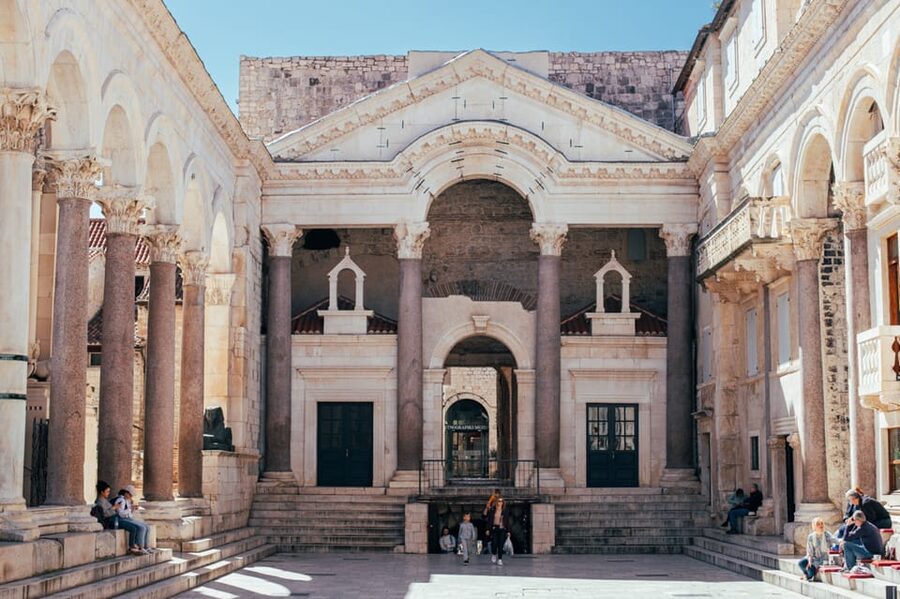
- A Roman palace that is still a neighborhood: Ancient walls surround homes, shops, streets, and everyday life in central Split.
- The Peristyle explains imperial power: This ceremonial square was linked to Diocletian’s worship as the son of Jupiter.
- The Cathedral began as a mausoleum: The building’s change from pagan tomb to Christian cathedral gives the tour one of its strongest stories.
- The Vestibule marks the imperial threshold: This grand entrance once welcomed dignitaries to Diocletian’s private quarters.
- The Golden Gate has a small surprise: The former guard corridor contains the Church of St. Martin, described as the city’s smallest church.
- A flexible format keeps the tour personal: The program can be adjusted, with a maximum of 10 participants.
Why Diocletian’s Palace feels different from a museum
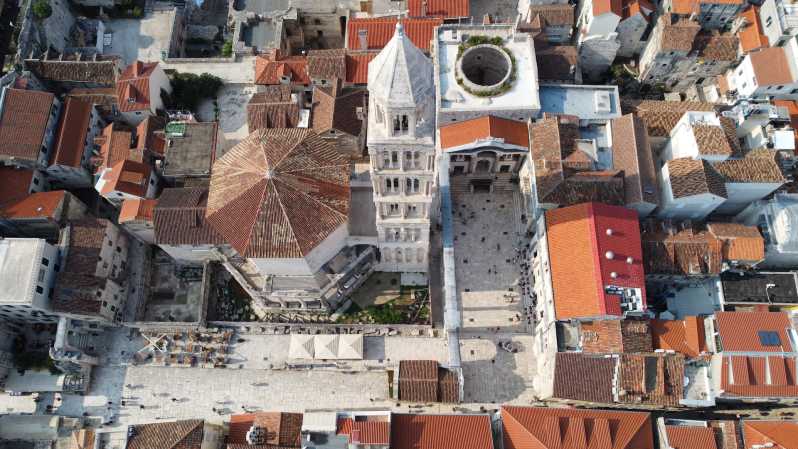
Diocletian’s Palace is not a quiet ruin set apart from the city. It forms the core of Split, with local people living and moving through spaces first built for a Roman emperor. That changes the mood from a standard archaeological visit.
You are not simply looking at fragments behind glass. You are walking through doorways, alleys, and courtyards that remain part of daily life. Ancient columns share space with modern homes. Roman stone sits beside ordinary city activity. I find that contrast useful because it shows how old buildings survive by being used, not only preserved.
The palace dates back about 1700 years and was built and inhabited by Emperor Diocletian. His decision to create a grand residence and retirement complex here shaped the entire center of Split. The tour uses the main surviving spaces to explain how the emperor presented himself, protected his residence, and separated public ceremony from private life.
Because this is a private or very small-group experience, you can ask questions as you go. The stated maximum is 10 participants, which is small enough for a guide to keep the group together and respond to individual interests. The format is also individually customizable, a useful feature if you care more about architecture, religion, Roman government, or the later life of the palace.
More Walking Tours in Split
- Split: Old Town and Diocletian Palace Walking Tour
★ 4.9 · 4,727 reviews - Walking Tour of Split and Diocletian’s Palace
★ 5.0 · 2,588 reviews - Krka Waterfalls tour with Trogir Walking tour and Krka panoramic boat cruise
★ 5.0 · 1,659 reviews
Starting at the bronze model on the Riva
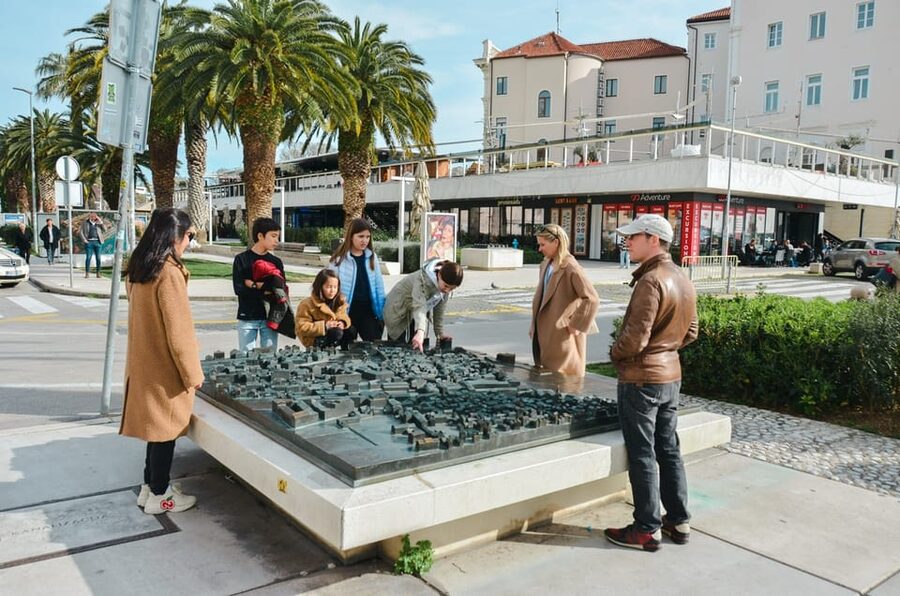
The meeting point is the bronze model of Split at the eastern end of the Riva promenade. This is a practical starting place because the model gives you a quick visual sense of the city before you enter the palace.
The Riva is Split’s waterfront promenade, but the tour begins by orienting you to the shape of the old center. From the model, your guide can help connect the palace walls and gates to the streets you will walk. That early map matters because Diocletian’s Palace is not laid out like a modern museum with a simple entrance, exit, and numbered rooms.
The activity ends back at the same meeting point. That makes the route easy to plan around other time in Split. You do not need to arrange a separate ride from the final stop, and you finish near the promenade rather than in an unfamiliar part of the city.
The Peristyle and the emperor as Jupiter’s son
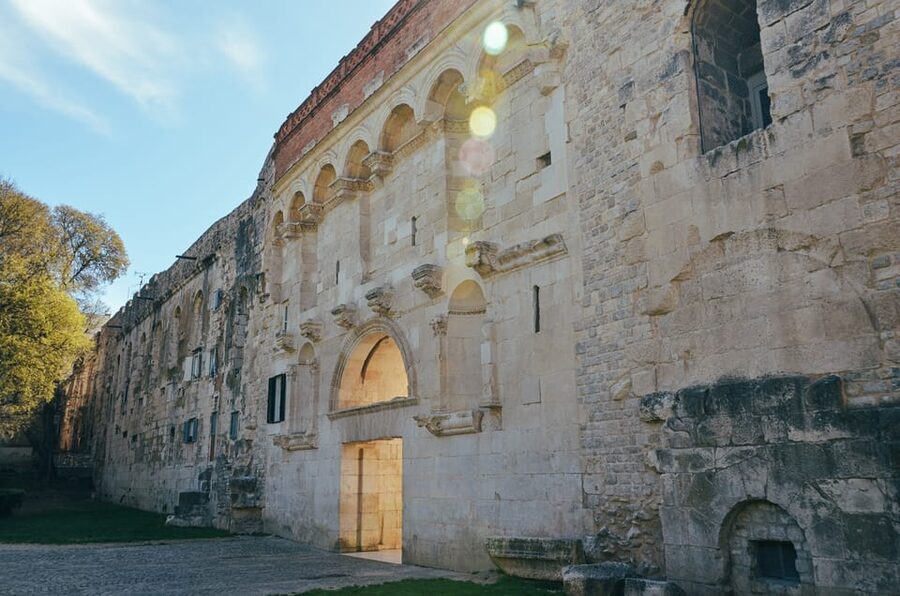
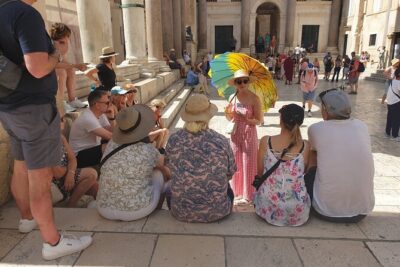
The Peristyle is one of the tour’s essential stops. This ceremonial square was an important meeting place during Diocletian’s era, and the emperor was worshipped there as the son of Jupiter.
That detail tells you how Roman rule worked. Diocletian was not presented only as a political leader. His authority had a religious side, too. The Peristyle helped create a setting where the emperor could appear before his subjects with the status of a divine figure.
I like this stop because it gives the palace a human scale. You can picture people gathering in the same central space for ceremony and public business, even though the meaning of the site has changed. The square is not simply an attractive collection of columns. It was designed to support a carefully staged image of power.
Your guide’s explanation is especially useful here. Without context, the Peristyle can look like a photogenic courtyard. With context, you begin to see the relationship between architecture, ceremony, and imperial control.
The open setting also makes this a good place to ask questions. If you want to know how the emperor related to ordinary subjects, why Jupiter mattered, or how public areas connected to private rooms, this is the point to raise it.
Split Cathedral, from imperial tomb to Christian church
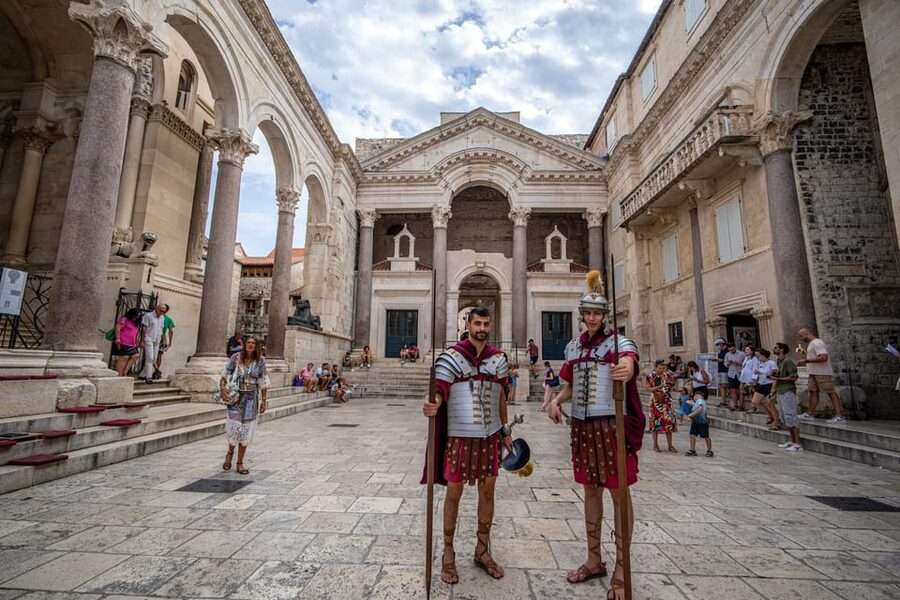
Split Cathedral adds one of the most striking changes in the palace’s story. The structure was originally built as Diocletian’s mausoleum, but after Christianization, the emperor’s remains disappeared and the building became a cathedral.
That shift says a great deal about the changing identity of Split. A monument created to honor a Roman emperor was given a new religious purpose. The building survived, but the message it carried changed.
The tour focuses on the cathedral’s fascinating background and its exterior. You should not assume that every interior area will be open. Church services and special events can prevent access to some sights, and the program may need to change slightly in those cases.
Even from outside, the former mausoleum is a powerful stop because its original purpose and later use are so different. I appreciate tours that explain not only what a building was designed to be, but also how later generations adapted it. This is one of the clearest examples on the route.
If religious services are taking place, keep in mind that the change is not a failure of the tour. The cathedral remains an active church, not only an attraction. The tradeoff is that a living historic site sometimes takes priority over sightseeing.
Still Split, at a slower pace:
- Split: Krka Waterfalls Trip with Boat Cruise and Swimming
★ 4.8 · 10,519 reviews - From Split: Krka Waterfalls, Food & Wine Tasting Tour
★ 5.0 · 9,326 reviews - Blue cave, Mamma Mia and Hvar, 5 islands speedboat tour
★ 5.0 · 7,150 reviews - From Split: Krka Waterfalls, Food & Wine Tasting Tour
★ 4.9 · 6,598 reviews
The Vestibule and the route to private imperial rooms
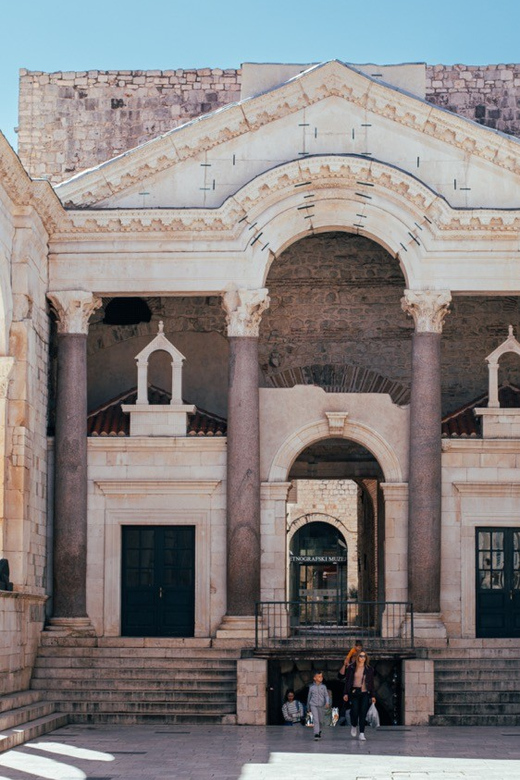
The Vestibule was the grand entrance to Diocletian’s private chambers. It welcomed dignitaries from across the Roman world and marked the boundary between public access and the emperor’s personal quarters.
That boundary is worth noticing. A palace is not just a collection of rooms. It is also a system of access. The Vestibule helped control who could approach the emperor and how they entered his private world.
This stop gives you a sense of ceremony before you reach the private side of the complex. I would pay attention to the transition itself: the route from public meeting space toward the emperor’s rooms reflects his status and the careful order of palace life.
The Vestibule also helps tie the Peristyle and the private chambers together. One area was linked to public imperial display, while the other led toward personal quarters. The tour’s value comes from seeing how these spaces worked as parts of one residence rather than as unrelated ruins.
Because the tour can be customized, you can ask your guide to spend more time on construction, court life, or the difference between public and private areas. That personal adjustment is harder to get in a large group.
The North Gate, Golden Gate, and Church of St. Martin
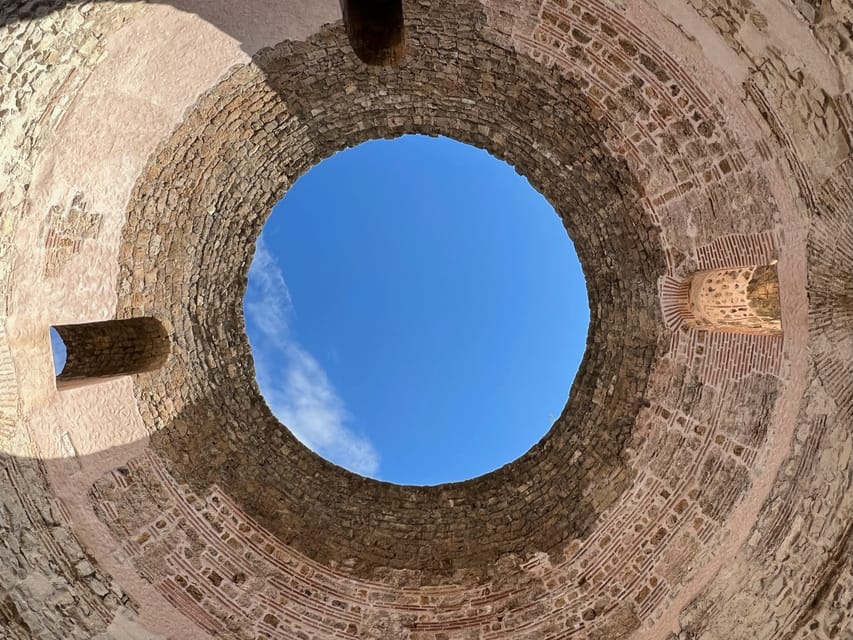
The North Gate was the most important city gate in the Roman era. It is also known as the Golden Gate, or Porta Aurea, and it offers a useful look at how the palace connected to the outside world.
Gates were practical structures, but they also carried political meaning. They controlled movement, helped protect the complex, and gave visitors a formal first impression. The Golden Gate was not an afterthought at the edge of the palace. Its importance reflected the need to manage entry into the imperial city.
Inside the former guard corridor, you will find the Church of St. Martin, described as the smallest church in Split. This is the kind of detail that makes a guided walk worthwhile. You might pass through an old defensive space and see only a narrow corridor. A guide can point out how the structure was reused and why this tiny church matters.
The North Gate also reinforces the theme running through the entire tour: Roman spaces have been repeatedly adapted. Imperial rooms became part of a medieval and modern city. Guard areas gained religious uses. The palace did not stop changing when the Roman period ended.
A route shaped by living city life
The palace’s greatest appeal is also one of its limitations. Since people still live and work inside the complex, you get a more immediate sense of Split than you would in an isolated ruin. At the same time, the route may include ordinary city movement, restricted access, and changing conditions.
That is a fair trade for seeing the site as part of real life. You may find the atmosphere less controlled than in a museum, but it is also less artificial. The old walls are not merely scenery. They frame homes, streets, and daily routines.
A guide helps you read this mixed setting. Roman architecture can be easy to overlook when it is folded into a working city. The tour points out why a gate, courtyard, or corridor mattered and how later use altered the original plan.
I would not choose this experience if you want a completely quiet archaeological site with every room open. I would choose it if you want the palace explained as a place that has continued to serve the city for centuries.
What the private format is worth at $135

The listed price is $135 per person. That is not a bargain walking tour, so the question is what you receive for the extra cost.
The answer is personal attention. The group is limited to 10 participants, and the tour is individually customizable. You are paying for a guide who can adjust the emphasis, answer questions, and keep the visit focused rather than delivering the same short speech to a large crowd.
The price makes the most sense for couples, families, or small groups who care about Roman architecture and want a structured introduction to Split. It can also work well at the beginning of your stay, since one five-star rating specifically praised the tour as a fast way to see the highlights, learn a lot, and get oriented in the city center.
That orientation has real value. Diocletian’s Palace can feel confusing at first because the ancient complex and modern streets overlap. A guided route helps you understand where the major spaces fit and makes it easier to recognize them later when you walk through the center on your own.
The cost is harder to justify if you only want a quick look at the Peristyle and Golden Gate. You can see parts of the palace while walking around Split without a guide. The tour earns its price through interpretation, organization, and flexibility, not simply through access to the streets.
Guide Dana and language choices
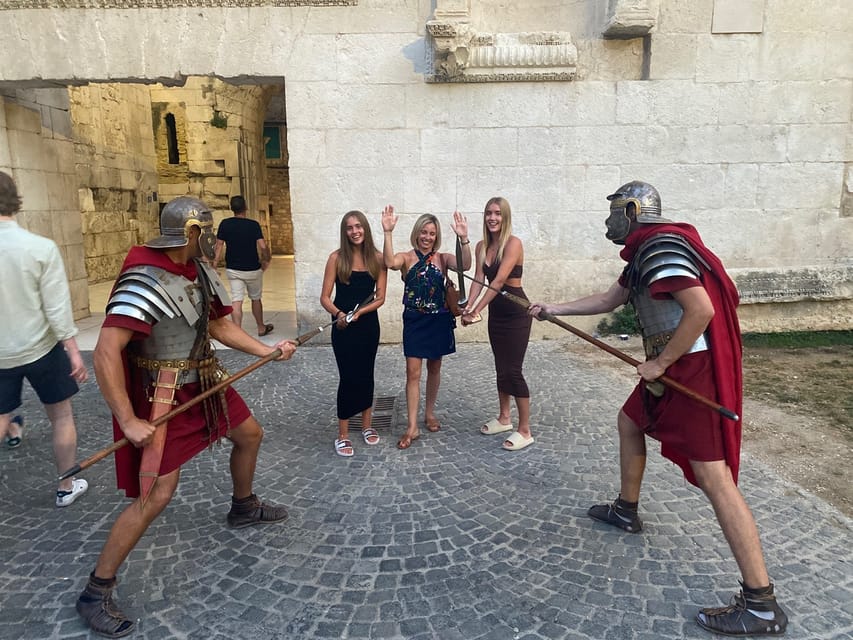
Guide Dana receives especially strong praise for her enthusiasm and for making the private visit memorable. That gives you a useful clue about the style to expect: this is intended to be a personal, engaged walk rather than a dry recital of dates.
No guide can guarantee the same experience for every departure, but Dana’s name is worth noting if you are able to request or confirm her availability. A lively guide matters at Diocletian’s Palace because many of the most important details are not obvious from the stonework alone.
The tour is offered in English, French, and German. Choose the language in which you can comfortably ask questions about Roman religion, imperial life, and the later Christian use of the buildings. A tour is most useful when you can follow the explanation without effort.
Practical points before you reserve
The walk begins and ends at the bronze city model at the eastern end of the Riva. Plan to meet there rather than at a separate palace entrance. Returning to the same spot keeps the logistics simple.
The program can change if a church service or event blocks access. Since Split Cathedral is still an active church, this is an important possibility to accept before booking. You may see the exterior and receive the historical explanation even if an interior visit is not possible.
Parts of the site are not wheelchair accessible. The tour can be adapted to special needs, but you should tell the provider in advance. That conversation matters because the palace was built long before modern access standards, and the route includes old spaces that may be difficult to reach.
Booking allows you to reserve now and pay later, which helps if your schedule in Split is still taking shape. Cancellation is available up to 24 hours before the tour for a full refund. Those terms reduce the risk of making plans around changing travel arrangements.
Who will get the most from this Split walk?
I would recommend this tour to anyone who wants a clear introduction to Diocletian’s Palace and prefers conversation over a large-group lecture. It is a particularly good fit for first-time visitors who want to understand the city center quickly.
History fans will appreciate the route’s range. You move from imperial religion at the Peristyle to the mausoleum’s conversion into a cathedral, then to the Vestibule and the defensive importance of the Golden Gate. The stops show political, religious, residential, and military sides of the complex.
Families and small groups may also like the customizable format. You can ask for more explanation or move along when the group has understood a point. The maximum of 10 participants keeps the experience manageable without requiring a completely solitary tour.
I would be more cautious if mobility is a serious concern and you have not contacted the provider beforehand. I would also think twice if your only goal is an inexpensive overview, since $135 per person is a substantial price for a walk through an area you can partly visit on your own.
Should you book the Diocletian’s Palace private tour?
Book it if you want the ancient center of Split to make sense, not just look old. The strongest reasons are the small group, the adjustable program, Dana’s praised enthusiasm, and the chance to see a Roman palace that remains part of everyday city life.
The best value comes when you ask questions and use the guide’s knowledge to connect the Peristyle, Cathedral, Vestibule, and Golden Gate. If you want a fast orientation at the start of your time in Split, the tour can save you from wandering past important details.
Skip it if you prefer independent sightseeing, need a fully accessible route without advance planning, or are unwilling to accept occasional changes caused by church services or events. For the right visitor, this is a focused and personal way to understand why Diocletian’s Palace remains the heart of Split.
FAQ
How much does the Diocletian’s Palace private walking tour cost?
The price is $135 per person.
How many people can join the tour?
The tour is designed for a maximum of 10 participants.
Where does the tour begin?
The meeting point is the bronze model of the city of Split at the eastern end of the Riva promenade.
Where does the tour end?
The activity ends back at the meeting point.
Which languages are available?
The tour is offered in English, French, and German.
Can the tour be customized?
Yes. The tour is individually customizable.
Can every sight be visited on every departure?
Not always. Some sights may be unavailable because of events or church services, and the program may be adjusted slightly.
Is the tour wheelchair accessible?
The site is partially not wheelchair accessible, but the tour can be adapted to special needs if you inform the provider in advance.
Just added around Split
- Slatine – Island Hopping Excursion (Trogir/Blue Lagoon/Shipwreck)★ 4.0 · 24 reviews
- Krka Waterfalls & Primošten from Trogir, Seget, Čiovo & Kaštela★ 5.0 · 18 reviews
- Island Hopping Boat Excursion with Lunch (Trogir,Blue Lagoon, Šolta)★ 3.5 · 6 reviews
- From Trogir, Seget, Okrug: Krka Waterfalls & Šibenik Culture Tour★ 5.0 · 10 reviews
- From Split & Trogir: ATV Quad Tour on Island Čiovo★ 5.0 · 21 reviews
- Split: Blue Lagoon Boat Trip with Lunch, Wine and Snorkeling★ 5.0 · 3 reviews
- Split Sunset Stand Up Paddle Tour★ 5.0 · 16 reviews
- Split: Sunset Guided Kayaking Tour★ 4.8 · 71 reviews
Walking Tours, compared.
Walking Tour of Split and Diocletian’s Palace
Read our review →


Krka Waterfalls tour with Trogir Walking tour and Krka panoramic boat cruise
Read our review →
City Walls Early Morning or Sunset Walking Tour
Read our review →Browse the lists this tour appears in