
Reviewed · WALKING TOURS
Split Diocletian Palace Highlights – Private walking tour
Ancient Rome still runs daily life here. This 90-minute private walk links Split’s Riva, Diocletian’s Palace, old gates, market, and palace rooms with clear historical context. I like the small-group format and the chance to get restaurant, bar, and leisure suggestions from a local guide. I also like that the route mixes major monuments with everyday Split, including the Green Market and busy Riva.
The main drawback is that the price is high at $137.80 per person, especially since paid interiors are not included and several sights are viewed only from outside. Still, the tour’s private format and guide-led storytelling can make sense if you want a focused introduction rather than a large group walk.
In This Review
- Key points to know before booking
- Why Split’s Riva is the right place to begin
- Walking through a palace that is still in use
- The southern cellars reveal the palace’s scale
- The Peristyle puts imperial power on display
- Saint Domnius shows how Roman and Christian Split overlap
- The eastern gate leads toward the market
- Triclinium explains Roman dining habits
- The Vestibule and Temple of Jupiter
- The western Iron Gate opens onto Pjaca
- The Golden Gate faces the road to Salona
- The Green Market brings the tour into present-day Split
- What the private format is worth at $137.80
- Who will get the most from this walk
- Should you book Split’s private palace walk?
- FAQ
- How long does the Split Diocletian Palace tour last?
- Where does the tour begin?
- Where does the tour end?
- Is the tour offered in English?
- Are entrance fees included?
- How many people can join the tour?
- Can the tour be adapted for special needs?
- What is the cancellation policy?
Key points to know before booking
- Diocletian’s Palace is still a living neighborhood: Homes, shops, cafés, and daily activity fill the ancient walls.
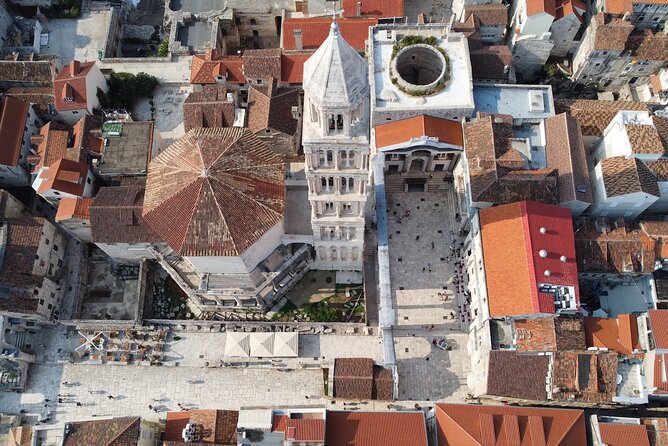
- The route covers the palace from every side: You see the Riva, southern cellars, Peristyle, cathedral, gates, market, and Pjaca.
- The tour lasts about 90 minutes: It gives you a useful first look, but it is not a slow museum visit.
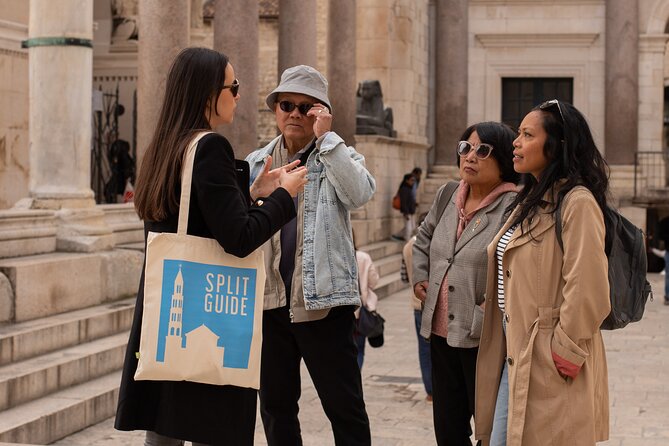
- Guide Dana receives special praise: Her storytelling and historical explanations are a major part of the appeal.
- The group is intended to stay small: The tour is designed for up to six participants, although the additional information gives a maximum of ten.
- No paid sights are included: Cathedral and Temple of Jupiter visits are from outside, so allow extra time and money if you want to enter.
Why Split’s Riva is the right place to begin
The tour starts at Split’s Riva, the broad waterfront promenade where locals and visitors sit in cafés, watch the harbor, and enjoy the sun. It is not just a scenic opening. The Riva gives you a quick sense of how Split works today, with social life unfolding directly beside the old palace walls.
You get about 10 minutes here at the start, then return for another five minutes at the end. That repeated view is useful. At the beginning, you are getting your bearings. At the finish, you can recognize how the palace sits behind the promenade and decide where to stop for a drink or meal.
The meeting point is by the model of Split’s historical center at Obala Hrvatskog narodnog preporoda 23. Since the Riva can be active, look for the model and arrive with enough time to find the exact starting place.
More Walking Tours in Split
- Split: Old Town and Diocletian Palace Walking Tour
★ 4.9 · 4,727 reviews - Walking Tour of Split and Diocletian’s Palace
★ 5.0 · 2,588 reviews - Krka Waterfalls tour with Trogir Walking tour and Krka panoramic boat cruise
★ 5.0 · 1,659 reviews
Walking through a palace that is still in use
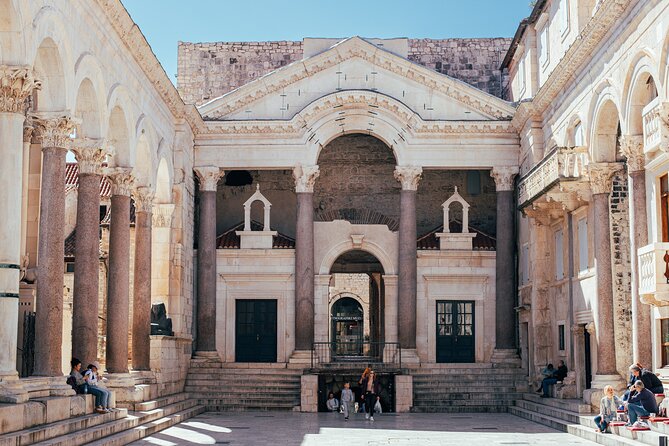
Diocletian’s Palace is the central reason to book this experience. Built more than 1,700 years ago for Roman Emperor Diocletian, it is not presented as a quiet archaeological museum. Streets, businesses, homes, and cafés occupy the space inside the old walls.
That makes the visit more interesting than a simple procession of ruins. You are looking at ancient stone while modern life carries on around it. I like this kind of setting because it helps you understand that the palace was not built as a detached monument. It was a working imperial complex, and Split has continued to adapt it.
The tour spends about 15 minutes in the palace itself. That is enough for a guide to explain the main layout and point out details you could easily pass without noticing. It is not enough for every corner, so consider this a well-organized introduction rather than a complete archaeological study.
The southern cellars reveal the palace’s scale
Through the south gate, the route reaches Diocletian’s cellars. These spaces are especially useful because they help you picture the size and structure of the palace above. The cellars are described as very well preserved, and their broad, sturdy form gives you a physical sense of the imperial complex.
Only about five minutes are assigned here, so the stop is brief. That may feel short if you enjoy Roman construction or want time for detailed photographs. Still, the cellars are one of the most practical parts of the walk because the palace plan can be hard to understand from street level alone.
The tour information says there are no entrance fees and that sights are visited from outside. At the same time, the route enters the palace cellars through the south gate. If seeing the cellars is important to you, confirm exactly what portion is included when you book, since paid interior access is not part of the package.
The Peristyle puts imperial power on display
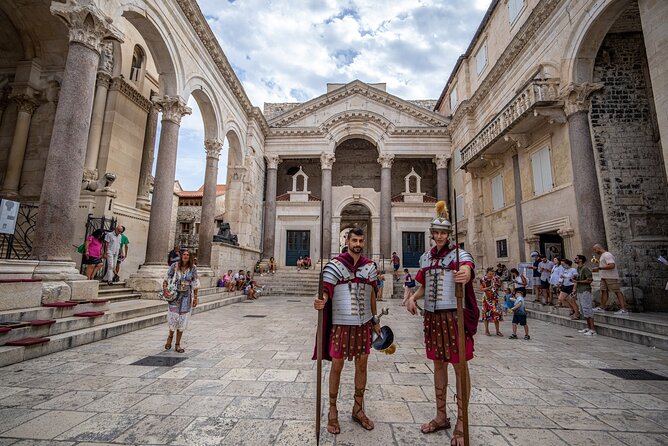
The Peristyle is the symbolic heart of the palace. In Diocletian’s time, it served as a sacred meeting place where the emperor appeared before his subjects and presented himself as the son of Jupiter.
The stop lasts about 10 minutes. That gives you time to look around while your guide explains how the space worked as both ceremony and political theater. The point is not only that Roman columns and stone survive. It is that the layout was designed to make one person appear larger than life.
I would pay close attention to how the guide connects the Peristyle with the rest of the palace. Without that explanation, it can look like another attractive square. With context, it becomes the stage where Diocletian shaped his public image.
Still Split, at a slower pace:
- Split: Krka Waterfalls Trip with Boat Cruise and Swimming
★ 4.8 · 10,519 reviews - From Split: Krka Waterfalls, Food & Wine Tasting Tour
★ 5.0 · 9,326 reviews - Blue cave, Mamma Mia and Hvar, 5 islands speedboat tour
★ 5.0 · 7,150 reviews - From Split: Krka Waterfalls, Food & Wine Tasting Tour
★ 4.9 · 6,598 reviews
Saint Domnius shows how Roman and Christian Split overlap
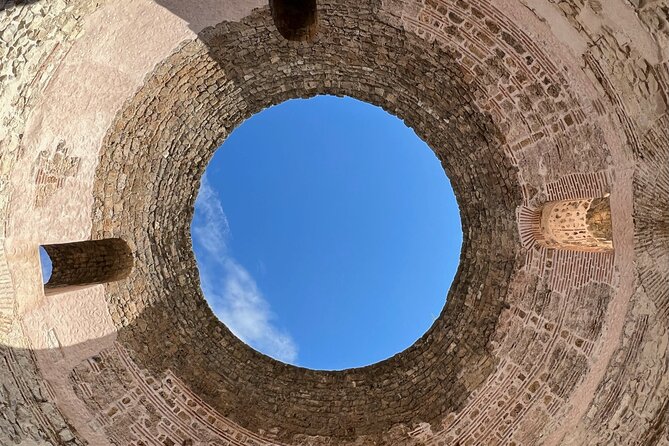
The Cathedral of Saint Domnius began as Diocletian’s mausoleum. During the Christianization of the area, the emperor’s coffin and remains disappeared, and the pagan mausoleum became a Christian cathedral.
The tour views the cathedral from outside, with about five minutes at the stop. That limitation matters. If you want to see the interior, climb the tower, or spend time examining the building closely, you will need to arrange that separately. No entrance fee is included here.
Even from the outside, the site explains one of Split’s most striking changes. A structure built to honor a Roman emperor was given a new religious purpose. The cathedral is not a separate attraction floating beside the palace. It is part of the palace’s long transformation.
The eastern gate leads toward the market
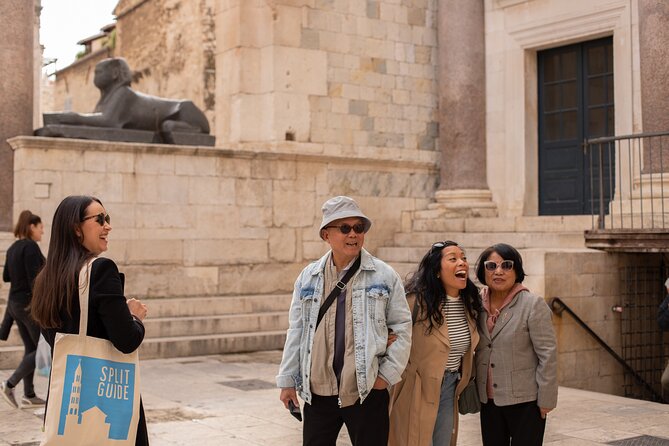
The route continues to the eastern gate, described in the tour details as the Silver Gate, although the stop heading also calls it the Iron Gate. It was walled up several times over the centuries and reopened in the 1940s.
Today, this side of the palace leads toward the market, which gives the old stone a practical modern setting. The stop lasts about five minutes. That is enough to understand the gate’s role and continue toward the Green Market, but not enough for a long market visit.
This is one reason I like the route. You are not kept inside a sealed monument. The walk shows how the palace connects with ordinary shopping streets and food stalls. If you want to browse produce or buy traditional foods, plan to return after the tour rather than trying to shop while keeping up with the group.
Triclinium explains Roman dining habits
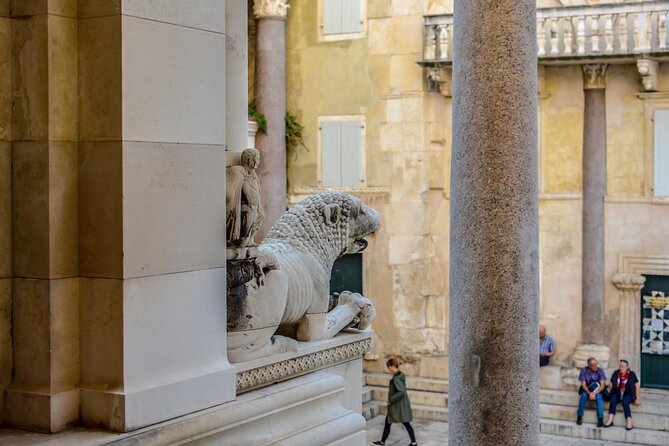
At the Triclinium, or dining room, the guide discusses how Diocletian entertained guests. Meals could include local wine, fish, honey, and as many as 20 courses in one evening.
The stop lasts 10 minutes, making it one of the longer pauses. Food details are useful here because they turn an architectural label into a scene you can picture. The room was not simply a formal hall. It was part of the emperor’s social world, where dining helped display wealth and status.
I would treat the information about the courses as a window into imperial dining rather than a typical Roman meal. The point is excess. A table with that many courses tells you how Diocletian used hospitality to impress and control his guests.
The Vestibule and Temple of Jupiter
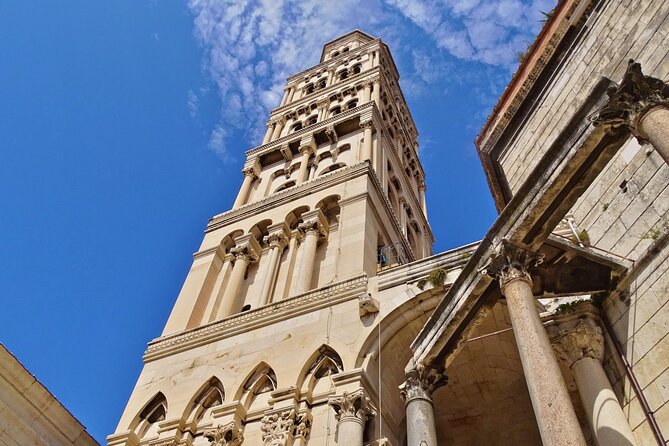
The Vestibule marked the entrance to Diocletian’s private chambers. The five-minute stop gives you a chance to understand the division between public ceremony and imperial privacy.
That distinction helps tie the route together. The Peristyle was for public appearances. The Vestibule led toward the emperor’s more private world. Even a short explanation can make the palace feel like a carefully arranged residence rather than a collection of unrelated ruins.
The Temple of Jupiter is now a baptistery. The tour views it from outside and spends about five minutes there. Again, no entrance fee is included. The change from pagan temple to Christian baptistery echoes the cathedral’s story, showing how later residents reused the palace instead of abandoning it.
If you want paid interior visits, this tour may feel incomplete on its own. Its strength is the guided route and the historical connections, not a long examination of indoor monuments.
The western Iron Gate opens onto Pjaca
The western Iron Gate was built as a double gate, like the northern and eastern gates. The space between the gates was designed as a trap where attackers could be struck with stones, arrows, and hot oil.
The stop itself is brief, about five minutes, but the defensive design is easy to understand when you are standing at the entrance. Leaving the gate brings you to Pjaca, a handsome square and a welcome change from the narrower palace streets.
This part of the walk shows the palace as a fortified complex. The gates were not decorative entrances. They controlled movement and protected the emperor’s residence. Pjaca also gives you a useful orientation point for exploring Split after the tour.
The Golden Gate faces the road to Salona
The Golden Gate was the most important gate in Roman times. From here, the road led toward Salona, the capital of the Roman province.
The five-minute stop is short, but the gate is a key piece of the palace plan. It shows that Diocletian’s complex was connected to the wider Roman administration, not isolated on the coast. The route lets you compare the Golden Gate with the eastern and western entrances and understand how each side served a different purpose.
Because the tour moves quickly, listen for the guide’s explanation of direction and function. It is easy to see several gates in one walk and remember only their names. Their links to roads, markets, defense, and imperial movement make them more memorable.
The Green Market brings the tour into present-day Split
The Green Market lies on the east side of the palace. Fresh fruit, vegetables, and traditional foods are sold there each day.
The official stop is only about five minutes, so you will get a glance rather than a full market experience. I would use this moment to note what you want to inspect later. The market is a good place to continue your own exploration after the guide finishes.
This is also where the tour feels most connected to local routine. The palace is not only about emperors and temples. It is part of a city where people shop, eat, work, and meet. That mix gives the walk more character than a route focused only on grand monuments.
What the private format is worth at $137.80
At $137.80 per person, this is not a budget introduction to Split. The price needs to be judged against the private or very small-group setting, the guide’s time, and the convenience of a route built around your interests.
The tour is designed for a maximum of six participants, though the additional details give a maximum of ten for the activity. That difference is worth clarifying before you pay. A group of six feels meaningfully more personal than a large city walk, while a group closer to ten may feel less private.
The format can be good value if you want to ask questions, request restaurant and bar suggestions, or adapt the walk around special needs. The experience includes recommendations for restaurants, bars, and leisure activities, and the route can be individually adjusted.
The value is weaker if you mainly want entry to the cathedral, Temple of Jupiter, or other paid sites. Those admissions are not included. You are paying primarily for interpretation, orientation, and a guided look at the palace’s exterior spaces.
The tour is often booked about 22 days ahead, which suggests you should not leave it until the last moment if your dates are fixed. Confirmation arrives at booking, and free cancellation is available up to 24 hours before the start time. Poor weather can lead to a new date or a full refund, since the experience requires good weather.
Who will get the most from this walk
I would recommend this tour to a first-time visitor who wants the palace explained in a short, orderly route. The 90-minute length is especially useful on a cruise stop, a short stay, or a first morning in Split when you want basic orientation before exploring alone.
It also suits anyone who prefers a personal guide to a large group. The praise for Dana is specific: she is described as an exceptional guide who shares substantial history and stories. That makes her storytelling a major reason to consider this experience, though guide availability should be confirmed if you are hoping for Dana in particular.
Families and mixed-age groups may like the adaptable format. Most people can participate, service animals are allowed, and the tour can be adjusted for special needs when you inform the provider in advance.
I would hesitate if you want a long archaeological visit, extensive indoor access, or a low-cost walk. The stop times are tightly planned, and several attractions are viewed only from outside.
Should you book Split’s private palace walk?
Book it if you want a compact, personal introduction to Split with a guide who can connect Roman power, Christian reuse, market life, and modern city streets. The route is well chosen, and the mix of Riva cafés, palace gates, cellars, Peristyle, cathedral, Pjaca, and Green Market gives you a useful first map of the city.
Skip it if your main goal is entering every major monument. In that case, a self-guided visit with separate admission tickets may give you more time indoors for less money.
For many visitors, the best plan is to take this walk early in your stay, then return to the cathedral, cellars, Temple of Jupiter, market, or favorite square afterward. That approach lets the guide handle the confusing layout while leaving you free to explore at your own pace.
FAQ
How long does the Split Diocletian Palace tour last?
The tour lasts approximately 1 hour and 30 minutes.
Where does the tour begin?
It begins at the model of Split’s historical core at Obala Hrvatskog narodnog preporoda 23, 21000 Split, Croatia.
Where does the tour end?
The tour ends at Republic Square, also known as Prokurative, in Split.
Is the tour offered in English?
Yes. The experience is offered in English and uses a mobile ticket.
Are entrance fees included?
No entrance fees are included. The cathedral and Temple of Jupiter are viewed from outside, and the tour information says the sights are visited only from the outside. The route also includes the palace cellars, so confirm the exact access included when booking.
How many people can join the tour?
The tour is designed for a maximum of six participants. Additional information gives a maximum of ten travelers for the activity, so you should confirm the group size if this is important to you.
Can the tour be adapted for special needs?
Yes. The tour can be adapted to participants’ special needs if you inform the provider in advance. Most people can participate, and service animals are allowed.
What is the cancellation policy?
You can cancel for a full refund up to 24 hours before the experience starts. Changes or cancellations made less than 24 hours before the start time are not accepted for a refund. If poor weather causes the tour to be canceled, you will be offered another date or a full refund.
Just added around Split
- Walking Tour Split★ 4.7 · 61 reviews
- Unique vintage Tomos moped tour Split – Back to the ’80s★ 4.8 · 17 reviews
- Trogir: White Lagoon, Maslinica & Blue Lagoon Speedboat Tour★ 4.8 · 11 reviews
- Essential Diocletian’s Palace Tour for First-Time Visitors★ 4.8 · 19 reviews
- Split: Trogir Open Top Bus Trip + Free Split Walking Tour★ 4.1 · 17 reviews
- Trogir; Private walking tour of higlights of Trogir★ 4.7 · 3 reviews
- Trogir: Old Town Guided Walking Tour★ 4.6 · 76 reviews
- TROGIR: Blue Lagoon & 3 Islands Half-day Speedboat tour★ 4.6 · 28 reviews
Walking Tours, compared.
Walking Tour of Split and Diocletian’s Palace
Read our review →


Krka Waterfalls tour with Trogir Walking tour and Krka panoramic boat cruise
Read our review →
City Walls Early Morning or Sunset Walking Tour
Read our review →Browse the lists this tour appears in