
Reviewed · WALKING TOURS
Split: Cultural Walking Tour with Anthropologist Guide
Some city tours leave the hard questions untouched. This one does not. The two-hour walk through Split links Roman ruins and medieval lanes with Croatia’s modern politics, religion, identity, demographics, sexuality, and economics. It is led in English by cultural anthropologist and teacher Marin, who uses the city itself as a classroom.
I like the tour’s honest treatment of contested history and its ability to connect ancient sites with current social issues. I also like the extra audio-visual material, which gives Marin another way to explain difficult subjects. The main consideration is its subject matter: this is not a light monument stroll, and some discussions may feel too serious for visitors who simply want dates, architecture, and pretty photographs.
The $33 price is fair for a two-hour private-feeling intellectual experience, especially if you take it early in your stay. You will see many of central Split’s main sights while gaining context that a standard sightseeing route often skips. Just arrive ready to listen, think, and perhaps question a few familiar national stories.
In This Review
- Key points to know before booking
- Why this Split tour takes a different path
- Starting at Park Josipa Jurja Strossmayera
- Golden Gate: entering Split through power and memory
- Peristil: more than Split’s postcard square
- Diocletian’s Cellars and the layers below the city
- People’s Square and the public life of Split
- Židovski prolaz and the value of uncomfortable subjects
- Fruit Square: daily life, commerce, and social change
- Riva: a short pass with a wide view of the city
- Republic Square and the final connection to modern Croatia
- Marin’s teaching style and the audio-visual material
- Is $33 good value for two hours?
- Who should book this walk?
- Practical details for your two hours
- Should you book the Split Cultural Walking Tour?
- FAQ
- Where does the tour start?
- How long does the tour last?
- What language is the tour conducted in?
- Who leads the tour?
- What places are included?
- Does the tour discuss modern Croatian issues?
- Is extra material included?
- Is the tour wheelchair accessible?
- Can I cancel for a refund?
Key points to know before booking
- Marin connects ancient monuments to modern Croatia, rather than treating Split’s Roman center as a self-contained museum.
- Controversial subjects are central, including politics, geopolitics, religion, identity, demographics, sexuality, history, and economics.
- The route covers major central sights, from the Golden Gate and Peristil to People’s Square, Fruit Square, Riva, and Republic Square.
- Extra audio-visual material supports each topic, useful when a complicated issue needs more than a spoken explanation.
- The tour suits curious visitors who want context, especially those interested in how societies remember and argue about the past.
- The meeting point is easy to find, at the fountain in the middle of Park Josipa Jurja Strossmayera, at Ul. kralja Tomislava 12.
Why this Split tour takes a different path
Most introductory walks through Split focus on Emperor Diocletian, Roman stonework, churches, squares, and the pleasant business of finding your way around. Those basics are here too, but they are only the starting point.
Marin uses each location to ask how history is selected, remembered, and used. A Roman gate can lead to questions about power. A religious passage can open a discussion about identity. A public square can help explain politics and social change.
That approach gives you more than a list of dates. It helps you understand why the city and country can hold several versions of the past at once. You may hear about ancient, medieval, socialist, and modern Croatia in a single walk, with the links between those periods made clear.
I especially like the way this format avoids putting the tour in one narrow box. It is part history lesson, part cultural study, part city orientation, and part conversation about present-day Croatia. You still see the central sights, but you are encouraged to look at them as places used by real communities, not simply as attractive backdrops.
The tone is direct. The tour was designed around historical and present-day taboos, so it does not smooth every rough edge for tourist comfort. That can make it more useful, but it also means you should not expect a breezy walk filled only with amusing legends.
More Walking Tours in Split
- Split: Old Town and Diocletian Palace Walking Tour
★ 4.9 · 4,727 reviews - Walking Tour of Split and Diocletian’s Palace
★ 5.0 · 2,588 reviews - Krka Waterfalls tour with Trogir Walking tour and Krka panoramic boat cruise
★ 5.0 · 1,659 reviews
Starting at Park Josipa Jurja Strossmayera
The walk begins at the large park at Ul. kralja Tomislava 12. Find the fountain in the center of the park, where the group meets.
This is a practical place to start because you are outside the tightest lanes of the old center. You can settle in before entering the denser historic area, and Marin can establish the larger themes of the walk before the monuments begin competing for your attention.
Bring comfortable shoes. The tour is only two hours, but Split’s old center includes stone paving and busy pedestrian passages. Since the route moves through several squares and historic lanes, you will get more from it if you can watch and listen rather than worry about your feet.
The exact end point deserves a quick check before you go. The route description identifies Trumbićeva obala as the final stop, while the practical meeting information says the activity ends back at the meeting point. That may reflect a route variation or a return walk, so confirm the finish when you book.
Golden Gate: entering Split through power and memory
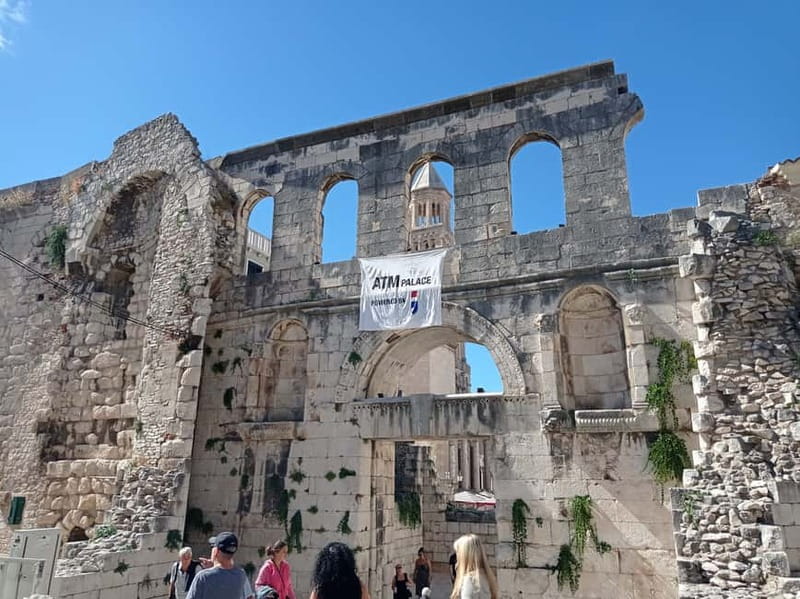
The Golden Gate receives about 15 minutes of guided attention. This is one of the strongest places to begin thinking about who built Split, who controlled it, and how later generations use the remains of earlier power.
You will not simply hear that the gate belonged to Diocletian’s palace. The location can frame questions about authority, empire, and the way modern Croatia presents its Roman past. The stonework is impressive, but the larger value lies in seeing how a monument can serve both as an archaeological object and a symbol.
For a first visit, this stop also helps you get your bearings. The old center can feel like a maze at street level. A good explanation here gives you a mental map for the rest of the walk.
Peristil: more than Split’s postcard square
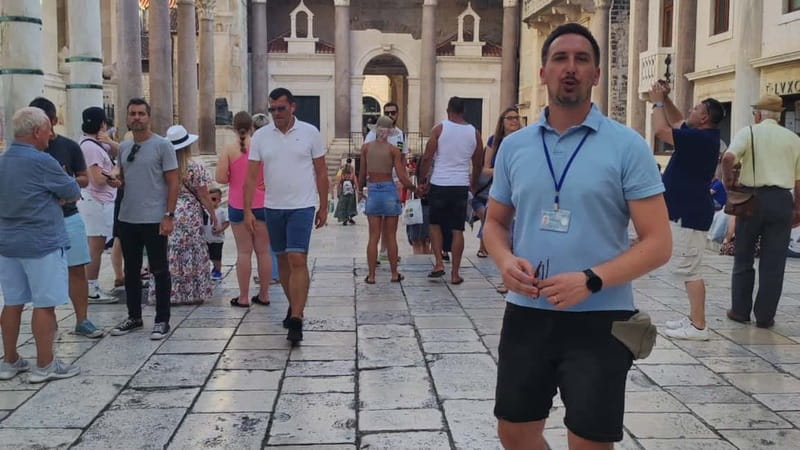
The 15-minute stop at Peristil is likely one of the tour’s main teaching points. This famous square is often presented as the visual heart of Diocletian’s palace, and it certainly makes a strong first impression. Yet the tour asks you to consider what else the square represents.
Peristil brings together architecture, religion, public ceremony, and political power. Marin can use its layout and surviving buildings to show how authority was displayed in the Roman period, then connect that display to later ideas about community and identity.
This is also where the tour’s wider method becomes clear. You are not expected to memorize every architectural label. Instead, the site becomes evidence in a larger story about how people in the region have been governed, represented, and remembered.
Give yourself a moment to look up and around. The square can be crowded, and the stone surfaces create plenty of visual distraction. If you want photographs without interrupting the discussion, return later with your camera.
Still Split, at a slower pace:
- Split: Krka Waterfalls Trip with Boat Cruise and Swimming
★ 4.8 · 10,519 reviews - From Split: Krka Waterfalls, Food & Wine Tasting Tour
★ 5.0 · 9,326 reviews - Blue cave, Mamma Mia and Hvar, 5 islands speedboat tour
★ 5.0 · 7,150 reviews - From Split: Krka Waterfalls, Food & Wine Tasting Tour
★ 4.9 · 6,598 reviews
Diocletian’s Cellars and the layers below the city
The guided section in Diocletian’s Cellars lasts about 10 minutes. That is shorter than the Peristil stop, but the cellars provide a useful change of angle. Here, the palace is understood from below, through its foundations, storage spaces, and later use.
A brief stop means Marin must keep the explanation focused. That is helpful if you prefer a clear argument rather than an exhaustive architectural lecture. The cellars can otherwise become a blur of stone corridors and disconnected facts.
This part of the walk may also help you understand how Split developed around and inside the palace. Ancient buildings were not frozen in time. They were reused, adapted, and incorporated into daily life. That idea supports the tour’s main point: the past is not separate from the present. It continues to shape how a city works and how it tells its own story.
People’s Square and the public life of Split

People’s Square gets around 15 minutes. Its name alone makes it a natural place to discuss public space, civic life, and the relationship between ordinary residents and political institutions.
The square shifts the focus away from the emperor’s palace and toward the city as a lived community. This is where the tour can move from Roman authority to later urban society, showing how places of gathering carry social meaning.
I like this part because it helps prevent the tour from becoming too palace-centered. Split is not only an ancient complex with shops and cafés inside it. It is also a city where public squares have seen changing customs, arguments, celebrations, and forms of control.
If you are taking the tour near the beginning of your stay, this stop can also sharpen your reading of the rest of Split. You may notice how much of the old center is public stage, working neighborhood, commercial zone, and heritage site at the same time.
Židovski prolaz and the value of uncomfortable subjects
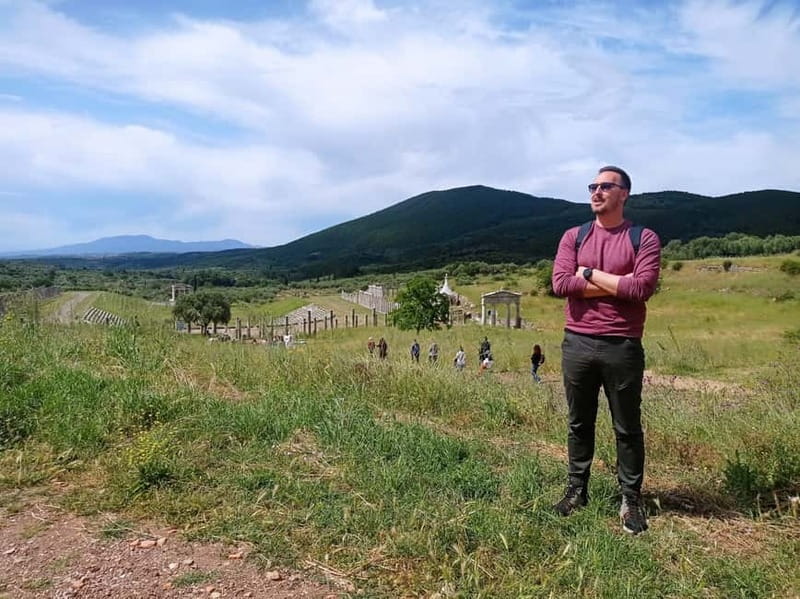
The 10-minute visit to Židovski prolaz is one of the route’s more specific stops. The passage gives Marin a place to discuss Jewish history and the ways smaller communities can be remembered, overlooked, or represented within a national story.
This is exactly the kind of subject that can disappear from a standard introductory tour. A guide working from a cultural anthropology background can make space for questions of minority identity, religion, belonging, and historical silence.
Do not expect a long standalone lecture here. Ten minutes passes quickly, and the stop works best as part of the broader argument about who gets included in public memory. The value comes from the connection to other stops, not from treating the passage as an isolated attraction.
Fruit Square: daily life, commerce, and social change
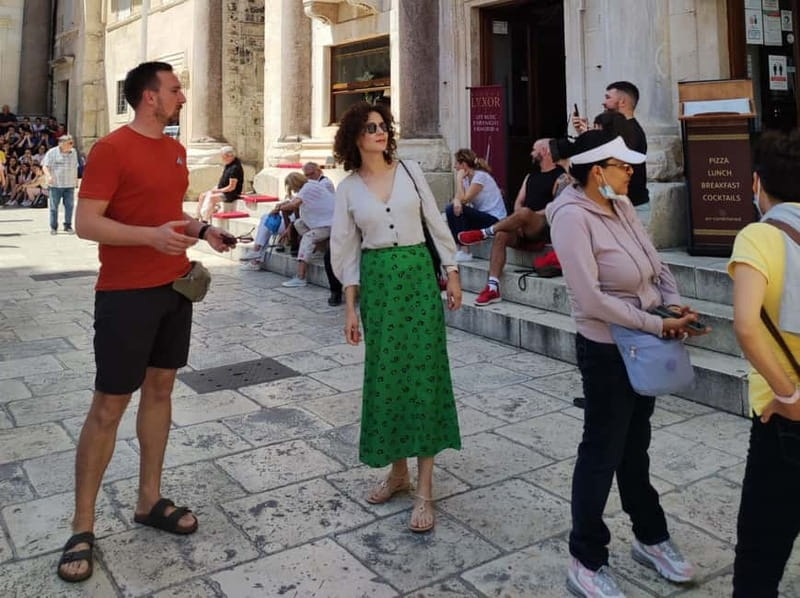
Fruit Square receives about 15 minutes of guided explanation. The name points toward its everyday commercial past, which gives the tour another way to move from grand monuments to ordinary life.
Here, the story can turn toward economics, social class, changing urban habits, and the use of central space. A market-related square tells you something different from an imperial gate. It shows how residents buy, sell, meet, and adapt to changes in the city.
This is also a good location for thinking about modern tourism. The old center is both a home and a visitor destination, and those roles can pull in different directions. The tour’s focus on ongoing social processes makes this kind of place more useful than a quick photograph and a name in a guidebook.
You may find this stop especially helpful if you want to understand Split beyond its famous Roman core. It places human routines beside monumental history.
Riva: a short pass with a wide view of the city

The route passes along the Riva for about five minutes rather than treating it as a full lecture stop. That is sensible. The waterfront offers a strong visual pause, but a short passage keeps the walk moving.
The Riva can help tie together the city’s geography, public life, and relationship with the sea. You get a different sense of Split here than in the enclosed palace lanes. The change in space can make the earlier discussions easier to place.
Because this is a pass-by section, do not expect the same depth as at the Golden Gate or People’s Square. If you want time for photographs or a quiet waterfront sit, return on your own after the tour.
Republic Square and the final connection to modern Croatia
Republic Square receives roughly 15 minutes, giving Marin another broad public setting for the tour’s political and social themes. By this point, the walk has moved through imperial, religious, commercial, and civic spaces. The square helps pull those threads together.
This is where the tour’s modern focus may feel most complete. The goal is not simply to explain what happened in Split long ago. It is to show how past events and public symbols continue to influence Croatian identity, politics, and social debate.
The route then identifies Trumbićeva obala as its final point. Since the practical meeting information also says the activity ends back at the starting point, ask Marin or the booking provider about the exact finish before arranging a tight connection afterward.
Marin’s teaching style and the audio-visual material
Marin is described as both a cultural anthropologist and a school teacher, and that combination matters. He is not only presenting facts. He is explaining difficult ideas in a way meant to keep the group involved.
A participant described him as passionate, clear, and attentive to the structure of the walk. Another noted that he related the material to architecture and allowed time for interpretation. That suggests a guide who treats questions as part of the experience rather than as interruptions.
The extra audio-visual material is another useful feature. Some subjects, especially political movements or changing identities, are easier to understand with an image, document, or other visual aid. The supplied material can give shape to topics that might otherwise remain abstract.
The tour also made room for a deaf participant during rainy conditions, including time for interpretation. That does not promise that every need can be handled in the same way, but it does show a thoughtful approach to participation. The activity is listed as wheelchair accessible.
Is $33 good value for two hours?
At $33 per person, this is not the cheapest way to walk around Split. You can see many of the same streets and squares without paying anything. The value comes from the interpretation, the connections between sites, and the focus on subjects that are rarely central on a basic sightseeing walk.
I would consider the price reasonable if you care about modern Croatia as much as ancient Split. In two hours, you cover a useful set of central locations and receive a connected explanation rather than a series of unrelated facts.
The value is strongest when you take it early in your visit. The tour can give you a framework for later days in Dalmatia, especially if you plan to see more of Croatia and want a better sense of its social and political background.
It is less useful if you want long visits inside individual monuments, detailed architectural measurements, or plenty of unstructured photo time. In that case, a standard historical tour or self-guided visit may suit you better.
Who should book this walk?
I would choose this tour for intellectually curious adults, older teenagers, teachers, students, and anyone who wants to understand how history affects present-day life. A participant found it suitable for people over 15 because the material is serious but not technical. That is a useful guide, though it is not presented as an official age rule.
It also suits people who have already seen the usual Roman highlights and want a second layer. You do not need specialist training. The themes are broad and explained through familiar places.
You may want to skip it if your ideal holiday mood is purely relaxed, if you dislike political discussion, or if you prefer a guide to avoid disputed subjects. The tour’s purpose is to address those issues directly, not to soften them.
Practical details for your two hours
The walk lasts two hours, with starting times available when you check the date. It is conducted in English by a live guide.
Meet at the fountain in the middle of Park Josipa Jurja Strossmayera, at Ul. kralja Tomislava 12, 21000 Split. Since the meeting point is in a park, allow enough time to locate the fountain rather than arriving at the address at the last second.
There are no extra costs listed for the activity. You can cancel up to 24 hours in advance for a full refund, and the reserve-now, pay-later option keeps your plans flexible.
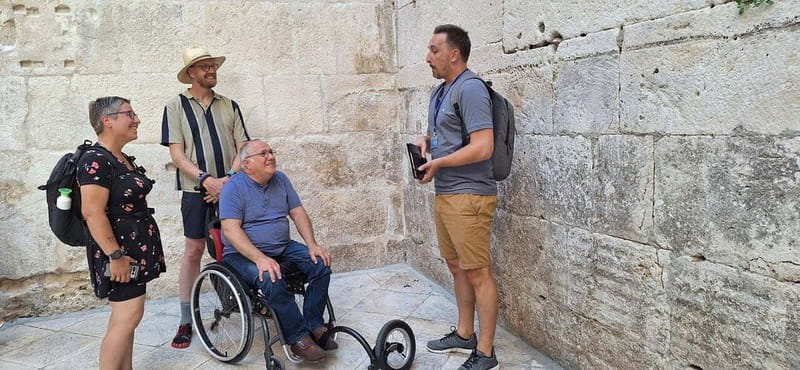
The tour is wheelchair accessible, though you should still confirm any personal access needs in advance. The route includes historic streets, squares, and passages, so a quick check with the provider is sensible if you require specific assistance.
Should you book the Split Cultural Walking Tour?
Book it if you want Split explained as a living society, not only as a Roman monument. Marin’s anthropological approach, direct treatment of controversial issues, and careful links between past and present make this a strong first-day choice for curious visitors.
Skip it if you want a purely visual walk with minimal discussion. For everyone else, $33 buys a useful two-hour introduction to the city’s buildings, arguments, identities, and unfinished questions. That is a fair exchange, and it may change how you see every later stop in Croatia.
FAQ
Where does the tour start?
It starts at Ul. kralja Tomislava 12 in Split, at the large Park Josipa Jurja Strossmayera. Meet next to the fountain in the middle of the park.
How long does the tour last?
The walking tour lasts two hours. Starting times vary, so check availability for your chosen date.
What language is the tour conducted in?
The live guided tour is conducted in English.
Who leads the tour?
The tour is led by Marin, a cultural anthropologist and school teacher.
What places are included?
The route includes the Golden Gate, Peristil, Diocletian’s Cellars, People’s Square, Židovski prolaz, Fruit Square, the Riva, and Republic Square. It begins at Park Josipa Jurja Strossmayera.
Does the tour discuss modern Croatian issues?
Yes. It covers politics, geopolitics, religion, identity, demographics, sexuality, history, and economics, with attention to contested historical and contemporary subjects.
Is extra material included?
Yes. Additional audio-visual material is provided for each topic covered during the tour.
Is the tour wheelchair accessible?
Yes, the activity is listed as wheelchair accessible.
Can I cancel for a refund?
Yes. You can cancel up to 24 hours in advance for a full refund. The reserve-now, pay-later option allows you to book without paying immediately.
Just added around Split
- Slatine – Island Hopping Excursion (Trogir/Blue Lagoon/Shipwreck)★ 4.0 · 24 reviews
- Krka Waterfalls & Primošten from Trogir, Seget, Čiovo & Kaštela★ 5.0 · 18 reviews
- Island Hopping Boat Excursion with Lunch (Trogir,Blue Lagoon, Šolta)★ 3.5 · 6 reviews
- From Trogir, Seget, Okrug: Krka Waterfalls & Šibenik Culture Tour★ 5.0 · 10 reviews
- From Split & Trogir: ATV Quad Tour on Island Čiovo★ 5.0 · 21 reviews
- Split: Blue Lagoon Boat Trip with Lunch, Wine and Snorkeling★ 5.0 · 3 reviews
- Split Sunset Stand Up Paddle Tour★ 5.0 · 16 reviews
- Split: Sunset Guided Kayaking Tour★ 4.8 · 71 reviews
Walking Tours, compared.
Walking Tour of Split and Diocletian’s Palace
Read our review →

Krka Waterfalls tour with Trogir Walking tour and Krka panoramic boat cruise
Read our review →
City Walls Early Morning or Sunset Walking Tour
Read our review →Browse the lists this tour appears in