
Reviewed · WALKING TOURS
Chill Private Walking Tour of Diocletian’s Palace
Roman Split rewards a closer look. This private walk brings Diocletian’s Palace to life through its surviving streets, cellars, gates, temples, and later Croatian layers. I like the small-group format, which lets your guide adjust the pace and answer questions, and I especially like the use of 3D reconstructions to show how the palace looked 17 centuries ago. The main drawback is that interior admission fees are not included, so the advertised price is not the full cost if you want to enter every paid site.
The tour is led by Mili, an experienced and personable guide praised for clear explanations, good communication, and a relaxed sense of humor. I also like that the route begins at the Eastern Gate and ends at the Golden Gate, giving you a useful north-south walk through the old center rather than simply circling one square.
At $107.84 for a private group of up to 15 people, the value depends on your party size. For two people it is a fairly costly walk, but for a family or larger group the per-person price becomes much more reasonable. Plan on about 90 minutes to two hours, with extra time if you choose the cathedral or substructure interiors.
In This Review
- Five things to know before you book
- Why Diocletian’s Palace works so well as a walking tour
- Starting at the Peristyle, the palace’s grand center
- Going below ground in the palace substructures
- Seeing a Roman mausoleum become Saint Domnius Cathedral
- The Temple of Jupiter and the palace’s second life
- Triklinij and a glimpse of imperial private life
- Papalićeva Street and the palace as a town
- Fruit’s Square and Croatia beyond Rome
- The Golden Gate and the palace’s northern defenses
- Grgur Ninski, the final lesson in Croatian history
- What the private format and timing are worth
- Optional tickets and the true cost
- How the guide’s style affects the experience
- Cancellation and weather details
- Who should book this Split walk?
- Should you book the Chill Private Walking Tour?
- FAQ
- Where does the tour start?
- Where does the tour end?
- How long does the tour last?
- How many people can join?
- What language is offered?
- Are admission tickets included?
- Can I visit the cathedral interior?
- Can I visit more of the palace substructures?
- What happens if the weather is poor?
Five things to know before you book
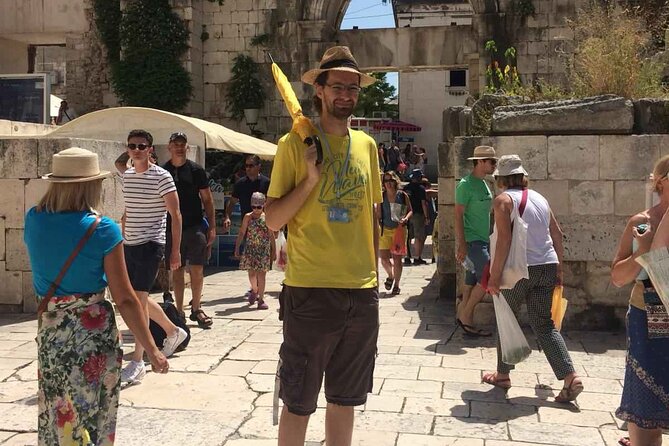
- The palace is still part of everyday Split: You walk through streets, squares, shops, and homes built into and around the ancient complex.
- 3D images make the ruins easier to understand: The guide compares present-day remains with reconstructions of the original Roman palace.
- Optional interiors add depth: Paid areas in the substructures, cathedral, and Temple of Jupiter can extend the tour by roughly 30 minutes.
- The route ends at the Grgur Ninski statue: You finish outside the Golden Gate with a short look at Croatian history beyond the Roman period.
- Private means genuinely private: Only your own group takes part, with a maximum of 15 people.
- Evening can be a smart choice in hot weather: The route is outdoors for much of its length, and the walk may feel easier later in the day.
Why Diocletian’s Palace works so well as a walking tour
Diocletian’s Palace is not an isolated ruin behind a fence. It is part of Split’s city center. Modern life runs through its Roman framework, and that can make the place confusing at first. A column may support a café, a medieval wall may form the side of a house, and a Roman corridor may lead somewhere that feels entirely modern.
That layering is the real subject of this walk. You are not only studying a Roman emperor’s retirement residence. You are watching the palace change from an imperial complex into a medieval town and then into the living center of Split.
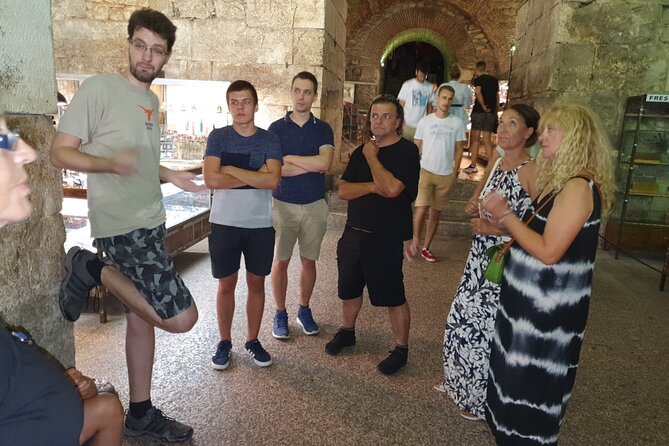
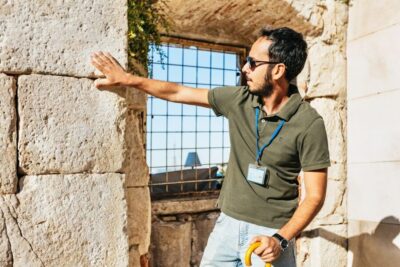
A guide helps connect those pieces. Mili’s route uses stories, dates, architectural clues, and visual comparisons rather than asking you to admire stones without context. His style also appears to suit families and mixed-age groups. One party specifically praised the balance of history, culture, humor, and communication, with teenagers enjoying the experience as much as adults.
The private format matters here. You can ask why one section survived while another disappeared, pause over a confusing architectural detail, or request more information about the palace’s later use. In a large group, those questions can be harder to fit in.
More Walking Tours in Split
- Split: Old Town and Diocletian Palace Walking Tour
★ 4.9 · 4,727 reviews - Walking Tour of Split and Diocletian’s Palace
★ 5.0 · 2,588 reviews - Krka Waterfalls tour with Trogir Walking tour and Krka panoramic boat cruise
★ 5.0 · 1,659 reviews
Starting at the Peristyle, the palace’s grand center
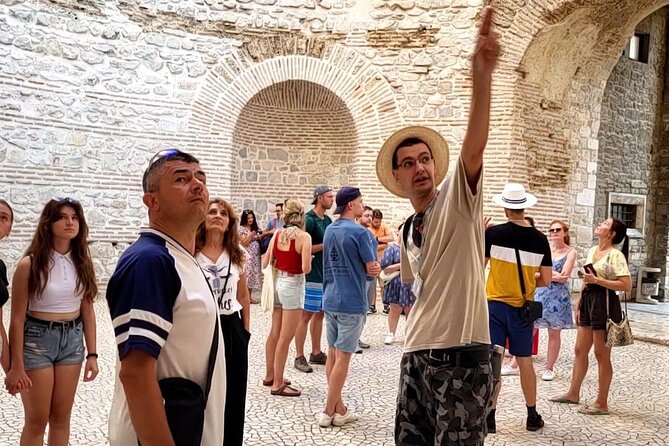
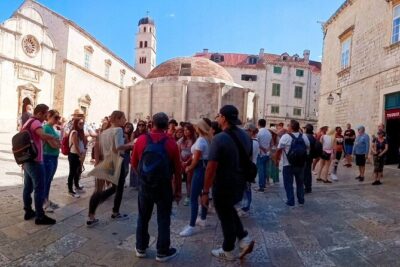
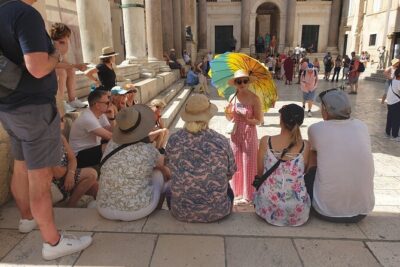
The tour begins at the Peristyle, the most imposing open space in the palace. This is the right place to start because it gives you the basic idea of Diocletian’s project before the walk moves into smaller corners.
You learn who Diocletian was and why he built the palace. The Peristyle also helps you picture the ceremonial side of the complex, rather than seeing it only as a collection of narrow lanes and broken walls.
The stop lasts about 20 minutes, making it the longest single introduction on the route. That is useful. You get time to look up, compare the surviving stonework, and ask questions before moving onward.
The square can feel visually dense, especially if you are seeing the palace for the first time. The guide’s 3D reconstructions are particularly helpful here. They offer a reference point for the original arrangement and show what has been lost, altered, or reused.
Going below ground in the palace substructures
From the Peristyle, you enter the free section of the Diocletian Palace substructures. This stop is scheduled for about 10 minutes, so the included portion is an introduction rather than a long underground visit.
The substructures matter because they reveal the palace’s construction and layout. They also help explain how the upper rooms were supported and organized. Without this lower level, the palace can seem like a random mix of walls. Below ground, the plan becomes easier to read.
You can choose to buy a ticket for the museum section of the substructures. If you do, the guide can take you through the additional area, adding around 20 minutes. That option is worth considering if Roman engineering and palace design interest you, but it is not essential for someone who wants a brisk overview.
The practical point is to decide before the tour whether you want the extended version. The basic route keeps moving, while the paid section gives you more time with the palace’s preserved interior structure.
Seeing a Roman mausoleum become Saint Domnius Cathedral
The Cathedral of Saint Domnius is one of the tour’s strongest historical contrasts. It began as part of Diocletian’s Roman complex, yet it now serves as a Christian cathedral. That change is easier to understand when you are standing beside the building rather than reading about it later.
The guide explains how a Roman tomb was converted into a church. This is a compact lesson in Split’s changing beliefs and political life, told through the building itself.
The exterior portion takes roughly 10 minutes. If you have a cathedral ticket, you can go inside and add about 10 minutes. I would consider paying for the interior if you enjoy seeing how old structures were adapted, since the building’s story is not limited to its Roman origins.
You should also keep expectations clear. This is a walking tour with a short cathedral visit, not a full architectural study or extended church tour. The optional interior adds useful detail, but the central explanation happens outside.
Still Split, at a slower pace:
- Split: Krka Waterfalls Trip with Boat Cruise and Swimming
★ 4.8 · 10,519 reviews - From Split: Krka Waterfalls, Food & Wine Tasting Tour
★ 5.0 · 9,326 reviews - Blue cave, Mamma Mia and Hvar, 5 islands speedboat tour
★ 5.0 · 7,150 reviews - From Split: Krka Waterfalls, Food & Wine Tasting Tour
★ 4.9 · 6,598 reviews
The Temple of Jupiter and the palace’s second life
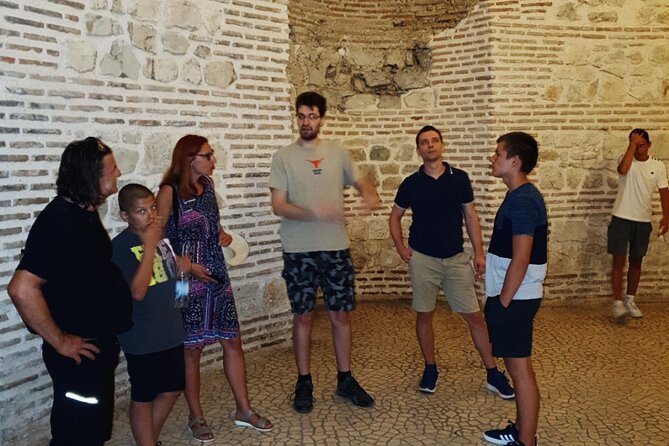
The Temple of Jupiter is another well-preserved Roman structure that later found a new role through the church. The tour uses it to explain both Roman religion and the practical survival of older buildings after their original purpose faded.
The stop lasts around 10 minutes. If you buy a ticket for the small interior, the guide can take you inside. Otherwise, you still receive the main explanation from outside.
This stop works best when paired with the cathedral. One building shows a Roman tomb becoming a cathedral, while the other shows a temple repurposed by Christianity. Together, they make the palace’s later development easier to grasp.
The interior is small, so I would not make the optional ticket a must unless you have a strong interest in religious architecture or Roman remains. The outside explanation covers the key points.
Triklinij and a glimpse of imperial private life
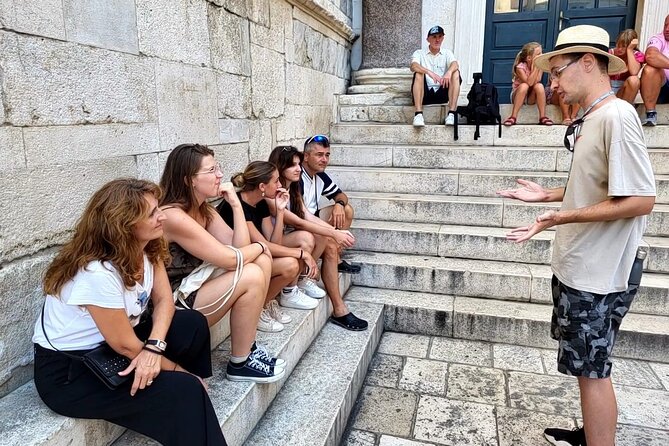
At Triklinij, the route reaches the southeastern corner of the palace. Much of this area has been destroyed, but the surviving construction allowed for a partial reconstruction.
This stop lasts about 15 minutes and shifts the focus from public ceremony to private life. You get an impression of how Diocletian may have used the palace, rather than seeing it only as a fortress or state complex.
The reconstruction is valuable because empty foundations can be difficult to interpret. A partial rebuilding gives your eye something to work with. It also pairs well with the 3D comparisons used elsewhere during the tour.
There is a limit, of course. The reconstruction cannot restore everything that was lost, so you should treat it as a carefully supported impression rather than a complete picture of the emperor’s rooms.
Papalićeva Street and the palace as a town
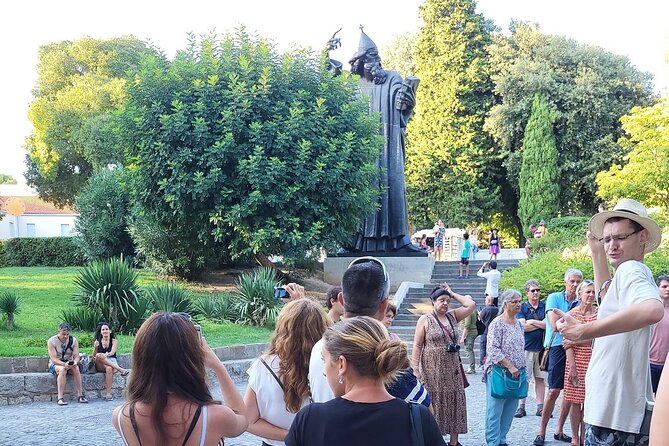
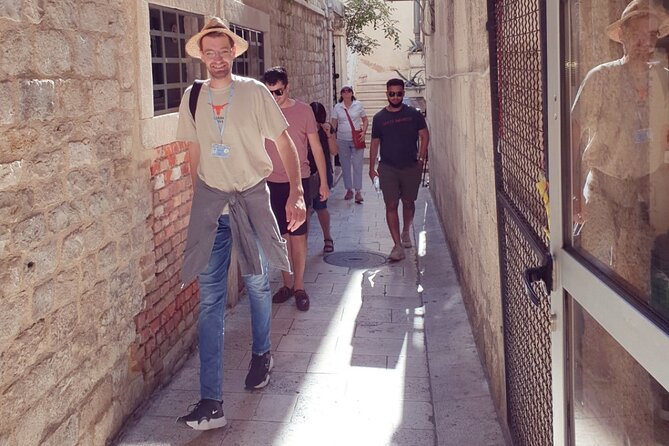
The walk through Papalićeva Street lasts about 15 minutes and takes you through the northern half of the palace. This is where the route feels less like a formal archaeological visit and more like a walk through Split’s old town.
The alleyway carries smaller stories and details that are easy to miss if you hurry from one famous monument to another. It also shows how the palace’s Roman structure was absorbed into later streets and buildings.
This part is valuable for understanding the site as a living place. You are not simply moving between preserved monuments. You are following a route shaped by centuries of ordinary use.
The narrow lanes may not offer a single grand view, but they reward careful looking. Keep your attention on doorways, walls, changes in stone, and the way newer construction meets older fabric.
Fruit’s Square and Croatia beyond Rome
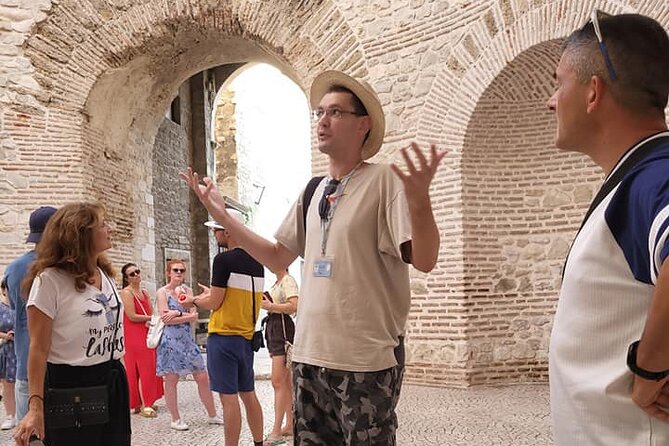
Fruit’s Square, also called Trg Brace Radic, sits outside the palace and introduces an important period of Croatian history. The stop lasts about 15 minutes and broadens the tour beyond Diocletian.
That change of setting is useful. You see how the palace relates to the city around it, not just how it looked in the Roman period. Newer buildings have grown around and into the old structure, and the square helps make that relationship clear.
I like this part of the route because it prevents the tour from becoming a single-period history lesson. Split’s identity comes from several eras sharing the same small area. The guide connects the Roman foundation to the later Croatian story.
If your main goal is only Roman archaeology, this stop may feel less central. If you want to understand Split as a city, it earns its place on the route.
The Golden Gate and the palace’s northern defenses
Near the end, you reach the Golden Gate, the palace’s northern entrance. The stop takes around 10 minutes and focuses on fortifications, gates, and the changes made between the original construction and the present day.
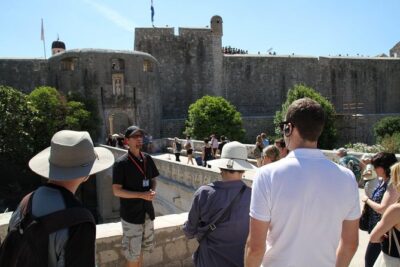
The gate gives you a strong sense of the palace’s defensive edge. It also helps you understand the route as a complete crossing of the old complex, from the Eastern Gate to the northern side.
This is a good place to use the visual comparisons again. A fortified entrance can be hard to picture after centuries of alteration, but the original plan becomes clearer when you can compare the existing gate with a reconstructed version.
The Golden Gate is also a practical orientation point. If you are staying in or around central Split, you finish near one of the city’s most recognizable landmarks rather than being left in an unfamiliar part of town.
Grgur Ninski, the final lesson in Croatian history
The final stop is outside the Golden Gate, beside the bronze statue of Grgur Ninski. The bishop was important in Croatian history, and his story allows the guide to wrap up the historical sequence that began with Diocletian.
This is a sensible ending. You start with the Roman emperor and finish with a major Croatian figure, moving from imperial construction through religious change and later national history.
The statue also gives the group a clear meeting and finishing point. The route does not end inside a paid attraction, so you can continue exploring Split immediately afterward.
Mili’s approach appears strongest at this kind of transition. His explanations are described as relaxed, entertaining, and easy to follow, with occasional groan-worthy puns. That light touch can help when the subject becomes dense.
What the private format and timing are worth
The price is $107.84 per group, with up to 15 people allowed. For a full group, that is strong value because you receive a private guide for a walk lasting roughly 90 minutes to two hours. For one or two people, the cost is harder to justify unless you place a high value on personal questions and a flexible pace.
The private setup is especially useful for families. You can move at your own speed, and the guide can adjust the amount of detail. One group of four appreciated the comfortable pace and the guide’s willingness to check if they wanted more or less information.
The tour is offered in English. Confirmation arrives at booking, and the meeting point is the Eastern, or Silver, Gate at Poljana kraljice Jelene 5. The finish is outside the Golden Gate at Dioklecijanova 7, beside the Grgur Ninski statue.
Most people can take part, service animals are allowed, and the route is near public transportation. Since much of the experience happens outdoors on old city streets, comfortable shoes and weather awareness are sensible choices, though the supplied details do not specify a particular accessibility surface or step-free route.
Warm days may favor an evening start. One party specifically recommended an evening walk during hot weather. The listed operating period runs from May 1 through October 31, 2026, with hours shown as Monday from 8:00 a.m. to 6:00 p.m. Confirm your exact selected time when booking.
Optional tickets and the true cost
No interior admission is included. The free portions of the substructures, cathedral, and Temple of Jupiter are covered from outside, while tickets for the paid sections are your responsibility.
That arrangement keeps the base price simple and gives you control. You do not pay for interiors that do not interest you. On the other hand, anyone expecting an all-inclusive archaeological visit should budget extra.
The possible additions are fairly clear:
- The museum section of the substructures adds about 20 minutes.
- The cathedral interior adds about 10 minutes.
- The small Temple of Jupiter interior is also optional.
You do not need to buy every ticket. I would choose based on your interests and available time. The free route already covers the main story, while the paid interiors provide more physical evidence of how Roman and later religious buildings were used.
How the guide’s style affects the experience
The strongest praise is directed at Mili’s communication and manner. He is described as punctual, responsive before the walk, helpful during the route, and able to explain complicated layers without making the experience feel stiff.
That matters in Diocletian’s Palace. The site can be difficult to read without help, and a guide who simply recites dates would miss the point. Here, the approach combines history, culture, humor, and visual material.
The guide also appears flexible when conditions change. During one sudden thunderstorm, he waited for the worst rain to pass and changed the route to avoid flooding. That does not remove the need to watch the forecast, but it suggests practical judgment when the weather turns.
Game of Thrones references are available for fans, but they are not the entire focus. If you do not follow the series, you can still expect the main subject to be Split’s architecture and history.
Cancellation and weather details
You can cancel for a full refund if you do so at least 24 hours before the start time. Changes or cancellations within 24 hours are not accepted for a refund.
The experience requires good weather. If poor conditions cause a cancellation, you are offered another date or a full refund. Since the route is a walking experience, this policy is worth noting before choosing a tight schedule around a cruise departure or other fixed plan.
Who should book this Split walk?
I would recommend it most to families, couples who want a private guide, and groups of friends who prefer questions and conversation over a fixed lecture. It also suits first-time visitors who want to understand why the palace feels like a town rather than a single monument.
History fans should consider adding the paid interiors. The free route is enough for a broad introduction, but the substructures and cathedral interior give you more to examine.
You may want a different experience if you prefer to explore entirely alone, need a fully documented step-free itinerary, or want a long museum visit. This is a moderate-length outdoor walk with optional interiors, not a full-day archaeological program.
Should you book the Chill Private Walking Tour?
Book it if you want a clear, friendly introduction to Split and can gather enough people to make the private price work. The 3D reconstructions, flexible pace, optional interiors, and final route through Croatian history give the walk more substance than a quick monument-by-monument stroll.
For two people, compare the cost with a group tour before deciding. For a family or larger party, the $107.84 group rate can be a sensible way to get personal attention without paying separately for every participant.
I would also choose an evening time during hot weather and decide in advance which interiors matter to you. If you want to understand how Roman construction, Christian reuse, medieval streets, and modern Split occupy the same space, this tour is a strong choice.
FAQ
Where does the tour start?
It starts at the Eastern, or Silver, Gate, at Poljana kraljice Jelene 5 in Split.
Where does the tour end?
The walk ends outside the Golden Gate at Dioklecijanova 7, beside the bronze statue of Grgur Ninski.
How long does the tour last?
The tour lasts approximately 1 hour 30 minutes to 2 hours. Optional interior visits can add extra time.
How many people can join?
This is a private activity for your group, with up to 15 people included in the group price.
What language is offered?
The tour is offered in English.
Are admission tickets included?
No. The free sections are included, but tickets for optional interiors in the substructures, Cathedral of Saint Domnius, and Temple of Jupiter are not included.
Can I visit the cathedral interior?
Yes, if you have a ticket for the cathedral. The interior visit adds about 10 minutes to the route.
Can I visit more of the palace substructures?
Yes. You can buy a ticket for the museum section of the substructures, adding approximately 20 minutes.
What happens if the weather is poor?
The tour requires good weather. If it is canceled because of poor conditions, you are offered a different date or a full refund.
Just added around Split
- Walking Tour Split★ 4.7 · 61 reviews
- Unique vintage Tomos moped tour Split – Back to the ’80s★ 4.8 · 17 reviews
- Trogir: White Lagoon, Maslinica & Blue Lagoon Speedboat Tour★ 4.8 · 11 reviews
- Essential Diocletian’s Palace Tour for First-Time Visitors★ 4.8 · 19 reviews
- Split: Trogir Open Top Bus Trip + Free Split Walking Tour★ 4.1 · 17 reviews
- Trogir; Private walking tour of higlights of Trogir★ 4.7 · 3 reviews
- Trogir: Old Town Guided Walking Tour★ 4.6 · 76 reviews
- TROGIR: Blue Lagoon & 3 Islands Half-day Speedboat tour★ 4.6 · 28 reviews
Walking Tours, compared.
Walking Tour of Split and Diocletian’s Palace
Read our review →


Krka Waterfalls tour with Trogir Walking tour and Krka panoramic boat cruise
Read our review →
City Walls Early Morning or Sunset Walking Tour
Read our review →Browse the lists this tour appears in