Reviewed · SPLIT TOURS
Split and Trogir Half Day Tour from Split (with port pickup)
Croatia’s past is packed into four hours. This half-day tour links Trogir’s stone lanes with Split’s Roman core, making it a smart choice when your cruise stop gives you only one morning. I like the simple port pickup and the chance to see two UNESCO-listed places without arranging separate transport. I also like the guides’ warm, personal style, especially Tina, Sandra, and Roko, who are praised for clear storytelling and local insight.
The main tradeoff is time. Trogir gets about an hour, while several Split and Trogir sights receive short guided visits rather than a slow, detailed exploration. Entry fees are extra, and the tour ends in central Split rather than returning you to the ship, so you need to allow time for the walk back to the terminal.
In This Review
- Key points to know before booking
- Why this four-hour route works from a cruise ship
- Trogir: Romanesque lanes on a compact island town
- Saint Lawrence Cathedral rewards close attention
- Kula Kamerlengo and Trogir’s defensive edge
- Split’s Roman heart inside Diocletian’s Palace
- Cathedral of Saint Domnius: a Roman mausoleum turned church
- Prokurative brings a Venetian touch to Split
- What the guides add to the experience
- Price, group size, and what you actually receive
- Walking demands and practical comfort
- Who should book this Split and Trogir tour?
- Should you book it?
- FAQ
- How long is the Split and Trogir tour?
- Where does the tour begin?
- Where does the tour end?
- How far is the port from the ending point?
- Is port pickup included?
- How do cruise passengers find the guide?
- Are admission fees included?
- Are food and drinks included?
- What should cruise passengers provide when booking?
- Can I cancel for a full refund?
Key points to know before booking
- Two historic towns in one morning: Visit Trogir’s medieval center and Split’s Roman palace district on a compact four-hour route.
- Port pickup is built in: Look for the Croatian Trails sign near the red hop-on, hop-off buses outside the cruise terminal.
- The guides are a major strength: Tina, Sandra, Roko, Hrvoje, and Josipa are praised for lively explanations, local stories, and care for the group.
- The tour involves plenty of walking: Stone lanes, old squares, and palace passages call for comfortable shoes and moderate fitness.
- You finish in Split’s center: The Riva is about a 20-minute walk from the ship’s terminal, or your guide can help arrange a taxi.
- Plan for a group setting: The maximum is 50 people, though some departures have been much smaller.
Why this four-hour route works from a cruise ship
Split is one of those ports where the old town begins almost at the waterfront. That makes independent sightseeing possible, but Trogir is harder to add without a vehicle. This tour solves that problem with an air-conditioned coach and a guide who handles the road, timing, and broad story of the region.
The stated duration is about four hours. That is long enough to get a useful first look at both towns, but not long enough to linger everywhere. You will hear the main story, see the signature monuments, and have some free time. You will not get a museum-heavy visit or a leisurely meal built into the schedule.
The port pickup is especially useful if you are arriving by cruise ship. For an early ship arrival between 7:00 and 8:30 in the morning, pickup is scheduled for 9:00. If your ship docks later, the exact pickup time is adjusted to your arrival details. At booking, you need to provide your ship name, docking time, time you can leave the ship, and the time you must be back on board.
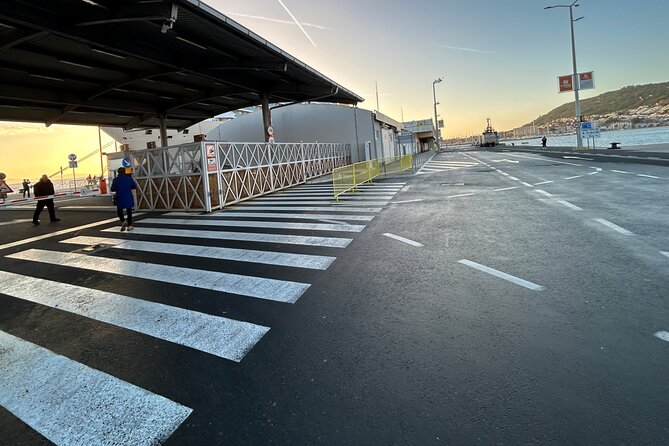
Follow the written instructions carefully. The guide carries a Croatian Trails sign and waits at the entrance to the terminal, next to the red sightseeing buses, past the fence as you leave the ship. This is more precise than simply asking around the port, where directions can easily send you elsewhere.
The tour operates in all weather. Bring suitable clothing, since the day includes outdoor walking and the schedule does not stop for rain or heat. One person described a very hot day, while another completed the tour in pouring rain, so a small umbrella, water, sun protection, and sturdy shoes are sensible additions.
A few more Split trips worth comparing
- Split: Krka Waterfalls Trip with Boat Cruise and Swimming
★ 4.8 · 10,519 reviews - From Split: Krka Waterfalls, Food & Wine Tasting Tour
★ 5.0 · 9,326 reviews - Blue cave, Mamma Mia and Hvar, 5 islands speedboat tour
★ 5.0 · 7,150 reviews
Trogir: Romanesque lanes on a compact island town
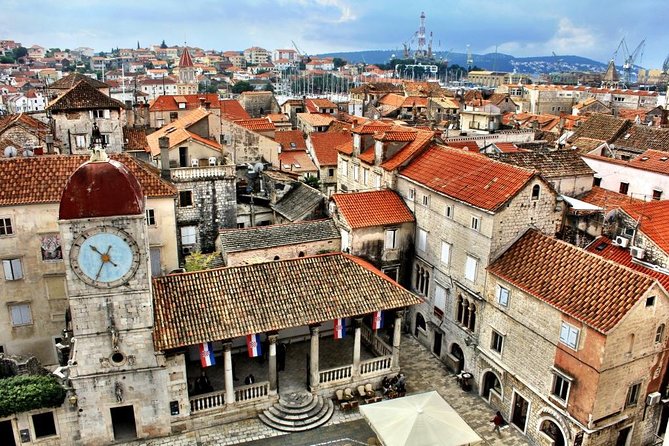
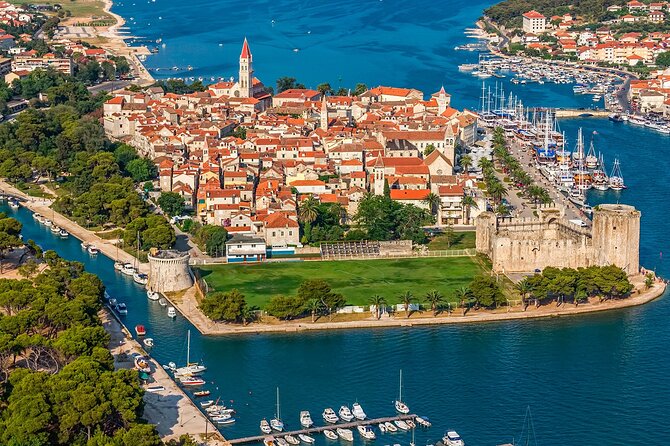
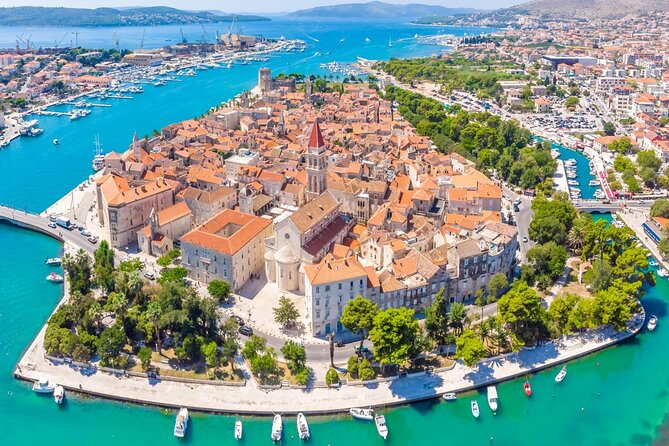
The route begins with a short coastal drive to Trogir. Founded by Greek colonists in the third century BC, the town has more than 2,300 years of continuous urban life. That long timeline is easy to feel because the streets gather Greek, Roman, medieval, Venetian, Renaissance, and Baroque traces into a very small area.
You get about an hour for the guided visit and free exploration. That is enough to understand Trogir’s layout and admire its main buildings, but you should resist trying to cover every side street. Stay close to the guide during the formal walk, then use your free minutes for photos, a quick look at the waterfront, or a snack.
The town’s appeal is not one single monument. It is the way the old stone buildings, narrow lanes, church façades, and small squares fit together. Trogir feels more intimate than Split, and the short visit gives you a pleasant change of pace before the larger city.
One useful tip comes from the tour itself: take the guide’s suggestion for gelato in Trogir if you have free time. Other departures included chances to sample local liquor and cheese, though these extras should not be treated as guaranteed parts of every outing.
Saint Lawrence Cathedral rewards close attention
The Cathedral of St. Lawrence is Trogir’s major monument. It is a triple-naved basilica built over several centuries, so its Romanesque and Gothic elements show how styles changed through Dalmatia’s past.
The cathedral is listed as a free stop in the tour details, but other monument entry fees are not included. The schedule gives it about 15 minutes, which means you should expect an exterior explanation and a brief look rather than an extended architectural study. If the interior is open and you want more time, ask the guide how admission and timing work that day.
This is a good example of the tour’s overall style: you receive context quickly, then move on. I like that approach for a first visit, but it may feel rushed if you are passionate about church art or medieval architecture.
Kula Kamerlengo and Trogir’s defensive edge
Kula Kamerlengo is a 15th-century fortress built as part of an expansion of the earlier Veriga Tower. Its name comes from camerlengo, an administrative title meaning chamberlain.
The castle receives about 20 minutes in the schedule, with admission not included. Today it is also used for summer performances, giving the fortress a life beyond its military past. You should think of this as a strong visual stop and a chance to hear how Trogir protected itself, not as a long castle tour.
Still Split, at a slower pace:
- From Split: Krka Waterfalls, Food & Wine Tasting Tour
★ 4.9 · 6,598 reviews - Split/Trogir: Blue Cave, Mamma Mia, Hvar and 5 Island Tour
★ 4.6 · 6,320 reviews - Blue Lagoon & 3 Islands Cruise with Lunch from Split
★ 4.5 · 5,756 reviews - Split: Old Town and Diocletian Palace Walking Tour
★ 4.9 · 4,727 reviews
Split’s Roman heart inside Diocletian’s Palace
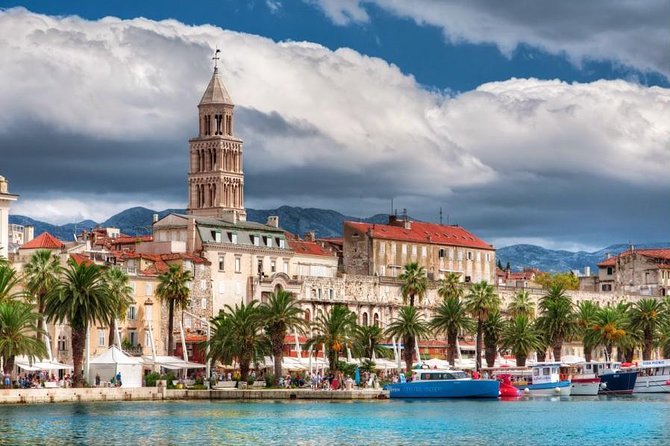
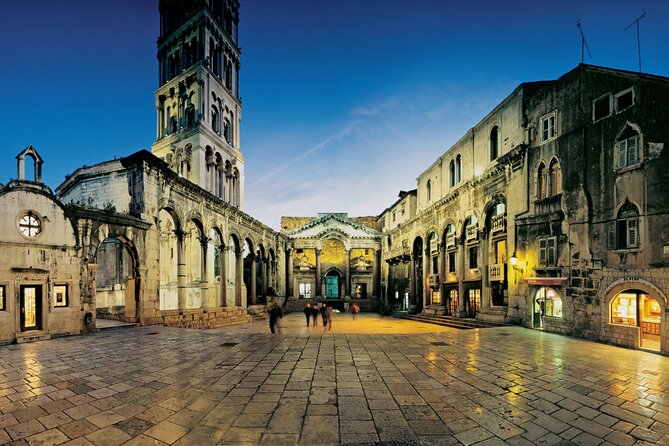
Split’s old town is built into the palace of Emperor Diocletian, constructed around the turn of the fourth century AD. Calling it a palace can undersell what you see. The complex forms roughly half of the historic center, so homes, shops, cafés, lanes, and monuments occupy the same ancient structure.
The guided palace visit lasts about 20 minutes, and admission is not included. That short time works best when your guide focuses on the major spaces and explains how an imperial Roman residence became the center of a living city.
I especially like this part for people who find ancient sites easier to understand when daily life is still present around them. You are not looking at an isolated ruin behind a fence. You are walking through a city district where Roman walls and later buildings share the same space.
The downside is obvious: 20 minutes is only an introduction. You may want to return after the tour to explore more slowly, find a café, or revisit a passage that caught your eye. Since the tour ends near the Riva, that extra time is easy to arrange if your ship schedule permits.
Cathedral of Saint Domnius: a Roman mausoleum turned church
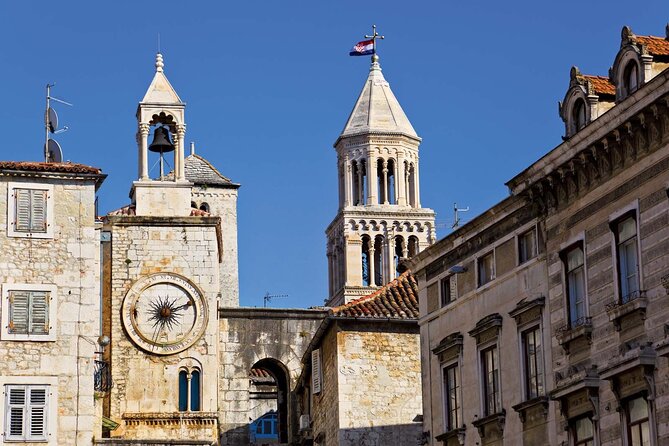
The Cathedral of St. Domnius is one of Split’s most striking examples of old and new occupying the same structure. The church formed from the imperial Roman mausoleum, with a bell tower added to the complex. Strictly speaking, the church is dedicated to the Virgin Mary, while the bell tower is dedicated to St. Domnius.
The tour allows about 20 minutes here, and admission is not included. Your guide can explain the unusual conversion from imperial tomb to Christian cathedral, which gives the building its special character. You will likely leave with a clearer sense of how Split grew around Diocletian’s original complex.
If you want to climb the bell tower or spend time inside, check whether the extra admission and time fit your schedule. The tour’s purpose is to show the key sights, not to provide a long independent stop at each one.
Prokurative brings a Venetian touch to Split
Prokurative, formally linked with the 19th-century redevelopment of Split, gives the city a completely different look. General Marmont supervised its construction, and Split mayor Antonio Bajamonti helped initiate it. The design draws heavily on Italian architecture and resembles Venice’s St. Mark’s Square.
You get about 15 minutes here, with no admission charge. It is a useful contrast to the Roman palace: after seeing ancient imperial architecture, you see how later leaders shaped Split according to their own political and cultural ideals.
This is a quick orientation stop, but it also makes a good photo break. Do not expect a long lecture or an interior visit. The value lies in seeing another layer of the city’s development and understanding that Split is not only Roman.
What the guides add to the experience
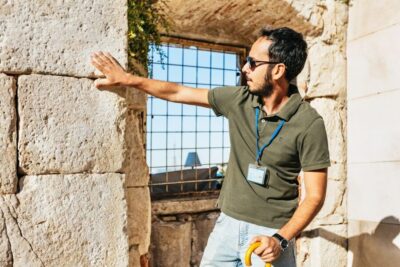
The strongest part of this tour is the guiding. Tina is repeatedly praised for her energy, organization, strong English, humor, and ability to explain Croatian history without losing the group. She is also described as a local schoolteacher, which helps explain the clear, structured way she presents complicated subjects.
Sandra receives similar praise for her passion and practical suggestions. She has helped people choose restaurants and shops during free time, and her relaxed manner made the sightseeing feel unhurried. Roko is praised for combining professionalism, humor, and a deep grasp of Trogir and Split, while Hrvoje is singled out for his explanations of both towns.
Josipa also handled a difficult weather day with care and apologised when traffic and rain shortened the program. That matters because the route depends on road conditions. The drive is short, but coastal traffic can change the timing, and the tour provider does not promise identical transfer lengths every day.
The personal touches are useful. Tina is praised for sharing local perspective rather than only reciting dates, and guides have offered advice about food, shops, gelato, local liquor, and cheese. Those details help you use your free time well.
There is one important caution. Guide quality is central to the experience, and different departures may have different guides. The consistently positive comments about Tina and Sandra are encouraging, but you should book this as a well-organized group tour rather than expecting a private guide assigned to your party.
Price, group size, and what you actually receive

At $78.61 per person, the tour is not the cheapest way to see Split. You can walk around Split’s center independently, and the port is close to the old town. The price makes more sense if you value the coach transfer to Trogir, a professional guide, port coordination, and a quick historical framework for both towns.
The air-conditioned coach is an important comfort on warm days and a practical shelter in wet weather. You also avoid working out your own transport between Split and Trogir, a meaningful benefit during a limited cruise stop.
The maximum group size is 50 people. That is large enough for a full coach, and the experience can feel less personal at capacity. Some departures, however, have had only seven people or a small group of around ten. You cannot count on that size, but it is worth understanding the range before booking.
Food, drinks, and entry fees are not included. The tour ends at Split Riva21, in the city center, and does not provide a return transfer to the ship. The walk back to the cruise terminal takes about 20 minutes, or the guide can help you get a taxi.
That final detail deserves serious attention. If your re-boarding time is tight, build in a cushion for the walking route, traffic, and any taxi wait. The tour requires your ship information at booking, but you still need to manage your own return margin.
Walking demands and practical comfort
Expect a moderate physical level. Trogir and Split are historic stone towns, so the route includes walking on uneven surfaces, narrow lanes, and open squares. One person described it as a Level 2 outing, meaning manageable but not effortless.
Wear shoes with good grip. Carry water, especially in warm weather, and dress for changing conditions. The tour runs in rain as well as sunshine, and weather has affected the amount of sightseeing on some departures.
Service animals are allowed, and the meeting point is near public transportation. The supplied information does not promise full wheelchair accessibility or step-free access, so contact the provider before booking if you have mobility needs.
Free cancellation is available until 24 hours before the local start time for a full refund. Changes or cancellations inside that window are not refunded. If the minimum number is not reached and the provider cancels, you will be offered another date or experience, or a full refund.
Cruise passengers should be especially careful with the pickup instructions. One delayed start was tied to the disembarkation time entered during booking, not a late guide. Enter your ship details accurately, read the final message sent through Viator, and look for the Croatian Trails sign rather than relying on general port directions.
Who should book this Split and Trogir tour?
I would choose this tour if you are visiting Split on a cruise and want Trogir without handling transport yourself. It is also a good fit if you like history explained by a lively local guide, prefer a planned route, and want a first look at two towns before exploring Split on your own.
It suits couples, families with older children, and friends who can keep a moderate walking pace. The short length leaves part of the day free, which is useful on a port call.
I would choose a longer or more specialised visit if you want extensive cathedral interiors, fortress time, museum visits, or a relaxed meal in Trogir. I would also think twice if your ship’s return schedule is very tight, since the end point is not the terminal and the route can be affected by traffic or weather.
Should you book it?
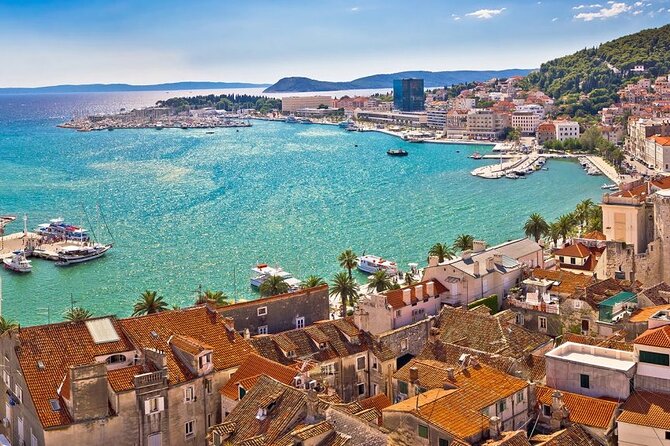
Book it if convenience and context matter more than slow sightseeing. The combination of Trogir’s compact medieval center, Split’s Roman palace, an air-conditioned coach, and strong guides offers good value for a short port visit.
Just set the right expectations. You will see a lot, walk a lot, and hear a great deal in four hours. You will need to pay for selected entries, arrange your own return to the ship, and accept that some stops are brief. For a first taste of Split and Trogir, especially with a guide such as Tina, Sandra, or Roko, this is a practical and appealing choice.
FAQ
How long is the Split and Trogir tour?
The experience lasts approximately four hours.
Where does the tour begin?
It begins at the New Split Berth for Cruise Ships, Obala kneza Domagoja 16, Split.
Where does the tour end?
The tour ends at Split Riva21 in the city center. Drop-off at the ship’s terminal is not included.
How far is the port from the ending point?
The walk from the city center back to the ship’s terminal takes about 20 minutes. Your guide can help you arrange a taxi if needed.
Is port pickup included?
Yes. Port pickup is included for cruise ship passengers.
How do cruise passengers find the guide?
Look for a guide holding a Croatian Trails sign at the entrance to the ship’s terminal, next to the red hop-on, hop-off buses and past the fence as you leave the ship.
Are admission fees included?
No. Entry fees are not included in the tour price.
Are food and drinks included?
No. Food and drinks are not included.
What should cruise passengers provide when booking?
You must provide your ship name, docking time, disembarkation time, and re-boarding time.
Can I cancel for a full refund?
Yes, if you cancel at least 24 hours before the experience’s start time. Cancellations made less than 24 hours before the start are not refunded.
Just added around Split
- Walking Tour Split★ 4.7 · 61 reviews
- Unique vintage Tomos moped tour Split – Back to the ’80s★ 4.8 · 17 reviews
- Trogir: White Lagoon, Maslinica & Blue Lagoon Speedboat Tour★ 4.8 · 11 reviews
- Essential Diocletian’s Palace Tour for First-Time Visitors★ 4.8 · 19 reviews
- Split: Trogir Open Top Bus Trip + Free Split Walking Tour★ 4.1 · 17 reviews
- Trogir; Private walking tour of higlights of Trogir★ 4.7 · 3 reviews
- Trogir: Old Town Guided Walking Tour★ 4.6 · 76 reviews
- TROGIR: Blue Lagoon & 3 Islands Half-day Speedboat tour★ 4.6 · 28 reviews
Split Tours, compared.
Krka Waterfalls Trip with Boat Cruise and Swimming
Read our review →
Blue cave, Mamma Mia and Hvar, 5 islands speedboat tour
Read our review →
Split/Trogir: Blue Cave, Mamma Mia, Hvar and 5 Island Tour
Read our review →
Blue Lagoon & 3 Islands Cruise with Lunch from Split
Read our review →