Reviewed · GUIDED
Split and Trogir Half Day Guided tour
Two Dalmatian towns, one busy day. This Split and Trogir tour packs Roman ruins, medieval streets, waterfront views, and local stories into roughly five to six hours. I like the smart pairing of Diocletian’s Palace with Trogir, and I like that round-trip transport removes the hassle of arranging a second destination yourself. The main tradeoff is pace: there is a lot of walking, and Trogir can feel short if the group starts late or must meet a tight return time.
The tour costs $60.49 per person, with group discounts available, and runs in English. Guides such as Antonia, Ivana, Ante, Mia, and Frane have earned especially warm praise for their storytelling, humor, and love of Croatia. Still, the experience is not identical every day. Group size can reach 50, though one group was divided into smaller parties of nine, and guide quality can vary.
In This Review
- Key points to know before booking
- Starting at Split’s Golden Gate
- The Palace Basements and the Game of Thrones connection
- Peristyle, Vestibule, and the heart of Roman Split
- Golden Gate, Riva Harbor, and Fruit Square
- The short ride from Split to Trogir
- Trogir’s city hall and central square
- Saint Lawrence’s Cathedral and St. Sebastian
- Kula Karmelengo and the end of the visit
- What the guides add to the day
- Walking, weather, and group comfort
- Is $60.49 a fair price?
- Who should book this Split and Trogir tour?
- FAQ
- How long does the Split and Trogir tour last?
- Where does the tour start?
- Where does the tour end?
- Is transportation included?
- Is the tour offered in English?
- Are admission tickets included?
- Is there free time in Trogir?
- What happens if the weather is poor?
Key points to know before booking
- Diocletian’s Palace is more than a single monument: you walk through streets, squares, gates, and living parts of Split’s old town.
- Trogir adds a different mood: its compact historic center feels quieter, more intimate, and easier to explore at a relaxed pace.
- The guides are the tour’s strongest feature: Antonia, Ivana, Ante, Mia, Frane, and Slavico are praised for clear explanations and lively local perspective.
- Expect plenty of walking: most of it is not uphill, but old stone paving and summer heat can make the day tiring.
- Transport keeps the day simple: an air-conditioned vehicle takes you from Split to Trogir and back to the Golden Gate meeting point.
- Paid entries are extra: admission to Saint Lawrence’s Cathedral and Kula Karmelengo is not included.
Starting at Split’s Golden Gate
The tour begins at the Golden Gate, at Dioklecijanova 7, in the heart of Split’s old town. This is a practical meeting point because the gate is one of the clearest landmarks in the palace complex. The activity also ends there, so you are not left searching for a distant drop-off point.
I would arrive early, especially during the cruise season. Split’s old town can become crowded, and the operator may combine groups. One experience began about 15 minutes late, while another group found that a larger party was split into smaller groups. The stated maximum is 50 people, but the actual walking group may be smaller.
The tour operates in English and includes a professional guide. Children must be accompanied by an adult, service animals are allowed, and most people can participate. Wear shoes that can handle uneven stone and bring protection from the sun. The tour runs in all weather conditions, so a light rain layer is sensible too.
A few more Split trips worth comparing
- Split: Krka Waterfalls Trip with Boat Cruise and Swimming
★ 4.8 · 10,519 reviews - From Split: Krka Waterfalls, Food & Wine Tasting Tour
★ 5.0 · 9,326 reviews - Blue cave, Mamma Mia and Hvar, 5 islands speedboat tour
★ 5.0 · 7,150 reviews
The Palace Basements and the Game of Thrones connection
The first stop is the substructure of Diocletian’s Palace, often called the palace basements. These underground rooms helped support the emperor’s residence above and offer one of the clearest ways to understand the original layout.
The setting also appeared in Game of Thrones, which gives the stop an extra hook for fans of the show. Even without that connection, the basements help you picture how a Roman imperial complex was built and later absorbed into a living city.
The listed stop does not include an admission charge, but the tour information also warns that entrance tickets to historical monuments are not included. That wording means you should not assume every interior area is covered. Ask your guide which spaces are open as part of the walking route and which require separate payment.
Peristyle, Vestibule, and the heart of Roman Split
The Peristyle is the ancient main square of the palace. This is one of the tour’s key moments because the space brings together Roman architecture, later religious use, and everyday city life. You do not simply look at a ruin. You see an old imperial center that has remained part of Split’s public life.
The guide spends about 20 minutes here, enough time to explain the square and point out the details you might miss while walking alone. The strongest guides, including Frane and Ivana, are praised for showing how the palace changed over roughly 1,700 years. That context matters. Without it, you may see scattered columns and stone walls. With it, you begin to understand how the old residence became streets, homes, businesses, and churches.
The Vestibule follows. This rounded entrance once led toward Diocletian’s private residence. It receives a shorter visit of about 10 minutes, but it gives you another piece of the palace plan and helps connect the public Peristyle with the emperor’s private quarters.
Your guide may add stories about local customs, architecture, or modern life in Split. Antonia is especially praised for combining facts with personal stories and recommendations. That local voice is a major reason to choose a guided walk instead of simply using a phone map.
Golden Gate, Riva Harbor, and Fruit Square
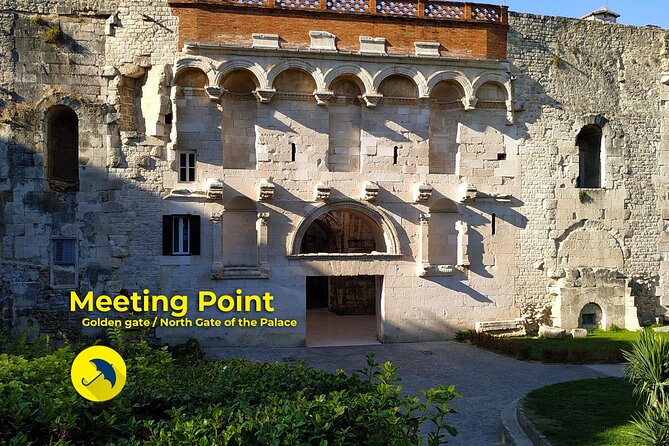
The Golden Gate is both an important Roman entrance and the tour’s meeting point. The north gate was designed as a formal approach to the palace, and its scale helps you grasp how imposing the original complex must have been.
The scheduled visit lasts about 20 minutes. This is useful for orientation because Split’s old town can feel like a maze of narrow passages. Once you know where the gate sits, you can return later without much trouble.
The route then reaches Riva Harbor, Split’s famous waterfront promenade. The stop is brief, around 10 minutes, but it provides a change of scene after the enclosed stone lanes. You get open harbor views and a chance to see how the old city meets the water.
Fruit Square, or Trg Braće Radić, receives about 20 minutes. It is one of Split’s more interesting squares, with a mixture of historic buildings and lively city activity. The name comes from the former fruit market, and the square is a good example of Split’s habit of layering ordinary daily life over old architectural settings.
The Split portion is not only a list of monuments. It is an orientation walk. You see the major places first, then you can return later for a café, a museum, shopping, or another look at the palace after the group has moved on.
Still Split, at a slower pace:
- From Split: Krka Waterfalls, Food & Wine Tasting Tour
★ 4.9 · 6,598 reviews - Split/Trogir: Blue Cave, Mamma Mia, Hvar and 5 Island Tour
★ 4.6 · 6,320 reviews - Blue Lagoon & 3 Islands Cruise with Lunch from Split
★ 4.5 · 5,756 reviews - Split: Old Town and Diocletian Palace Walking Tour
★ 4.9 · 4,727 reviews
The short ride from Split to Trogir
After the Split walk, you travel to Trogir in an air-conditioned vehicle. The transport is included, which is valuable because it saves you from arranging public transport or a taxi for the second half of the day.
The ride also gives your feet a break. That matters because the walking begins almost immediately in Split and continues through Trogir. One direct account describes the transfer as a small-van ride, while the official capacity allows up to 50 participants. The vehicle and group arrangement may therefore vary.
If you are visiting Split from a cruise ship, pay close attention to the return time. One delayed or enlarged group had to shorten its time in Trogir because some people needed to return to their ship. The operator also received praise for calling ahead about ship schedule changes, but you should still make your own timing clear before the tour begins.
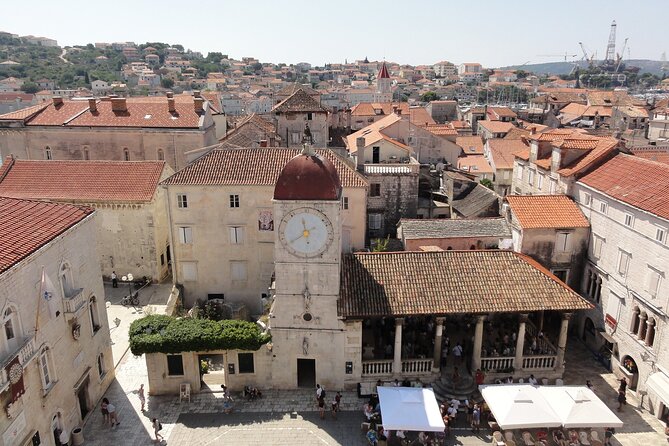
Trogir’s city hall and central square
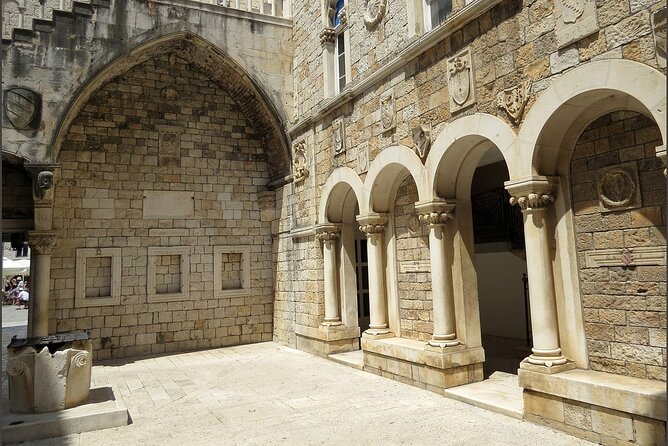
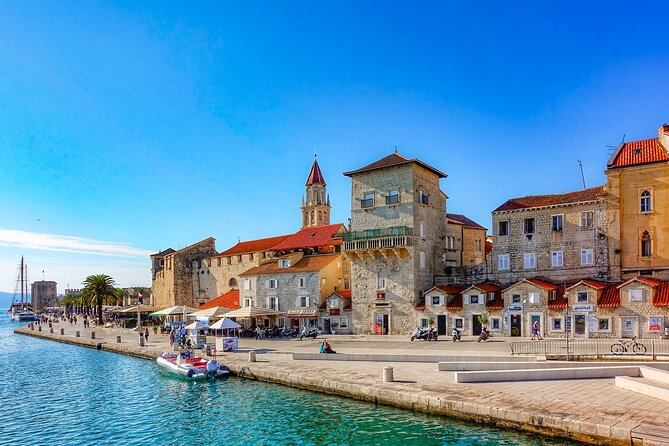
Trogir feels different from Split almost at once. The old center is compact, and the tour focuses on the main sights rather than trying to cover every lane. The first listed stop is the city hall, described as a building with an interesting past.
From there, the guide leads you to Trogir’s central square. This is the main stage for the town’s architecture and civic life. You can expect explanations of the buildings around the square, along with time to look closely at the stonework and layout.
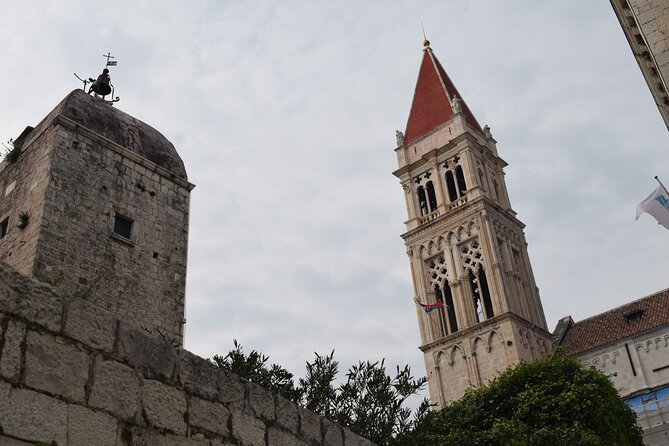
Trogir is especially appealing if you enjoy smaller historic centers. Split has the energy of a working city built around an ancient palace. Trogir offers a more concentrated visit, with a slower feel and plenty of attractive corners for photographs.
The tour includes free time in Trogir. This is one of its best features because you are not kept beside the guide every minute. You can use the break for a drink, photographs, or a short wander. The catch is that the free period may feel limited. Several accounts praise Trogir but wish there had been more time to explore.
Saint Lawrence’s Cathedral and St. Sebastian
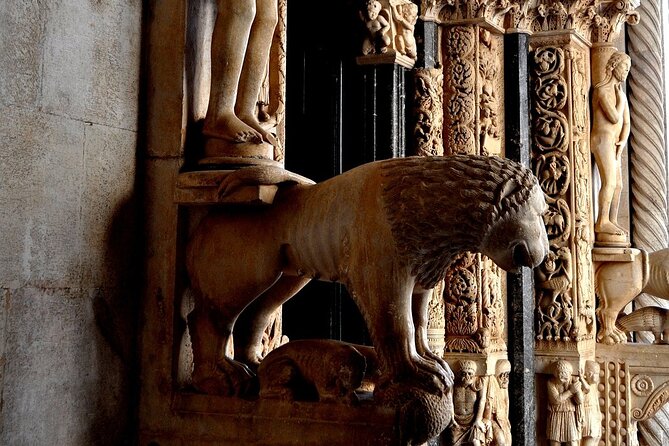
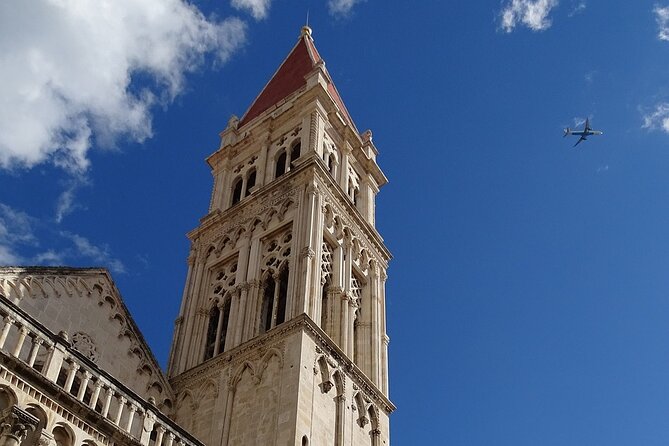
Saint Lawrence’s Cathedral is dedicated to Trogir’s patron saint and is one of the town’s main sights. The guided stop lasts about 15 minutes. Admission is not included, so budget extra if you want to enter.
Because the tour is short, you may receive a clear introduction rather than an extended visit. That is fine for a first look, but anyone especially interested in churches, sculpture, or medieval architecture may want to return independently if time allows.
The stop at St. Sebastian lasts about 10 minutes. The building was once a church and now serves as a memorial place. It adds a different layer to the town’s story and shows that Trogir’s old buildings have not all kept their original function.
These stops are where a good guide makes a real difference. Mia is praised for continuing her explanations under shelter during poor weather, while Antonia receives repeated praise for linking architecture with Croatian history. The guide’s delivery can turn a quick stop into something memorable.
Kula Karmelengo and the end of the visit
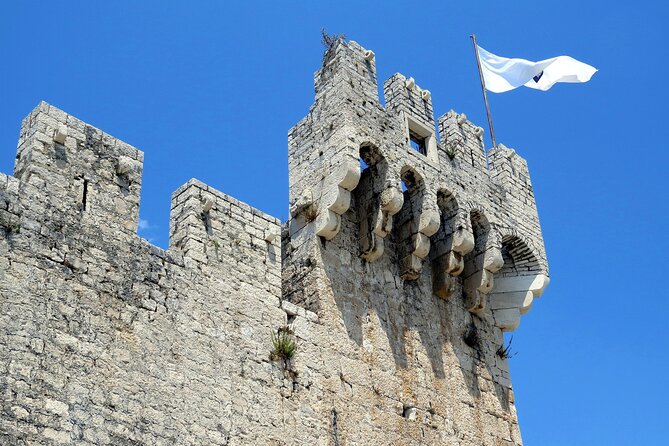
Kula Karmelengo is a Venetian fortress and the final listed stop. The visit lasts about 10 minutes, and admission is not included.
The fortress gives the Trogir walk a strong finish. After churches, civic buildings, and the central square, you see the military side of the town. The Venetian connection also broadens the story beyond Roman Split and local medieval development.
You then have free time before returning to Split. The exact balance between guided commentary and free wandering can change with traffic, weather, group size, and the needs of cruise passengers. If Trogir is your main reason for booking, tell the guide early that you would like to protect as much free time there as possible.
What the guides add to the day
The most praised part of this tour is its human side. Frane is described as easy to understand, with a strong voice and useful Croatian perspective. Ivana receives praise for her enthusiasm and ability to explain how the palace changed over centuries.
Ante is described as a local history student who brings both facts and energy. Mia is praised for patience and flexibility, while Antonia receives particularly strong comments for her passion, humor, and personal recommendations. Slavico is noted for combining historical explanations with a good sense of humor.
That does not mean every guide will offer the same depth. One experience had an English-speaking guide whose language skills were limited, and the guide mainly transported the group between points without giving much detail. It was still enjoyable for that group, but it shows why you should keep expectations realistic. This is a group tour, not a guaranteed private lecture.
Walking, weather, and group comfort
Plan on a lot of walking. The route is generally not uphill, but Split and Trogir both use old stone surfaces, and you will be on your feet through several stops. Anyone with limited mobility or low walking stamina may find the full day demanding.
Summer heat and cruise ship crowds can also affect the experience. The route includes narrow old-town spaces where large groups and warm weather make moving slowly unavoidable. Start on time, carry water, and use the free time for a short rest rather than trying to squeeze in another major sight.
The tour operates in all weather conditions, though poor weather may lead to cancellation and a choice of another date or a full refund. Dress for the forecast, and do not count on every explanation taking place in a dry indoor setting.
Is $60.49 a fair price?
At $60.49, the tour is priced reasonably for a five to six-hour outing that includes a guide, an air-conditioned vehicle, guided visits in two old towns, and return transport. You are paying for planning as much as for the commentary. Getting from Split to Trogir and back without arranging transport yourself has real value.
The price does not include food, drinks, or entrance tickets to historical monuments. Saint Lawrence’s Cathedral and Kula Karmelengo are specifically listed as extra, so carry a little additional money if you want to go inside.
I consider the price strongest for first-time visitors who want a clear introduction to both towns. It is less attractive if you prefer long museum visits, quiet photography, or complete control over the schedule. In that case, a private tour or separate visits may suit you better, though that would likely cost more.
Free cancellation is available up to 24 hours before the start time. Cancellations or changes inside that window are not refunded, and weather-related cancellations offer a different date or full refund.
Who should book this Split and Trogir tour?
You should consider booking it if you want to see the two most important old-town experiences near Split in one organized outing. It suits first-time visitors, cruise passengers with a defined shore day, couples, families with older children, and anyone who prefers a guide to explain what they are seeing.
It is also a good choice if you value local storytelling. The best guides add Croatian viewpoints, personal recommendations, humor, and small details that are difficult to get from a printed guidebook.
You may want another plan if you have trouble walking, dislike group schedules, or want several hours alone in Trogir. The tour can reach 50 people, although smaller walking groups may be used. It also works best when you accept that Trogir is an introduction, not an exhaustive visit.
FAQ
How long does the Split and Trogir tour last?
The experience lasts approximately five to six hours.
Where does the tour start?
It starts at the Golden Gate, Dioklecijanova 7, 21000 Split, Croatia.
Where does the tour end?
The activity ends back at the Golden Gate meeting point.
Is transportation included?
Yes. An air-conditioned vehicle takes you between Split and Trogir, with return transportation to Split included.
Is the tour offered in English?
Yes. The tour operates in English.
Are admission tickets included?
No. Food, drinks, and entrance tickets to historical monuments are not included. Saint Lawrence’s Cathedral and Kula Karmelengo are listed as having extra admission costs.
Is there free time in Trogir?
Yes. The tour includes free time in Trogir, though the amount can depend on the day’s timing.
What happens if the weather is poor?
If the experience is canceled because of poor weather, you can choose another date or receive a full refund. You can also cancel up to 24 hours before the start time for a full refund.
Just added around Split
- Walking Tour Split★ 4.7 · 61 reviews
- Unique vintage Tomos moped tour Split – Back to the ’80s★ 4.8 · 17 reviews
- Essential Diocletian’s Palace Tour for First-Time Visitors★ 4.8 · 19 reviews
- Trogir: White Lagoon, Maslinica & Blue Lagoon Speedboat Tour★ 4.8 · 11 reviews
- Split: Trogir Open Top Bus Trip + Free Split Walking Tour★ 4.1 · 17 reviews
- Trogir; Private walking tour of higlights of Trogir★ 4.7 · 3 reviews
- Trogir: Old Town Guided Walking Tour★ 4.6 · 76 reviews
- TROGIR: Blue Lagoon & 3 Islands Half-day Speedboat tour★ 4.6 · 28 reviews
Guided, compared.

Plitvice & Rastoke Guided Day Trip with Ticket
Read our review →
Plitvice Lakes Guided Tour with Entry Tickets
Read our review →
Plitvice Lakes National Park Guided Day Tour from Split
Read our review →
Rastoke & Plitvice Lakes Guided Tour with Ticket
Read our review →