Reviewed · SPLIT TOURS
Small-Group Communist Tour of Split – Boutique group tour
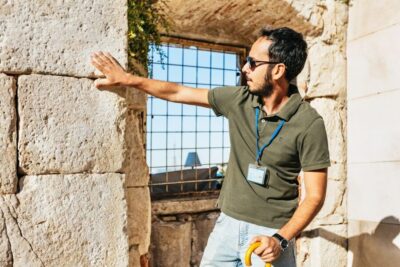
Split has a story beyond Diocletian’s Palace. This 3.5-hour tour follows the city’s communist past through war damage, modernist buildings, shopping, housing, and the violent breakup of Yugoslavia. I like the focus on local history and the use of a private, air-conditioned vehicle to connect places spread across Split. I also like the very small group size, capped at eight people, which should make it easier to ask questions and keep the discussion personal.
The tour is best for anyone curious about Yugoslavia, socialist architecture, or the everyday life of Tito’s era. A guide such as Boris, described as a local historian and history teacher, adds welcome depth. The main drawback is that this is not a gentle sightseeing loop through the old town. Some stops are short, the subject can be politically and emotionally heavy, and the $108.14 price is considerable for three and a half hours.
In This Review
- Key points to know before booking
- Why Split’s communist past deserves a morning
- Starting at Trg Franje Tuđmana: war damage and a new state
- Poljud Stadium and the bold side of Yugoslav architecture
- Koteks shopping center and the practical side of socialism
- Split 3: a planned neighborhood made for daily life
- Kopilica and the armored train that closes the story
- How the vehicle and small group affect the experience
- Is $108.14 a fair price?
- Who should book this Split history tour?
- My final take: a strong choice for curious visitors
- FAQ
- Where does the Communist Tour of Split begin?
- What time does the tour start?
- How long does the tour last?
- Where does the tour end?
- How many people can join the tour?
- Is transportation included?
- Is the tour offered in English?
- Is a drink included?
- Can I cancel for a full refund?
Key points to know before booking
- The tour begins at 9 a.m. at Trg Franje Tuđmana, near the Sv. Frane bus stop, and returns there.
- A private air-conditioned vehicle links the scattered sites, saving you long walks across modern Split.
- Poljud Stadium and Split 3 show off Yugoslav modernist design, including buildings presented at New York’s Museum of Modern Art.
- The route covers daily life, not only politics, with shopping, housing, education, health care, work, and social life all part of the discussion.
- The final stop uses an armored train to explain Yugoslavia’s violent collapse, giving the tour a serious ending.
- A local soft drink from the communist period is included, and free cancellation is available up to 24 hours before departure.
Why Split’s communist past deserves a morning
Most first visits to Split stay close to the Roman palace, the waterfront, and the lanes of the old center. Those places are essential, but they tell only part of the city’s story. After World War II, Split became part of a new communist state, and its neighborhoods, public buildings, shopping centers, sports facilities, and transport systems reflected a very different set of ideas.
This tour helps you read that newer layer of the city. You see how Yugoslavia tried to build a society that was socialist but not fully cut off from the West. That tension shaped everything from consumer goods to architecture. It also helps explain why people could enjoy certain freedoms and comforts while living under a one-party system and the rule of Josip Broz Tito.
I appreciate that the route does not treat communism as a museum subject sealed safely in the past. You look at real buildings still connected to daily life. Some have aged well, while others show years of neglect or changing priorities. The result should feel more like a guided conversation with the city than a collection of political dates.
The subject is not light. The final discussion covers the collapse of Yugoslavia in the 1990s and the war that followed. You should book this tour because you want context, not simply attractive views and quick facts.
A few more Split trips worth comparing
- Split: Krka Waterfalls Trip with Boat Cruise and Swimming
★ 4.8 · 10,519 reviews - From Split: Krka Waterfalls, Food & Wine Tasting Tour
★ 5.0 · 9,326 reviews - Blue cave, Mamma Mia and Hvar, 5 islands speedboat tour
★ 5.0 · 7,150 reviews
Starting at Trg Franje Tuđmana: war damage and a new state
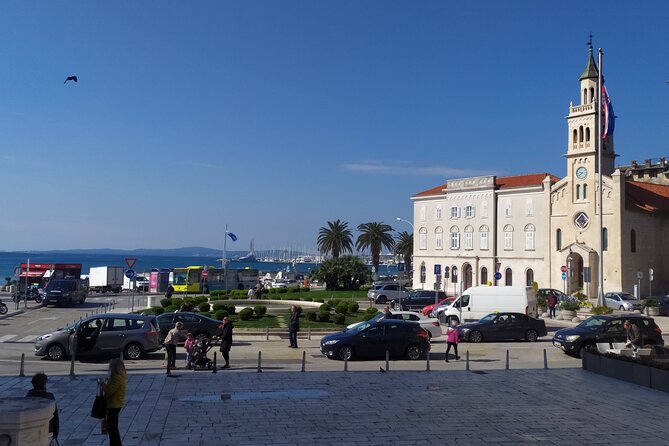
The morning begins at the bus stop on Trg Franje Tuđmana, also called Franje Tuđman Square. The meeting point is near public transportation, which makes it practical if you are staying outside the old center. The tour starts at 9 a.m., so allow enough time to find the Sv. Frane stop and arrive ready to begin.
The opening section lasts about 25 minutes. It sets up the major events of World War II in Split and Yugoslavia, then explains how those events led to the creation of the communist state. You also see photographs showing wartime damage in Split.
This is an important beginning because the rest of the tour depends on political context. Without it, a modernist apartment block can look like just another concrete building. With it, you begin to understand why housing, public space, and large civic projects mattered so much after the war.
The stop is free, as are all the listed stops. Do not expect a museum visit or an indoor exhibition here. The value comes from the guide’s explanation and the photographs, so this is a good time to ask about the difference between wartime destruction and later socialist rebuilding.
Poljud Stadium and the bold side of Yugoslav architecture
The next stop is a short panoramic visit lasting about 10 minutes. The focus is Poljud Stadium, one of Split’s best-known symbols and one of the most impressive public buildings from communist Yugoslavia.
Poljud was built for the Mediterranean Games, described as the biggest sporting event in Yugoslavia up to that time. Its unusual roof and sweeping form made it important far beyond Split. The stadium was also included in a Yugoslav architecture exhibition at the Museum of Modern Art in New York, which shows how seriously the country’s modern design was taken abroad.
You also hear about the China Wall, described as the widest existing building in Split. It is another example of Yugoslav socialist architecture, though its scale and purpose differ from the stadium. Together, the two sites show how the state used large buildings to signal confidence, progress, and a modern national identity.
This is a panoramic stop, so you should not expect a long architectural inspection. The short timing keeps the tour moving, but design enthusiasts may wish for more time around Poljud. Still, the stop works well as an introduction to the visual language of Yugoslavia: daring shapes, large public ambitions, and a willingness to try forms that were not simply copied from the Soviet Union.
Koteks shopping center and the practical side of socialism
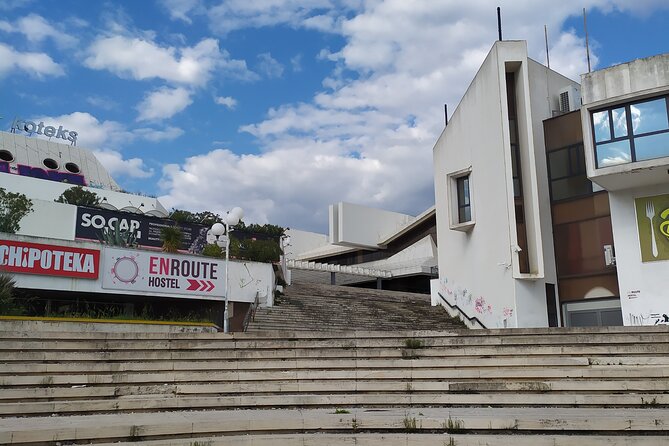
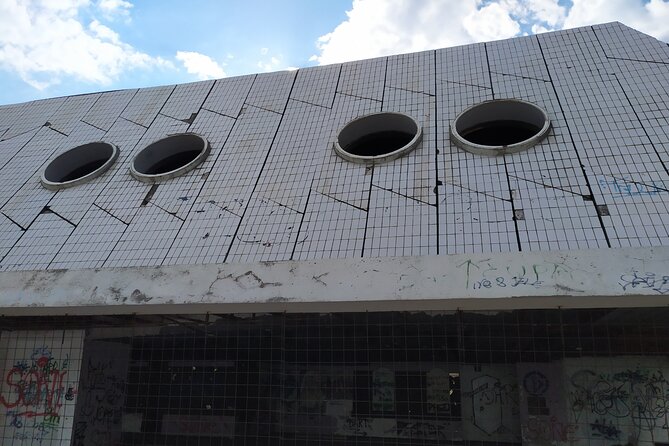
At Prodajni centar Koteks, the tour shifts from grand architecture to ordinary buying and selling. The walk around this site lasts about 30 minutes and focuses on what was described as the first shopping mall in Yugoslavia.
A shopping center may sound like an odd communist landmark, but Koteks helps explain Yugoslavia’s unusual position. The country was socialist, yet it was more open to the West than most Eastern European states. People encountered Western products, traveled, and developed consumer habits, but supply could still be uneven. Getting certain goods often required patience, personal contacts, or creative workarounds.
That mix of openness and shortage is one of the most useful themes on the tour. You are not given a simple picture of a society where everything was controlled in exactly the same way. Instead, you learn how people navigated a system that offered some consumer choices while still limiting access to many goods.
The shopping center’s later decline also matters. It shows how buildings that once represented modern life can lose their purpose as economic conditions and shopping habits change. I like this stop because it moves the conversation away from leaders and ideology and toward the practical question of how people supplied their homes.
If you are mainly interested in grand monuments, Koteks may feel less dramatic than Poljud or Split 3. Its value lies in the explanation. Pay attention to the contrast between the original promise of a modern socialist shopping center and its later decay.
Still Split, at a slower pace:
- From Split: Krka Waterfalls, Food & Wine Tasting Tour
★ 4.9 · 6,598 reviews - Split/Trogir: Blue Cave, Mamma Mia, Hvar and 5 Island Tour
★ 4.6 · 6,320 reviews - Blue Lagoon & 3 Islands Cruise with Lunch from Split
★ 4.5 · 5,756 reviews - Split: Old Town and Diocletian Palace Walking Tour
★ 4.9 · 4,727 reviews
Split 3: a planned neighborhood made for daily life
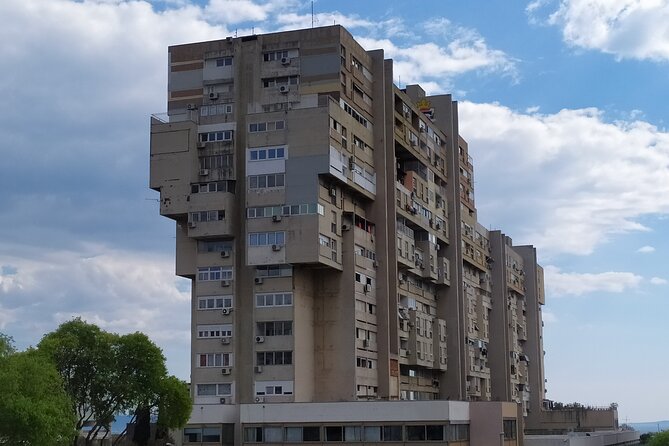
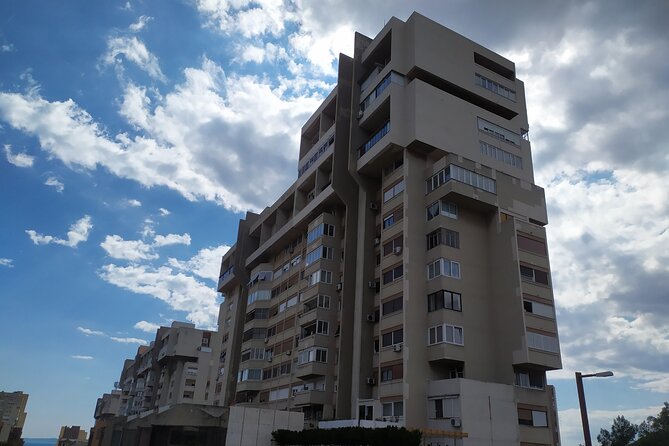
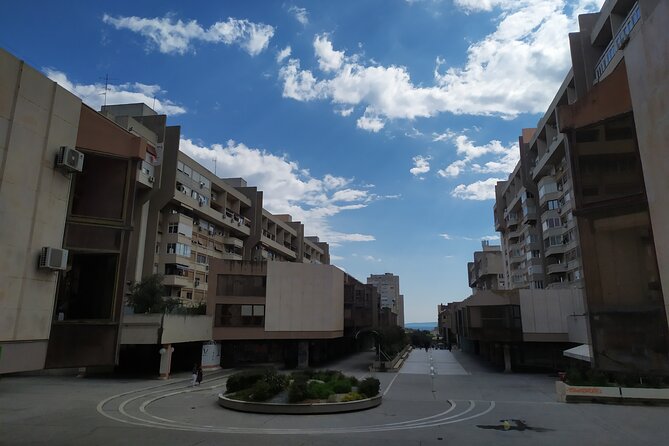
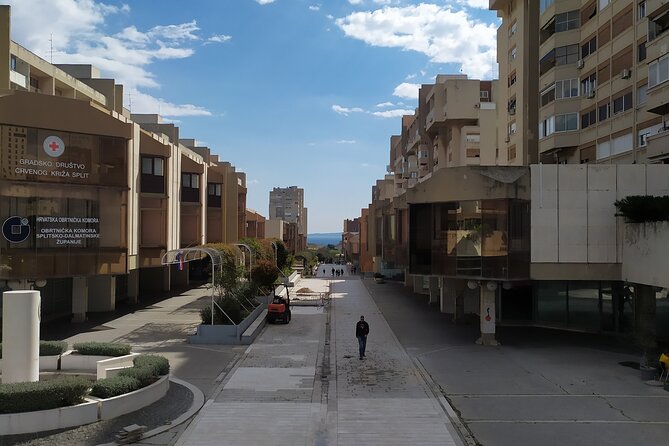
The longest stop is Split 3, with about 1 hour and 10 minutes for walking and free time. This is the heart of the tour for anyone interested in urban design and housing.
Split 3 was planned as a complete neighborhood built around the idea of living, working, and resting in one place. It became known internationally as an example of carefully planned modern housing, and it was also included in the Yugoslav architecture exhibition at New York’s Museum of Modern Art.
The neighborhood includes several architectural styles by local architects. One building, known as the Cruiser, is singled out for its distinctive form. Walking through the area gives you a chance to compare the different buildings and see how each architect left a personal mark on a large public project.
This is where the tour’s subject becomes tangible. You hear about housing policy, education, health care, the economy, social life, and politics while looking at the spaces built to support those systems. A planned neighborhood can reveal more about government priorities than a political speech. The arrangement of homes, public areas, and services shows what the state thought a modern citizen needed.
The guide also discusses Tito’s dictatorship. That balance is important. Yugoslavia’s social programs and modern housing projects are not presented as proof that the system was perfect. The tour also addresses political control and the limits of life under communist rule.
Free time at Split 3 gives the stop a less hurried feel. You can look around, absorb the scale of the buildings, and continue the discussion without being pushed immediately back into the vehicle. The tradeoff is that the neighborhood requires walking, and its appeal depends on your interest in architecture and social history. If you want only postcard views, this section may seem long. If you enjoy understanding how cities work, it is likely the most rewarding part.
Kopilica and the armored train that closes the story
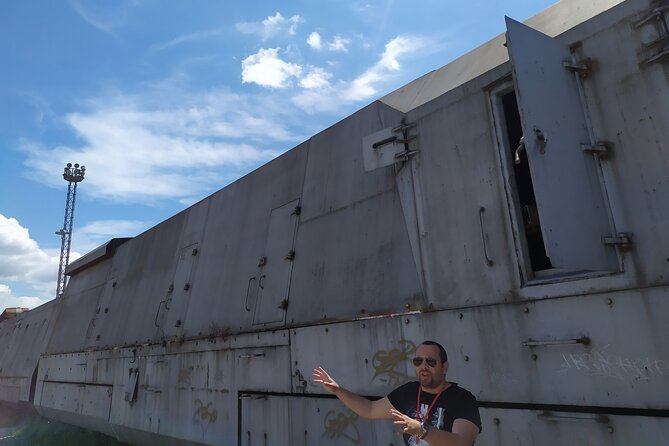
The final stop is at Split Predgrađe, near Kopilica railway station. The visit lasts about 30 minutes and turns to the reasons Yugoslavia failed to survive and why its breakup in the 1990s became so violent.
The visual focus is an armored train displayed beside the railway. It symbolizes the beginning of Yugoslavia’s bloody end and the renewed conflict among nations and religious groups in southeast Europe. The train gives the discussion a physical object, but the subject is the hardest part of the morning.
This ending is useful because it prevents the earlier architecture from being treated as a complete success story. The stadium, shopping center, and planned housing projects all belong to a state that eventually broke apart. Understanding that contradiction is central to understanding modern Split.
You should be prepared for a serious conversation. The tour does not end with a scenic café or a cheerful final monument. It ends by connecting the built environment to political failure, nationalism, war, and lasting changes in regional relations.
The activity returns to the original meeting point. That makes the final location practical if you need to continue sightseeing in central Split, but the information may stay with you for the rest of the day.
How the vehicle and small group affect the experience
The private air-conditioned vehicle is not just a comfort. The sites are dispersed across modern Split, and reaching them on foot would take extra time and energy. The vehicle lets the tour cover more ground while leaving the longest stop, Split 3, for walking.
The group maximum is eight people. That is a major advantage for a topic that depends on questions and explanation. In a large coach group, a discussion about Yugoslav consumer life or Tito’s political system can become a speech. With fewer people, you have a better chance to ask about details that interest you.
A five-star rating from seven published reviews gives the tour a strong early record, though the sample is small. One particularly useful account describes a one-on-one tour with Boris, who was praised for his strong command of the subject and his ability to make the visit personal. You should not assume you will have the same private arrangement, but the small-group format offers a similar possibility of direct conversation.
The tour is offered in English and uses a mobile ticket. Most people can participate, and the meeting point is near public transportation. There is no admission charge listed for the stops, since the experience is built around the guide, the vehicle, and the places themselves rather than museum entry.
Is $108.14 a fair price?
At $108.14 per person, this is not a budget sightseeing ride. You are paying for about three and a half hours, private transportation, a group capped at eight, an English-speaking local history guide, and a route that would be awkward to organize independently.
The value depends on your interests. If you already plan to visit only Diocletian’s Palace and the waterfront, this tour adds a whole new side of Split. It also saves you from researching scattered buildings and working out transport between them. For an architecture fan, a student of Yugoslavia, or anyone trying to understand the region beyond the usual tourist route, the cost can make sense.
The value is weaker if you want entrance tickets, elaborate meals, or a broad overview of all Split attractions. There are no paid attractions included, and the included refreshment is a typical local soft drink that was popular during communist Yugoslavia and remains popular today. It is a nice period detail, but not a major financial benefit.
I would compare the price with the cost of arranging a private guide and transport separately. The small group and specialized subject are the main reasons to pay more. If the group fills to eight, the experience may feel less personal than a private tour, but it should still be far more focused than a standard city tour.
Who should book this Split history tour?
I would recommend it most strongly to:
- People curious about Yugoslavia and the years after Tito
- Architecture fans interested in modernist and socialist design
- Visitors who have already seen the Roman center and want a different side of Split
- Students and history-minded travelers who want local examples rather than only national politics
- Anyone who prefers a small group and direct access to a guide
Families with older children may find the topic useful, but the final section on war and political violence requires maturity. The route is also less suitable if you want a relaxed morning of cafés, beaches, or traditional monuments.
Book it early if the subject matters to you. It is booked an average of 10 days ahead, and the eight-person limit keeps the format small. Free cancellation is available until 24 hours before the 9 a.m. start. After that point, the cost is not refunded, and changes are not accepted. Poor weather or failure to reach the minimum number of participants can lead to a new date or a full refund.
My final take: a strong choice for curious visitors
You should book the Communist Tour of Split if you want to understand how the city grew after World War II and why Yugoslavia remains such an important part of its identity. The strongest elements are the personal guidance, the small vehicle-based route, and the chance to see Poljud, Koteks, Split 3, and Kopilica in one morning.
I would skip it if your time in Split is very short or your interests are limited to ancient history. For everyone else, this is a thoughtful way to see the city beyond its famous stone walls. The tour does not offer easy answers, and that is part of its value. It shows both the ambition of Yugoslav socialism and the painful reasons that system fell apart.
FAQ
Where does the Communist Tour of Split begin?
It begins at the Sv. Frane bus stop on Trg Franje Tuđmana, 21000 Split, Croatia.
What time does the tour start?
The tour starts at 9 a.m.
How long does the tour last?
The tour lasts approximately 3 hours and 30 minutes.
Where does the tour end?
It ends back at the original meeting point.
How many people can join the tour?
The group maximum is eight travelers.
Is transportation included?
Yes. The tour includes private transportation in an air-conditioned vehicle.
Is the tour offered in English?
Yes. English is the listed language for the activity.
Is a drink included?
Yes. A typical local soft drink associated with communist Yugoslavia is included.
Can I cancel for a full refund?
Yes. You can cancel at least 24 hours before the start time for a full refund. Cancellations or changes made less than 24 hours before departure are not refunded or accepted.
Just added around Split
- Walking Tour Split★ 4.7 · 61 reviews
- Unique vintage Tomos moped tour Split – Back to the ’80s★ 4.8 · 17 reviews
- Trogir: White Lagoon, Maslinica & Blue Lagoon Speedboat Tour★ 4.8 · 11 reviews
- Essential Diocletian’s Palace Tour for First-Time Visitors★ 4.8 · 19 reviews
- Split: Trogir Open Top Bus Trip + Free Split Walking Tour★ 4.1 · 17 reviews
- Trogir; Private walking tour of higlights of Trogir★ 4.7 · 3 reviews
- Trogir: Old Town Guided Walking Tour★ 4.6 · 76 reviews
- TROGIR: Blue Lagoon & 3 Islands Half-day Speedboat tour★ 4.6 · 28 reviews
Split Tours, compared.
Krka Waterfalls Trip with Boat Cruise and Swimming
Read our review →
Blue cave, Mamma Mia and Hvar, 5 islands speedboat tour
Read our review →
Split/Trogir: Blue Cave, Mamma Mia, Hvar and 5 Island Tour
Read our review →
Blue Lagoon & 3 Islands Cruise with Lunch from Split
Read our review →