Reviewed · GUIDED
Salona & Amphitheater – Private guided tour – Admission incl.
Roman ruins sit just outside Split. This private walking tour takes you through Salona, once a Roman metropolis of about 60,000 people, then follows its cemeteries, basilicas, baths, gates, forum, theater, and amphitheater. I like the private format, since your guide can focus on your group rather than a crowd, and I like the unusually broad route, which shows Salona as a whole city rather than a single ruin. The tour also has a strong personal touch: Ivan is described as a pleasant, well-informed guide.
The main drawback is the price, $203.50 per person, especially for a tour lasting about two and a half hours. You should also confirm the admission arrangement before paying, since the tour title says admission is included while the Salona stop lists an adult entrance fee of about 10 euros as not included. The open-air site requires walking, and the tour depends on good weather.
In This Review
- Key things to know before visiting Salona
- Why Salona deserves time beyond Split’s palace
- Starting at the Salona main entrance
- Manastirine and the Christian cemetery
- Tusculum and Don Frane Bulić
- The bishop’s palace and the vanished cathedrals
- Roman baths and the five bridges
- Porta Caesarea and the marks of Roman traffic
- Forum, temple, and ancient theater
- The Cemetery of the 16 Sarcophagi
- Kapljuc and the five Christian martyrs
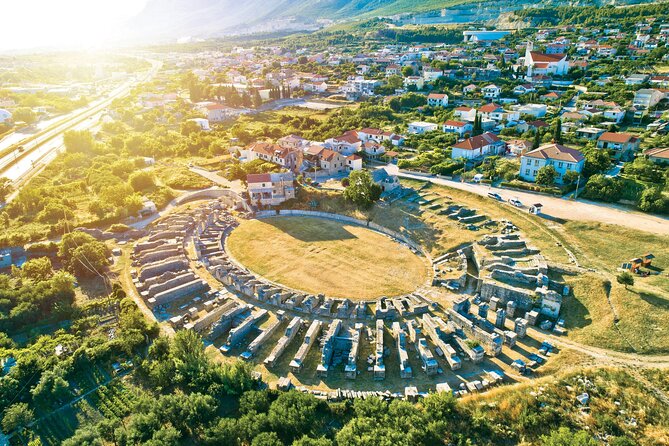
- The Salona amphitheater, the final 30 minutes
- What $203.50 per person really buys
- Who should book this private walk?
- Practical details that affect your visit
- Should you book the Salona tour?
- FAQ
- Where does the tour begin?
- Where does the tour end?
- How long does the tour last?
- Is the tour private?
- What language is offered?
- Is admission included?
- Can service animals participate?
- What happens if the weather is poor?
Key things to know before visiting Salona
- Salona was once home to about 60,000 people, making these ruins the remains of a major Roman city, not a small roadside settlement.
- The amphitheater is the tour’s main prize, with enough surviving structure to help you picture Roman public life.
- The route includes Christian cemeteries and martyr sites, including Manastirine and Kapljuc.
- You visit the old city gate, baths, forum, temple, theater, and industrial quarter, giving the tour a wide historical range.
- This is a private tour for your group only, with an English-speaking guide and a meeting point at Salona’s main entrance.
- The tour lasts about 2 hours and 30 minutes, so wear practical shoes and be ready for steady walking between sites.
Why Salona deserves time beyond Split’s palace
Split gets much of the attention because Diocletian’s Palace sits right in the center of town. Salona gives you a different picture. Here, you are looking at the remains of a full Roman city that once supported roughly 60,000 residents.
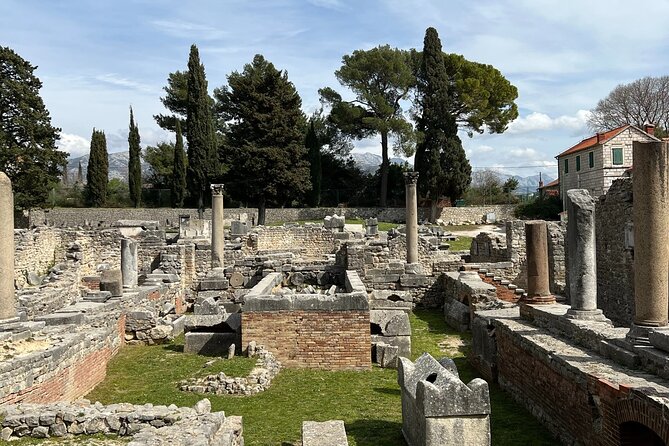
That scale matters. You are not just inspecting a preserved arch or a single temple. You are moving through the scattered pieces of streets, religious buildings, burial grounds, public baths, gates, and entertainment spaces. The ruins are spread across an open-air archaeological site, so the visit feels like city exploration rather than a quick monument stop.
Salona was destroyed by the Avars in the sixth century. That violent end helps explain why the site feels incomplete. Walls stop abruptly. Foundations are often more visible than buildings. Yet those fragments are useful when a guide explains how the pieces fit together.
I like having a private guide here because Salona is not always self-explanatory. A bath complex can look like a low stone outline if you do not know what you are seeing. A worn road can seem ordinary until you learn that it once led through a Roman gate. The guide provides the missing connections.
A few more Split trips worth comparing
- Split: Krka Waterfalls Trip with Boat Cruise and Swimming
★ 4.8 · 10,519 reviews - From Split: Krka Waterfalls, Food & Wine Tasting Tour
★ 5.0 · 9,326 reviews - Blue cave, Mamma Mia and Hvar, 5 islands speedboat tour
★ 5.0 · 7,150 reviews
Starting at the Salona main entrance
The tour begins at Salona’s main entrance at Ul. don Frane Bulića 58 in Solin, just outside Split. The end point is the same place, which keeps the day simple. You do not need to arrange a different pickup point or figure out where the walk finishes.
At the entrance, your guide gives general information before you start walking. This opening matters because it sets the scale of the site and gives you a basic map in your head. Salona is not a compact palace courtyard. You will cover several areas, with short stops at each.
The tour is offered in English and uses a mobile ticket. It is near public transportation, though the supplied details do not specify routes or travel times. Most people can take part, and service animals are allowed.
The advertised duration is about two hours and thirty minutes. That is enough time for a broad introduction, but it is not an exhaustive archaeological study. You will see many important areas, usually with short stops of 10 to 15 minutes, then spend about 30 minutes at the amphitheater.
Manastirine and the Christian cemetery
Manastirine was first used as a Roman necropolis and later became a Christian cemetery. This change gives you a clear look at how the city’s religious life developed over time.
The site is linked with St. Domnius, the martyr and patron of Split. His burial here connects Salona with the religious identity of modern Split. You are not just seeing tombs. You are seeing a place tied to the early Christian community and to a figure still important in the region.
The stop lasts about 15 minutes. That is enough for an explanation and a look around, though you should not expect a long, detailed visit to every burial feature. The value comes from the story and setting, especially when your guide connects Manastirine with the later Christian sites on the route.
Tusculum and Don Frane Bulić
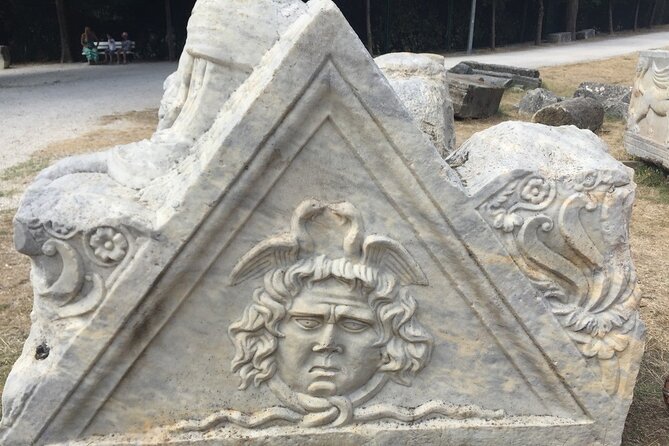
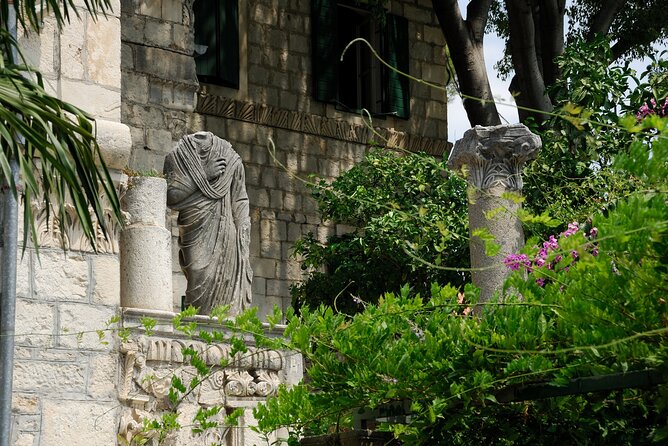
Tusculum offers a change of pace. It was built by Don Frane Bulić, a prominent clergyman and archaeologist from Split, and served as his office and meeting place. Some rooms can be visited.
This stop adds a more recent layer to the ancient site. You are not only looking backward to Roman Salona. You are also seeing how modern archaeologists studied, protected, and interpreted the ruins.
I find this useful because archaeological sites do not preserve themselves by accident. A building such as Tusculum reminds you that Salona became a subject of serious study long after its ancient city life ended. The stop lasts about 15 minutes and gives you a break from foundations and open-air ruins.
Still Split, at a slower pace:
- From Split: Krka Waterfalls, Food & Wine Tasting Tour
★ 4.9 · 6,598 reviews - Split/Trogir: Blue Cave, Mamma Mia, Hvar and 5 Island Tour
★ 4.6 · 6,320 reviews - Blue Lagoon & 3 Islands Cruise with Lunch from Split
★ 4.5 · 5,756 reviews - Split: Old Town and Diocletian Palace Walking Tour
★ 4.9 · 4,727 reviews
The bishop’s palace and the vanished cathedrals
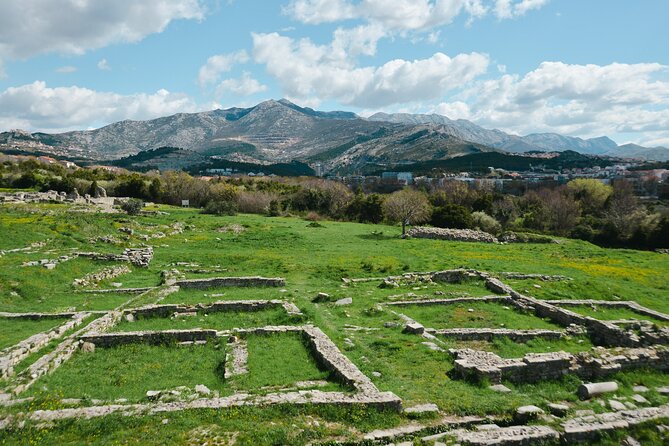
At the bishop’s palace, also called the Palatium episcopi, you see foundation walls connected with the period when Christians were allowed to worship openly. The remains of two cathedrals are also part of this area.
The buildings are no longer standing in a way that makes their original form immediately clear. You will mostly see foundations, so this is another place where the guide’s explanation earns its keep. I would pay attention to the layout rather than expect a dramatic structure.
The stop takes about 15 minutes. It works best as part of the larger story: Roman city, early Christian community, bishops, churches, cemeteries, and martyrs. Each section adds a piece to Salona’s religious past.
Roman baths and the five bridges
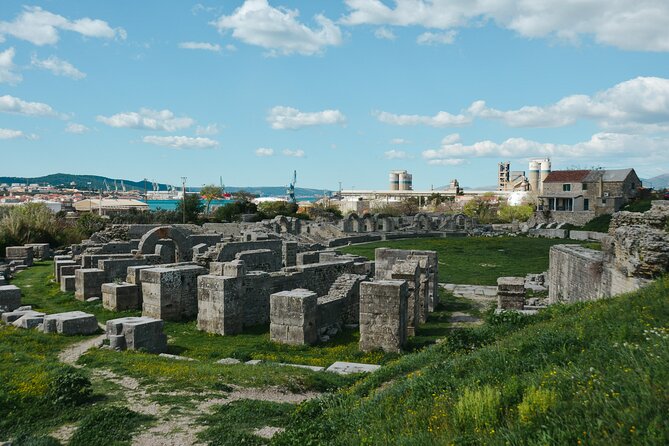
The large urban spa was used for several hundred years. Roman baths were more than places to wash. They were centers of social and cultural life, so the remains point to the daily routines of ordinary city life as well as grand public events.
This is one of the stops where a short explanation can transform simple stonework. You can think about how the baths served as meeting places and how long they remained in use. The visit lasts about 10 minutes, which gives you a useful introduction without slowing the whole route.
Pet Mostova, or the five bridges, belonged to an industrial area outside the old city center. The name is memorable, and the location helps you picture Salona as a working city with activity beyond its central public buildings.
This area may appeal most to you if you enjoy seeing the practical side of Roman life. Not every stop is a grand monument. Some show infrastructure and production, which makes the city feel more complete.
Porta Caesarea and the marks of Roman traffic
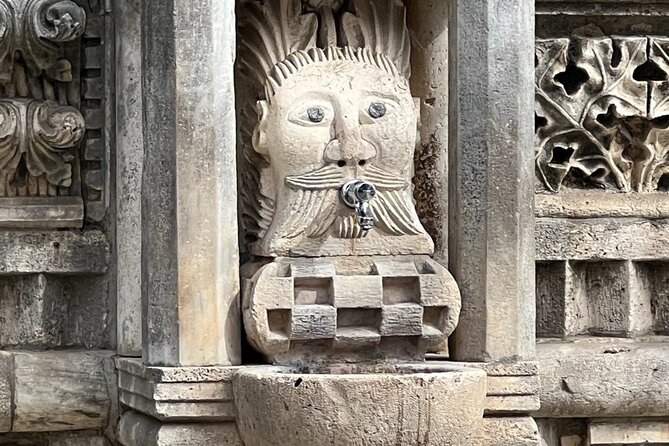
The Porta Caesarea was the capital gate in Roman times. The most vivid detail here is easy to understand: the ruts left by Roman chariots can still be seen.
Those grooves are small, but they make the past feel unusually direct. A written explanation tells you that vehicles passed through the gate. Wheel ruts let you see the traffic itself, or at least its lasting effect on the road.
You will spend about 10 minutes here. Take a moment to look down at the roadway before moving on. It is the sort of detail you can miss if you hurry from one large ruin to the next.
Forum, temple, and ancient theater
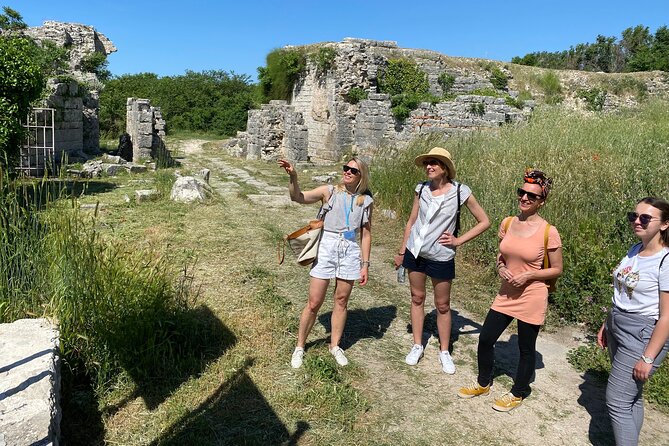
In the oldest part of Salona, the remains include the forum, a temple, and an ancient Roman theater. This is the civic heart of the route, where public, religious, and cultural life came together.
The ruins are not presented as a single preserved complex. You will see remains and foundations, then use the guide’s account to picture how the area functioned. A private tour helps here because you can ask questions about the layout and spend a little more time on the parts that interest you.
The stop is scheduled for about 10 minutes. That is brief, but it fits the tour’s wider purpose. You are getting a guided overview of Salona’s major zones rather than a long academic session at one building.
The Cemetery of the 16 Sarcophagi
Along Ul. don Frane Bulića 91, the route reaches the Cemetery of the 16 Sarcophagi. This necropolis lies beside the road leading toward the amphitheater.
Roman cemeteries were placed outside city walls, and this site shows that rule in a straightforward way. Burial grounds were part of the city’s edge, not hidden in some distant rural place. The road itself becomes part of the story, linking the cemetery with the public arena ahead.
The scheduled stop is about 10 minutes. I would treat it as a transition point. You are leaving the central city and following the route toward the amphitheater, while also seeing how burial customs shaped the city’s outskirts.
Kapljuc and the five Christian martyrs
Kapljuc includes another basilica and necropolis. It is linked with five martyrs who died in Salona’s amphitheater during the persecution of Christians under Diocletian at the beginning of the fourth century.
This is one of the strongest narrative links on the tour. Earlier, you see Christian burial sites and churches. Now you are given the story of people connected directly with the arena you are about to visit.
The stop takes about 10 minutes. The brief timing means the guide needs to keep the explanation focused, but the subject gives the walk emotional weight without requiring a separate museum visit.
The Salona amphitheater, the final 30 minutes
The amphitheater is the final and longest stop, with about 30 minutes set aside for it. It is the visual high point of the tour and the place where several earlier themes meet: Roman entertainment, public architecture, Christian persecution, and the city’s long decline.
The structure is relatively well preserved, although much of its stone was removed by the Venetians for use in churches in Venice. That fact explains why the arena is impressive but incomplete. You can still read the shape of the building and imagine its role in Salona, but you should not expect a fully restored stadium.
I like ending here. The amphitheater gives the route a strong finish, and the earlier cemetery and martyr stops make the arena more than a photo stop. Your guide can connect the building to the people who lived, worshipped, and died in Salona.
Thirty minutes is a sensible amount of time. You have room to look around, ask questions, and absorb the structure without spending the whole tour at one site. If the amphitheater is your main interest, this is also the part where the private format may be most useful.
What $203.50 per person really buys
At $203.50 per person, this is not a budget sightseeing walk. The value depends heavily on how much you want personal guidance and how difficult you find ancient ruins to read without help.
You are paying for a private activity, so only your group participates. That can be worthwhile if you want to ask questions freely, move at your own pace within the scheduled visit, or avoid being attached to a large group. It is also useful for families or friends with a shared interest in Roman and early Christian sites.
The tour covers a lot in two and a half hours. You visit eleven named areas, with the amphitheater receiving the longest stop. That broad coverage gives you a solid introduction to Salona, but the price may feel high if you prefer to wander slowly or only want to see the arena.
Admission needs checking before you book. The tour name indicates admission is included, while the Salona entrance details list an adult ticket of about 10 euros as not included. Ask the provider which statement applies to your booking so the final cost is clear.
Who should book this private walk?
I would recommend it most strongly if you enjoy archaeology but do not want to decode a large ruin site alone. Salona rewards context, and the route covers enough ground that a guide can save you from missing the meaning of ordinary-looking foundations, road ruts, cemeteries, and bath remains.
It also suits you if you have already seen Diocletian’s Palace in Split and want a wider view of the Roman world around the city. The tour shows where the ancient population lived, worshipped, worked, traveled, and watched public events.
Families may appreciate the private setup, especially since the group can ask questions without holding up strangers. History-focused couples and small groups should also find the format comfortable.
I would hesitate if your budget is tight, if you dislike walking through open-air ruins, or if you want a full-day archaeological study. The short stops keep the route moving, but they leave limited time for lingering at each location.
The experience has a perfect 5 rating from eight submitted reviews, and Ivan is specifically praised as a pleasant companion with strong subject knowledge. That personal quality matters here. A good guide can make the difference between seeing scattered stones and understanding a city.
Practical details that affect your visit
The meeting point is Salona’s main entrance at Ul. don Frane Bulića 58, 21210 Solin, Croatia. The tour returns there, so your arrival and departure point are the same.
You receive confirmation when booking, and the activity is offered in English. It is near public transportation, though no specific transport instructions are provided. Bring a mobile ticket and allow enough time to reach the main entrance.
Plan for walking outdoors. The tour requires movement between several archaeological areas, and the weather matters. If poor weather causes cancellation, you are offered another date or a full refund.
Free cancellation is available up to 24 hours before the start time. Changes or cancellations made within 24 hours are not accepted for a refund, and the cut-off follows local time.
Should you book the Salona tour?
Book it if you want a focused, private introduction to Salona and value a guide who can connect Roman civic life with early Christian history. The amphitheater is excellent, but the real strength is the complete route: baths, bridges, gate, forum, theater, cemeteries, basilicas, and the arena all belong to the same ancient city.
Skip it if you only want a quick amphitheater visit or need to keep costs low. At $203.50 per person, the private format must matter to you for the price to make sense.
Before booking, confirm whether the roughly 10 euro adult admission is included. If that detail is settled and the price fits your plans, this is a useful way to see the Roman world beyond Split’s famous palace.
FAQ
Where does the tour begin?
The tour begins at Salona’s main entrance, Ul. don Frane Bulića 58, 21210 Solin, Croatia.
Where does the tour end?
The activity ends back at the Salona main entrance, the same place where it begins.
How long does the tour last?
The tour lasts approximately 2 hours and 30 minutes.
Is the tour private?
Yes. Only your group participates in the private tour.
What language is offered?
The tour is offered in English.
Is admission included?
The tour title states that admission is included, but the Salona entrance details list an adult fee of about 10 euros as not included. Confirm this point with the provider before booking.
Can service animals participate?
Yes. Service animals are allowed.
What happens if the weather is poor?
The experience requires good weather. If it is canceled because of poor weather, you are offered a different date or a full refund.
Just added around Split
- Walking Tour Split★ 4.7 · 61 reviews
- Unique vintage Tomos moped tour Split – Back to the ’80s★ 4.8 · 17 reviews
- Trogir: White Lagoon, Maslinica & Blue Lagoon Speedboat Tour★ 4.8 · 11 reviews
- Essential Diocletian’s Palace Tour for First-Time Visitors★ 4.8 · 19 reviews
- Split: Trogir Open Top Bus Trip + Free Split Walking Tour★ 4.1 · 17 reviews
- Trogir; Private walking tour of higlights of Trogir★ 4.7 · 3 reviews
- Trogir: Old Town Guided Walking Tour★ 4.6 · 76 reviews
- TROGIR: Blue Lagoon & 3 Islands Half-day Speedboat tour★ 4.6 · 28 reviews
Guided, compared.
Plitvice & Rastoke Guided Day Trip with Ticket
Read our review →
Plitvice Lakes Guided Tour with Entry Tickets
Read our review →
Plitvice Lakes National Park Guided Day Tour from Split
Read our review →
Rastoke & Plitvice Lakes Guided Tour with Ticket
Read our review →