Reviewed · SPLIT TOURS
Private Walks & Storytelling – the best small group tour in Split
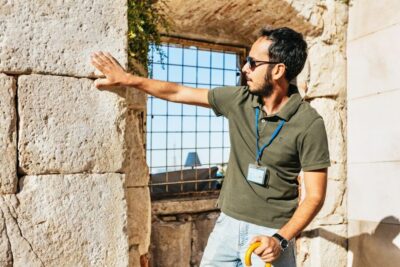
Split tells its best stories on foot. This private walk links the Riva, Diocletian’s Palace, Roman temples, local food, and modern city life with a licensed guide who knows the town personally. I especially like the small-group format and the chance to shape the outing around your interests. I also like that Mirjana, the guide, adds everyday stories and practical food and coffee advice rather than stopping at dates and monuments. The main consideration is price: at $238.34 per group, it is excellent value for a full group but costly for one or two people.
Mirjana is a local expert born and raised in Split, and her approach suits anyone who wants the city explained through both history and daily life. You will walk for roughly one hour to one hour and 40 minutes, with stops that include the palace cellars, Peristyle, Cathedral of Saint Domnius, Golden Gate, and a chocolate tasting.
The route covers plenty in a short time, so you should expect a brisk introduction rather than a complete study of Split. The cathedral and Temple of Jupiter may involve extra admission, and the walk requires good weather. Still, the private setup lets you ask questions, adjust the finish, and spend more time on the parts that catch your attention.
In This Review
- Key points to know before booking
- Why this Split walk feels different
- Starting slowly on the Riva
- Below the palace in Diocletian’s Substructures
- Peristyle, the cathedral, and Jupiter’s temple
- The narrowest lane and Split’s newer old town
- Nadalina chocolate adds a local taste
- The Golden Gate and Grgur Ninski
- How good is the $238.34 group price?
- What the five-star praise tells you
- Who should book this experience?
- Practical details that affect your day
- Should you book Mirjana’s Split walk?
- FAQ
- Where does the tour start?
- Where does the tour end?
- How long does the walking tour last?
- How many people can join?
- Is the tour offered in English?
- Are admission fees included?
- What happens if I need to cancel?
Key points to know before booking
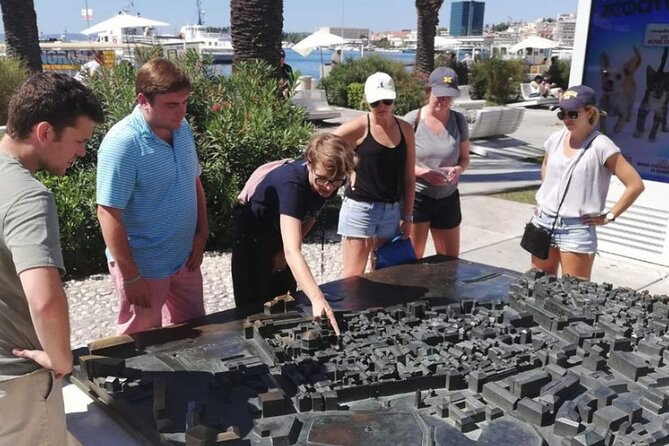
- Mirjana leads a personal Split experience: She was born and raised in the city and is a licensed guide, storyteller, and certified history interpreter.
- The route connects Roman stones with modern life: You will see Diocletian’s Palace, but also cafés, laundry, local customs, food production, and the slow pomalo way of life.
- A small group makes the price work: One booking covers up to 10 people, making the cost far better for families or groups than for a couple.
- Chocolate is part of the lesson: Nadalina provides locally flavored samples while Mirjana explains food production.
- You can adjust the ending: The stated finish is near the Golden Gate and Grgur Ninski Statue, but the walk can end elsewhere if you arrange it at the start.
- Allow up to 100 minutes: The planned stops add up to about one hour and 40 minutes, though the advertised duration can be as short as one hour.
Why this Split walk feels different
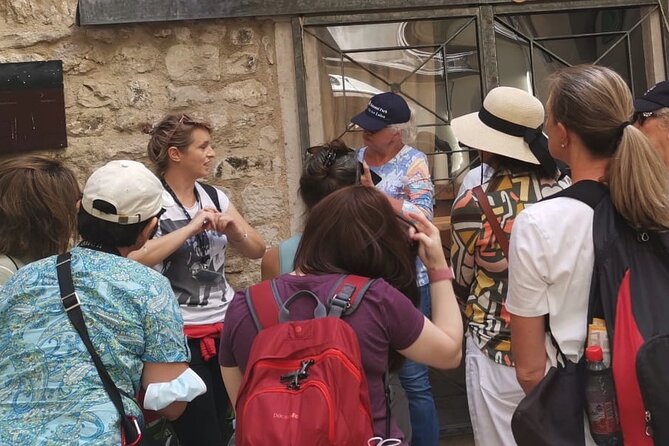
Many city walks treat Diocletian’s Palace as a Roman monument with a modern town attached. This one reverses the emphasis. You see an ancient palace, but you also see people living among its walls, shops operating in old spaces, and narrow lanes still used for ordinary errands.
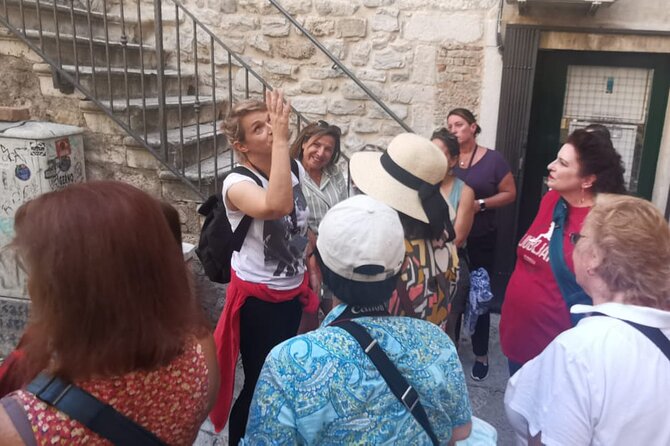
I like that balance. The guide does not only explain who built what. She connects the imperial past to Split’s customs, food, folklore, and current concerns. That makes the palace easier to understand because you see it as part of a living town, not a museum behind a rope.
The private format matters here. Your group can ask about Roman history, Croatian culture, local food, or places to eat after the walk. The guide can also adjust the conversation for a mixed-age group. Mirjana has handled groups with teenagers and adults, and her storytelling style is meant to keep both generations involved.
The experience is offered in English and uses a mobile ticket. It is limited to 10 people, which is large enough for a family gathering but still much more personal than a standard coach excursion. Service animals are allowed, public transportation is nearby, and most people can take part.
A few more Split trips worth comparing
- Split: Krka Waterfalls Trip with Boat Cruise and Swimming
★ 4.8 · 10,519 reviews - From Split: Krka Waterfalls, Food & Wine Tasting Tour
★ 5.0 · 9,326 reviews - Blue cave, Mamma Mia and Hvar, 5 islands speedboat tour
★ 5.0 · 7,150 reviews
Starting slowly on the Riva
You meet at the Brass Gate, also called Porta Aenea, at Obala Hrvatskog narodnog preporoda 22. This puts you beside the Riva, Split’s waterfront promenade, where the city’s social life is easy to read.
The opening 15 minutes focus on how local people use the Riva. Coffee, conversation, sunshine, and sea views matter here as much as any formal sight. Mirjana uses this setting to explain Split’s pace and the local idea of pomalo, meaning take it easy.
That beginning is useful because it gives you a way to read the city for the rest of your stay. You are not simply told that Split is relaxed. You see how that mood takes shape in public life.
The opening also sets up the move into the old town. As you leave the water, the walk shifts from broad views to narrow lanes and Roman walls. You may see ordinary details such as laundry and daily routines alongside ancient stone. That contrast is one of the most appealing parts of the experience.
A small bite is included in this early section, though the details of the food are not fixed. If food matters to you, ask Mirjana what is available and tell her about allergies or preferences when you meet.
Below the palace in Diocletian’s Substructures
The next stop takes you under Diocletian’s Palace for about 10 minutes. The Substructures, often called the palace cellars, show the lower level of the imperial complex and help explain how the upper palace was supported and arranged.
This is a short stop, but it gives the palace physical weight. Above ground, the old center can feel like a maze of shops, restaurants, and lanes. Below ground, the stonework makes the age of the place much easier to grasp.
Mirjana’s storytelling focuses on work, trade, and the people who shaped and used these spaces. That is a welcome change from a tour that only discusses emperors. You get a sense of the hands behind the stone and the long life of the city beneath its grand architecture.
Admission is listed as free for this part. Wear comfortable shoes, since the whole experience is a walking tour through historic streets and interior spaces. The supplied details do not promise a long cellar visit, so do not book this expecting an extended archaeological presentation.
Peristyle, the cathedral, and Jupiter’s temple
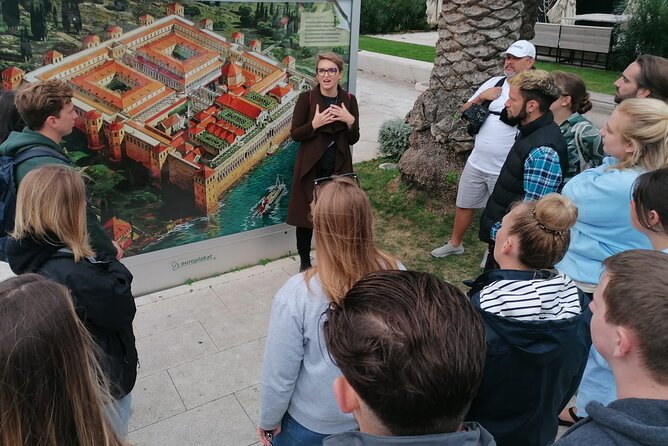
From the Substructures, you reach the Peristyle, the open imperial square at the heart of the palace. This is one of the route’s key moments. It gives you a clear sense of the palace’s scale and helps you picture how ceremonial Roman space later became part of everyday Split.
Mirjana talks about stories from behind the old walls, traditional customs, modern Split, and the local preference for taking life slowly. I like this stop because the setting does much of the teaching. The architecture is formal and grand, while the city around it remains practical and lived-in.
The Cathedral of Saint Domnius rises beside the Peristyle. It is described as one of the oldest and smallest cathedrals in the world, and the tour points out how the cathedral is partly protected and tucked behind the tall bell tower. The stop lasts about 10 minutes.
Admission to the cathedral is not included, so check the cost at the time of booking or ask the guide. The information provided does not state the current entrance fee. If you want to spend longer inside, mention that at the start because the scheduled visit is brief.
The Temple of Jupiter follows for another 10 minutes. Its original purpose reflected the connection between Emperor Diocletian and Jupiter, the Roman god of the sky and thunder. During the Middle Ages, the temple became a baptistery dedicated to Saint John the Baptist.
That change is a useful lesson in how Split developed. A Roman religious building was not simply abandoned. It was given a new role, and the new faith became part of the old structure. Admission here is also not included.
Still Split, at a slower pace:
- From Split: Krka Waterfalls, Food & Wine Tasting Tour
★ 4.9 · 6,598 reviews - Split/Trogir: Blue Cave, Mamma Mia, Hvar and 5 Island Tour
★ 4.6 · 6,320 reviews - Blue Lagoon & 3 Islands Cruise with Lunch from Split
★ 4.5 · 5,756 reviews - Split: Old Town and Diocletian Palace Walking Tour
★ 4.9 · 4,727 reviews
The narrowest lane and Split’s newer old town
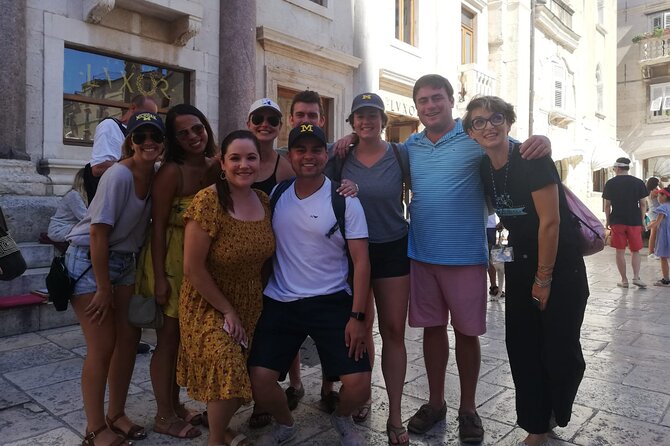
The short passage called Pusti me da prodjem, or Let Me Pass Street, takes only about two minutes. It runs between the ancient Temple of Jupiter and a medieval building that is now a hotel.
Local people consider it the narrowest street in town. The name tells you what to do when someone approaches. It is a tiny stop, but it adds humor and a clear sense of how old city planning still shapes movement today.
The route then reaches Narodni Trg, or People’s Square, for about five minutes. As the ancient walls could no longer hold the growing population, Split expanded westward. This district became a newer old town, with northern and southern European influences meeting in its stone streets.
I appreciate this transition because it prevents the walk from becoming only a palace tour. You see how Split grew beyond the Roman core and how different periods sit next to one another. The stop is short, but it helps you understand the city plan before the walk turns toward food and the northern gate.
Nadalina chocolate adds a local taste
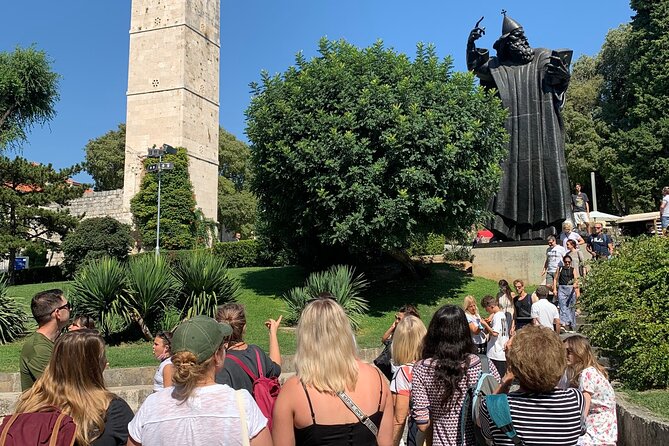
Near the end of the walk, you stop at Nadalina chocolate for about eight minutes. You receive samples of chocolate with local flavors while Mirjana talks about food production.
This is more than a sweet pause. Food gives you another way into local culture, and the tasting breaks up the stone and architecture. It also makes the route easier for younger visitors, who may not want every minute devoted to Roman building methods.
The tasting is included, though the available samples may vary. If you have allergies or dietary restrictions, tell the guide at the start. The tour information does not specify ingredients or alternatives.
Mirjana also provides suggestions for food, activities, and places to go after the walk. That practical advice can be especially useful early in your stay, when you are still deciding where to eat or what deserves more of your time. One particularly helpful detail from the experience is her willingness to assist with food and coffee recommendations.
The Golden Gate and Grgur Ninski
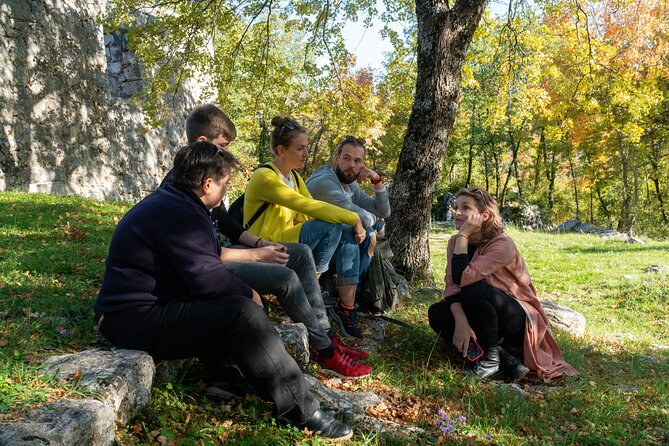
The Golden Gate, or Porta Aurea, is one of the four main Roman entrances to Diocletian’s Palace. It faced north toward Salona, the capital of the Roman province of Dalmatia and the birthplace of Diocletian.
The stop lasts about 10 minutes. Mirjana explains the military thinking behind the palace gates and points out lesser-noticed buildings nearby. This is a good place to connect the palace to its wider setting. The gate was not built only for decoration. It formed part of a planned imperial complex with routes, defenses, and links to the surrounding province.
The tour ends at the northern palace wall, near the statue of Grgur Ninski. The final 15 minutes bring together a fourth-century wall, twentieth-century art, and present-day city life.
The statue is connected with a local custom: you make a wish. It is a simple ending, but a pleasant one. Instead of finishing with a list of facts, the walk ends with something you can do and remember.
The stated end point is Ul. Stari pazar 9, but you can ask for another ending at the beginning. That flexibility is useful if you want to finish near your accommodation, a restaurant, or a transport connection. The tour does not promise transport, so you should plan to walk to your next stop.
How good is the $238.34 group price?
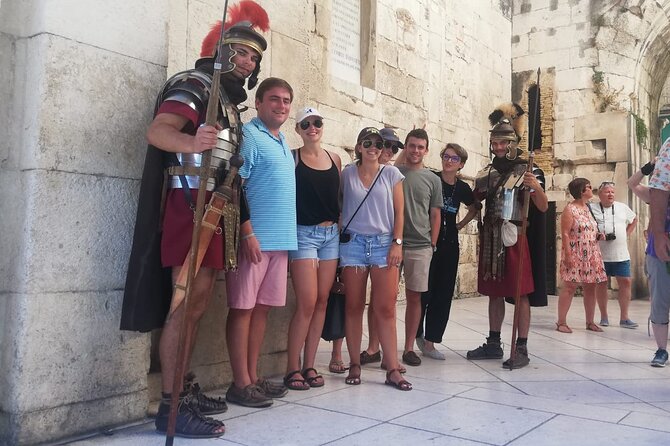
The price is $238.34 for a group of up to 10 people. That works out to about $23.83 each if you fill all 10 places, or about $47.67 per person for a group of five.
For a family or group of friends, the value is strong. You get a private guide, a route that can respond to your interests, local food samples, and advice for the rest of your stay. A private walk also avoids the common problem of trying to hear a guide while standing inside a crowded old town.
For two people, the math is less attractive. At about $119.17 per person, you are paying for privacy and flexibility more than for the number of sights covered. That can still be worthwhile if personal attention is your priority, but a shared walking tour may cost less.
The tour includes the guide’s service and the tasting stops described above. All fees and taxes are not included, and admission to the Cathedral of Saint Domnius and Temple of Jupiter is specifically excluded. Ask about those costs before you set your budget.
The route is advertised at one hour to one hour and 40 minutes. The listed stop times total about 100 minutes, so I would plan for the longer duration, especially if you ask questions or choose to linger. You should not schedule a tight lunch, ferry, or museum appointment immediately afterward.
What the five-star praise tells you
The strongest praise focuses on Mirjana rather than on the monuments alone. Her clear explanations, warm manner, and ability to respond to different ages are central to the experience.
I would pay attention to that if you are booking for a mixed group. Teenagers and adults often want different things from a history walk, yet the guide has been able to keep both involved. Her storytelling also connects Croatian history with current cultural issues, which gives the tour more relevance than a string of Roman dates.
Her flexibility comes up repeatedly. She has adjusted arrangements after confusion about meeting details, helped with luggage arrangements, and offered coffee and restaurant advice. Those examples suggest a guide who pays attention to the practical side of your day, not just the formal route.
One especially appealing description compares the walk to exploring an ancient city with a long-lost friend. That captures the intended mood: personal, conversational, and full of local context. You should still remember that this is a short tour, not a full-day companion service.
Who should book this experience?
I would recommend it most strongly for:
- Families who want a guide able to speak to adults and teenagers.
- First-time visitors who need a clear introduction to Split.
- Small groups who can share the $238.34 cost.
- People who care about local stories, food, folklore, and present-day life.
- Visitors who want restaurant, coffee, and activity suggestions from someone local.
- Anyone who prefers a private pace over a fixed large-group schedule.
You may want another option if you are traveling alone or as a couple and mainly want the lowest possible price. You may also prefer a longer specialist tour if your main interest is Roman archaeology, cathedral interiors, or military architecture.
The route is not designed as a full-day historical study. It gives you a well-shaped introduction, then leaves you with enough time to continue exploring on your own.
Practical details that affect your day
The meeting point is the Brass Gate on the Riva, at Obala Hrvatskog narodnog preporoda 22, 21000 Split. Look for Porta Aenea when checking your map, since both names are used.
The scheduled end is near Ul. Stari pazar 9, but the guide can change the finish if you agree at the beginning. The tour operates Monday through Sunday from 8:00 AM to 9:00 PM during the stated operating period, January 29, 2023 through December 8, 2026.
You receive confirmation when booking, and a mobile ticket is provided. The tour is offered in English and accepts groups of no more than 10 people.
Most people can participate, and service animals are allowed. The supplied details do not give a specific accessibility route or step-free guarantee, so ask before booking if that matters for your group.
Free cancellation is available until 24 hours before the local start time. Within 24 hours, changes and refunds are not accepted. Poor weather can lead to a new date or full refund, and a cancellation caused by too few bookings also brings the choice of another date, another experience, or a full refund.
Should you book Mirjana’s Split walk?
Book it if you want Split explained by a local person who can connect Roman remains with coffee culture, family life, food, folklore, and the city’s pomalo rhythm. The combination of private attention, a manageable route, chocolate samples, and useful follow-up advice gives the walk real value for a group.
I would book it early if your dates are fixed, since the experience is often reserved well ahead, with an average booking lead time of 52 days. For a full group, the price is sensible. For only one or two people, book it because you want Mirjana’s personal storytelling and flexibility, not because it is the cheapest way to see Diocletian’s Palace.
FAQ
Where does the tour start?
It starts at the Brass Gate, also called Porta Aenea, at Obala Hrvatskog narodnog preporoda 22, 21000 Split, Croatia.
Where does the tour end?
The stated end is at Ul. Stari pazar 9, 21000 Split, Croatia. You can request another ending by speaking with the guide at the beginning.
How long does the walking tour last?
The experience lasts approximately one hour to one hour and 40 minutes. The planned stops add up to about 100 minutes.
How many people can join?
The private tour accepts a maximum of 10 travelers.
Is the tour offered in English?
Yes. The tour is offered in English, and a mobile ticket is available.
Are admission fees included?
All fees and taxes are not included. Admission to the Cathedral of Saint Domnius and the Temple of Jupiter is specifically not included. Other stops list admission as included or free.
What happens if I need to cancel?
You can cancel at least 24 hours before the local start time for a full refund. Cancellations or changes made less than 24 hours before the start are not accepted, and poor weather or an unmet minimum group size may lead to a different date or a full refund.
Just added around Split
- Slatine – Island Hopping Excursion (Trogir/Blue Lagoon/Shipwreck)★ 4.0 · 24 reviews
- Krka Waterfalls & Primošten from Trogir, Seget, Čiovo & Kaštela★ 5.0 · 18 reviews
- Island Hopping Boat Excursion with Lunch (Trogir,Blue Lagoon, Šolta)★ 3.5 · 6 reviews
- From Trogir, Seget, Okrug: Krka Waterfalls & Šibenik Culture Tour★ 5.0 · 10 reviews
- From Split & Trogir: ATV Quad Tour on Island Čiovo★ 5.0 · 21 reviews
- Split: Blue Lagoon Boat Trip with Lunch, Wine and Snorkeling★ 5.0 · 3 reviews
- Split Sunset Stand Up Paddle Tour★ 5.0 · 16 reviews
- Split: Sunset Guided Kayaking Tour★ 4.8 · 71 reviews
Split Tours, compared.

Krka Waterfalls Trip with Boat Cruise and Swimming
Read our review →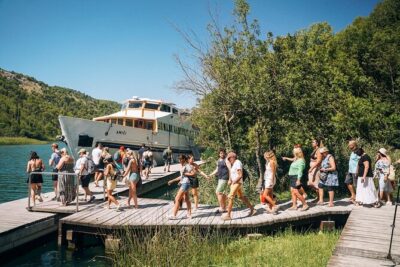
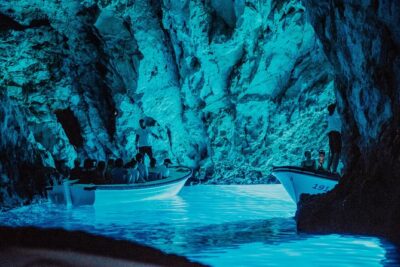
Blue cave, Mamma Mia and Hvar, 5 islands speedboat tour
Read our review →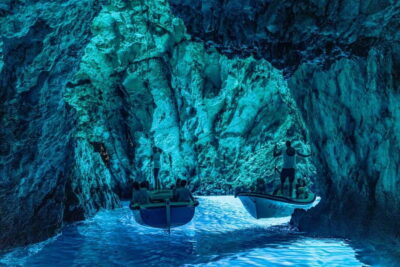
Split/Trogir: Blue Cave, Mamma Mia, Hvar and 5 Island Tour
Read our review →
Blue Lagoon & 3 Islands Cruise with Lunch from Split
Read our review →