Reviewed · SPLIT TOURS
People of Split – meet the locals
Split keeps its Roman life. I like that this private walk goes beyond grand ruins and shows how people still live inside Diocletian’s Palace. I also like the personal touch of Mirjana, a native of Split whose storytelling brings together Roman rule, local customs, old trades, and Croatia’s more recent past.
The main consideration is the short format. At roughly 1 hour 20 minutes to 1 hour 35 minutes, this is an introduction rather than a full city tour. You will see key places, hear plenty of stories, and get local suggestions, but you will not have time to linger at every stop.
In This Review
- Key points to know before booking
- Why this Split walk feels different
- Starting beside the Split sign at Riva Harbor
- Entering the Diocletian’s Palace substructures
- The Peristyle, where imperial Rome meets daily Split
- Dominisova Street and the value of slowing down
- Rubbing Gregory of Nin’s toe
- Pjaca, old trades, and Split’s social life
- The guide’s storytelling is the main value
- Is $258.88 good value for up to eight?
- Who should book this experience?
- Final call: book it for the human side of Split
- FAQ
- Where does the People of Split tour begin?
- Where does the tour end?
- How long does the experience last?
- How many people can join the private tour?
- What language is the tour offered in?
- Is admission included at the listed stops?
- Is the tour near public transportation?
- Can I cancel for a full refund?
Key points to know before booking
- A private walk for up to eight people: Your group gets the guide’s attention without being folded into a large crowd.
- Mirjana leads with stories, not a list of dates: Her approach covers daily life, local culture, Roman Split, and Croatia’s modern past.
- The route stays in and around Diocletian’s Palace: You visit the Riva, the palace substructures, the Peristyle, Dominisova Street, Pjaca, and the Golden Gate.
- Local life is part of the subject: Expect stories about residents, clotheslines, old trades, artisans, markets, and the habit of simply watching Split go by.
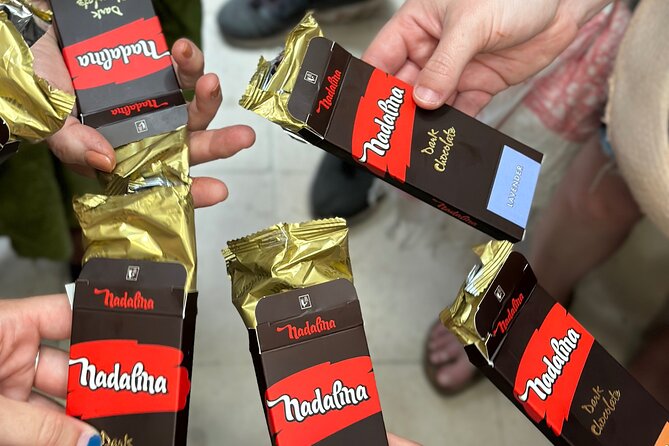
- Snacks and photo advice are included: You get local tasting along with suggestions for good picture spots.
- The price works best for a full group: At $258.88 for up to eight people, the cost is easier to justify when shared among several people.
Why this Split walk feels different
Split is not a museum sealed behind ropes. The old core grew around the palace built for Roman Emperor Diocletian, and people still pass through its lanes, hang laundry from windows, and carry on with ordinary life among ancient walls.
That is the central idea behind People of Split. You still get the famous sights, but the focus shifts from monuments alone to the people and habits that give those monuments meaning. I appreciate that balance. A good guide can explain a column, but a great local guide also explains why a street matters on an ordinary morning.
Mirjana is the guide named for this experience. She is a native of Split and works as both a local guide and a heritage storyteller. The supplied comments about her point to a warm, funny, flexible style. She is praised for adapting to different interests, speaking clearly for larger groups, and making room for questions.
Her storytelling also reaches beyond the Roman period. She has discussed Dalmatian life, traditional crafts, the former Yugoslavia, and the conflicts of the 1990s. That wider view matters because Split is not only an ancient city. It is also a modern Croatian city shaped by family memories, political change, and everyday work.
A few more Split trips worth comparing
- Split: Krka Waterfalls Trip with Boat Cruise and Swimming
★ 4.8 · 10,519 reviews - From Split: Krka Waterfalls, Food & Wine Tasting Tour
★ 5.0 · 9,326 reviews - Blue cave, Mamma Mia and Hvar, 5 islands speedboat tour
★ 5.0 · 7,150 reviews
Starting beside the Split sign at Riva Harbor
The walk begins at the Split sign near Riva Harbor. This gives you an easy visual meeting point and starts the experience with a photo.
Riva is Split’s waterfront promenade, and it is a natural place to get your bearings. From here, the route leads into the old center, where the Roman palace and later city life overlap. The opening stop lasts about 15 minutes and has no admission charge.
I like the photo at the start because it creates a simple marker for the day. It also keeps the opening relaxed. You are not rushing straight into a dense explanation of architecture. Instead, you meet the guide, take a picture, and begin moving through a city that is nearly 1,700 years old.
One practical point: the walk takes place in central Split, so comfortable shoes will help. The supplied details do not promise a completely level route, and old-city streets can require attention underfoot. The route is near public transportation, and most people can participate. Service animals are allowed.
Entering the Diocletian’s Palace substructures
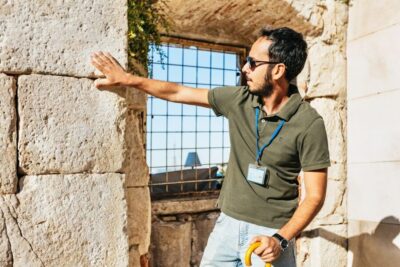
The second stop goes into the substructures of Diocletian’s Palace. This is a short visit of about 10 minutes, but it provides useful context for understanding how the palace was built.
The substructures are part of a 1,700-year-old building still in use today. They also appeared in Game of Thrones, which adds a pop-culture angle for anyone who knows the show. I would treat that as a small bonus, not the main reason to book. The real value is seeing how the lower level helps explain the palace above it.
A short stop here means Mirjana has to choose her details carefully. That is where a strong storyteller helps. Instead of attempting a full architectural lecture, she can connect the space to the emperor, the palace, and modern Split.
The no-ticket format is useful if you want a quick introduction without adding entrance costs. It also keeps the tour moving. If you want a long, detailed examination of the substructures, this experience may feel too brief. If you want a clear first look before exploring on your own, the timing makes sense.
The Peristyle, where imperial Rome meets daily Split
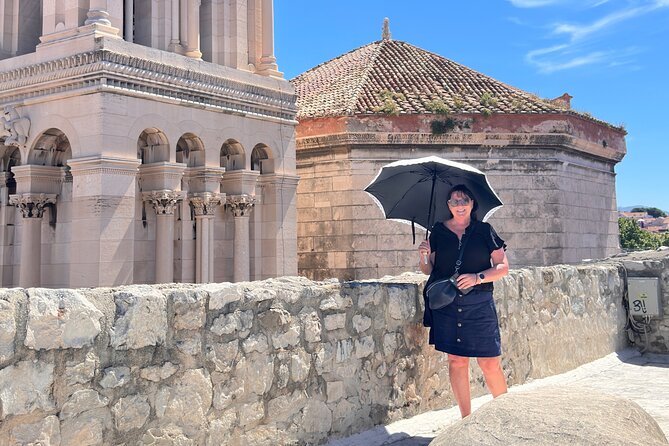
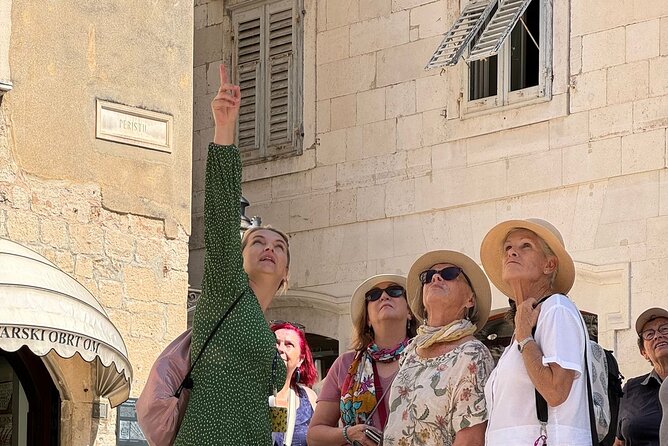
The longest stop is at the Peristyle of Diocletian’s Palace, lasting about 35 minutes. This is the heart of the walk.
Diocletian built the palace in the fourth century as a retirement residence. Today, the Peristyle sits within Split’s active center, where ancient stone and present-day life share the same space. You pause here for photographs, but the point is not just to pose in front of impressive columns.
Mirjana uses the Peristyle to explain myths, legends, and the people connected with the palace. This is also where the walk turns toward local culture. You may visit less obvious corners, sample fresh produce from local vendors, and meet artisans who continue crafts practiced across generations.
That combination is one of the strongest reasons to choose this tour. The ancient setting gives the stories weight, while the local encounters keep the experience from becoming a recital of Roman dates. I especially like the emphasis on supporting the local community through small purchases and contact with craftspeople.
The word local can be used loosely on many city walks. Here, it has a clearer meaning. You are encouraged to notice how residents use the palace, how old trades remain visible, and how food and craft fit into the city’s daily rhythm.
The Peristyle is also the point where the guide’s speaking style matters most. One comment describes Mirjana as someone who brings stories to life with warmth and enthusiasm. Another praises her ability to connect physics and culture with the city’s past. Those details suggest a guide who may offer more than the standard explanation of what you are looking at.
Still Split, at a slower pace:
- From Split: Krka Waterfalls, Food & Wine Tasting Tour
★ 4.9 · 6,598 reviews - Split/Trogir: Blue Cave, Mamma Mia, Hvar and 5 Island Tour
★ 4.6 · 6,320 reviews - Blue Lagoon & 3 Islands Cruise with Lunch from Split
★ 4.5 · 5,756 reviews - Split: Old Town and Diocletian Palace Walking Tour
★ 4.9 · 4,727 reviews
Dominisova Street and the value of slowing down
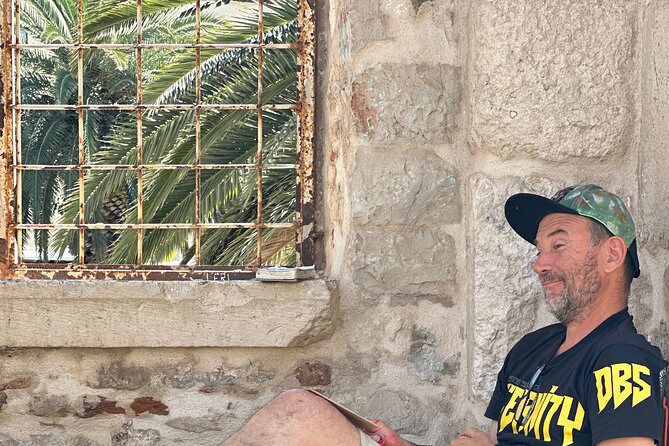
Dominisova ulica gets about 10 minutes. There is no major ticketed sight here. Instead, the activity is walking, looking, and learning how residents inhabit the old center.
Locals lean from windows for fresh air and hang clothes to dry. These small details are easy to miss if you hurry from one famous building to the next. Mirjana uses the street to make a simple point: you understand a place better when you pause and observe the people who live there.
I like this part because it asks you to change your pace. It is not a dramatic stop, and that is exactly why it can be useful. Split’s character is not found only in imperial stone. It is also in windows, laundry, narrow lanes, and the ways residents adapt to life inside an ancient complex.
Still, this stop may not satisfy you if you want a long list of monuments. There is no grand viewpoint or formal attraction here. Its appeal depends on your interest in ordinary life and close observation.
Rubbing Gregory of Nin’s toe
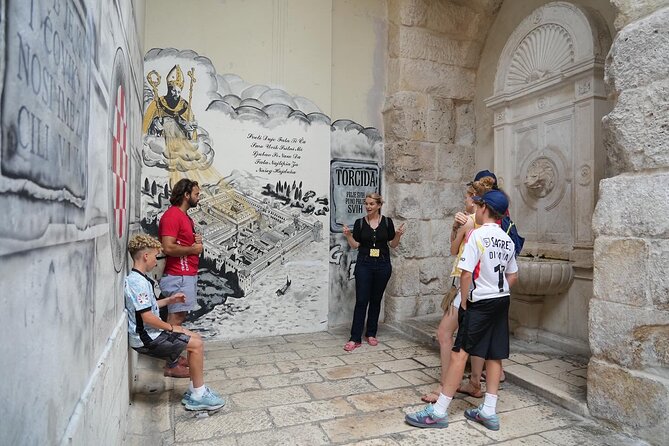
The walk then reaches the statue of Grgur Ninski, or Gregory of Nin. The stop lasts about 10 minutes.
You will hear why the statue is in Split and get the chance to rub one of its toes. The polished toe is a familiar ritual, and it gives the stop a playful edge. It is also a good example of how a guide can connect a public monument with local custom.
I would not expect a long historical treatment from this short pause. The appeal is the story, the tradition, and the photo opportunity. It breaks up the heavier Roman material and gives you something simple to do.
Because the tour is private, you can ask Mirjana to explain the statue in more detail if that topic catches your interest. The experience information does not promise a fixed script, and her reputation for adapting to questions suggests some flexibility.
Pjaca, old trades, and Split’s social life
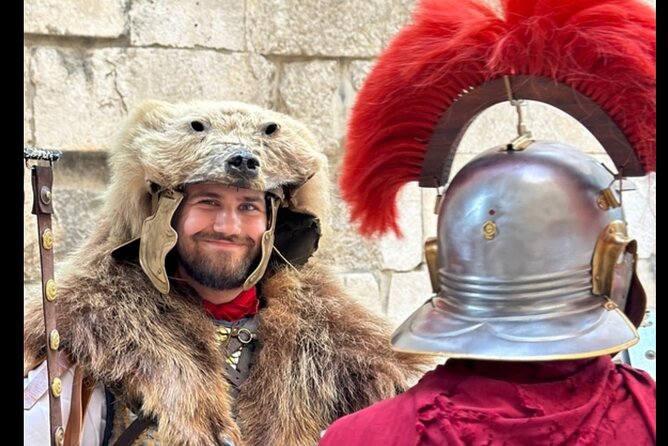
The final listed stop is Narodni Trg, commonly called Pjaca. It is described as the first square built outside the ancient city, and the visit lasts about 10 minutes.
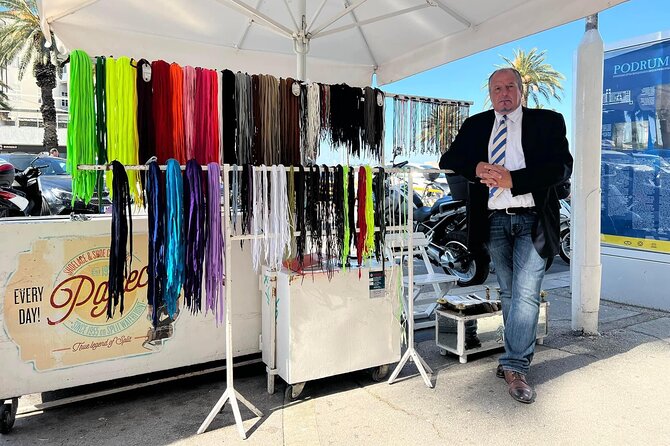
Pjaca is presented as a place for romance, people-watching, activism, daily walks, old trades, and traditional crafts. That range makes it a fitting end to a tour about the people of Split. The palace tells you how the city began, while Pjaca helps show how the city expanded and developed its public life.
You may hear stories about people who met and fell in love here, along with accounts of trades and craftsmen. The square also offers a useful lesson in how public spaces work. A place can be historic without being frozen. People use it for errands, conversations, causes, and routines.
The tour ends at the Golden Gate on Dioklecijanova 7. That is a practical finish because the gate is a major landmark and a useful point from which to continue exploring the old center. The listed hours for the Golden Gate are 8:00 a.m. to 6:00 p.m. daily for the stated operating period, though the walk itself is a guided outdoor experience with free admission at the listed stops.
The guide’s storytelling is the main value
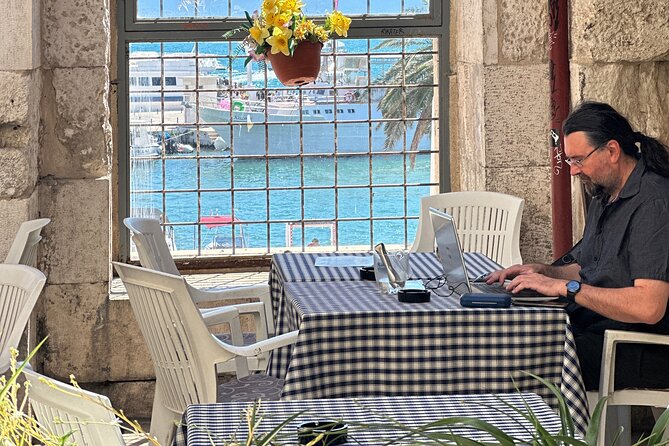
The strongest feature here is not the number of stops. It is the way the guide connects them.
Mirjana’s approach is repeatedly described as personal, warm, funny, and passionate. She is praised for listening to what people want to know rather than forcing every group through the same speech. That matters on a private tour, especially when one person wants Roman architecture and another wants local customs or recent Croatian history.
Her English is described as very strong, and she has been praised for speaking clearly enough for a large group. Since the experience is offered in English, that reassurance is useful. Still, your enjoyment will depend partly on how much you like story-based guiding. If you prefer a strict lecture packed with dates and architectural labels, this may not be your ideal format.
The comments also point to a longer version of a walk with Mirjana lasting two hours, while this experience is advertised at about 80 to 95 minutes. I would use that as a guide to her range, not as a promise that this particular booking will last two hours. The stated time is short and should be treated as fixed for planning purposes.
Is $258.88 good value for up to eight?
The price is $258.88 per group, with up to eight people included. That works out to about $32.36 per person if you fill all eight places. For four people, it is about $64.72 each. For two, it is about $129.44 each.
That makes the group size important. I see good value here for a family or group of friends that wants a private introduction to Split and can share the cost. The guide’s ability to respond to your interests is more useful when you are not competing with a large crowd.
For one or two people, the price is harder to justify based only on the short duration. You are paying for a private guide, a native perspective, heritage interpretation, snacks, and photo suggestions rather than for admission to a major paid site. The listed stops have no admission charge, so the value rests almost entirely on the storytelling and local access.
I would book it early in a Split visit if you want help understanding the old center. The route can give you ideas for where to return, what to photograph, and which local details deserve a second look.
Who should book this experience?
I would recommend it to you if you want:
- A private walk with only your own group
- A native guide who can discuss both old and recent Croatian life
- Stories about residents, customs, crafts, and daily routines
- A short orientation to Diocletian’s Palace
- Local snacks and suggestions for good photo locations
- A guide who can adapt the conversation to your questions
It suits first-time visitors especially well because the route covers several essential places without taking half a day. It can also work for repeat visitors who have seen the Peristyle but want more insight into life around it.
I would hesitate if you want extensive time inside each site, a long archaeological explanation, or a tour built around paid museum admission. The schedule is compact, and some stops last only 10 minutes.
The experience is wheelchair and mobility-device dependent in ways the supplied information does not explain, so ask before booking if you need detailed route information. It is near public transportation, service animals are allowed, and most people can participate.
Final call: book it for the human side of Split
Book People of Split if you want Split explained through people as much as through stones. The itinerary covers the main old-center sights, but its real purpose is to show you windows, laundry, crafts, food, public squares, local rituals, and the stories that connect them.
Mirjana appears to be the key reason to choose this walk. Her mix of Roman history, Dalmatian culture, Croatian memory, and everyday observation gives the experience more personality than a standard monument tour.
For a full group, the price is sensible. For a couple, it is a larger purchase for a short walk, so you should value private guiding and personal storytelling before booking. If that sounds like your kind of travel, this is a friendly, focused way to meet Split beyond its postcard views.
FAQ
Where does the People of Split tour begin?
It begins at the Split sign at Riva Harbor, 21000, Grad, Split, Croatia.
Where does the tour end?
The tour ends at the Golden Gate at Dioklecijanova 7, 21000, Split, Croatia.
How long does the experience last?
The approximate duration is 1 hour 20 minutes to 1 hour 35 minutes.
How many people can join the private tour?
The price covers one private group of up to eight people.
What language is the tour offered in?
The experience is offered in English.
Is admission included at the listed stops?
The listed stops show free admission. The experience includes a heritage interpretation guide, a local guide, photo spot suggestions, and snacks.
Is the tour near public transportation?
Yes. The supplied information states that the experience is near public transportation.
Can I cancel for a full refund?
Yes. You can cancel at least 24 hours before the experience start time for a full refund. Cancellations or changes made less than 24 hours before the start time are not accepted for a refund.
Just added around Split
- Walking Tour Split★ 4.7 · 61 reviews
- Unique vintage Tomos moped tour Split – Back to the ’80s★ 4.8 · 17 reviews
- Trogir: White Lagoon, Maslinica & Blue Lagoon Speedboat Tour★ 4.8 · 11 reviews
- Essential Diocletian’s Palace Tour for First-Time Visitors★ 4.8 · 19 reviews
- Split: Trogir Open Top Bus Trip + Free Split Walking Tour★ 4.1 · 17 reviews
- Trogir; Private walking tour of higlights of Trogir★ 4.7 · 3 reviews
- Trogir: Old Town Guided Walking Tour★ 4.6 · 76 reviews
- Trogir: Blue Lagoon, Maslinica, and Solinska Bay Boat Tour★ 4.9 · 88 reviews
Split Tours, compared.

Krka Waterfalls Trip with Boat Cruise and Swimming
Read our review →

Blue cave, Mamma Mia and Hvar, 5 islands speedboat tour
Read our review →
Split/Trogir: Blue Cave, Mamma Mia, Hvar and 5 Island Tour
Read our review →
Blue Lagoon & 3 Islands Cruise with Lunch from Split
Read our review →