Reviewed · SPLIT TOURS
Nocturnal Tours Trogir & Split – Soul of the Old Split Tour
Split changes after dark. The stone lanes grow quieter, lantern light softens the palace walls, and old stories take center stage. I like the small group of no more than eight people, which should make it easier to hear the guide and ask questions. I also like the route’s unusual mix of Roman history, local characters, cinema, harbor life, and a famous love story. The main consideration is timing: at about 80 minutes, this is a focused introduction rather than a full historical tour.
The $28.90 price feels fair if you want an evening orientation with a strong storytelling element. The experience has earned a 4.8 rating from 10 reviews, with 90 percent of participants recommending it. Still, the tour depends on good weather, and the late 9 p.m. start may not suit families with young children or anyone who prefers daytime sightseeing.
In This Review
- Key details before you book
- Why a night walk suits Split
- Starting at Diocletian’s Palace
- People’s Square and the city’s social side
- The Grgur Ninski Statue and a quick art stop
- Riva Harbor, where Split performs itself
- Kino Karaman, a surprising piece of cinema history
- Matejuška and the story of Roko and Cicibela
- What the guide brings to the experience
- Is $28.90 a good value?
- Who should book this evening walk?
- Should you book Soul of the Old Split?
- FAQ
- How long does the Soul of the Old Split Tour last?
- What time does the tour start?
- Where does the tour begin?
- Where does the tour end?
- How many people can join the tour?
- Is the tour offered in English?
- What happens if bad weather cancels the tour?
Key details before you book
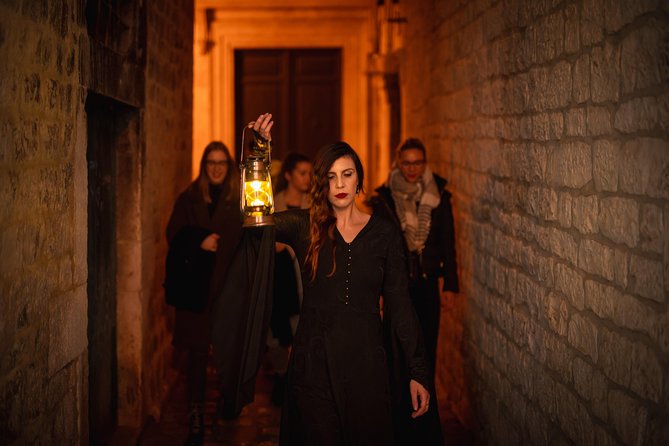
- Lantern-lit Split: See the old center after sunset, when the palace lanes take on a quieter mood.
- Six compact stops: The route covers Diocletian’s Palace, People’s Square, the Grgur Ninski Statue, Riva Harbor, Kino Karaman, and Matejuška.
- Strong storytelling: The guide brings out unusual tales, including Split humor and the tragic love story of Roko and Cicibela.
- Small-group format: A maximum of eight people gives this walk a personal feel.
- Easy city-center route: The walk begins at Hrvojeva 4 and ends at Pharmacy Matejuška on Trumbićeva obala.
- Short evening commitment: The tour lasts about 1 hour and 20 minutes, making it easy to fit around dinner or other plans.
Why a night walk suits Split
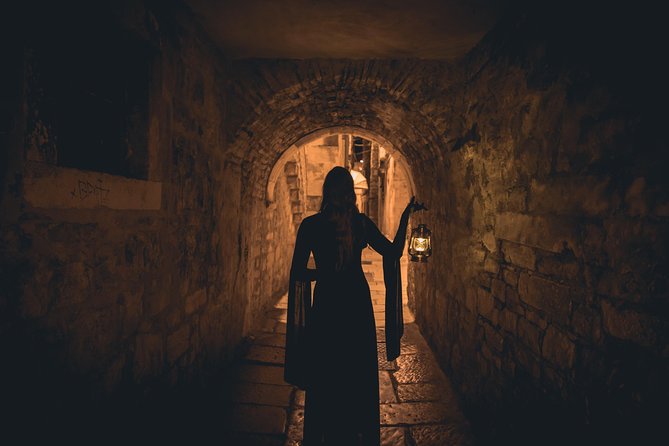
Split’s center is not a museum district sealed off from daily life. People live, work, eat, meet, and pass through the lanes built into Diocletian’s Palace. At night, you get a different sense of that overlap. The palace becomes less about checking off monuments and more about listening to stories in the spaces where the city still functions.
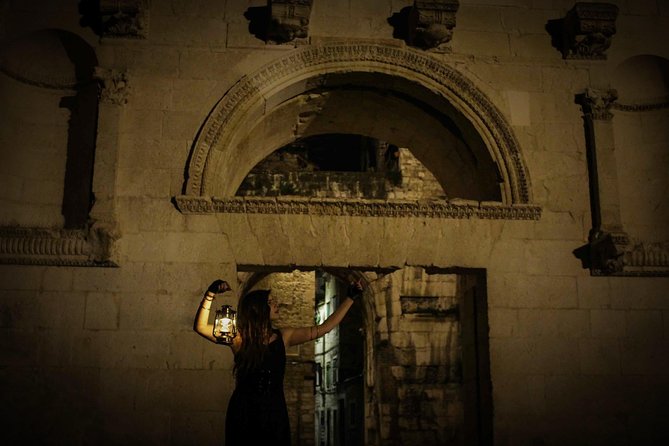
The lantern-lit approach is a good match for the subject. Diocletian’s life and death remain surrounded by mystery, and the evening setting gives the guide room to present the emperor as a complicated figure rather than a simple Roman hero. You can expect a mix of history, local tales, and character sketches instead of a lecture packed with dates.
I particularly like the route’s scale. Six stops in 80 minutes means the guide can keep the pace moving while still giving each place a reason to matter. You are not asked to spend half the night standing in one square, but you also get more than a quick walk past the palace walls.
A few more Split trips worth comparing
- Split: Krka Waterfalls Trip with Boat Cruise and Swimming
★ 4.8 · 10,519 reviews - From Split: Krka Waterfalls, Food & Wine Tasting Tour
★ 5.0 · 9,326 reviews - Blue cave, Mamma Mia and Hvar, 5 islands speedboat tour
★ 5.0 · 7,150 reviews
Starting at Diocletian’s Palace
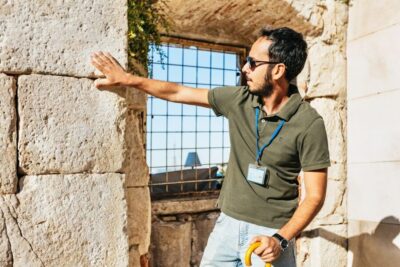
The tour begins at Hrvojeva 4 at 9 p.m., close to the heart of Split’s old town. This is the right place to start because the city’s story is tied directly to Diocletian’s Palace. The palace is not simply a grand ruin at the edge of town. Its walls, passageways, and buildings form the setting for much of central Split.
The first stop lasts about 30 minutes, making it the longest section of the walk. That tells you where the emphasis lies. The guide will focus on Emperor Diocletian, whose reputation remains controversial and whose final years and death are not fully clear.
This is valuable for first-time visitors because the palace can feel like a maze. A good explanation helps you understand why the old town has such an unusual layout and why Roman structures appear alongside later buildings. You should leave this part with a clearer sense of how Split grew around the palace instead of merely around it.
There is no separate admission charge for this stop. You are exploring public areas as part of the walking tour, so the price goes toward the guide’s time, route planning, and storytelling rather than a museum ticket. If you want detailed archaeological access or interior visits, this walk may not go far enough. Its strength is context and atmosphere.
People’s Square and the city’s social side
From the palace, the route continues to Narodni Trg, or People’s Square. The stop lasts about 10 minutes. This square served as Split’s main meeting place from ancient times through the 1970s, which gives the guide a chance to move from imperial history to everyday city life.
I like this change of subject. A city is not only shaped by rulers and monuments. It is also shaped by where people meet, argue, celebrate, and watch one another. The stories connected with the square focus on notable local figures and strong personalities who left their mark there.
You may find this part especially useful if you want to understand Split beyond its Roman remains. The palace explains the city’s physical framework, while People’s Square helps explain its social habits. Ten minutes is brief, but it keeps the walk lively and prevents the tour from becoming too heavy.
The Grgur Ninski Statue and a quick art stop
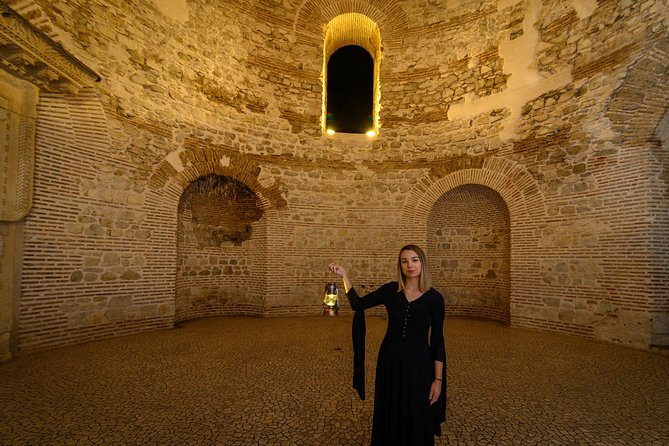
The next pause is at the 8.5-meter statue of Grgur Ninski, created by Ivan Meštrović, Croatia’s most important sculptor. The stop lasts about five minutes, so this is a short visual break rather than a full art discussion.
The statue is memorable simply because of its size and presence. A guide can also give the monument a place within Croatian cultural identity and explain why Meštrović matters. Since the walk is conducted in English, you can expect the essential story in a form that is easy to follow without spending too much time away from the main route.
Five minutes is enough to see the statue and hear its key context. It is not enough for a detailed study of Meštrović’s career, so art lovers may want to explore his work separately. For this tour, the stop works as a compact introduction.
Still Split, at a slower pace:
- From Split: Krka Waterfalls, Food & Wine Tasting Tour
★ 4.9 · 6,598 reviews - Split/Trogir: Blue Cave, Mamma Mia, Hvar and 5 Island Tour
★ 4.6 · 6,320 reviews - Blue Lagoon & 3 Islands Cruise with Lunch from Split
★ 4.5 · 5,756 reviews - Split: Old Town and Diocletian Palace Walking Tour
★ 4.9 · 4,727 reviews
Riva Harbor, where Split performs itself
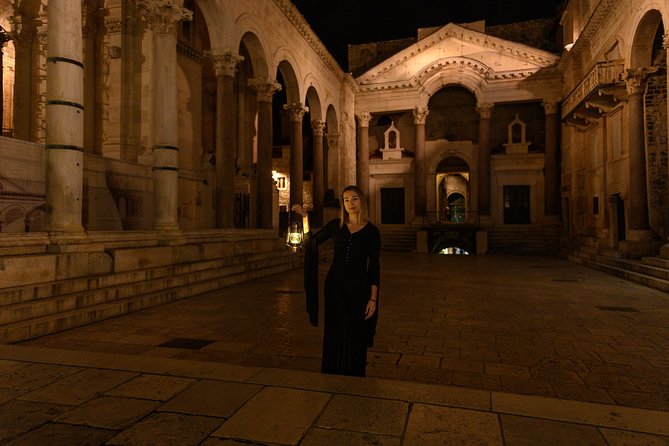
The walk then reaches Riva Harbor, Split’s waterfront promenade. The stop lasts about 10 minutes. Riva is described as a kind of mirror for the city, and that is a useful way to think about it. The waterfront reflects local habits, humor, social life, and public drama.
Here the storytelling turns toward laughter, Split’s particular sense of humor, and the city’s greatest love tragedy. That blend sounds more personal and local than a standard sightseeing script. You are not just hearing what a building was used for. You are hearing how the city sees itself.
The waterfront also provides a change of scenery after the enclosed palace lanes. I would pay attention to the contrast: stone passages create a feeling of time layered upon time, while the Riva opens the view and gives the story a public stage.
Because this is an evening walk, the promenade may be one of the more atmospheric sections. At the same time, the tour does not promise a long waterfront visit. Ten minutes is enough for stories and orientation, not a leisurely stop for a drink or extended photography.
Kino Karaman, a surprising piece of cinema history
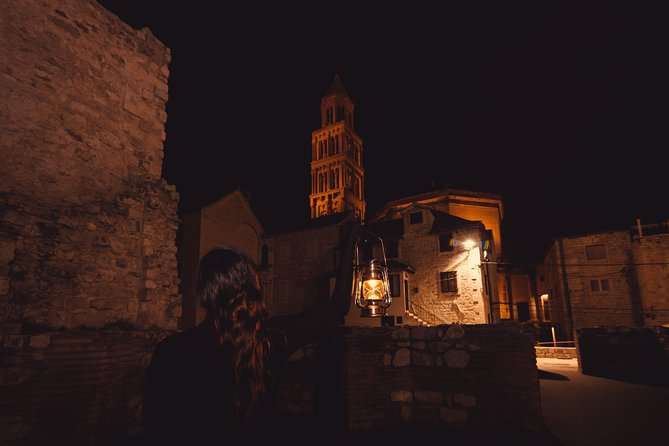
Kino Karaman receives only five minutes, but it may be the most unexpected stop. It is identified as the oldest cinema in Split and the oldest cinema in all of Europe. That claim gives the walk a welcome turn away from the usual Roman and medieval subjects.
This stop shows why the tour is more than a standard palace circuit. Split’s identity includes entertainment, public gathering places, and modern city life, not just ancient stone. A short explanation here can also help you notice how much history is packed into a small area.
Do not expect a film screening or a long visit inside the cinema. The stop is brief and works mainly as a story point along the route. Still, if you enjoy unusual facts, it may be one of the details you remember afterward.
Matejuška and the story of Roko and Cicibela
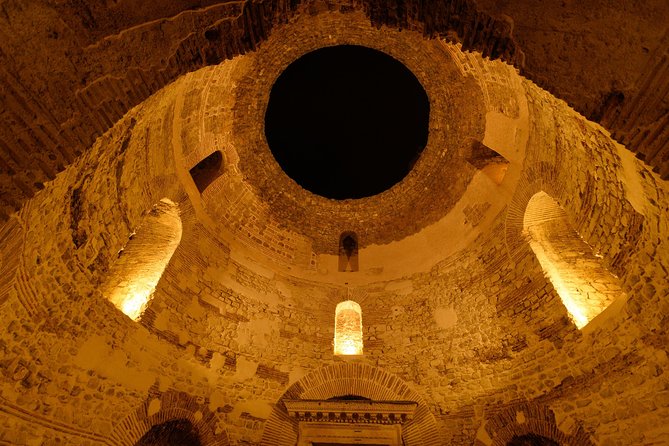
The final stop is Matejuška, the old fishermen’s port. The tour ends at Pharmacy Matejuška, Pharmacy Split Riva, Trumbićeva obala 16. This gives the walk a clear progression from the imperial palace to the working harbor.
Matejuška is tied to the beloved local love story of Roko and Cicibela. The story adds emotional weight to the final section and brings the tour back to ordinary people rather than emperors, sculptors, or public squares.
I like ending here. The route does not finish at the most famous monument and leave you with a postcard view. It finishes in a part of Split associated with fishermen and local memory. That choice supports the tour’s promise to show the city through stories, not just through grand architecture.
The end point can also be practical. You finish near the Riva and Matejuška area, where you can continue your evening on foot. The information provided does not specify restaurant recommendations or the exact distance from the final stop to your accommodation, so plan your return independently.
What the guide brings to the experience
The strongest praise goes to the storytelling. One review describes the guide as a fantastic storyteller who shared tales that might not appear on other tours. That is the clearest clue about the experience’s personality. The value is not only in reaching each stop. It is in hearing local stories presented with warmth and humor.
The guide’s response also suggests genuine affection for Split. That matters on a night walk, where tone and delivery can shape the whole experience. A dry list of facts would not make much use of the lantern setting. This tour appears designed around narrative, personality, and the feeling that the city’s past still has a voice.
Another review praises the tour as entertaining, enjoyable, safe during the Covid period, and beautiful in its setting. The safety comment refers to that particular period and should not be treated as a current operating guarantee. Still, it reinforces the impression of a carefully managed small-group activity.
The guide’s name is not provided, so I cannot tell you who will lead your specific departure. What you can count on is an English-language experience and a maximum group size of eight.
Is $28.90 a good value?
At $28.90 per person, this is not the cheapest way to walk through Split. You can see much of the old town without paying anything, and every listed stop has free admission. The question is not access to the streets. It is the value of having someone connect them through stories.
For that price, you receive about 80 minutes with an English-speaking guide, a planned route through six locations, and a group capped at eight people. That is a reasonable deal if you prefer a personal introduction and do not want to research Diocletian, Meštrović, Riva, and Matejuška on your own.
The value is weaker if you mainly want photographs or a long, relaxed walk. The schedule is fairly tight, and the tour does not include paid entrances, food, drinks, or transportation. You are paying for interpretation and company, not extras.
I would see it as a first-evening orientation. Afterward, you can return to the palace or waterfront with a better idea of what you are seeing. It also works well for someone who has only one night in Split and wants a compact introduction after dinner.
Who should book this evening walk?
I would recommend it to:
- First-time visitors who want a clear introduction to central Split
- People who enjoy legends, local personalities, humor, and unusual city stories
- Couples interested in the Roko and Cicibela love story
- Solo visitors who prefer a small group instead of exploring alone
- History fans who want Diocletian placed in a local setting
- Anyone who likes an evening activity lasting less than 90 minutes
I would think twice if you need a fully accessible route, since the information only says most people can participate and does not provide detailed surface or step information. Service animals are allowed, and the meeting point is near public transportation, but the route’s precise walking conditions are not specified.
The 9 p.m. start is another practical issue. It is excellent for an atmospheric night walk, but it may be too late for some children. The tour also requires good weather and a minimum number of participants. If poor weather or insufficient participation cancels the experience, you can choose another date or receive a full refund.
Free cancellation is available up to 24 hours before the start time. Cancellations or changes made less than 24 hours before departure are not refunded or accepted, so keep that deadline in mind.
Should you book Soul of the Old Split?
Book this tour if you want stories with your sightseeing, not simply a list of monuments. The small group, lantern-lit setting, and route from Diocletian’s Palace to Matejuška give the evening a clear sense of place. The 4.8 rating and 90 percent recommendation rate support the idea that the guide’s delivery is the tour’s strongest feature.
Skip it if you want museum interiors, long stops, or a detailed archaeological lecture. For everyone else, $28.90 is a sensible price for a short, personal introduction to Split, especially at the start of a visit. The best reason to choose it is simple: you finish not only knowing where Split’s main old-town landmarks are, but also why the city remembers them.
FAQ
How long does the Soul of the Old Split Tour last?
The tour lasts approximately 1 hour and 20 minutes.
What time does the tour start?
The scheduled start time is 9 p.m.
Where does the tour begin?
The meeting point is Hrvojeva 4, 21000 Split, Croatia.
Where does the tour end?
The tour ends at Pharmacy Matejuška, Pharmacy Split Riva, Trumbićeva obala 16, 21000 Split, Croatia.
How many people can join the tour?
The group has a maximum of eight people.
Is the tour offered in English?
Yes. The tour is offered in English.
What happens if bad weather cancels the tour?
If poor weather causes a cancellation, you will be offered a different date or a full refund.
Just added around Split
- Walking Tour Split★ 4.7 · 61 reviews
- Unique vintage Tomos moped tour Split – Back to the ’80s★ 4.8 · 17 reviews
- Trogir: White Lagoon, Maslinica & Blue Lagoon Speedboat Tour★ 4.8 · 11 reviews
- Essential Diocletian’s Palace Tour for First-Time Visitors★ 4.8 · 19 reviews
- Split: Trogir Open Top Bus Trip + Free Split Walking Tour★ 4.1 · 17 reviews
- Trogir; Private walking tour of higlights of Trogir★ 4.7 · 3 reviews
- Trogir: Old Town Guided Walking Tour★ 4.6 · 76 reviews
- Trogir 1.5-Hour City Tour★ 4.4 · 37 reviews
Split Tours, compared.

Krka Waterfalls Trip with Boat Cruise and Swimming
Read our review →

Blue cave, Mamma Mia and Hvar, 5 islands speedboat tour
Read our review →
Split/Trogir: Blue Cave, Mamma Mia, Hvar and 5 Island Tour
Read our review →
Blue Lagoon & 3 Islands Cruise with Lunch from Split
Read our review →