Reviewed · SPLIT TOURS
Experience Split With Local Professional Historian – Small Group
Split makes more sense once you know its layers. This two-hour walking tour links Roman ruins, Christian landmarks, medieval squares, and modern local life with Boris, a licensed guide who has a master’s degree in history and grew up in Split. I especially like the small maximum of 12 people, which makes it easier to hear, ask questions, and keep the tour conversational. I also like the picture book with 3D reconstructions, a useful aid when you are trying to picture the palace before later buildings filled its spaces.
The main consideration is that the tour covers a lot in roughly two hours, so several major sights are viewed from outside. Admission tickets are not included, and the tour does not try to provide a full interior visit to the cathedral, Jupiter’s Temple, or every section of the palace. Still, at $38.62 per person, it offers a strong introduction for first-time visitors who want context before exploring on their own.
In This Review
- Key Things to Know Before Booking
- Why This Small Group Walk Works
- Meeting the Palace at the Golden Gate
- Gregory of Nin and a Lesson in Public Memory
- Diocletian’s Palace, From Imperial Residence to City Block
- The Peristyle and the Emperor’s Public Theater
- Cellars, the Triclinium, and Roman Dining
- Jupiter’s Temple and the Cathedral of Saint Domnius
- Vestibulum and the Emperor’s Private World
- Riva Harbor and Split’s Everyday Rhythm
- Fruit’s Square and People’s Square
- Price, Timing, and Group Size
- Who Will Get the Most From This Tour?
- Should You Book Experience Split?
- FAQ
- How long does the Experience Split walking tour last?
- What language is the tour offered in?
- What is the maximum group size?
- Where does the tour begin?
- Where does the tour end?
- Are admission tickets included?
- What is included in the tour?
- Can I cancel for a full refund?
Key Things to Know Before Booking
- Boris brings history into the present: His teaching background and personal stories about Split help connect Roman architecture with daily life in the city today.
- The group stays small: With no more than 12 people, you should have a better chance of hearing the guide and asking questions than on a large city walk.
- The 3D images are genuinely useful: The display book helps you picture the original palace layout and understand how later buildings changed it.
- The route covers Split’s main historic core: You visit the Golden Gate, Peristyle, Temple of Jupiter, Cathedral of Saint Domnius, Vestibulum, Riva, Fruit’s Square, and Pjaca.
- It is more than a Roman history lesson: The walk includes the palace’s change into a medieval city, local customs, regional issues, restaurants, coffee shops, and practical ideas for the rest of your stay.
- The finish is useful for planning: The tour ends at People’s Square, where Boris suggests additional places to visit.
Why This Small Group Walk Works
Diocletian’s Palace is not an isolated ruin behind a fence. It is woven into the center of Split, with homes, shops, cafés, lanes, churches, and public squares occupying the old Roman complex. Without a guide, you can see impressive stonework and still miss how the place changed from an imperial residence into a living city.
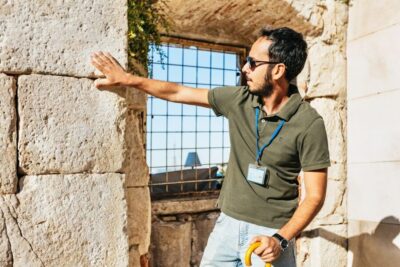
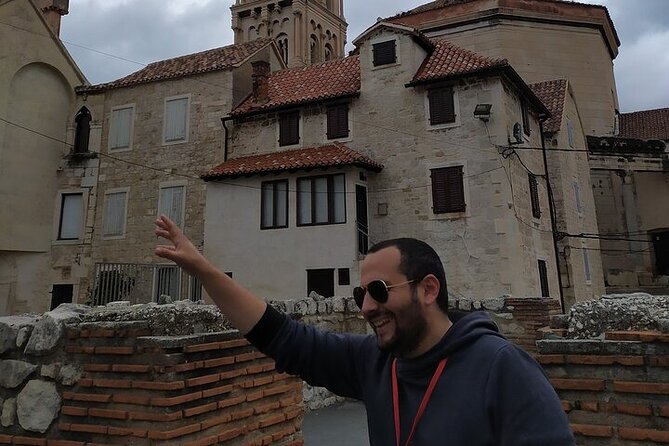
That is the real value here. Boris does not only point out old walls. He explains why the palace was built, how its spaces worked, and what happened after the Roman period. His former work as a history teacher comes through in the way he asks questions, includes children and teenagers, and makes room for conversation rather than delivering a hurried speech.
The tour has received a 5 out of 5 rating from 86 reviews, with 99 percent of participants recommending it. Those numbers point to a clear strength: the guide’s delivery. The repeated praise is not just for facts about the palace. Boris is described as friendly, funny, patient, fluent in English, and willing to discuss Croatia’s regional differences and present-day culture.
That matters because Roman architecture can become a blur after the third column. Personal stories and local advice give the walk a human scale. Boris has also helped people with photographs and suggested places for ice cream, coffee, meals, shops, and further sightseeing.
A few more Split trips worth comparing
- Split: Krka Waterfalls Trip with Boat Cruise and Swimming
★ 4.8 · 10,519 reviews - From Split: Krka Waterfalls, Food & Wine Tasting Tour
★ 5.0 · 9,326 reviews - Blue cave, Mamma Mia and Hvar, 5 islands speedboat tour
★ 5.0 · 7,150 reviews
Meeting the Palace at the Golden Gate
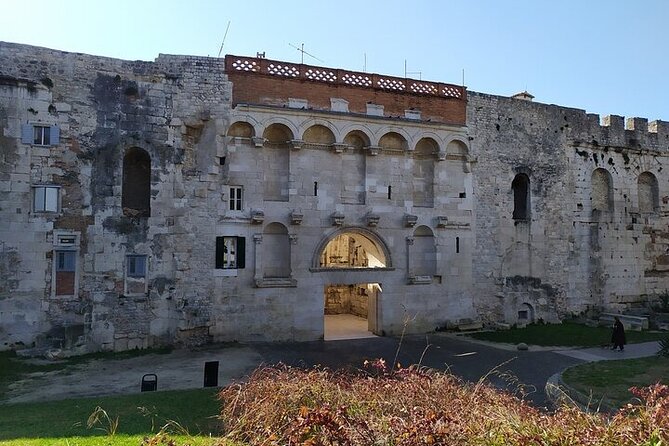
The walk begins at the Golden Gate on Dioklecijanova 7, the northern entrance to Diocletian’s Palace. The name sounds grander than the material: the gate is made of stone, not gold. It is one of Split’s best-known meeting points and faces the statue of Gregory of Nin.
This is a sensible opening because it introduces both the Roman palace and the later city at once. Boris explains the importance of the gate and gives you the basic story of Split before the route moves farther inside. You begin to understand that the palace was not simply a country retreat. It was a fortified imperial residence with organized entrances and carefully planned public and private areas.
The Golden Gate is also a practical place to begin because it gives you a clear landmark in the old center. Admission is free at this stop. Arrive ready to walk and listen in a busy historic area, since the route continues through streets and open squares rather than indoor galleries.
Gregory of Nin and a Lesson in Public Memory
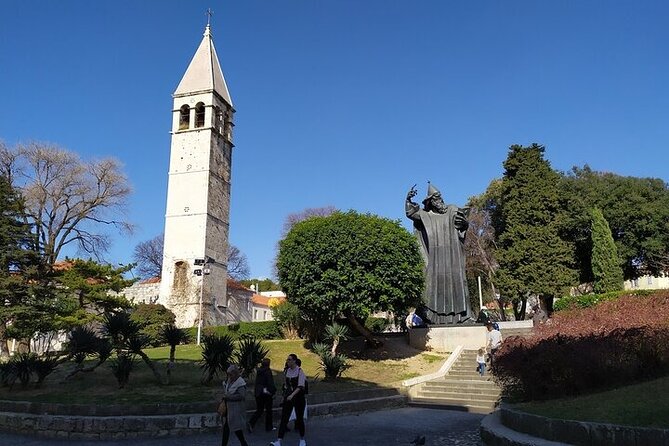
The nearby statue of Grgur Ninski, or Gregory of Nin, brings the tour into Croatia’s medieval and national story. Boris explains the historical figure, the monument’s importance, and the work of its sculptor.
This stop is brief, but it adds useful contrast. You move from imperial Rome to a later Croatian figure whose statue has become part of Split’s everyday visual identity. The monument is also a good reminder that a city’s meaning is not fixed in the period when its oldest buildings were constructed.
Boris’s use of pictures and reconstructed images makes this part more than a quick photo stop. The visual material helps you connect a surviving monument with what is no longer visible. If you enjoy history but find dates and names hard to retain, this approach should make the information easier to follow.
Diocletian’s Palace, From Imperial Residence to City Block
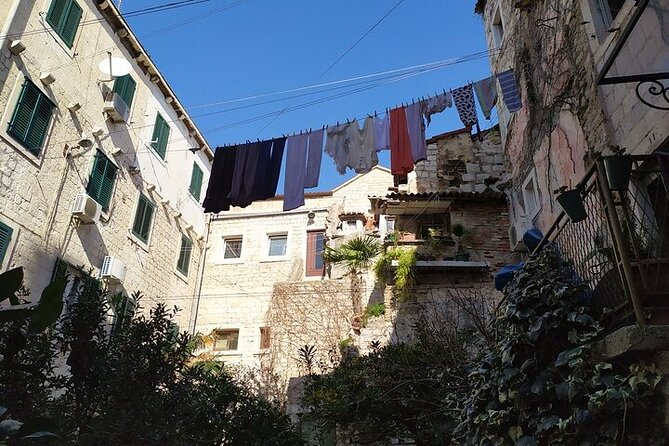
Inside the palace, Boris covers the emperor Diocletian, the major parts of the complex, and the way the Roman residence changed into a medieval city. You see the Peristyle, Jupiter’s Temple from outside, the central section of the cellars, the Triclinium, and the exterior of the cathedral, once the imperial mausoleum.
The most valuable part is the explanation of change over time. A Roman building may now contain a church, a shop, or a private doorway, and that mixture can be confusing. Boris explains how Christianity affected the palace and how later residents adapted old structures for new purposes.
You should expect an overview rather than a close examination of every room. One useful feature is his display book, which includes pictures and 3D reconstructions. These images help show how the original palace may have looked and how its spaces related to one another.
The tour does not include admission tickets, so the focus is on outdoor areas and selected views. If you want to enter paid sections afterward, Boris points out details worth noticing inside the cathedral and other sights. That makes this walk a good first step, but not a substitute for a full archaeological or museum visit.
Still Split, at a slower pace:
- From Split: Krka Waterfalls, Food & Wine Tasting Tour
★ 4.9 · 6,598 reviews - Split/Trogir: Blue Cave, Mamma Mia, Hvar and 5 Island Tour
★ 4.6 · 6,320 reviews - Blue Lagoon & 3 Islands Cruise with Lunch from Split
★ 4.5 · 5,756 reviews - Split: Old Town and Diocletian Palace Walking Tour
★ 4.9 · 4,727 reviews
The Peristyle and the Emperor’s Public Theater
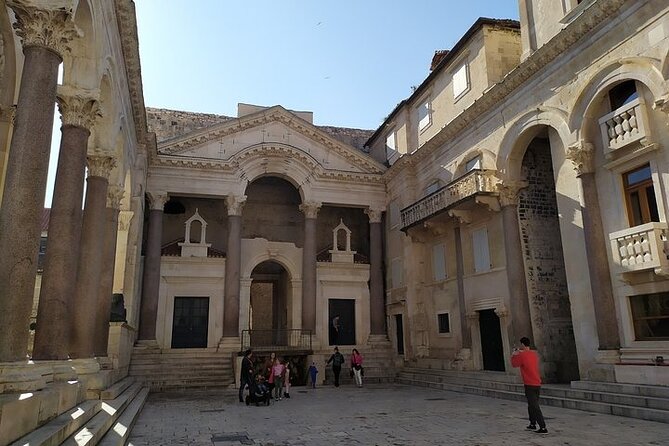
The Peristyle is the central space of the palace and one of the most memorable stops. Here Boris explains its function and importance, including the way it connected people with the emperor while also separating them from him.
That idea helps you read the architecture. The columns and open court were not only decorative. They shaped movement, ceremony, and access. From the center, you can look around and begin to picture how the palace operated as both a residence and a political setting.
Boris also explains how the buildings and patterns of life changed after the spread of Christianity. This is where the walk’s broad time range pays off. You are not left with a snapshot of one Roman emperor. You see how religious change and later settlement altered the meaning of the same spaces.
The Peristyle can be crowded and visually overwhelming. A small group helps, but you may still need to stay close to Boris and listen carefully. The benefit is that the guide can respond to questions instead of simply moving the group from one landmark to the next.
Cellars, the Triclinium, and Roman Dining
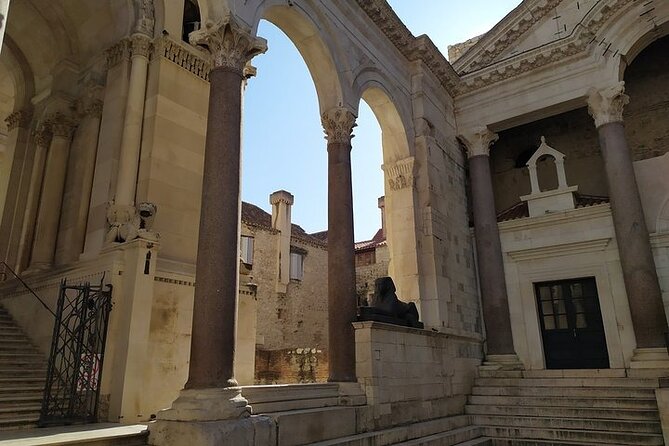
From the Peristyle, the route enters the central part of Diocletian’s cellars, also called the central substructure. Boris discusses how these spaces were used through history and why they matter to Split today.
The cellars are especially helpful for understanding the palace plan. Their layout preserves clues about the structure above, giving you a better sense of the emperor’s private quarters and the engineering behind them. You also hear about the Triclinium, the dining room connected with Roman eating habits and imperial entertaining.
This is one of the places where the visual reconstructions can do real work. Empty or altered rooms rarely explain themselves. A picture showing the earlier arrangement can turn a pile of stone into a readable part of the palace.
The cellar visit is relatively short, so do not expect a lengthy archaeological lecture. You get the larger picture, then can return independently if you want more time with the preserved structures.
Jupiter’s Temple and the Cathedral of Saint Domnius
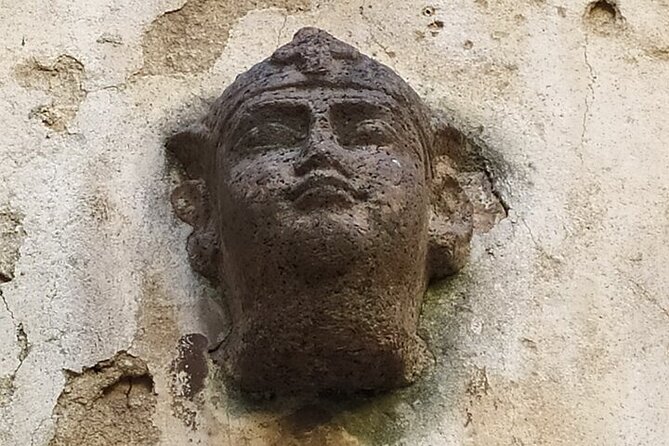
At Jupiter’s Temple, Boris explains the role of religion in the Roman Empire and the purpose of this particular temple. The visit is from outside, which keeps the walk moving but means you will not receive a full interior account.
The exterior stop becomes more meaningful when paired with the Cathedral of Saint Domnius. The cathedral occupies what was originally Diocletian’s mausoleum, a striking example of how later Christian Split reused an imperial Roman structure.
Boris points out significant parts of the cathedral and explains its story. He also alerts you to details inside, should you decide to buy admission and visit independently after the walk. This is practical guidance: you get an introduction without paying for an entrance you may not have planned to use.
If religious interiors are a priority, set aside extra time after the tour. The walk gives you the framework, but the outside explanation is not meant to replace a full visit.
Vestibulum and the Emperor’s Private World

The Vestibulum was the pre-entrance to Diocletian’s private chambers. Boris explains its function and the way its decoration reflected its importance.
This stop helps separate the palace’s public and private sides. The Peristyle represented ceremony and access. The Vestibulum led toward the emperor’s personal quarters, so its design carried a different purpose and message.
It is a compact stop, but it fits neatly into the overall explanation of how the palace worked. You are not just collecting monuments. You are learning how people moved through the complex and how architecture communicated rank.
Riva Harbor and Split’s Everyday Rhythm
The route then leaves the palace core for Riva, Split’s main waterfront promenade. Boris explains how Riva developed over the centuries and why it became such an important place for local life.
This is a welcome change of scale. After Roman gates, temples, and imperial rooms, the harbor shows you how Split functions as a present-day city. The waterfront is not presented as decoration alone. It is tied to how residents meet, walk, and use the center.
The stop is short, so treat it as a local orientation rather than a detailed harbor tour. It also gives Boris a natural chance to discuss the city beyond its ancient walls.
Fruit’s Square and People’s Square
Fruit’s Square, officially Trg Braće Radić, is small and attractive. Boris explains why it has that name, identifies the important monument in its center, and points out notable buildings around the square.
This stop rewards visitors who might otherwise hurry through. Small squares often reveal more about a city’s daily character than famous monuments do, and Boris uses the space to connect architecture with local use.
The walk ends at People’s Square, known locally as Pjaca. It has served as a center of city activity from medieval times to today. Boris discusses the square’s story, its surrounding buildings, and the old City Hall before recommending other places to see in Split.
Ending here is useful. You finish in a central part of town, with suggestions for continuing your day rather than being left at an arbitrary landmark. Several reviews praise Boris’s recommendations for restaurants, coffee, shops, and activities, and one person followed his advice during the same visit.
Price, Timing, and Group Size
At $38.62 per person, this is a reasonable price for a two-hour private-history-style experience without the private-tour price. The value depends on what you want. If you only need a quick list of famous sights, you can walk around the palace for free. If you want the Roman, medieval, religious, and modern pieces explained in one route, the fee is easier to justify.
The maximum group size is 12. In practice, the group may be smaller, and some departures have been nearly private, including a December tour that had only the booked party. A smaller group makes a real difference in narrow streets and crowded squares, especially when you want to ask about regional politics, family stories, or local customs.
The advertised duration is about two hours. It can run closer to two and a half hours when people ask questions and take part in discussion. Plan a little flexibility rather than scheduling a tight connection immediately afterward.
The tour is offered in English and includes a mobile ticket. No admission tickets are included. It requires good weather, and if poor weather or an insufficient number of bookings causes cancellation, you are offered another date or a full refund. Free cancellation is available up to 24 hours before the start time.
Who Will Get the Most From This Tour?
I would choose this walk early in a Split visit. It gives you a framework for the palace, then leaves you better prepared to return to the cathedral, cellars, museums, and squares at your own pace.
It suits adults who enjoy history, families with older children, and anyone who wants more than a list of dates. Boris has made the subject work for children and teenagers by asking questions and keeping the tone relaxed. His fluent English also helps if you want to discuss Croatia’s regional differences or current culture.
It may not suit you if you want long interior visits, extensive free time at each monument, or a tour focused mainly on Game of Thrones filming locations. You may hear about filming sites along the way, but the core subject is Split’s history and local life.
The route is a walking experience through the old center. Most people can participate, and service animals are allowed. The meeting point is near public transportation, and the end point at Pjaca makes it easy to continue exploring on foot.
Should You Book Experience Split?
Book it if you want the old city explained, not just photographed. The strongest reasons are Boris’s teaching ability, his lifelong connection with Split, the small group, and the 3D images that make the palace easier to understand.
The main limit is scope. Two hours cannot cover every interior, museum, or later chapter of the city. But as a first orientation to Diocletian’s Palace and central Split, this is a well-priced choice. I would especially recommend it for first-time visitors, families, history fans, and anyone who appreciates useful local advice along with the monuments.
FAQ
How long does the Experience Split walking tour last?
The tour lasts approximately two hours. It may last closer to two and a half hours when the group asks many questions and takes part in discussion.
What language is the tour offered in?
The experience is offered in English.
What is the maximum group size?
The maximum group size is 12 travelers.
Where does the tour begin?
The meeting point is the Golden Gate at Dioklecijanova 7 in Split.
Where does the tour end?
The tour generally ends at People’s Square, also known as Pjaca Square.
Are admission tickets included?
No. The tour price does not include admission tickets.
What is included in the tour?
The experience includes a local professional licensed guide with a master’s degree in history, along with pictures and 3D reconstruction images shown through a display book.
Can I cancel for a full refund?
Yes. You can cancel at least 24 hours before the experience start time for a full refund. Changes or cancellations made less than 24 hours before the start time are not accepted for a refund.
Just added around Split
- Walking Tour Split★ 4.7 · 61 reviews
- Unique vintage Tomos moped tour Split – Back to the ’80s★ 4.8 · 17 reviews
- Trogir: White Lagoon, Maslinica & Blue Lagoon Speedboat Tour★ 4.8 · 11 reviews
- Essential Diocletian’s Palace Tour for First-Time Visitors★ 4.8 · 19 reviews
- Split: Trogir Open Top Bus Trip + Free Split Walking Tour★ 4.1 · 17 reviews
- Trogir; Private walking tour of higlights of Trogir★ 4.7 · 3 reviews
- Trogir: Old Town Guided Walking Tour★ 4.6 · 76 reviews
- TROGIR: Blue Lagoon & 3 Islands Half-day Speedboat tour★ 4.6 · 28 reviews
Split Tours, compared.

Krka Waterfalls Trip with Boat Cruise and Swimming
Read our review →

Blue cave, Mamma Mia and Hvar, 5 islands speedboat tour
Read our review →
Split/Trogir: Blue Cave, Mamma Mia, Hvar and 5 Island Tour
Read our review →
Blue Lagoon & 3 Islands Cruise with Lunch from Split
Read our review →