Reviewed · SPLIT TOURS
Experience Split With Local Professional Historian – Private
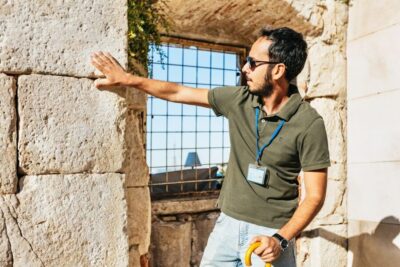
Split’s past is built into its streets. This private two-hour walk with historian Boris takes you from the Golden Gate through Diocletian’s Palace, its cellars, temples, cathedral, harbor, and lively old squares. I like the tour’s small private format and the guide’s use of 3D reconstruction images, which help you picture the palace before centuries of change. I also like that the starting time is flexible if you contact the provider ahead of time.
The main drawback is that the tour moves through many major sights in about two hours. You get a well-shaped introduction rather than a slow visit to every interior. The Cathedral of Saint Domnius and Jupiter’s Temple are viewed from outside, and admission tickets are not included, so plan extra time and money if you want to go inside.
In This Review
- Key points about this Split walking tour
- Why Diocletian’s Palace works best with a guide
- Starting at the Golden Gate and Gregory of Nin
- Inside the Palace: Peristyle, cellars, and the Triclinium
- Jupiter’s Temple and the Roman religious world
- The Cathedral of Saint Domnius and a palace transformed
- The Vestibulum and the emperor’s private quarters
- Riva Harbor, Fruit’s Square, and Pjaca
- What Boris adds to the experience
- Price, group size, and practical value
- Who should book this private walk?
- Should you book this Split history tour?
- FAQ
- How long is the private Split history tour?
- How many people can join the private tour?
- What language is the tour offered in?
- Where does the tour begin and end?
- Are admission tickets included?
- Can the starting time be adjusted?
Key points about this Split walking tour
- A private tour for up to 15 people: Your group gets the guide’s attention without being joined by strangers.
- Led by Boris, a local guide with a master’s degree in history: He explains both Roman Split and the medieval city that grew inside it.
- A clear route through Diocletian’s Palace: The walk includes the Golden Gate, Peristyle, central cellars, Triclinium, Jupiter’s Temple, Vestibulum, and the cathedral exterior.
- Visual help for a vanished palace: Boris uses a display book with 3D reconstruction images and historical pictures.
- Ends at Pjaca: The tour finishes on People’s Square, a useful spot for continuing your own walk through central Split.
- Flexible timing, with an important restriction: The advertised operating hours are Monday through Friday from 5:00 PM to 7:00 PM, but you should contact the provider before the tour to arrange the start.
Why Diocletian’s Palace works best with a guide
At first glance, Diocletian’s Palace can feel like a maze of stone lanes, shops, cafés, apartments, churches, and courtyards. That is part of its charm, but it can also blur the original Roman plan. This tour gives you the basic map: where the emperor lived, where ceremonies happened, where religion shaped daily life, and how a Roman residence became the center of a medieval and modern city.
The palace is not an isolated ruin outside town. It forms the core of Split. People live and work among ancient walls, and modern streets pass through spaces first designed for an emperor. A guide helps you notice the changes instead of seeing only a collection of old stones.
I especially like the use of reconstruction pictures. Roman buildings are often hard to understand when only fragments remain. A visual comparison lets you imagine the original scale and decoration, then match that image to what survives around you.
Because this is private, Boris can adjust the pace and explanation to your group. That matters if one person wants Roman architecture while another prefers stories about local life and later city changes. One couple also had a guide who made sure a companion recovering from a fall could sit during parts of the walk. That suggests a considerate approach, though you should still expect a walking tour over old-city surfaces.
A few more Split trips worth comparing
- Split: Krka Waterfalls Trip with Boat Cruise and Swimming
★ 4.8 · 10,519 reviews - From Split: Krka Waterfalls, Food & Wine Tasting Tour
★ 5.0 · 9,326 reviews - Blue cave, Mamma Mia and Hvar, 5 islands speedboat tour
★ 5.0 · 7,150 reviews
Starting at the Golden Gate and Gregory of Nin
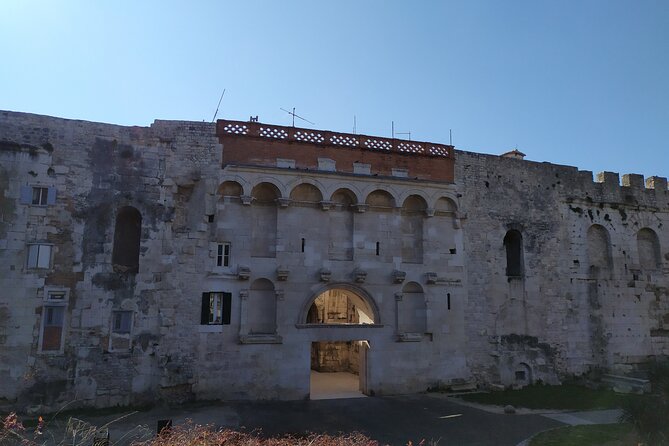
The meeting point is the Golden Gate, at Dioklecijanova 7. This northern entrance to Diocletian’s Palace is a sensible place to begin because it introduces both the palace and Split’s modern street life in one glance.
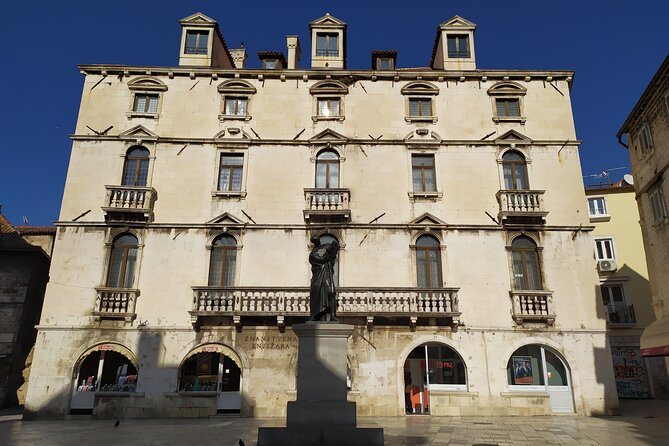
The name sounds grander than the material. The gate is made of stone, not gold. Boris uses it to explain the importance of the northern entrance and to set up the story of Split before the group moves deeper into the old city.
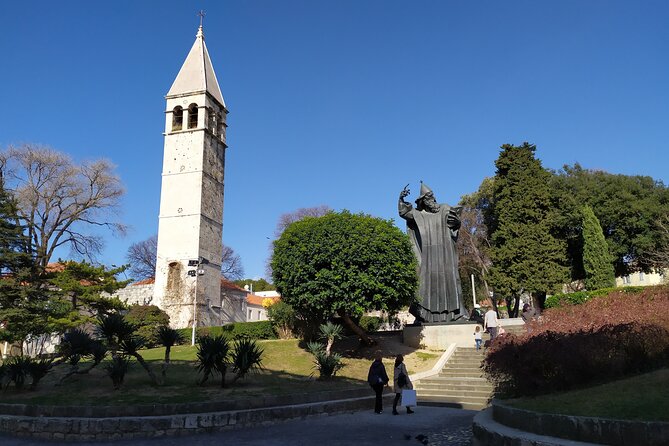
Directly opposite is the large statue of Gregory of Nin, or Grgur Ninski. The monument honors a medieval religious figure and was made by sculptor Ivan Meštrović. Boris explains Gregory’s place in Croatian history, the reason the statue matters, and the stories attached to this unusually imposing figure.
You will spend about 15 minutes at the Golden Gate and another 10 minutes at the statue. This is a good opening pace. You get names, dates, and context without being trapped in a long lecture before the walk has really begun.
Inside the Palace: Peristyle, cellars, and the Triclinium
The route then turns toward the main parts of Diocletian’s Palace. Diocletian was one of the most successful emperors of the Roman Empire, and his retirement palace was far more than a simple holiday home. The plan combined private imperial rooms, formal ceremonial spaces, religious buildings, service areas, and strong defensive walls.
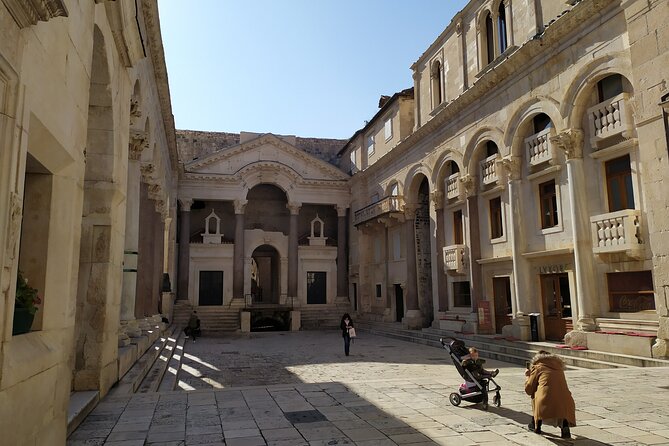
The Peristyle is the key place to understand that plan. This central square connected different parts of the palace and helped control access to the emperor. It was a meeting place, but it also separated the ruler from ordinary people. From here, you can look around and begin to see how the buildings related to one another.
Boris explains the square’s original role and the later changes brought by Christianity. Roman religious and imperial spaces did not simply vanish. Many were adapted, renamed, rebuilt, or given new functions. That shift from emperor worship to Christian worship is one of the most useful ideas in the tour.
From the Peristyle, the walk enters the central section of the palace cellars, also called the central substructure. These lower rooms are important for two reasons. They reveal how the palace was supported and organized, and they preserve the shape of rooms whose upper levels changed over time.
The cellars also show how the palace was used after the Roman period. Their story is not limited to Diocletian. Boris explains their role in Split’s later development and why these lower spaces still matter to the city today.
The route includes the Triclinium, the emperor’s dining room. Here the talk turns to Roman eating habits and the arrangement of an imperial meal. The name can sound technical, but the subject is easy to picture: dining was a formal social act, and the organization of the room reflected rank and power.
The time allotted to the palace, Peristyle, cellars, and Triclinium is about 20 minutes in each part of the route. That gives you a useful overview, but it also means you should not expect every architectural detail. If Roman design is your main interest, note the places you want to revisit after the tour.
Jupiter’s Temple and the Roman religious world
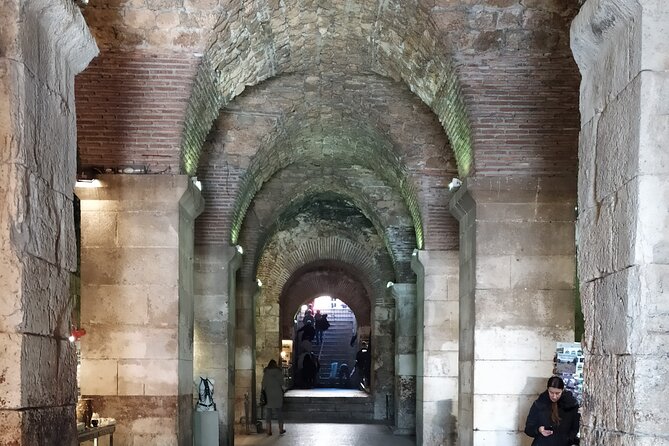
Jupiter’s Temple is viewed from outside, with about 10 minutes devoted to it. That may seem brief, but the stop adds an important piece to the palace plan.
Religion was central to Roman public and private life. Temples honored gods and helped express the authority of the emperor. By explaining Jupiter’s Temple in its setting, Boris connects the building to the wider Roman system rather than treating it as a stand-alone photo stop.
The outside-only approach is practical for a short walking tour, but it is also a clear limit. You will hear what to look for, yet you should not expect an interior visit as part of the experience. No admission tickets are included, so check the current arrangements if you want to enter any paid site later.
Still Split, at a slower pace:
- From Split: Krka Waterfalls, Food & Wine Tasting Tour
★ 4.9 · 6,598 reviews - Split/Trogir: Blue Cave, Mamma Mia, Hvar and 5 Island Tour
★ 4.6 · 6,320 reviews - Blue Lagoon & 3 Islands Cruise with Lunch from Split
★ 4.5 · 5,756 reviews - Split: Old Town and Diocletian Palace Walking Tour
★ 4.9 · 4,727 reviews
The Cathedral of Saint Domnius and a palace transformed
The Cathedral of Saint Domnius is another stop viewed from outside. Boris points out significant parts of the building and explains its story. He also highlights details to watch for if you decide to visit the interior on your own.
The cathedral occupies the former mausoleum of Diocletian, a striking example of how later Christian Split reused the emperor’s original complex. The change is not just architectural. It reflects a new religious order taking over a place built for imperial power.
Allow about 10 minutes here. That is enough for an explanation and orientation, but not for a full cathedral visit. I would treat this stop as preparation for returning later, especially if you want to see the inside at your own pace.
The Vestibulum and the emperor’s private quarters
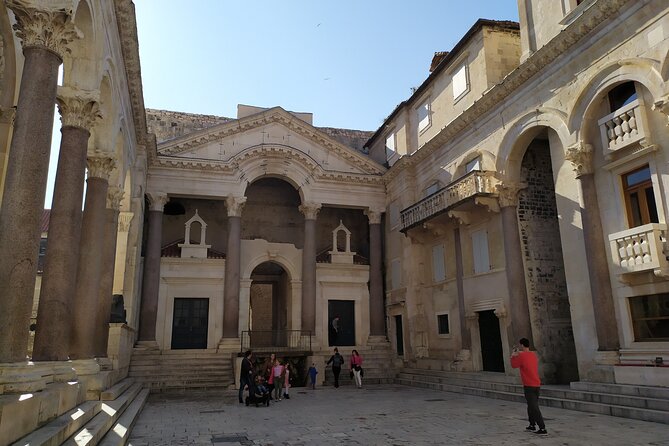
The Vestibulum was the entrance, or preentrance, to Diocletian’s private chambers. Its position tells you that you are moving from public and ceremonial areas toward the emperor’s personal section of the palace.
Boris explains how the Vestibulum was decorated, what it looked like, and how it functioned. This is a small but valuable stop because it helps you read the palace as a sequence of controlled spaces. Not every room was open to everyone, and the route toward the emperor’s quarters carried its own meaning.
The visit lasts about 10 minutes. It works best when you have already heard the explanation of the Peristyle, since the two places together show how public access narrowed as you approached the imperial apartments.
Riva Harbor, Fruit’s Square, and Pjaca
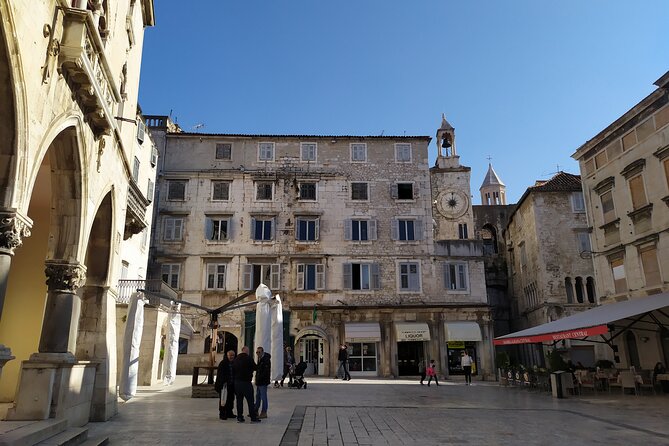
After the Roman heart of the route, the walk shifts toward the city that grew around it.
Riva Harbor is Split’s main promenade. You spend about five minutes here while Boris explains how the waterfront developed over the centuries and why it became important to local life. This short stop helps connect the palace to the sea and to the city beyond its ancient walls.
Fruit’s Square, or Trg Braće Radić, follows. The name comes from the fruit market once held there. Boris also points out the central monument and the important buildings around the square. At about 10 minutes, this is enough time to understand why the space matters without turning the walk into a long architectural survey.
The final stop is Pjaca, officially People’s Square, at Narodni trg 16. This has been a center of city activity from medieval times to the present. Boris explains the square’s story and its surrounding buildings, including the old City Hall.
Ending here is useful. You are not left at an anonymous street corner or taken back to the starting point. You finish in a central public square, with suggestions for other places to see in Split. If you have dinner plans, this location may also make the next part of your evening easier.
What Boris adds to the experience
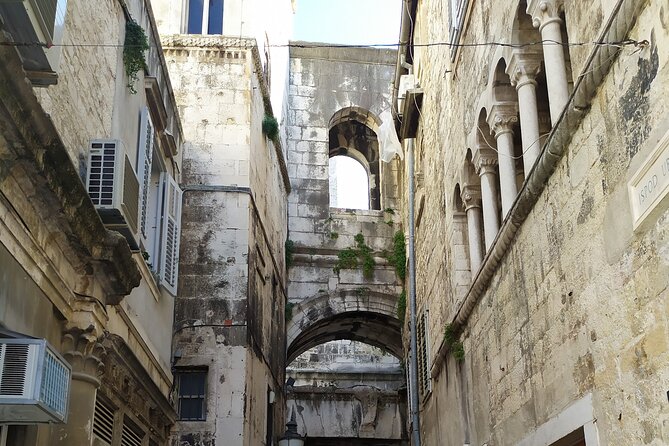
A guide with a master’s degree in history is not automatically a good guide. The useful question is whether the information is shaped for real people standing in real places. The available feedback points to Boris’s ability to adjust his explanations and respond to questions.
One couple included a serious history enthusiast and a partner who had little interest in archaeology. Boris reportedly pitched the material well enough for both people to enjoy it. That is a good sign for mixed groups, since you can ask for more detail without forcing everyone else into a seminar.
He also adjusted a tour for a delayed flight and helped the group finish in time for dinner reservations. The flexible starting-time policy is worth using, but contact Pomalo tours before the date rather than assuming every time is available.
The tour includes a display book with 3D reconstruction images and other pictures. Ask Boris to use these at the points where the original layout is hardest to see. The images should be most helpful around the palace’s vanished upper rooms and the changes from Roman residence to medieval city.
Price, group size, and practical value
The price is $156.21 per group of up to 15 people. For one or two people, that is not a bargain in absolute terms. For a larger family or group of friends, the calculation changes quickly. A full group could pay only a modest amount per person for a private guide and a focused introduction to Split’s center.
You are paying for interpretation, not entrance tickets. The listed stops have no admission charge for the tour, but the experience does not include admission tickets if you later choose to enter sites. Build that into your budget.
The two-hour length is a strength if you want orientation on arrival. It is short enough to fit before dinner or alongside other plans. It is not long enough for a complete archaeological visit, a cathedral interior tour, and an unhurried look at every square.
The listed hours are Monday through Friday, 5:00 PM to 7:00 PM, from April 1, 2023 through February 25, 2027. Since the tour description also says the starting time is flexible, confirm the exact time before booking. The experience is offered in English and uses a mobile ticket.
The meeting point is near public transportation, and service animals are allowed. Most people can participate, but this remains a walking route through the old city. If you have mobility concerns, tell Boris ahead of time and use the flexible pace to your advantage. A previous group found that he was willing to provide sitting pauses when needed.
Free cancellation is available up to 24 hours before the start time. Changes or cancellations inside that window are not accepted for a refund, and poor weather may lead to a new date or a full refund.
Who should book this private walk?
I would choose this tour if you want a clear first look at Split and prefer conversation over a large group lecture. It suits couples with different levels of interest, families who want to ask questions, and groups that value a private schedule.
It is also a good fit if you like Roman history but need help connecting ruins to the city around them. The route does not stop at Diocletian. It explains Gregory of Nin, medieval squares, the harbor, Christianity, and the continuing life of the old center.
You may want something else if you want extensive time inside the cathedral, a dedicated archaeological tour, or a full-day exploration. The outside visits and fixed two-hour length keep the experience brisk.
Should you book this Split history tour?
Book it if you want a well-organized introduction to Split’s Roman and medieval core, especially with a group large enough to make the private price worthwhile. Boris’s flexibility, visual material, and attention to different interests add real value.
Skip it if you already know Diocletian’s Palace well or want a long, highly technical study of architecture. For most first visits, though, the route gives you a useful map and enough context to make the rest of your time in Split more rewarding. Use the tour to get oriented, then return on your own to the cathedral, temple, or cellar areas that catch your interest.
FAQ
How long is the private Split history tour?
The tour lasts approximately two hours.
How many people can join the private tour?
The price covers one private group of up to 15 people.
What language is the tour offered in?
The tour is offered in English.
Where does the tour begin and end?
It begins at the Golden Gate, Dioklecijanova 7, in Split. It generally ends at People’s Square, also called Pjaca Square, at Narodni trg 16.
Are admission tickets included?
No. Admission tickets are not included. Jupiter’s Temple and the Cathedral of Saint Domnius are visited from outside, and Boris can explain what to look for if you decide to enter the cathedral afterward.
Can the starting time be adjusted?
The tour offers a flexible starting time, but you need to contact the provider before the tour. The stated operating hours are Monday through Friday from 5:00 PM to 7:00 PM.
Just added around Split
- Walking Tour Split★ 4.7 · 61 reviews
- Unique vintage Tomos moped tour Split – Back to the ’80s★ 4.8 · 17 reviews
- Trogir: White Lagoon, Maslinica & Blue Lagoon Speedboat Tour★ 4.8 · 11 reviews
- Essential Diocletian’s Palace Tour for First-Time Visitors★ 4.8 · 19 reviews
- Split: Trogir Open Top Bus Trip + Free Split Walking Tour★ 4.1 · 17 reviews
- Trogir; Private walking tour of higlights of Trogir★ 4.7 · 3 reviews
- Trogir: Old Town Guided Walking Tour★ 4.6 · 76 reviews
- TROGIR: Blue Lagoon & 3 Islands Half-day Speedboat tour★ 4.6 · 28 reviews
Split Tours, compared.

Krka Waterfalls Trip with Boat Cruise and Swimming
Read our review →

Blue cave, Mamma Mia and Hvar, 5 islands speedboat tour
Read our review →
Split/Trogir: Blue Cave, Mamma Mia, Hvar and 5 Island Tour
Read our review →
Blue Lagoon & 3 Islands Cruise with Lunch from Split
Read our review →