Reviewed · SPLIT TOURS
Diocletian’s Palace Small Group Tour in Split
Split’s old town is built inside a Roman palace. That makes this two-hour walking tour a smart way to get your bearings while seeing the Peristyle, Vestibule, cellars, and Golden Gate with a local guide. You are not simply looking at ruins from behind a barrier. You walk through streets where daily life continues among ancient walls.
I like the choice of departures throughout the day, since an early start can help you avoid the strongest August heat. I also like the guide-led approach: guides such as Luka, Sandra, Jelena, and other local hosts have been praised for clear history, friendly conversation, humor, and practical tips about shops and the city.
The main consideration is the tour’s size. It is marketed as a small-group experience, but the stated maximum is 99 people, while one group was about 20 and another became a private tour. Ask at the meeting point if a compact group matters to you.
In This Review
- Key points to know before booking
- Why Diocletian’s Palace is unlike a normal palace visit
- Starting at Mrčelina 1 in Split
- Walking through the 17-century-old city center
- The Peristyle, where Roman ceremony met city life
- The Vestibule and its striking circular interior
- The cellars reveal the palace’s original plan
- The Golden Gate marks the northern entrance
- What the local guide adds to the walk
- Is $60.21 a fair price?
- Who will enjoy this Split walking tour?
- Booking, cancellation, and practical details
- Final verdict: book it for context, not just admission
- FAQ
- Where does the Diocletian’s Palace tour begin?
- Where does the tour end?
- How long does the tour last?
- What language is the tour offered in?
- What is included in the tour price?
- Are food and drinks included?
- Is cathedral admission included?
- Can I cancel for a full refund?
Key points to know before booking
- The entire old town is part of the experience: Diocletian’s Palace is not an isolated monument. Its lanes, homes, shops, and squares form much of Split’s city center.
- The Peristyle gives you the palace’s grandest Roman setting: This central square was designed for imperial ceremony and still works as the visual heart of the tour.
- The cellars are among the best-preserved ancient palace substructures: They help you understand the original layout above ground.
- The guide adds local context: Along with Roman history, you can hear about Mediterranean life, local shops, and modern Split.
- Early morning is a useful choice in summer: One detailed account found an early August departure especially pleasant.
- Cathedral tickets are not included: The walking tour covers major exterior and public areas, but you pay separately if you want to enter the cathedral.
Why Diocletian’s Palace is unlike a normal palace visit
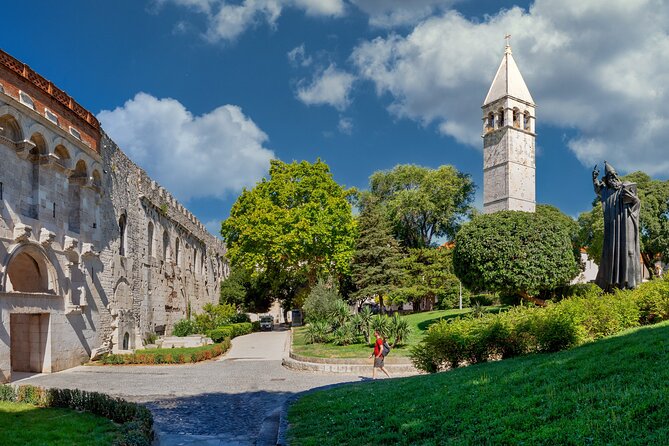
Many palace tours begin at a grand entrance and proceed room by room. Split works differently. Diocletian’s Palace is a huge Roman complex that became the foundation of the modern city, so you may pass a café, a home, or a shop before suddenly finding yourself beside a column that is roughly 1,700 years old.
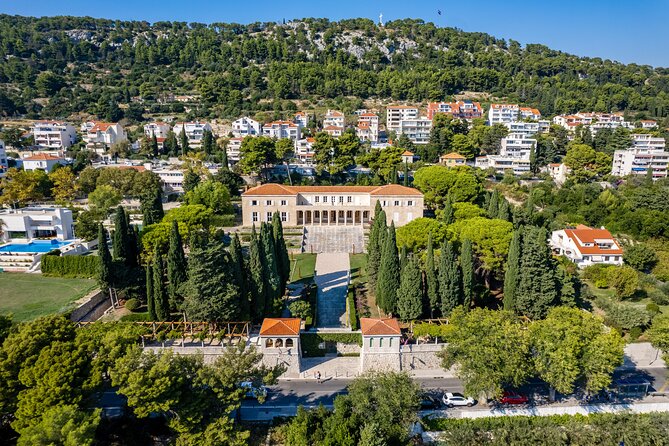
Calling it a palace can also give you the wrong picture. About half the complex was intended for Emperor Diocletian’s personal use, while the rest served the military garrison. The whole structure had the feel of a fortified residence, with defensive walls, gates, courtyards, and underground support spaces.
That mixture is what makes a guided walk useful. Without help, you can easily see the old stones but miss how the parts fit together. A good guide shows you where imperial ceremony took place, how people entered the complex, and how later buildings grew into the Roman framework.
The tour is offered in English and lasts about two hours. That is long enough for a solid first look without taking up an entire morning or afternoon. I would treat it as an introduction to Split rather than a complete archaeological study. You will leave with a clearer map in your head and a list of places you may want to revisit on your own.
A few more Split trips worth comparing
- Split: Krka Waterfalls Trip with Boat Cruise and Swimming
★ 4.8 · 10,519 reviews - From Split: Krka Waterfalls, Food & Wine Tasting Tour
★ 5.0 · 9,326 reviews - Blue cave, Mamma Mia and Hvar, 5 islands speedboat tour
★ 5.0 · 7,150 reviews
Starting at Mrčelina 1 in Split
The meeting point is South Tours Travel Agency at Mrčelina 1, 21000 Split. The activity also ends back at the meeting point, which is convenient if you have onward plans or want to return to your hotel after the walk.
The booking provides a mobile ticket, and confirmation is sent at the time of booking. Since the old town is a maze of lanes, allow enough time to find the agency rather than cutting your arrival close. The tour includes a local guide and a professional guide, but food, drinks, and cathedral admission are not included.
Several departure times are offered during the day. I would favor the earliest practical option in the hotter months. An early August walk was praised as a good way to see the center before the day became more tiring. A later departure may suit your schedule, but you should expect warmer conditions and potentially more activity in the narrow streets.
The stated maximum is 99 people. That is a surprisingly high ceiling for something described as small group, so group size may depend on the departure. One tour had about 20 people, and another became a private outing with Jelena. If personal attention is important, ask how many people are assigned to your time.
Walking through the 17-century-old city center
The first and longest part of the experience takes place inside Diocletian’s Palace itself. You walk through the old town’s maze-like streets, moving between Roman remains and later buildings. The supplied schedule gives this section about two hours, with the more specific stops taking roughly ten minutes each. In practice, the guide’s storytelling connects these points into one continuous walk.
This is the part I like most because it shows Split as a living place. The palace is not preserved as a silent museum. Local life continues among the ancient walls, and the guide can point out details that explain how the city developed around the Roman structure.
You may see an ancient Egyptian sphinx set against much later architecture, including a 20th-century building. That contrast is not a distraction. It is the central fact of Split’s old town. Roman, medieval, and modern layers occupy the same small area.
The walk requires a moderate level of fitness. You should be comfortable standing and walking for about two hours on old city streets. The supplied information does not promise a particular route for mobility needs, so anyone with concerns should check with South Tours Croatia before booking.
The Peristyle, where Roman ceremony met city life
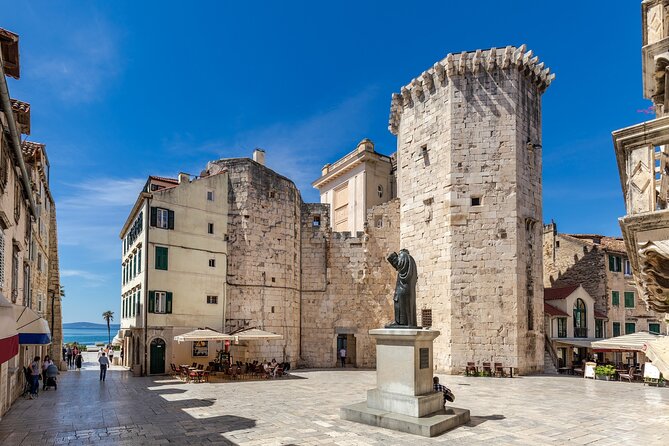
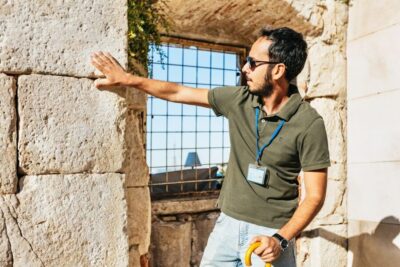
The Peristyle is the central square of the palace and one of the tour’s essential stops. Diocletian was celebrated here as the living son of Jupiter, so the space was designed to make imperial power feel physical and immediate.
Look at the scale and arrangement of the square as your guide explains its purpose. This was not just an open plaza. It was a stage for ceremony, surrounded by temples and monumental architecture. Today it still functions as a gathering place, which lets you see how a Roman setting can remain part of urban life.
The Peristyle also has unusual acoustics. That quality helped turn it into a setting for opera, classical works, and other performances. Even if nothing is being performed during your visit, the square’s shape helps explain why it works so well as a theater.
The scheduled stop is about ten minutes, but it may become one of the places you remember best. I would listen for the link between the emperor’s public image and the square’s design. The stones make more sense once you understand the message they were meant to send.
Still Split, at a slower pace:
- From Split: Krka Waterfalls, Food & Wine Tasting Tour
★ 4.9 · 6,598 reviews - Split/Trogir: Blue Cave, Mamma Mia, Hvar and 5 Island Tour
★ 4.6 · 6,320 reviews - Blue Lagoon & 3 Islands Cruise with Lunch from Split
★ 4.5 · 5,756 reviews - Split: Old Town and Diocletian Palace Walking Tour
★ 4.9 · 4,727 reviews
The Vestibule and its striking circular interior
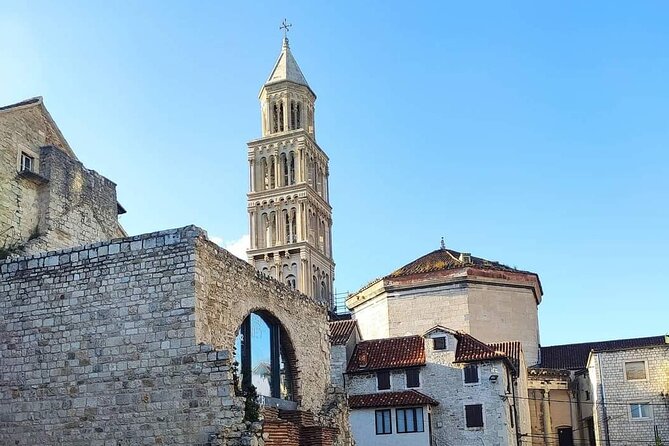
The Vestibule was part of the old imperial court. From outside, it has a rectangular form. Inside, its plan is circular, creating a strong change in mood as you move through it.
The space makes an impression because of its shape and monumentality rather than its size alone. Your guide can explain how it related to the palace’s ceremonial areas and why its design mattered.
This stop is listed at about ten minutes. That is enough for an explanation and a good look, though anyone hoping for a long architectural study may find the stop brief. The value here comes from seeing how Roman builders used geometry to control movement and create drama.
Pay attention to the transition from the narrow streets into the Vestibule. Split often works this way. A small passage suddenly opens into a space that was designed for an emperor, and the change gives you a physical sense of the palace’s original power.
The cellars reveal the palace’s original plan
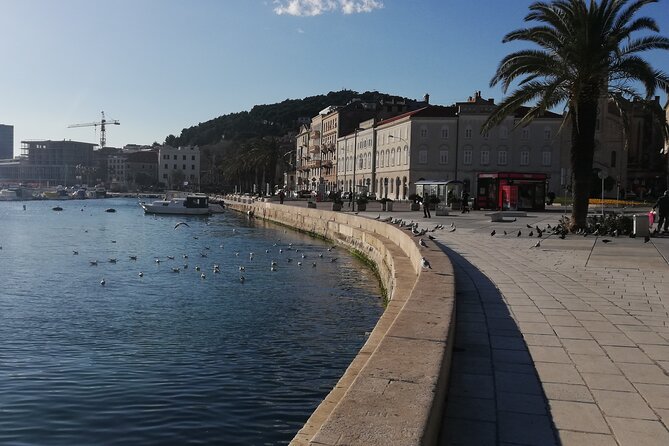
The Diocletian’s Palace Substructures are among the best-preserved ancient complexes of their kind. They are also one of the clearest places to understand the building above you.
The cellars supported the upper palace and followed much of its original arrangement. That makes them more than a collection of underground rooms. They help explain the palace’s structure, including how the imperial residence was organized and how the complex was built on a massive scale.
The cellars are scheduled for about ten minutes. That may feel short if you are interested in archaeology, but a focused explanation can still give you the main idea. I would pay attention to the practical side of the building: these spaces show how much engineering was needed to support the residence and military areas overhead.
Their preservation also helps explain why Split’s historic center received UNESCO World Heritage status in 1979. The city’s importance is not based on one surviving column or one attractive square. It comes from the survival of a large ancient complex that still shapes the modern center.
The Golden Gate marks the northern entrance

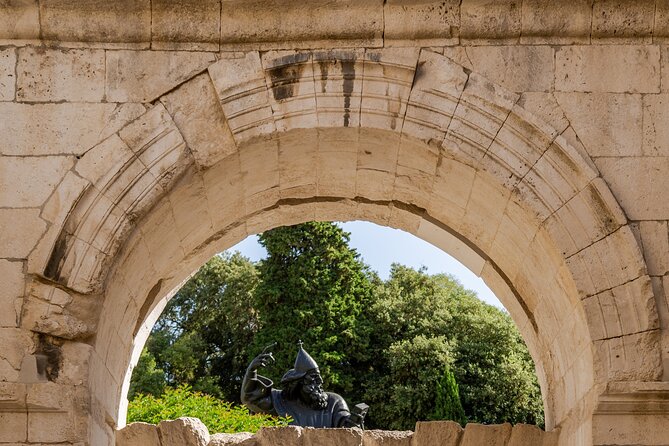
The Golden Gate, or Porta septemtrionalis in Roman terms, was one of the palace’s main entrances. It was built as a rectangular defensive gateway with double doors and a fortified design.
According to the historical account presented on the tour, Diocletian entered through these gates on June 1, 305, when he came to the completed palace. That date gives the gate a useful human connection. You are not only looking at a military entrance. You are standing where the emperor entered the retirement residence he had ordered built.
The gate’s defensive purpose is easy to miss if you see it as simply a photogenic arch. The guide can point out how the design worked as part of the palace’s protection, including the fortified outer arrangement known as a propugnaculum.
The stop lasts about ten minutes. It is a good place to think about the palace as both home and fortress. Diocletian wanted comfort and ceremony, but he also wanted security. The Golden Gate shows the second priority clearly.
What the local guide adds to the walk
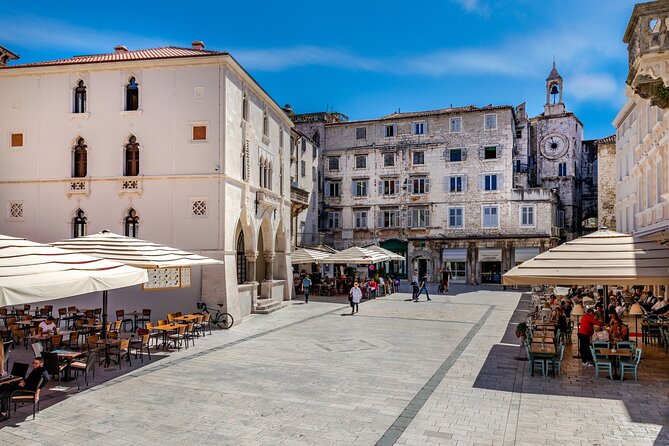
The guide is the main reason to choose this experience instead of simply following a map. The strongest praise has centered on guides who combine history with an easy manner.
Luka was described as exceptionally enthusiastic, well informed, generous with recommendations, and clearly pleased to be doing the work. Sandra received similar praise for her command of the subject and friendly style. Jelena was especially valued for answering questions, explaining the palace, and suggesting shops around the city.
Those details matter because Split’s old town can feel confusing on a first visit. You may want to know where to shop, how the local center fits together, or which details are worth another look. A guide who talks about local life as well as Roman history can make the walk feel less like a lecture.
The tone also seems to vary by guide. One account praised a quirky sense of humor, while another appreciated a young guide who was both friendly and smart. You cannot guarantee a particular guide unless the operator confirms one, but the pattern suggests that the human side of the tour is a real strength.
One person had a small problem finding or meeting the group. That is worth noting because the old town’s streets are easy to mix up. Go to the stated agency at Mrčelina 1 and arrive with time to spare.
Is $60.21 a fair price?
At $60.21 per person, this is not the cheapest way to walk around Split. You can see many palace streets and exterior features without paying an admission fee. The value comes from having the complex explained in context, with a fixed route that covers the key Roman points in about two hours.
The major stops themselves are listed with free admission. Cathedral tickets are extra, and food and drinks are not part of the price. That means you should judge the cost mainly as payment for the guide, organization, and local interpretation, not as an entrance package.
I think the price makes the most sense if Split is new to you, your time is limited, or Roman architecture is hard to read without explanation. It is less compelling if you have already studied the palace, prefer wandering alone, or plan to hire a private guide for a longer visit.
The value may also depend on group size. A group of around 20 can still work well, especially with a strong guide, while a much larger group may make questions and close listening harder. The possibility of a private tour is appealing, but it should not be assumed.
Who will enjoy this Split walking tour?
I would recommend it to a first-time visitor who wants a clear introduction to the old town without committing half a day. It also suits people who like history but want it explained in plain language and connected to present-day life.
You will probably get the most from it if you:
- Have around two hours available in Split
- Want to see the palace with a local guide
- Enjoy walking through old streets rather than visiting only formal museums
- Appreciate practical tips about shops and the city
- Can manage moderate walking and standing
- Prefer an English-language tour
Families with older children may find the palace’s fortress gates, underground cellars, and unusual ceremonial spaces more engaging than a standard museum. People with limited mobility should confirm the route before booking, since the tour requires moderate physical fitness and no specific accessibility plan is provided.
The tour is also useful near the beginning of a Split stay. Afterward, you can return to the Peristyle, explore the cellars at a slower pace if you choose, or use the guide’s local suggestions to shape the rest of your time.
Booking, cancellation, and practical details
The activity is provided by South Tours Croatia. Confirmation arrives when you book, and you can use a mobile ticket.
Free cancellation is available if you cancel at least 24 hours before the local start time. Cancellations made less than 24 hours before the start are not refunded, and changes within that period are not accepted.
The tour is offered in English. The advertised duration is approximately two hours, and it begins and ends at South Tours Travel Agency, Mrčelina 1, Split.
Final verdict: book it for context, not just admission
I would book this tour if you want Split’s old town to make sense quickly. The best parts are the Peristyle’s imperial setting, the well-preserved cellars, the fortified Golden Gate, and the chance to hear about modern local life from a guide who knows the city.
The 4.8 rating from 12 published ratings and 92 percent recommendation level point to a strong experience, with guide quality as the biggest asset. The main caution is the possible group size, plus the fact that the price does not cover cathedral entry or refreshments.
Choose an early departure in hot weather, arrive at Mrčelina 1 with time to spare, and confirm the expected group size if that affects your decision. For a first look at Split, this is a useful, well-focused introduction to a city where Roman history is not sealed away, but built into the streets you walk every day.
FAQ
Where does the Diocletian’s Palace tour begin?
It begins at South Tours Travel Agency, Mrčelina 1, 21000 Split, Croatia.
Where does the tour end?
The activity ends back at the meeting point.
How long does the tour last?
The tour lasts approximately two hours.
What language is the tour offered in?
The tour is offered in English.
What is included in the tour price?
A local guide and a professional guide are included.
Are food and drinks included?
No. Food and drinks are not included.
Is cathedral admission included?
No. Tickets for the cathedral are not included.
Can I cancel for a full refund?
Yes, if you cancel at least 24 hours before the experience start time. Cancellations made less than 24 hours in advance are not refunded, and changes within that period are not accepted.
Just added around Split
- Walking Tour Split★ 4.7 · 61 reviews
- Unique vintage Tomos moped tour Split – Back to the ’80s★ 4.8 · 17 reviews
- Trogir: White Lagoon, Maslinica & Blue Lagoon Speedboat Tour★ 4.8 · 11 reviews
- Essential Diocletian’s Palace Tour for First-Time Visitors★ 4.8 · 19 reviews
- Split: Trogir Open Top Bus Trip + Free Split Walking Tour★ 4.1 · 17 reviews
- Trogir; Private walking tour of higlights of Trogir★ 4.7 · 3 reviews
- Trogir: Old Town Guided Walking Tour★ 4.6 · 76 reviews
- Trogir: Blue Lagoon, Maslinica, and Solinska Bay Boat Tour★ 4.9 · 88 reviews
Split Tours, compared.

Krka Waterfalls Trip with Boat Cruise and Swimming
Read our review →

Blue cave, Mamma Mia and Hvar, 5 islands speedboat tour
Read our review →
Split/Trogir: Blue Cave, Mamma Mia, Hvar and 5 Island Tour
Read our review →
Blue Lagoon & 3 Islands Cruise with Lunch from Split
Read our review →