
Reviewed · WALKING TOURS
Daily or night walking tour through Medieval Šibenik
Small streets hide big stories. This 90-minute walk makes medieval Šibenik easier to read, from the stone face of St. James Cathedral to old water systems, church carvings, merchant measures, and narrow passages. I especially like the focus on Juraj Dalmatinac and the way the tour connects grand architecture with ordinary city life. I also like the choice of a daytime or evening departure, since Šibenik feels quite different under the sun and after dark.
The main consideration is the tour’s strong religious and architectural focus. Dario Mikulandra explains the city with great energy and detail, but one visitor hoping for a broader medieval-history tour found the discussion more centered on religion than expected. The stone steps and uneven lanes also require care, especially during the evening walk.
In This Review
- Key points to know before you book
- Why this Šibenik walk is worth your time
- Starting beside Šibenik’s medieval core
- St. James Cathedral: 105 years carved in stone
- St. Barbara and the medieval doctors’ relief
- The Four Wells and Šibenik’s underground water supply
- St. John’s Church and its unusual details
- St. Francis, the monastery, and old city defenses
- St. Spirit and the old religious brotherhoods
- Medulić Square, city measurements, and early electricity
- How Dario guides the experience
- Day or night, and who should book
- Should you book this $29.79 walk?
- FAQ
- Where does the Šibenik walking tour begin?
- Where does the tour end?
- How long does the tour last?
- Is the tour offered in English?
- Can I take the tour during the day or at night?
- What is the group size?
- Is admission to the listed stops included?
- What is the cancellation policy?
Key points to know before you book
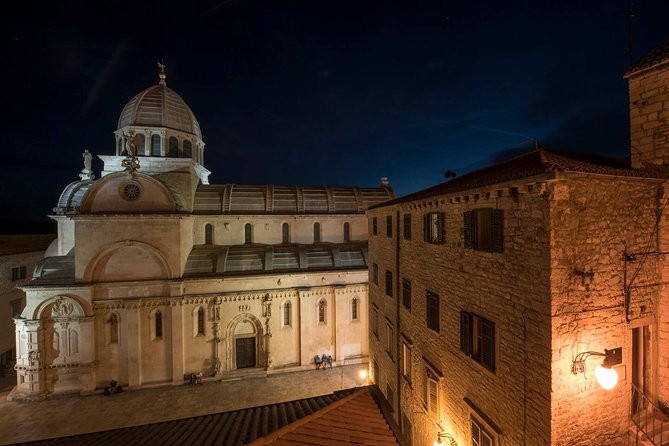
- St. James Cathedral takes center stage: You spend about 30 minutes learning how this UNESCO-listed Gothic-Renaissance masterpiece was designed and built entirely from stone.
- Dario Mikulandra leads the walk: His enthusiasm, patience, and detailed knowledge of Šibenik’s cathedral and old town are major strengths.
- Day or night departures are available: The same historic route can offer clear architectural views by day or a more atmospheric setting after sunset.
- The Four Wells reveal practical medieval life: You see an old underground cistern, its water filtration system, and the openings once used to draw fresh water.
- The route goes beyond the headline sights: Churches, palace walls, city defenses, measuring units, a Turkish clock, and even a medieval-style dog bowl all receive attention.
- The group is capped at 10 people: That is a useful size for asking questions and moving through narrow streets.
Why this Šibenik walk is worth your time
Šibenik can be easy to underestimate. Many people come for the Cathedral of St. James, take a few photographs, and move on. That would miss much of the pleasure of the old town. The city’s medieval center is full of clues, but you need someone to point them out.
This tour is built around those clues. A staircase is not just a staircase. A stone face is not just decoration. A hole in a wall may explain how water was collected, how a building was used, or how the city dealt with defense and trade.
I like that the walk does not stop with famous monuments. It moves through churches, squares, tunnels, passages, and less obvious corners. You get the grand story of Šibenik, but also practical details about water, weights, electricity, street life, and religious brotherhoods.
At $29.79 per person, the cost is reasonable for a small-group walk lasting around an hour and a half. Admission is listed as free at the stops, so you are paying mainly for Dario’s interpretation and the convenience of a carefully arranged route. That value is strongest if you enjoy architecture, religious art, or city history and want more than a quick orientation stroll.
The group limit of 10 matters here. Šibenik’s old center is made for walking, but some lanes and stairways are tight. A small group makes it easier to hear and gives you a better chance to ask about a detail that catches your eye.
More Walking Tours in Sibenik
- Private Sibenik Walking Historical Morning or Evening Tour
★ 5.0 · 93 reviews - Sibenik: Guided Evening Walking Tour
★ 4.9 · 62 reviews - Šibenik: Medieval Night Walking Tour
★ 5.0 · 19 reviews
Starting beside Šibenik’s medieval core
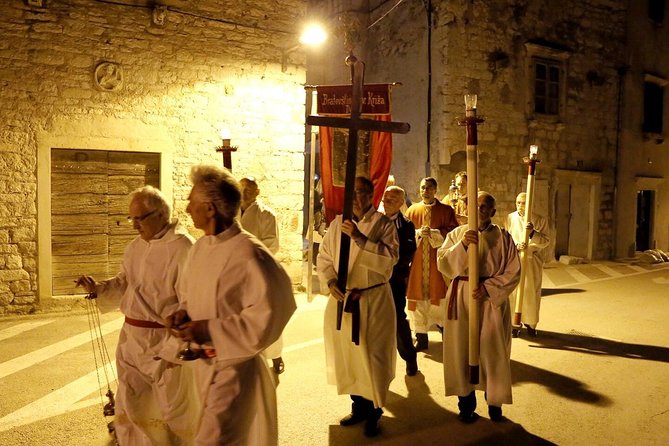
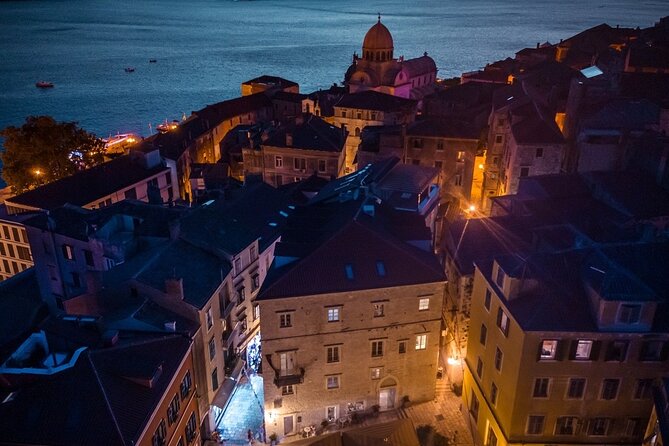
The walk begins at Ul. Biskupa Fosca 9 in Šibenik and returns to the same meeting point. The route stays within the historic center, so there is no need for a coach or other transport during the tour. The meeting point is near public transportation, which helps if you are arriving from another part of town.
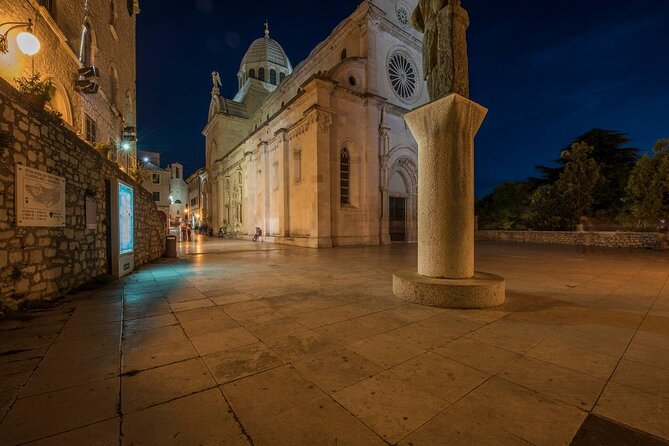
The experience is offered in English. You can choose a daytime or night walk, and each option has a clear advantage. Daylight helps with carved stone, window details, reliefs, and inscriptions. Evening gives the lanes a quieter, more dramatic mood, though you may need to pay closer attention to the uneven stone steps.
One particularly useful quality is Dario’s patience. He has been praised for taking care with a person who moved slowly on Šibenik’s many stone stairways. That does not make the route flat or effortless, but it suggests that the pace is not treated as a race.
St. James Cathedral: 105 years carved in stone
The Cathedral of St. James is the heart of the walk. Allow about 30 minutes here, which is a good share of the total time. The building is on the UNESCO World Heritage List and is regarded as one of the most important works of Croatian culture from the 15th and 16th centuries.
Dario explains what came before the cathedral, why construction began, and how the project developed over 105 years. That time span gives you a useful sense of medieval building work. This was not a single architect’s quick project. It was a long effort shaped by changing builders, ideas, resources, and religious aims.
The cathedral was built entirely from stone, without a conventional brick or timber framework. That alone makes it worth careful attention. You will hear about Juraj Dalmatinac, the leading builder connected with the project, and the way theology influenced the design of medieval churches.
Look closely at the exterior heads. The cathedral is famous for its many sculpted human faces, and the tour explains why they are there. You will also learn why shells appear in the building and why the presbytery was decorated with fruit and vegetables. These details help turn the cathedral from a grand façade into a record of the people and ideas behind it.
Dario also points out Juraj Dalmatinac’s hidden signature. That is exactly the sort of small feature I want from a city walk. You might pass it alone without knowing where to look, while a guide can connect the mark to the builder’s place in Šibenik’s story.
The cathedral discussion is the strongest part of the tour for anyone drawn to architecture. It also explains the main limitation: the presentation leans toward religious meaning and church history. If you want a social or military account of medieval Šibenik above all else, make sure this emphasis suits you.
St. Barbara and the medieval doctors’ relief
The Church of St. Barbara is a short stop of about 10 minutes, but it packs in several worthwhile details. It is a single-nave Gothic church begun around 1400, with a Gothic niche above the entrance containing a sculpture of St. Nicholas by Bonino from Milan.
The most unusual feature is on the north wall. A Gothic window includes a sculptural work made in 1419 as a vow by the Šibenik doctor Marko. It is described as a rare medieval relief showing physicians on the eastern Adriatic coast.
That detail changes how you look at a small church. Instead of seeing only a place of worship, you begin to notice the professional groups, personal promises, and civic relationships recorded in the stone. The stop also gives you a break from the scale of the cathedral without losing the architectural thread.
Still Sibenik, at a slower pace:
- From Split: Krka National Park Tour
★ 4.7 · 2,359 reviews - Vodice: Krka Waterfalls National Park Boat Tour
★ 4.6 · 250 reviews - Split: Krka Waterfalls Guided Day Trip with Swim & Boat Tour
★ 4.5 · 170 reviews - Split: Krka National Park Full-Day Tour with Wine Tasting
★ 4.9 · 142 reviews
The Four Wells and Šibenik’s underground water supply
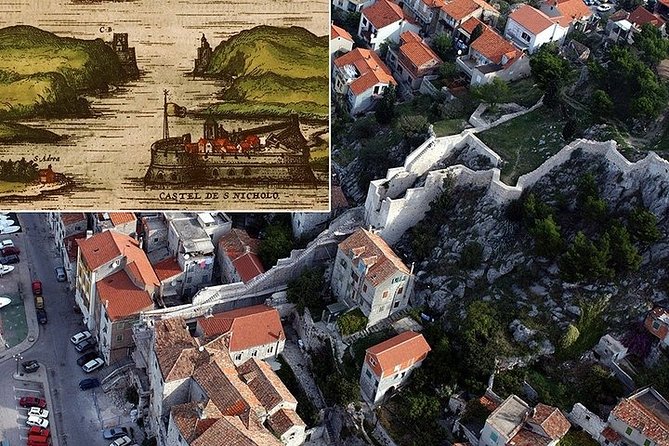
A few dozen meters from the cathedral, the route reaches Trg 4 bunara, the Square of the Four Wells. Beneath the plateau was a public city cistern, built to help Šibenik cope with drought and military sieges.
The construction contract dates to 1446, and Juraj Dalmatinac supervised the work. The cistern held 28,000 barrels of water, an impressive figure that makes the city’s dependence on stored water clear. A special tax helped pay for its construction, so this was not just an engineering project. It was a public investment tied to survival.
The square now has four wells on the surface, where water could be pumped. Below ground, you can see the cistern, its water filtration system, and the four openings, or crowns, through which fresh water was collected.
The entire complex has been renovated, and an underground café and wine bar occupy part of the space. That modern use does not replace the old story. Instead, it gives you a practical setting in which to understand how the system worked.
I find this one of the best stops for putting medieval life into everyday terms. Cathedrals tell you how people worshipped and expressed power. The cistern tells you how the city endured dry weather and siege. It is also a good example of why a guided walk adds value: the square looks attractive, but its engineering purpose is easy to miss.
St. John’s Church and its unusual details
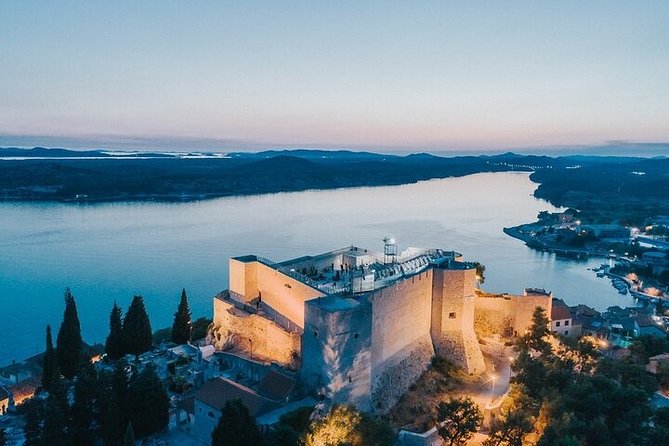
The Church of St. John is a Gothic-Renaissance building from the 15th century. It was first known as the Church of the Holy Trinity, and the route uses it to explain how several important medieval religious brotherhoods shaped this part of the city.
The staircase along the south side was made by the Šibenik builder Ivan Pribislavić. Its bas-relief decoration gives you another chance to compare practical building work with artistic detail.
At the foot of the bell tower is a Renaissance window by Nicholas of Florence. Above it is a relief showing a lamb beneath a winged angel. Another window, decorated with fruit and vegetables, was made by Nikola Firentinac and is described as one of the finest Renaissance windows in the city.
There is also a Turkish clock with one hand in the bell tower. It was brought from Drniš after the Turks left in the 18th century. The clock is a reminder that Šibenik’s buildings carry traces of changing political and cultural influences.
Dario points out mysterious iron hoops on the church’s north wall and explains their function from the early 17th century. This is the kind of detail that gives the walk its look twice quality. You are not simply being taken from one church to another. You are being shown the small pieces that make the old town feel lived in.
St. Francis, the monastery, and old city defenses

The Church of St. Francis was built in the second half of the 14th century at the southeastern edge of the historic center. It is a spacious Gothic building with a simple single-nave design and few exterior decorative elements.
Inside the Chapel of the Holy Cross is an organ made in 1762 by Petar Nakić, a noted builder of these instruments. The Franciscan complex also includes a 14th-century monastery and a library with 151 incunabula and a collection of handwritten codices.
The library holds the Šibenik Prayer, one of the oldest Croatian linguistic and literary monuments. It was written in Latin around 1375. Even if you are not a specialist in books or language, this detail adds weight to Šibenik’s place in Croatian cultural history.
Outside the monastery, you will see remains of the eastern city walls and the Vrančić Palace. Antun and Faust Vrančić were born there. The stop links religious life, scholarship, defense, and local family history in one compact part of the city.
The supplied route information does not specify extended interior visiting time at every church or library, so you should think of this as a guided look at the complex and its key details rather than a full museum visit. Dario’s explanation is the main attraction.
St. Spirit and the old religious brotherhoods
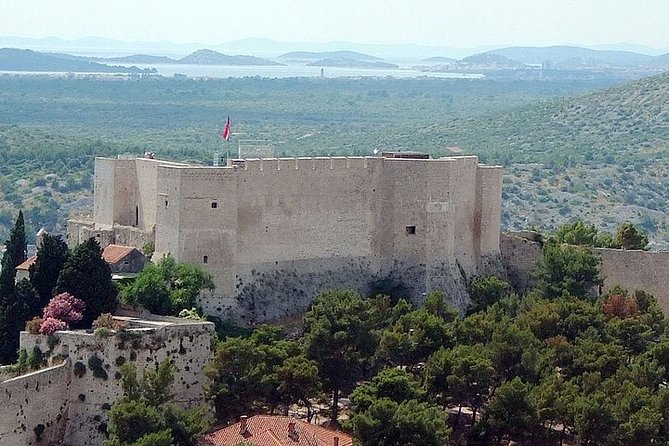
The Church of St. Spirit sits on Dinko Zavorović Square. It was built in the 17th century from a design by Antun Nogulović and is the third church encountered within a distance of about 100 meters.
That close grouping opens the door to a useful question: why did so many churches and brotherhoods share such a small area? The tour explains the role of the three important medieval brotherhoods and their place in society.
You will also hear about the custom of celebration. On the night of December 17 to 18, all the bells of Šibenik’s churches rang to announce the approach of Christmas. This is one reason an evening departure can work especially well. Church bells and old lanes make the city’s religious traditions easier to picture, even though the exact timing of bell ringing is not part of the tour itself.
The stop lasts about five minutes, so it is brief. Still, it helps organize the religious side of the city instead of treating each church as an isolated monument.
Medulić Square, city measurements, and early electricity
The final major section takes you to Medulić Square and Medulić Palace. In the Middle Ages, this was the seat of a small trading lodge. Dario uses the simple question of what a meter is to explain the problem of measurements in medieval commerce.
On the palace wall are official measuring units used by the Venetian Republic and by Šibenik. These physical standards show how trade depended on agreed sizes and lengths. They are easy to overlook, but they offer a direct link between architecture and daily business.
At nearby Divnić Palace, you can see a copy of a lamp that shone in 1895, when Šibenik became the first city in Europe to receive alternating electricity and street lighting from the hydroelectric plant on the Krka River.
The final oddity is a stone pet bowl marked AMOR D. CANI. It is a small, charming detail that brings the tour back down from palaces and public infrastructure to street-level life.
This section gives the walk a wider time range. You begin with medieval churches and end with 19th-century electricity, while still staying in the old center. It is a smart way to show that Šibenik’s story did not stop at the Middle Ages.
How Dario guides the experience
Dario Mikulandra is the personal guide for this walk. His style is enthusiastic and story-driven, with particular strength in the cathedral and the architecture of medieval and Renaissance Šibenik.
I would choose this tour if you like asking why a building looks the way it does. Dario explains construction, symbols, religious meaning, civic customs, and the practical use of old spaces. He also helps create a sense of what the town may have felt like 500 years ago, rather than handing you a list of dates.
The praise is not limited to information. Dario is also described as patient, engaged, and able to make the city’s past feel present. That matters on a walking tour, especially when the streets are made of stone steps and the route includes many churches in quick succession.
The fair warning is that his interests shape the experience. One assessment found the tour more religious than medieval in the broader social sense. I would not choose it if your main goal is food, modern Šibenik, nightlife, or a broad political survey of Dalmatia.
Day or night, and who should book
Choose the day tour if you care most about architecture. Natural light should make it easier to study the cathedral’s stonework, the Gothic windows, the reliefs, and the carved fruit and vegetables at St. John’s.
Choose the evening tour if you prefer atmosphere and do not mind taking extra care on the steps. One evening walk was praised as a particularly strong experience of medieval and Renaissance Šibenik, with the guide’s stories helping bring the town’s past to life.
This tour suits:
- People interested in Gothic and Renaissance architecture
- Visitors who want to understand St. James Cathedral in detail
- Anyone who enjoys small clues, unusual objects, and local stories
- English-speaking visitors seeking a small group
- Those comfortable walking through old lanes and over stone steps
Most people can participate, and service animals are allowed. The tour is near public transportation, but the route itself is on foot. Confirmation is provided at booking, and free cancellation is available until 24 hours before the start time. Cancellations within 24 hours are not refunded.
Should you book this $29.79 walk?
I would book it if you want Šibenik to make more sense. The cathedral alone is worth seeing, but Dario’s explanations connect it to water storage, trade, religious brotherhoods, city walls, clocks, books, and electricity. That broader connection is where the $29.79 feels justified.
I would be more cautious if you want a general sightseeing tour with little religious content. The route is also not ideal for anyone who cannot manage uneven stone steps, though Dario’s patient pace is a positive sign.
For architecture lovers, history-minded visitors, and anyone arriving in Šibenik without a clear plan, this is a strong choice. The small group, English-language format, choice of day or night, and concentration on details make it a useful introduction to the old town. Book the daytime option for carved stone and windows, or the evening option for a more atmospheric walk through Šibenik’s medieval lanes.
FAQ
Where does the Šibenik walking tour begin?
The tour begins at Ul. Biskupa Fosca 9, 22000, Šibenik, Croatia.
Where does the tour end?
The walk returns to the same meeting point.
How long does the tour last?
The experience lasts approximately 1 hour and 30 minutes.
Is the tour offered in English?
Yes. English is the listed tour language.
Can I take the tour during the day or at night?
Yes. The experience is offered as either a daytime or night walking tour.
What is the group size?
The tour has a maximum of 10 people.
Is admission to the listed stops included?
Admission is listed as free for the stops described on the route.
What is the cancellation policy?
You can cancel at least 24 hours before the start time for a full refund. Cancellations or changes made less than 24 hours before the start time are not refunded or accepted.
Just added around Sibenik
- Via ferrata Čikola Canyon★ 5.0 · 5 reviews
- Kayaking to the island Prvić★ 5.0 · 31 reviews
- Zipline Šibenik – Čikola Canyon★ 5.0 · 48 reviews
- Zipline Šibenik★ 5.0 · 3 reviews
- Via Ferrata tour – Čikola Canyon★ 5.0 · 20 reviews
- Exploring Vodice on Two Wheels★ 5.0 · 5 reviews
- Krka National Park & Zipline Šibenik – Čikola Canyon★ 5.0 · 3 reviews
- Private tour Sibenik full day★ 5.0 · 5 reviews
Walking Tours, compared.
Walking Tour of Split and Diocletian’s Palace
Read our review →
Krka Waterfalls tour with Trogir Walking tour and Krka panoramic boat cruise
Read our review →
City Walls Early Morning or Sunset Walking Tour
Read our review →Browse the lists this tour appears in