
Reviewed · WALKING TOURS
Sibenik: Guided Evening Walking Tour
Šibenik feels different after sunset. This 90-minute walk gives you a fine introduction to Šibenik’s old town, with narrow cobblestone lanes, quiet squares, and stories tied to churches, theaters, kings, and medieval waterworks. I like the evening timing, which helps you avoid the hottest part of the day and many daytime crowds. I also like the local focus: guides such as Irena, Mariana, and Marilea explain the small details you could easily miss alone. The main drawback is the route itself. Šibenik’s old town has steep, uneven streets, so this tour is not a good fit if you have mobility limitations.
At $45 per person, this is not the cheapest way to see a Croatian town, but it can be good value if you want context rather than a quick look at monuments. The guide-led format gives you a clear introduction before you choose your own café or restaurant for the rest of the evening.
In This Review
- Key points at a glance
- Starting beside the lantern at Gat Krka
- Narrow lanes and squares from another era
- St. James’ Cathedral and Šibenik’s stonework
- Stories hiding inside Šibenik’s churches
- Four Wells and the question of water
- The Croatian National Theater and early electric light
- What the evening setting adds
- Guide quality is the real value
- Is $45 a fair price?
- Who should book this Šibenik walk?
- Practical tips for a smoother evening
- Should you book it?
- FAQ
- How long does the Šibenik evening walking tour last?
- What language is the tour offered in?
- Where is the meeting point?
- How early should I arrive?
- Is hotel pickup included?
- Are food and drinks included?
- What should I wear or bring?
- Is the tour suitable for people with mobility impairments?
- Can I cancel for a refund?
Key points at a glance
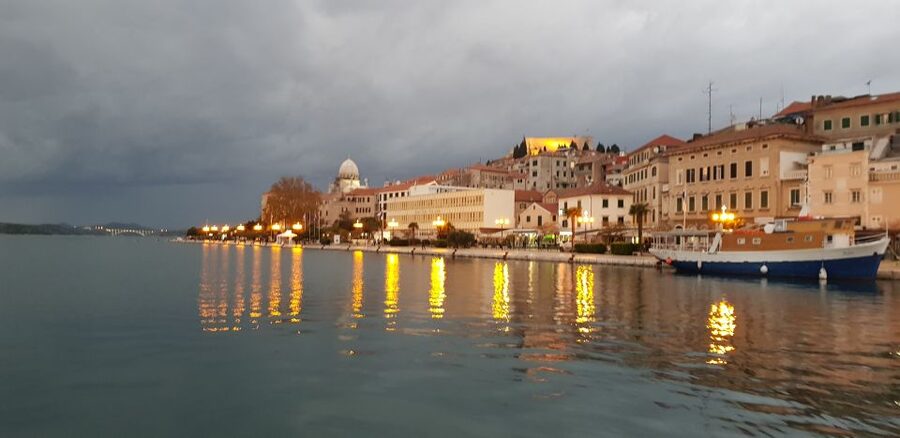
- A night-time view of Šibenik: The old town takes on a quieter, more atmospheric character after dark.
- A detail-focused local guide: Guides including Irena, Mariana, and Marilea are praised for clear explanations, humor, and an obvious affection for their home city.
- Major sights plus lesser-known corners: The walk includes St. James’ Cathedral, Four Wells, churches, squares, and narrow lanes.
- A surprising theater story: Šibenik’s Croatian National Theater received electric lighting in 1896, unusually early in the history of theaters.
- A strong choice for first-time visitors: You get historical orientation, architectural context, and ideas for exploring independently afterward.
- Bring proper shoes: Cobblestones and old-town slopes make comfortable footwear essential.
Starting beside the lantern at Gat Krka
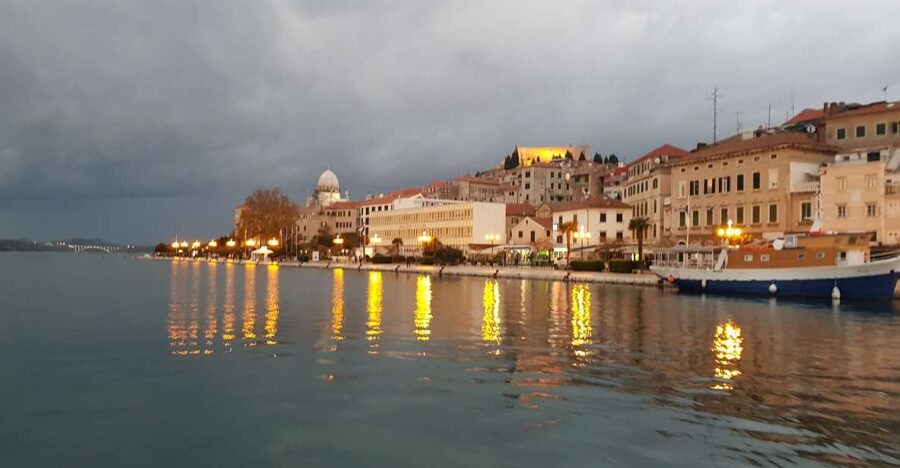
The meeting point is next to the lantern at the Gat Krka parking lot. Look for the guide wearing an orange cap, and arrive at least five minutes before the scheduled start.
This is a practical meeting place if you are coming into Šibenik from the waterfront or nearby parking area. Hotel pickup and drop-off are not included, so you need to make your own way there. Food and drinks are also separate, which makes sense for a walking tour that finishes in the center rather than at a restaurant.
The evening start matters here. Dalmatian towns can feel exposed and hot during the day, while sunset brings cooler air and softer light. You will still need to watch your footing, since old-town streets are made for history, not for perfectly smooth walking.
The duration is 90 minutes. That is long enough for a proper introduction without taking over your whole evening. You will not see every corner of Šibenik, but you should leave with a useful mental map and enough background to explore on your own.
More Walking Tours in Sibenik
- Private Sibenik Walking Historical Morning or Evening Tour
★ 5.0 · 93 reviews - Šibenik: Medieval Night Walking Tour
★ 5.0 · 19 reviews - From Sibenik: Private Walking Sibenik Sightseeing Tour
★ 4.9 · 15 reviews
Narrow lanes and squares from another era
The heart of the experience is a walk through Šibenik’s historic center. The route follows narrow, winding streets and leads into attractive squares framed by architecture from earlier centuries.
This is where a local guide adds real value. On your own, you may notice stone walls, carved details, bell towers, and old doorways, but you may not know why they matter. The guide connects these pieces and points out details that are easy to walk past.
The city’s Gothic-Renaissance character is especially effective in the evening. The reduced traffic and lower light help you imagine the old town as a working medieval and Renaissance center rather than simply a postcard setting. The walk is not just a parade of monuments. It is built around questions and stories, including why a church changed its patron saint, why a square has an unusual name, and how the city managed water in the Middle Ages.
That storytelling style is one of the tour’s strongest points. Irena is praised for bringing Šibenik to life and answering questions clearly. Other guides, including Mariana and Marilea, are also described as friendly, entertaining, and easy to follow. The repeated praise for humor matters because a long list of dates can make any old town feel like homework.
St. James’ Cathedral and Šibenik’s stonework
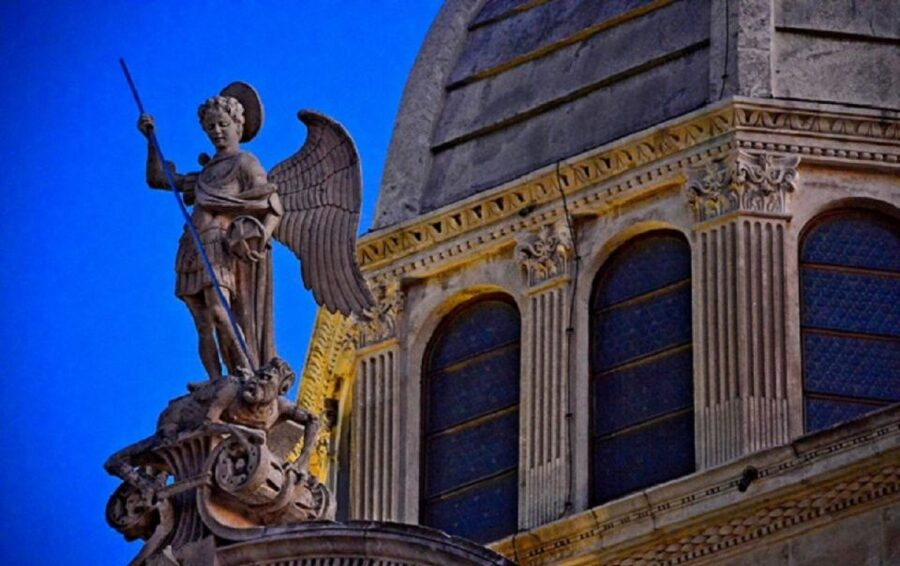
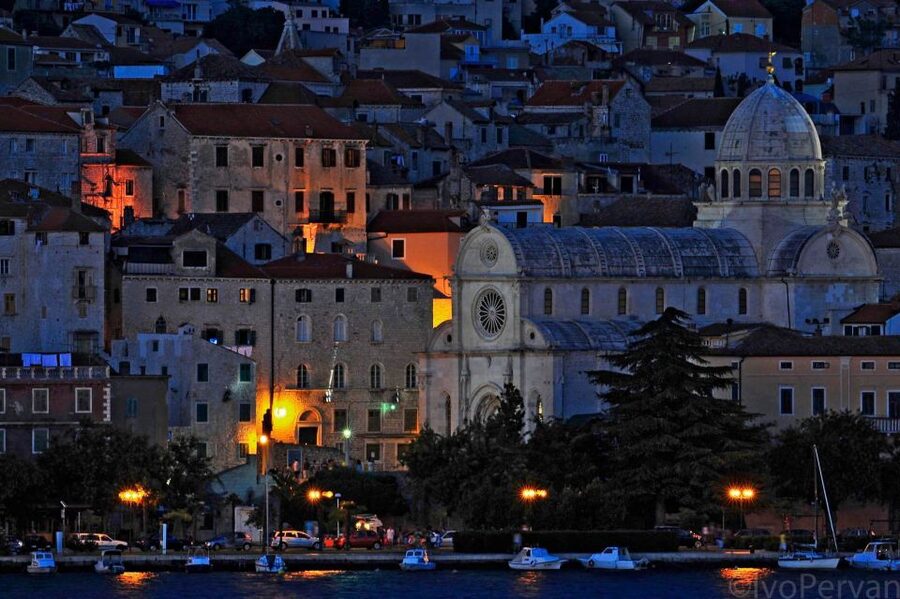
St. James’ Cathedral is the architectural centerpiece of the walk. It is entirely made of stone and is noted for its bold construction using stone slabs and ribs without binding material.
The cathedral is also known for its trefoil front façade and a row of 71 realistic sculpted portraits around the apses. Those faces are the kind of detail you may not study during a quick daytime visit, especially when you are busy taking in the building as a whole.
A guide can direct your attention to the parts that make the cathedral unusual. You will hear why it is important not only in Croatian architecture but also in the wider European story of Renaissance building. The point is not simply that the cathedral is old or impressive. Its structure and sculptural program give you specific reasons to look closely.
The evening setting may make the cathedral feel especially dramatic, although darkness can also make some details harder to see. If architectural detail is your top priority, you may want to visit again in daylight. If you want atmosphere and explanation together, the evening timing is a strong compromise.
Stories hiding inside Šibenik’s churches

Several churches appear along the walk, and each carries a different piece of the city’s story.
At the Church of St. Francis, you learn why it is considered special compared with other churches in Šibenik. The tour does not leave this as a simple stop for photographs. It uses the building to explain how religious institutions shaped the city.
The Church of St. John the Baptist had special importance during the Middle Ages and later changed its patron saint. That is the sort of detail that gives the old town a human edge. Buildings were not frozen in time. Their roles and names changed as Šibenik changed.
The Church of St. Krševan is identified as the oldest church in town. The Church of the Assumption of the Blessed Virgin Mary has its own story, including who uses it and who built its unusual bell tower. The guide also shares a memory aid for the artist’s name, which is a small but useful touch when you are trying to retain several unfamiliar Croatian names.
The Church of St. Barbara has four bells, and the tour explains when they ring. That may sound like a minor fact, but these details help you notice how the old town still has a daily rhythm. You are not only looking at stone façades. You are learning how churches function within the city.
Still Sibenik, at a slower pace:
- From Split: Krka National Park Tour
★ 4.7 · 2,359 reviews - Vodice: Krka Waterfalls National Park Boat Tour
★ 4.6 · 250 reviews - Split: Krka Waterfalls Guided Day Trip with Swim & Boat Tour
★ 4.5 · 170 reviews - Split: Krka National Park Full-Day Tour with Wine Tasting
★ 4.9 · 142 reviews
Four Wells and the question of water
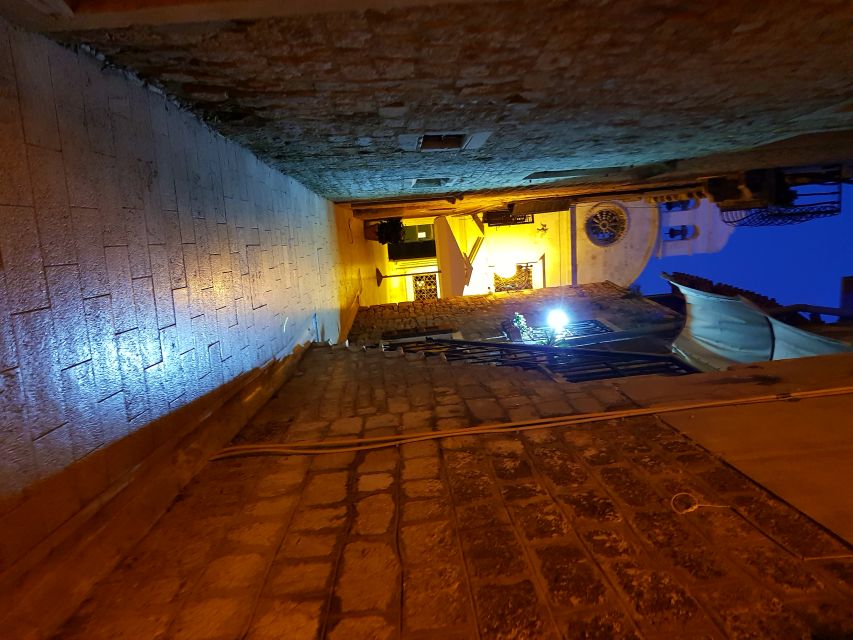
The public cistern called Four Wells offers a change of focus. Instead of concentrating on religion or architecture, the guide explains why the cistern was built during the Middle Ages.
Water management is one of the best subjects for a city walk because it reveals the practical problems behind grand buildings. A town could have fine churches and powerful rulers, but it still needed reliable water. Four Wells gives you a glimpse of the engineering and civic planning that supported life in the old city.
The tour also raises a curious question about Šibenik’s main city square and why it is not actually in the city. This kind of puzzle keeps the walk engaging. Rather than asking you to memorize a string of dates, the guide gives you odd facts that you can carry with you afterward.
King Petar Krešimir is another important figure. You will learn who he was and why he matters to Šibenik and its people. That local emphasis is useful because Croatian history can be hard to follow when you are seeing several Dalmatian towns in a short trip. The walk gives Šibenik its own identity instead of treating it as just another stop along the Adriatic.
The Croatian National Theater and early electric light
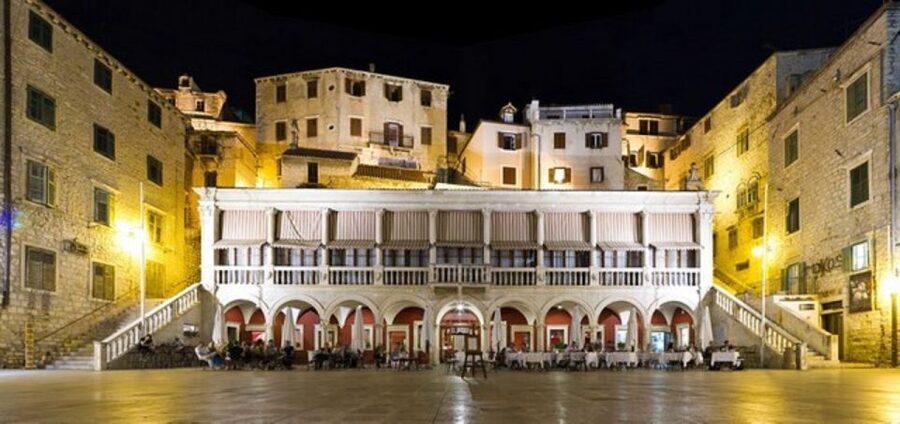
The Croatian National Theater in Šibenik adds a surprising modern note to the route. When it was built, it was considered the largest and most beautiful theater in southern Europe. In 1896, it received electric lighting, making it one of the first theaters in the world to do so.
This is an excellent example of why a guide can improve a walk. A theater façade may not tell you that Šibenik was connected to new technology at such an early date. The fact adds a layer of ambition and civic pride to the town’s story.
It also prevents the tour from becoming too focused on the medieval period. Šibenik is not only a place of old stones and church towers. Its story includes public culture, performance, and technological change.
What the evening setting adds
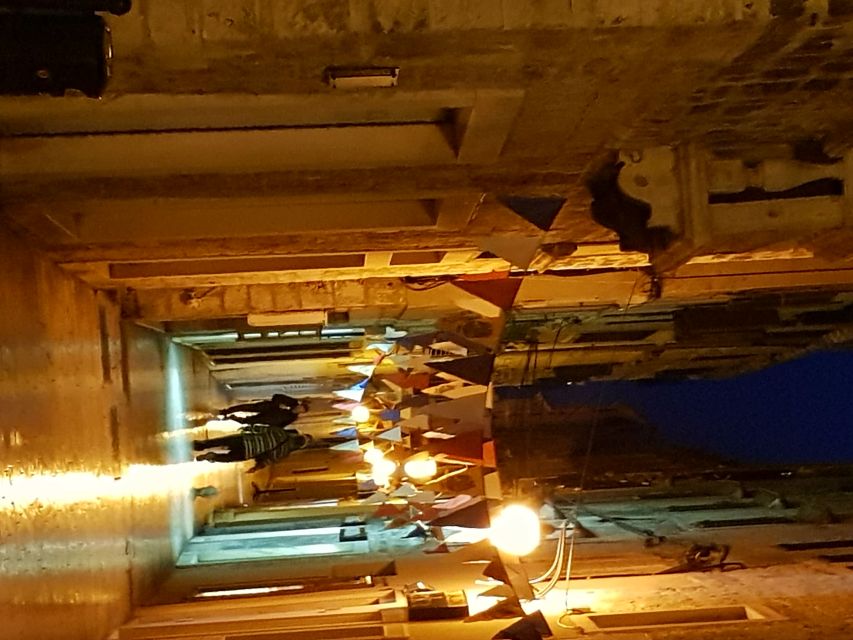
The tour is marketed as a way to see Šibenik in a different light, and that is more than a poetic description. Evening changes how you move through the old town.
You avoid the usual daytime heat and may encounter fewer crowds. The narrow streets can feel more intimate, and the squares become places to pause rather than simply spaces between sightseeing stops. The atmosphere is a major part of the appeal.
There is a trade-off. Low light can make it harder to inspect carved stonework or take sharp photographs. You may also find the route more demanding after a full day of sightseeing, especially if your legs are tired. I would schedule this early in your stay, when the information can help shape the rest of your time in Šibenik.
The tour finishes with the chance to find cafés and restaurants on your own. That is useful because the guide gives you a basic orientation, then leaves you free to choose your own dinner rather than steering you into a fixed meal arrangement.
Guide quality is the real value
The strongest reason to book is the guide. The experience depends less on transportation, special access, or elaborate extras and more on how well the person leading you explains the city.
Irena receives especially warm praise for her professional style, humor, and love of Šibenik. One description highlights her ability to answer questions, while another says she made the town feel alive. Mariana is also praised for being fun and clear, and Marilea for showing architectural details that many people would miss.
That pattern tells you what to expect from the best version of this tour: not a rushed march from one landmark to another, but a conversation with someone who knows the city closely. The guide points out fine details, explains local stories, and helps you notice things you might otherwise pass without a second glance.
The language options are English, German, and Croatian. If you have a question, ask it. The personal accounts of this experience place considerable emphasis on the guides’ ability to respond rather than simply recite prepared information.
Is $45 a fair price?
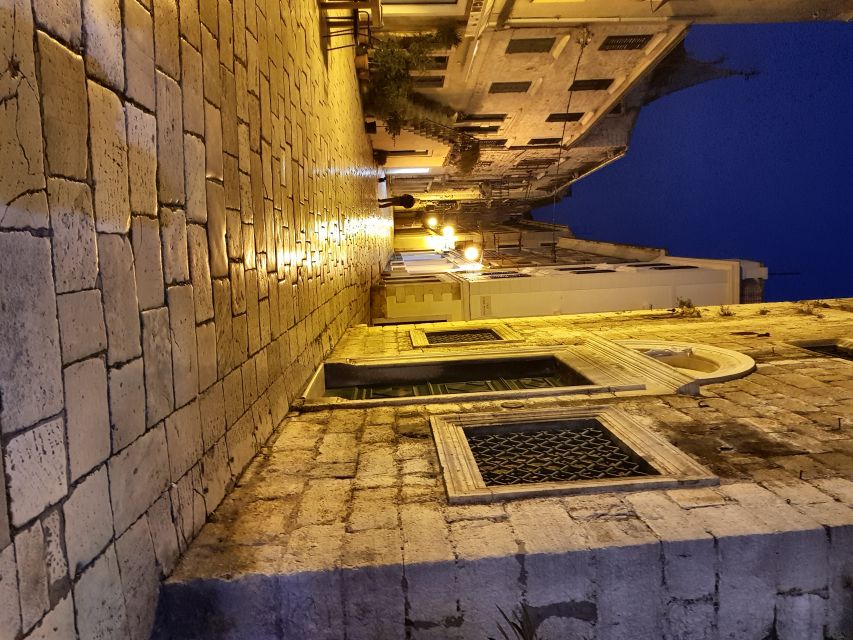
At $45, the tour costs more than walking through Šibenik independently, which is free. The question is what you want to get from your evening.
If you are comfortable reading signs, using a guidebook, and researching the cathedral and churches yourself, you may not need to pay for a guided walk. You can also choose your own pace and stop whenever you like.
I think the price is easier to justify if Šibenik is new to you, if you have limited time, or if you want a local explanation of the city’s less obvious details. Ninety minutes works out to about $30 per hour, and the fee covers a live guide rather than transport or admission to a separate attraction.
Since hotel transfers, food, and drinks are not included, factor in those costs separately. The tour is best viewed as a focused orientation, not a full evening package.
Who should book this Šibenik walk?
I would recommend it to first-time visitors who want to understand the old town before exploring independently. It also suits history fans, architecture lovers, and anyone who prefers a small city walk to a large bus excursion.
You will get the most from it if you enjoy asking questions and looking at details. The tour covers churches, civic spaces, water systems, a theater, a king, and the cathedral, so it has more range than a simple highlight walk.
It is less suitable if you need step-free access or find cobblestones and slopes difficult. The activity is specifically not suitable for people with mobility impairments, and comfortable shoes are essential.
The tour is offered in English, German, and Croatian. If you need hotel pickup, a meal, or a longer visit inside individual monuments, this will not provide those extras.
Practical tips for a smoother evening
- Arrive five minutes early at the lantern beside the Gat Krka parking lot.
- Look for the orange cap worn by the guide.
- Wear comfortable shoes with a secure grip.
- Bring a light layer if the evening turns cool.
- Keep your schedule open after the walk so you can choose a café or restaurant nearby.
- If you care about photographing stone details, consider seeing the cathedral again during daylight.
- Ask about the churches, Four Wells, and the theater. These are among the places where the guide’s explanations add the most value.
Should you book it?
Book this tour if you want Šibenik to become more than a pretty old town on your itinerary. The evening setting, local guides, and unusual stories about Four Wells, electric theater lighting, church bells, and St. James’ Cathedral give you a better sense of how the city developed.
Skip it if you prefer exploring alone, need an accessible route, or want included food and transport. For most first-time visitors who can manage uneven streets, the $45 price is reasonable for a well-led introduction, especially when you have only one evening to understand Šibenik.
FAQ
How long does the Šibenik evening walking tour last?
The tour lasts 90 minutes.
What language is the tour offered in?
The live guide can conduct the tour in English, German, or Croatian.
Where is the meeting point?
Meet next to the lantern at the Gat Krka parking lot. The guide will be wearing an orange cap.
How early should I arrive?
You should arrive at least five minutes before the scheduled start time.
Is hotel pickup included?
No. Hotel pickup and drop-off are not included.
Are food and drinks included?
No. Food and drinks are not included in the tour price.
What should I wear or bring?
Bring comfortable shoes, since the route uses cobblestone streets and includes old-town walking.
Is the tour suitable for people with mobility impairments?
No. The activity is not suitable for people with mobility impairments.
Can I cancel for a refund?
You can cancel up to 24 hours in advance for a full refund. The reserve-now, pay-later option is also available.
Just added around Sibenik
- The beauty of the Middle Ages-Šibenik★ 4.7 · 7 reviews
- Šibenik : Zipline Šibenik – Čikola Canyon★ 5.0 · 3 reviews
- Sibenik: Guided Walking Tour★ 5.0 · 8 reviews
- Šibenik walking tour in one hour!★ 5.0 · 6 reviews
- Sibenik: Full-Day Kornati National Park Boat Tour★ 5.0 · 19 reviews
- RIVIERA TOUR FROM ŠIBENIK, ZLARIN, PRVIĆ AND TIJAT★ 4.6 · 14 reviews
- Private Krka Waterfalls Tour from Split with stop in Trogir★ 5.0 · 5 reviews
- Panorama & Wine tour – Eco City Tour Šibenik★ 5.0 · 4 reviews
Walking Tours, compared.
Walking Tour of Split and Diocletian’s Palace
Read our review →

Krka Waterfalls tour with Trogir Walking tour and Krka panoramic boat cruise
Read our review →
City Walls Early Morning or Sunset Walking Tour
Read our review →Browse the lists this tour appears in