Reviewed · GUIDED
Controversies behind Split and Croatia-Anthropologist guide
Split makes history argue with itself. This two-hour walking tour uses the city center to examine Diocletian’s Palace, local identity, Ottoman-era conflict, and Croatia’s difficult 20th century. I like its unusual focus on people and politics rather than a simple list of dates and buildings. I also like the small group limit of 12, which gives guide Marin room to answer questions and use maps and images on his iPad.
The main consideration is that this is a walking tour with plenty of time spent standing. Some stops offer little shade, and the discussion reaches sensitive subjects, including nationalism, war, religion, and political division. If you want only cheerful sightseeing, this may feel serious. If you want to understand how Split became Split, the $35 price is fair.
In This Review
- Key points to know before booking
- Why this Split tour feels different
- Starting at King Tomislav Street and entering the palace
- Riva and the public life of Split
- Venetian Split at Trg Braće Radić
- Narodni trg and the ground beneath your feet
- Šperun and the neighborhood behind the postcard
- Tuđman Square and Croatia’s hardest lessons
- Ending at Matejuška with a modern view of Split
- What $35 buys you in practical terms
- Timing, comfort, and who should book
- Should you book Controversies behind Split and Croatia?
- FAQ
- How long does the tour last?
- How much does the experience cost?
- What language is the tour offered in?
- How many people can join the tour?
- Where does the tour start?
- Where does the tour end?
- Does the tour include Diocletian’s Palace?
- Is the tour suitable for most people?
- Can I cancel for a full refund?
- What happens if bad weather cancels the tour?
Key points to know before booking
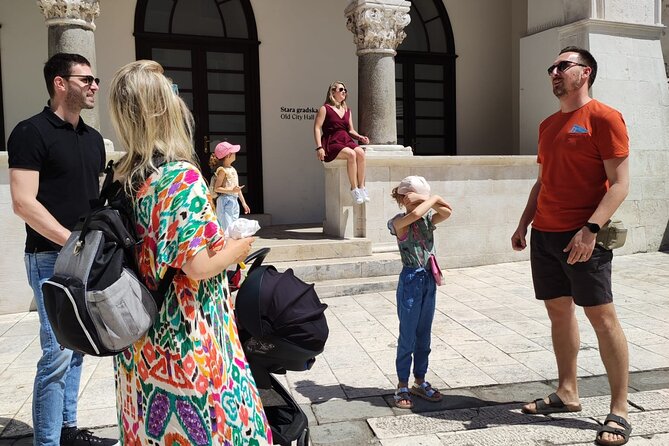
- Diocletian’s Palace is treated as a living argument: You look at the palace through the conflicts and local disputes attached to it across different periods.
- Marin teaches as much as he guides: His maps, visual material, humor, and willingness to answer questions are central to the experience.
- The route covers seven meaningful locations: You walk from King Tomislav Street through the palace and central squares to Riva, Šperun, Tuđman Square, and Matejuška.
- Modern Croatia receives serious attention: The final section addresses the late 20th century and issues that still divide Croatian society.
- A maximum of 12 people matters: This is small enough for a conversational feel rather than a guide speaking to a crowd.
- Expect a thoughtful walking class, not a photo stop marathon: The pace is steady, but the emphasis is on listening, discussion, and context.
Why this Split tour feels different

Most first visits to Split begin with Diocletian’s Palace, and that makes sense. The palace is the city’s great landmark, a maze of walls, lanes, squares, and later buildings. But a standard sightseeing walk can leave you with a pile of facts and little sense of how local people relate to the place.
This tour takes a different route. It treats the palace as a site that has been contested by local communities during every historical period. That idea gives the walk a clear purpose: you are not only looking at Roman remains, but asking who controlled them, who lived among them, and how their meaning changed.
I like that approach because it explains why Split can feel both ancient and thoroughly lived in. The experience also moves beyond the Roman period. You hear about Venetian rule, the Ottoman frontier, religious and social divisions, and the political struggles of modern Croatia.
Marin’s style is a major part of the appeal. He is described as warm, prepared, open to questions, and comfortable using maps and visual material on an iPad. He also brings humor to difficult topics. That balance matters here. A talk about war, identity, and political disagreement can become dry or heavy, but the guide’s teaching style keeps it moving.
The current score is 5 out of 5 from 59 ratings, with 100 percent recommending the experience. That does not mean every person will enjoy the same subject matter, but it does point to unusually consistent praise for the guide’s preparation, friendliness, pace, and ability to explain complicated ideas clearly.
A few more Split trips worth comparing
- Split: Krka Waterfalls Trip with Boat Cruise and Swimming
★ 4.8 · 10,519 reviews - From Split: Krka Waterfalls, Food & Wine Tasting Tour
★ 5.0 · 9,326 reviews - Blue cave, Mamma Mia and Hvar, 5 islands speedboat tour
★ 5.0 · 7,150 reviews
Starting at King Tomislav Street and entering the palace
The meeting point is at Ul. kralja Tomislava 12 in central Split. From there, the walk heads into the city center and gives you a framework for reading the palace and its surroundings.
The Diocletian’s Palace portion lasts about 35 minutes, making it the longest single stop. Admission is included where specified, but this should not be confused with a full museum tour or a long interior visit. The emphasis is on the site as a historical and social problem, with the guide explaining the controversies tied to it over time.
That focus is valuable because the palace is not an isolated ruin. It forms part of the city’s working center, and later generations built, adapted, and argued around it. You get a better sense of why an ancient imperial complex can still affect daily life and local identity.
The palace section is also where visual aids can help most. Maps and images on the guide’s iPad give you a way to compare periods and follow geography without relying only on verbal descriptions. If you learn best by seeing places in context, this is a useful feature.
You should expect to stand while listening. That is normal for a walking tour, but it can become tiring, especially in warm weather. Wear comfortable shoes, bring water, and consider booking a time that avoids the strongest midday heat if several departure options are available.
Riva and the public life of Split
The walk continues to Obala Hrvatskog narodnog preporoda, better known as Riva, Split’s traditional waterfront promenade. You spend about 15 minutes here, with no separate admission charge.
Riva is a good place to shift from architecture to public life. The promenade has long been connected with social activity and important historical events. In this setting, the guide can explain how public space reflects the city’s changing priorities and political moods.
I like this stop because it helps connect the old center to the city people use today. You are not simply told that Riva is attractive. You learn why it matters as a place where public life happens.
The open waterfront can also mean sun exposure. Shade may be limited, although the guide has made an effort to find shaded places when possible. This is another reason to bring water and protect yourself from the sun.
Venetian Split at Trg Braće Radić
Trg Braće Radić, an old Venetian square, receives about 15 minutes. This is where the tour turns to the turbulent period when Split was the last frontier fighting the Ottomans.
The useful part is not only the military story. The guide also examines how that period is viewed now and why it continues to shape local identity and politics. That present-day connection is the kind of detail you often miss when history is presented as a finished chapter.
You may find this section especially helpful if you know little about the competing influences that shaped the eastern Adriatic. The square gives the discussion a physical setting, while the subject shows how historical memory can remain active long after the fighting ends.
This is not a stop built around entering a monument. It is a listening stop in an open urban space. The experience works best if you are ready to pause, look around, and consider how the setting relates to the story.
Still Split, at a slower pace:
- From Split: Krka Waterfalls, Food & Wine Tasting Tour
★ 4.9 · 6,598 reviews - Split/Trogir: Blue Cave, Mamma Mia, Hvar and 5 Island Tour
★ 4.6 · 6,320 reviews - Blue Lagoon & 3 Islands Cruise with Lunch from Split
★ 4.5 · 5,756 reviews - Split: Old Town and Diocletian Palace Walking Tour
★ 4.9 · 4,727 reviews
Narodni trg and the ground beneath your feet
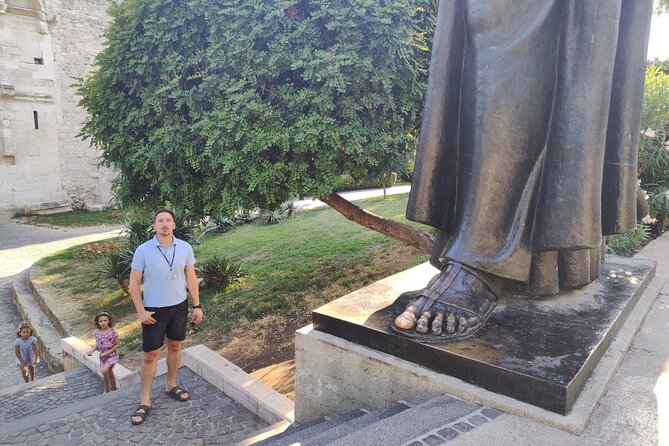
At Narodni trg, the guide discusses a surprising fact about the ground under the square: it was once an ancient graveyard, and human remains are still connected with the site.
The stop lasts about 15 minutes and is also used to discuss later events, including some infamous episodes. That combination gives the square more weight than its appearance might suggest. You see an ordinary public place, then learn about the layers of burial, public life, and conflict beneath it.
One strength of this tour is its attention to facts you could easily miss while walking alone. The story of the old graveyard is not necessarily visible from the surface, and the discussion of later events adds another layer to the square’s identity.
The material can be unsettling. The tour does not soften every subject into a pleasant anecdote, so you should expect frank historical discussion. That is part of its value, but it may not suit someone looking for a light introduction to Split.
Šperun and the neighborhood behind the postcard
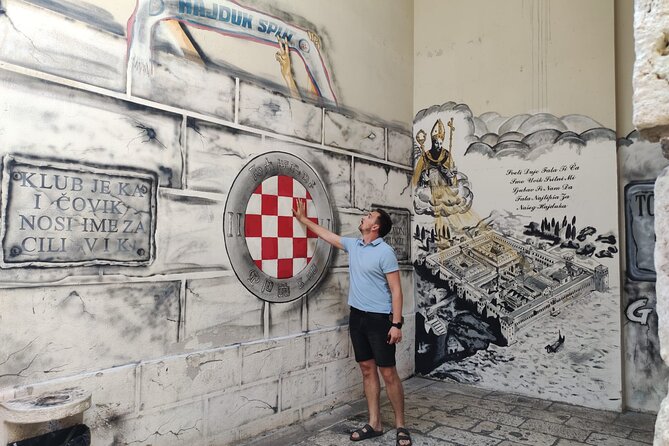
The route next reaches Šperun ulica, in a neighborhood known as one of Split’s most popular areas for visitor accommodation. The stop takes about 15 minutes.
The interesting question here is what existed before the neighborhood became a favorite base for visitors. The guide uses Šperun to explain the story behind the area, rather than treating it as a convenient backdrop for photos.
This is a useful reminder that accommodation districts have local identities of their own. When you stay in a place such as Šperun, you may notice the restaurants, lanes, and harbor access first. A local-history explanation gives you a better idea of what the neighborhood means within Split.
The stop also shows the tour’s balance. It does not remain inside Roman or medieval history. It looks at the city you are actually walking through now, including the areas shaped by modern tourism.
Tuđman Square and Croatia’s hardest lessons
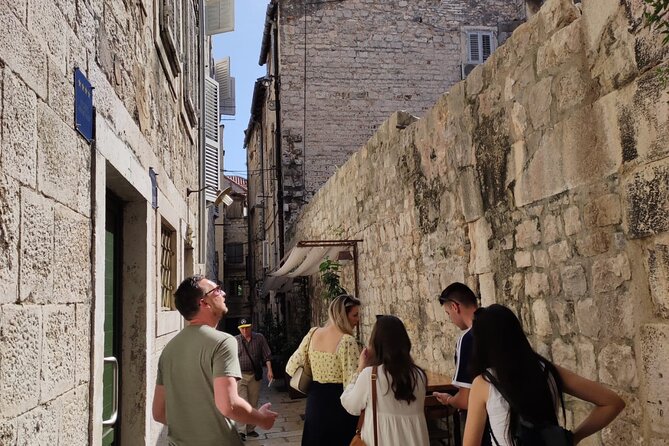
At Trg Franje Tuđmana, the tour moves into the late 20th century. The square is named after Croatia’s first president, and that name opens a discussion of the country’s turbulent recent past.
This is likely the most politically sensitive section. The guide addresses the period that many Croatian students find among the hardest parts of their history education, along with questions that still divide Croatian society.
For you, the value is direct: ancient stones can explain where Split came from, but modern political memory helps explain how the city feels today. The conversation about Franjo Tuđman places local streets within national debates about identity, government, war, and memory.
The tour does not appear designed to push one simple answer. Its appeal comes from a balance of ideas and an effort to show contradictions. If you enjoy asking questions and comparing viewpoints, this portion should be rewarding. If political history makes you uncomfortable, know that the subject is not a brief aside.
Again, expect to stand outdoors for around 15 minutes. A small group helps here because a difficult topic is easier to follow when you can ask the guide to clarify a point.
Ending at Matejuška with a modern view of Split
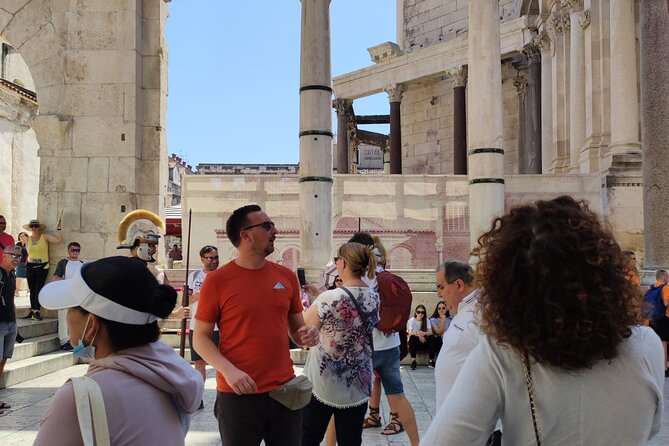
The final stop is Matejuška, where the tour ends after about 10 minutes. The location offers one of Split’s best-known views, and the guide uses it for final thoughts about modern Split.
This ending makes sense. After moving through Roman, Venetian, Ottoman-era, religious, neighborhood, and modern political subjects, you finish by looking at the city as a whole. The view provides a natural pause for considering how many different periods remain visible at once.
Admission is listed as included at the final stop, with no separate fee shown for the other public locations. The ending point is at Trumbićeva obala 2, so you finish near the waterfront rather than returning to the starting point.
That matters when planning the rest of your day. You may want to continue along the coast, stop for a drink, or use the waterfront as your next reference point. Since the tour is one-way, make sure you know where the route begins and ends before booking.
What $35 buys you in practical terms
At $35 per person, this is not the cheapest way to walk around Split, but it offers more than basic orientation. You receive roughly two hours of guided interpretation, a route through seven locations, an English-speaking guide, and a group capped at 12 people.
The strongest value comes from the subject matter. You are paying for connections between places, not simply access to them. A free walk through Narodni trg will show you the square. This experience explains the ancient cemetery beneath it, later events, and the social meaning that is harder to spot on your own.
The small group is also important. With up to 12 people, Marin can respond to questions and adjust explanations more easily than a guide managing a large crowd. The supplied visual material adds another layer without requiring you to carry a guidebook.
There are limits. The tour does not appear to include a long interior visit to every landmark, food, transport, or a large museum component. It is also not a private tour, and the amount of standing may bother people with limited stamina.
I consider the price reasonable for visitors who want serious context and personal interaction. It is less suitable if your priority is a quick list of monuments or the lowest possible cost.
Timing, comfort, and who should book
The experience is offered in English and has multiple tour times, which makes it easier to fit around a full day in Split. It is usually booked about 12 days ahead, so reserving early is sensible if your schedule is fixed.
The confirmation arrives at booking, and the tour is near public transportation. Service animals are allowed, and most people can participate. The group maximum is 12, but the supplied details do not promise step-free access or seating at each stop, so ask before booking if those points are important to you.
Good weather is required. If poor weather cancels the experience, you can receive a different date or a full refund. Otherwise, you can cancel for a full refund up to 24 hours before the start time. Cancellations or changes inside that window are not refunded or accepted.
I would choose this tour early in a Split visit if I wanted the rest of my sightseeing to have more meaning. It gives you names, conflicts, and social context that can change how you look at the palace, squares, and neighborhoods afterward.
Should you book Controversies behind Split and Croatia?
Book it if you want Split explained through people, memory, politics, and conflict, not only through beautiful stone. The tour is especially well suited to curious adults, students of history, and anyone who enjoys asking questions. Marin’s warmth, humor, maps, and clear teaching style appear to be the experience’s greatest strengths.
Think twice if you dislike standing, intense heat, or discussions of Croatia’s recent political divisions. You should also skip it if you want a relaxed highlights walk with minimal historical detail.
For the right audience, $35 buys a thoughtful and unusually grounded introduction to Split. You leave Matejuška with more than photographs. You have a better sense of why the city’s landmarks still matter to the people who live among them.
FAQ
How long does the tour last?
The tour lasts approximately two hours.
How much does the experience cost?
The price is $35 per person.
What language is the tour offered in?
The tour is offered in English.
How many people can join the tour?
The maximum group size is 12 people.
Where does the tour start?
The meeting point is Ul. kralja Tomislava 12, 21000 Split, Croatia.
Where does the tour end?
The tour ends at Trumbićeva obala 2, 21000 Split, Croatia, near Matejuška.
Does the tour include Diocletian’s Palace?
Diocletian’s Palace is part of the route, and admission is listed as included for that stop.
Is the tour suitable for most people?
Most people can participate, and service animals are allowed. The experience involves walking and standing, so you should consider your own comfort and mobility.
Can I cancel for a full refund?
Yes. You can cancel at least 24 hours before the start time for a full refund.
What happens if bad weather cancels the tour?
If poor weather causes the cancellation, you will be offered another date or a full refund.
Just added around Split
- Walking Tour Split★ 4.7 · 61 reviews
- Unique vintage Tomos moped tour Split – Back to the ’80s★ 4.8 · 17 reviews
- Trogir: White Lagoon, Maslinica & Blue Lagoon Speedboat Tour★ 4.8 · 11 reviews
- Essential Diocletian’s Palace Tour for First-Time Visitors★ 4.8 · 19 reviews
- Trogir; Private walking tour of higlights of Trogir★ 4.7 · 3 reviews
- Trogir: Old Town Guided Walking Tour★ 4.6 · 76 reviews
- Split: Trogir Open Top Bus Trip + Free Split Walking Tour★ 4.1 · 17 reviews
- TROGIR: Blue Lagoon & 3 Islands Half-day Speedboat tour★ 4.6 · 28 reviews
Guided, compared.


Plitvice & Rastoke Guided Day Trip with Ticket
Read our review →
Plitvice Lakes Guided Tour with Entry Tickets
Read our review →
Plitvice Lakes National Park Guided Day Tour from Split
Read our review →
Rastoke & Plitvice Lakes Guided Tour with Ticket
Read our review →