
Reviewed · VIP
Best of Split & Trogir: Private VIP Tour with Local Guide
Ancient stones, two remarkable towns. This six-hour private tour links Split’s Roman core with Trogir’s Venetian streets, giving you a focused introduction to central Dalmatia without the usual group shuffle. I like the private format, since only your party takes part, and I like the chance to visit both Diocletian’s Palace and UNESCO-listed Trogir in one day. The main drawback is cost: at $228.78 per person, it makes the most sense for a small group that values personal attention.
I also appreciate the local perspective. Kristina has been praised for her clear explanations, personal stories, and pride in keeping local traditions alive. Andrea has helped parties move through crowded areas with ease, and one useful tip from a past departure is that going to Trogir first can make the day’s timing work better.
In This Review
- The key details at a glance
- Why this private Split and Trogir combination works
- Peristyle: the ceremonial heart of Diocletian’s Palace
- Saint Domnius and Jupiter’s Temple
- Gregory of Nin and Split’s living traditions
- The palace substructures below Split
- Trogir’s central square and civic life
- Cathedral of St. Lawrence: several centuries in one building
- Kamerlengo Fortress and the maritime side of Trogir
- Čipiko Palace and Trogir’s noble past
- Price, private value, and the six-hour schedule
- Who will get the most from this tour
- Should you book the Split and Trogir VIP tour?
- FAQ
- How long does the private Split and Trogir tour last?
- Is this a private activity?
- Is pickup available?
- What language is the tour offered in?
- Are admission tickets included?
- Can I cancel for a full refund?
The key details at a glance
- Two historic towns in six hours: Split and Trogir are covered in one tightly arranged private outing.
- A guide for your group alone: The private setup allows questions, a flexible pace within the schedule, and easier movement through busy streets.
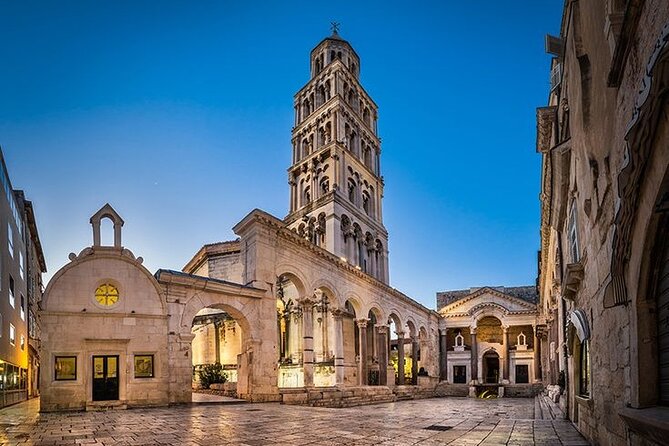
- Diocletian’s Palace from several angles: You see the Peristyle, Jupiter’s Temple, the cathedral area, and the palace substructures.
- Trogir’s medieval center: The route includes the main square, Cathedral of St. Lawrence, Kamerlengo Fortress, Town Loggia, and Čipiko Palace.
- Some admission fees are extra: Tickets are not included for the palace substructures, St. Lawrence’s Cathedral, Kamerlengo Fortress, or Čipiko Palace.
- English-language service with pickup offered: Confirmation arrives at booking, mobile tickets are accepted, and free cancellation is available until 24 hours before the start time.
Why this private Split and Trogir combination works
Split and Trogir are close enough to pair, but they feel different. Split grew around the palace of a Roman emperor and now has daily life threaded through its ancient walls. Trogir is smaller, more medieval, and shaped by centuries of Romanesque, Gothic, and Venetian building.
On your own, you could visit both in a day. The challenge is knowing what deserves your attention. A private guide gives structure to places that can otherwise blur together: columns, arches, statues, churches, and narrow lanes. You can ask why a Roman temple became part of a medieval city, or how a fortress fits into Trogir’s maritime past.
The six-hour length is useful for a first look. It is long enough to cover the major sights in both towns, yet short enough to fit into a busy Croatian itinerary. You should not expect a slow, scholarly day at every monument. The listed stops are generally planned in 15-minute segments, so the tour favors orientation and context over extended time inside each building.
That pace is also the tour’s practical strength. With a private party, your guide can keep the route moving and help you avoid wasting time at confusing entrances or crowded corners. Andrea has specifically been praised for navigating crowds smoothly, an advantage in Split when the palace streets are full.
A few more Split trips worth comparing
- Split: Krka Waterfalls Trip with Boat Cruise and Swimming
★ 4.8 · 10,519 reviews - From Split: Krka Waterfalls, Food & Wine Tasting Tour
★ 5.0 · 9,326 reviews - Blue cave, Mamma Mia and Hvar, 5 islands speedboat tour
★ 5.0 · 7,150 reviews
Peristyle: the ceremonial heart of Diocletian’s Palace
The Peristyle is the natural starting point for understanding Split. It sits at the crossing of the palace’s two main roads and was designed as the central open court of Emperor Diocletian’s imperial complex.
Look up at the colonnade and notice how formal the space feels. This was not simply a courtyard for casual strolling. It was meant to impress, and its scale helps explain the power Diocletian wanted his residence to project.
The stop is listed at about 15 minutes, with no admission ticket required. That makes it an easy first encounter with the palace. Your guide can give you the basic plan of the complex here, which helps you make sense of later stops.
The Peristyle is also one of those places where a short explanation adds a lot. Without context, you may see a handsome square. With context, you begin to read it as the meeting point between imperial ceremony, Roman planning, and modern Split.
Saint Domnius and Jupiter’s Temple
The Cathedral of Saint Domnius is one of Split’s most unusual buildings because of its age and continuity. It was consecrated around the beginning of the seventh century and is regarded as the oldest Catholic cathedral still in use in its original structure, without a near-total later rebuild.
The bell tower is not from the same period. It dates from the 12th century, a detail worth remembering when you look at the cathedral as a whole. The building brings several periods together in a compact part of the palace.
Nearby, the Temple of Jupiter shows another side of Diocletian’s residence. Built between 295 and 305, during construction of the palace, it was dedicated to the Roman god Jupiter and sits in the western section near the Peristyle.
These two sites help you see how Split changed without losing its Roman bones. A temple, a cathedral, and an imperial residence now occupy the same tight urban area. That layered use is one of the best reasons to take a guided walk here.
The provided timing does not specify an admission charge for these two stops. If entering a particular interior matters to you, ask the guide or provider what is covered before the tour begins.
Gregory of Nin and Split’s living traditions
The 8.5-metre statue of Gregory of Nin is a quick stop with a very recognizable local custom. Created by Croatian sculptor Ivan Meštrović, the statue is known for its shiny, worn toe.
Rubbing the toe is said to bring good luck. You can treat the custom seriously, play along, or simply admire how a public monument became part of the city’s daily visitor ritual. The stop takes about 15 minutes and has no admission fee.
This is also where a local guide can add something that a guidebook cannot. Kristina has been praised for sharing personal stories and explaining local traditions with warmth. She is a native of the area and takes pride in passing those traditions on, which gives this brief stop more meaning than a simple photo opportunity.
Still Split, at a slower pace:
- From Split: Krka Waterfalls, Food & Wine Tasting Tour
★ 4.9 · 6,598 reviews - Split/Trogir: Blue Cave, Mamma Mia, Hvar and 5 Island Tour
★ 4.6 · 6,320 reviews - Blue Lagoon & 3 Islands Cruise with Lunch from Split
★ 4.5 · 5,756 reviews - Split: Old Town and Diocletian Palace Walking Tour
★ 4.9 · 4,727 reviews
The palace substructures below Split
The Cellars of Diocletian’s Palace are among the strongest parts of the route. These underground halls once supported the emperor’s private apartments and are among the best-preserved ancient complexes of their kind.
The substructures matter because they reveal the palace’s original plan. Above ground, Split has been altered by homes, shops, cafes, and later construction. Below ground, the ancient layout is easier to read. You can see how the lower level supported the rooms above and how Roman engineering shaped the city that followed.
The stop is listed at roughly 15 minutes. Admission is not included, so budget for an extra ticket. That added cost is worth considering carefully. If you enjoy architecture and Roman engineering, this may be one of the most valuable paid portions of the day. If you prefer open-air streets and short visits, you may find the time limited.
I would ask how much time the group will actually have inside the substructures. The overall tour covers two towns, and six hours goes quickly once driving and transitions are included.
Trogir’s central square and civic life
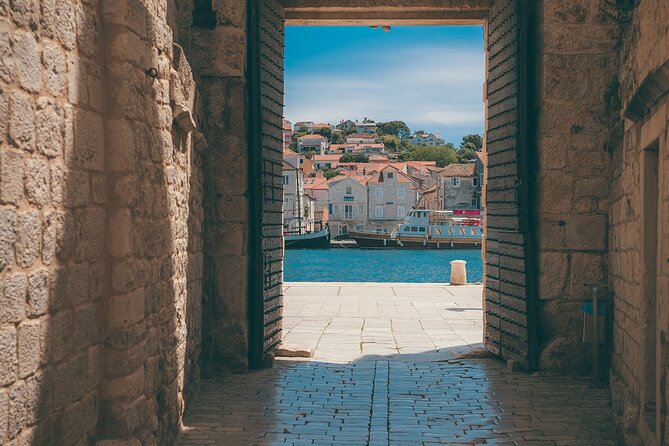
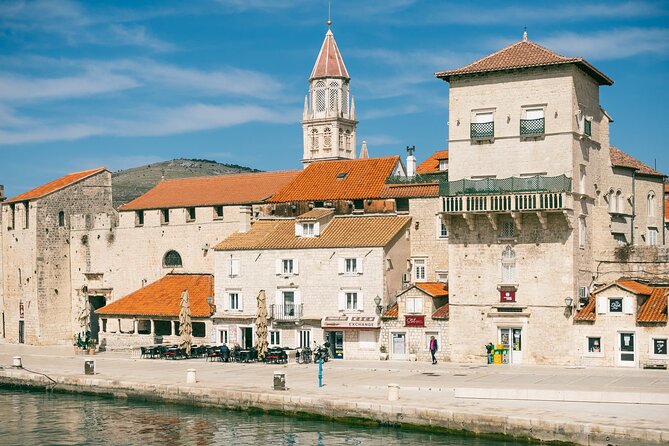
Trogir changes the mood. Its main square, also called John Paul II Square, is the focal point of the old town and is surrounded by major civic and religious buildings.
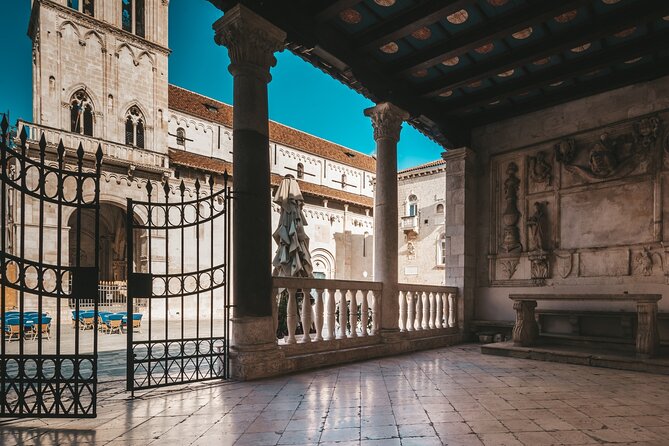
The square includes the Loggia and Clock Tower. The Loggia once served as a public courtroom, and its six pillars have decorated capitals. Two reliefs are carved into the wall, including The Relief of Justice by Nicholas Florentino.
In summer, a nearby coffee bar can partly block the pillars. That is a small but real point to keep in mind. You may not get a clean view of every architectural detail from every angle, but the relief remains visible.
The Town Loggia appears again as a separate stop in the route. It was a meeting place for medieval Trogir, where civic decisions were announced and legal matters were discussed. This detail helps you picture the town as a self-governing maritime center, not just a pretty collection of stone lanes.
The central square and Loggia are free to visit. The value here comes from interpretation. A private guide can connect the buildings to the town’s civic life and explain why Trogir’s compact center feels so different from Split’s palace district.
Cathedral of St. Lawrence: several centuries in one building
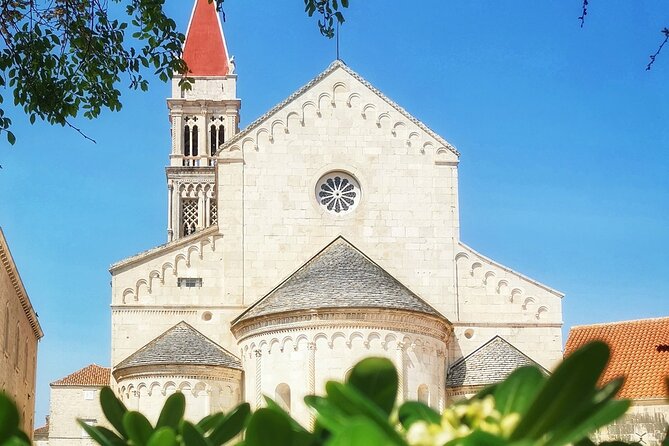
The Cathedral of St. Lawrence is Trogir’s main monument. It is a three-naved basilica built in Romanesque and Gothic styles, with construction lasting for several centuries.
That long building period is exactly what makes the cathedral interesting. Rather than showing one clean architectural style, it reflects the changing tastes and skills of Dalmatia over time. You can expect the guide to point out how Romanesque and Gothic elements meet within the same structure.
Admission is not included. The listed visit lasts about 15 minutes, so check what the paid entry covers and how much interior time is planned. If you want a slow look at architectural details, this may feel brief. If your goal is to understand Trogir’s main monuments and then continue through the town, the short stop fits the tour’s design.
Kamerlengo Fortress and the maritime side of Trogir
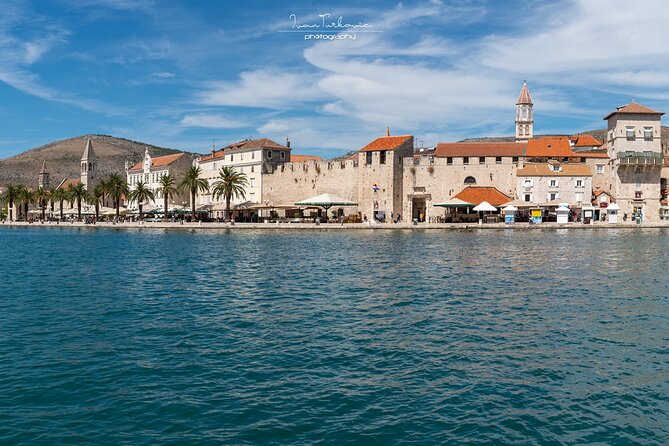
Kamerlengo Fortress sits by the coast and dates from the 15th century, when Venice controlled Trogir. Its purpose was practical: protect the town from attacks arriving by sea.
The fortress gives the route a useful change of focus. Churches and palaces tell you about faith and social power. Kamerlengo shows Trogir as a strategic port that had to defend its water access and trade routes.
The fortress offers views toward the old town, marina, and nearby islands. Admission is not included, and the stop is planned for about 15 minutes. That should be enough for a quick look and photographs, but not a long exploration of every corner.
If views are important to you, ask whether the tour enters the fortress or only pauses outside. The description says the fortress offers views, but it does not specify the exact access arrangement.
Čipiko Palace and Trogir’s noble past
Čipiko Palace is the largest residential palace in Trogir and an example of Gothic-Renaissance architecture. It belonged to the influential Čipiko family, giving you a glimpse into the wealth and status of the town’s noble class.
The palace is not included as an admission item, and the stop is listed at 15 minutes. You should think of it as part of the guided street tour rather than a long palace visit unless your guide confirms interior access.
This is a useful counterpoint to the public Loggia. The Loggia represents civic business and community decisions. Čipiko Palace represents private power, family wealth, and the social structure behind the town’s grand facades.
Price, private value, and the six-hour schedule
At $228.78 per person, this is not a budget sightseeing option. The price is easier to justify if you are traveling with family or friends and want a private guide rather than a large shared group. Group discounts are offered, so check the final rate for your party size.
The cost appears to cover the value of personal guiding and the convenience of combining Split and Trogir. It does not include every attraction ticket. You need to allow extra money for the palace substructures, St. Lawrence’s Cathedral, Kamerlengo Fortress, and Čipiko Palace.
The tour is booked, on average, 172 days ahead. That suggests you should reserve early if your dates are fixed, particularly during the busiest months. Confirmation arrives at booking, and a mobile ticket is accepted.
Pickup is offered, and the service is near public transportation. The exact pickup area and transport arrangement are not specified, so confirm those details before paying. The tour is offered in English.
The private format also makes this a good choice for mixed interests. One person can ask about Roman construction, another can focus on churches, and someone else can simply want the best route through the old towns. You are not tied to the questions or pace of a large party.
Who will get the most from this tour
I would recommend this experience to first-time visitors who want a clear introduction to Split and Trogir in one day. It is also a strong fit for families, couples, and small groups who prefer a guide focused only on them.
The route suits you if you enjoy history but do not want to spend an entire day in one museum. It gives you Roman remains, medieval civic buildings, Venetian defenses, churches, statues, and local customs in a compact package.
You may want something else if you prefer a relaxed pace, long meals, independent wandering, or extended time inside each paid monument. Fifteen-minute stops are efficient, but they can feel fast for serious architecture fans.
The guide can make a major difference. Kristina’s local stories and cultural pride sound especially useful at the Gregory of Nin statue and in Split’s living old town. Andrea’s skill at moving through crowds is valuable when the palace streets are busy. Since guides can vary, you may ask for a particular guide if that is possible.
Free cancellation is available if you cancel at least 24 hours before the start time. Changes or cancellations inside that window are not accepted for a refund.
Should you book the Split and Trogir VIP tour?
Book it if you want one private day covering two major historic centers, and if the price works for your group. The route gives you a strong first understanding of Split’s Roman foundation and Trogir’s medieval and Venetian character, with local explanation tying the pieces together.
I would especially choose it for a short stay in Split, a first visit, or a group that dislikes crowded excursions. Before booking, confirm pickup details, which interiors you will enter, and the extra admission costs. If you want leisurely exploration, plan a separate return visit to your favorite site.
For efficient sightseeing with personal attention, this is a well-focused choice. For the lowest possible cost or the slowest possible pace, it is less convincing.
FAQ
How long does the private Split and Trogir tour last?
The tour lasts approximately six hours.
Is this a private activity?
Yes. Only your group participates in the tour.
Is pickup available?
Pickup is offered. The available pickup details are not specified, so you should confirm the location and timing before the tour.
What language is the tour offered in?
The tour is offered in English.
Are admission tickets included?
Admission is not included for Diocletian’s Palace substructures, Saint Lawrence’s Cathedral, Kamerlengo Fortress, or Čipiko Palace. The Peristyle, Gregory of Nin Statue, Central Square in Trogir, and Town Loggia are listed with free admission. The information does not specify admission details for every other stop.
Can I cancel for a full refund?
Yes, if you cancel at least 24 hours before the experience’s start time. Cancellations or changes made less than 24 hours before the start time are not eligible for a refund.
Just added around Split
- Walking Tour Split★ 4.7 · 61 reviews
- Unique vintage Tomos moped tour Split – Back to the ’80s★ 4.8 · 17 reviews
- Trogir: White Lagoon, Maslinica & Blue Lagoon Speedboat Tour★ 4.8 · 11 reviews
- Essential Diocletian’s Palace Tour for First-Time Visitors★ 4.8 · 19 reviews
- Split: Trogir Open Top Bus Trip + Free Split Walking Tour★ 4.1 · 17 reviews
- Trogir; Private walking tour of higlights of Trogir★ 4.7 · 3 reviews
- Trogir: Old Town Guided Walking Tour★ 4.6 · 76 reviews
- TROGIR: Blue Lagoon & 3 Islands Half-day Speedboat tour★ 4.6 · 28 reviews
VIP, compared.

Elaphiti Islands On The Luxury Pirate Ship Karaka Dubrovnik
Read our review →
Luxury Blue Cave and Elaphiti Islands Small Group Tour
Read our review →
Luxury Blue Cave, Hvar and Vis Boat Tour from Split and Brac
Read our review →
Blue Cave & Hvar, 5 Islands Speedboat with Luxury Seats in Shade
Read our review →
Elaphite Islands Luxury Private Boat Tour with Cap Camarat 7.5
Read our review →
Bosnia Day Trip: Mostar and Kravice Waterfalls by Luxury Minibus
Read our review →
Elafiti Islands Private Luxury 4-Hour Speedboat Tour
Read our review →Browse the lists this tour appears in