

Reviewed · WALKING TOURS
Zadar: City Highlights Walking Tour in Polish
Sunset makes old stone glow. I like that this two-hour Polish walking tour follows Zadar’s main sights in a sensible line, from the Land Gate to the Sea Organ. I also like the timing: you see monuments in daylight, then watch the city change as evening arrives.
The main consideration is the required minimum of six full-price participants. If that number is not reached, the tour may not go ahead. You should also wear suitable clothing if you hope to enter a church, and bring water, a hat, and comfortable shoes.
- The route begins at the Land Gate, one of Zadar’s most striking entrances and an easy place to find your guide.
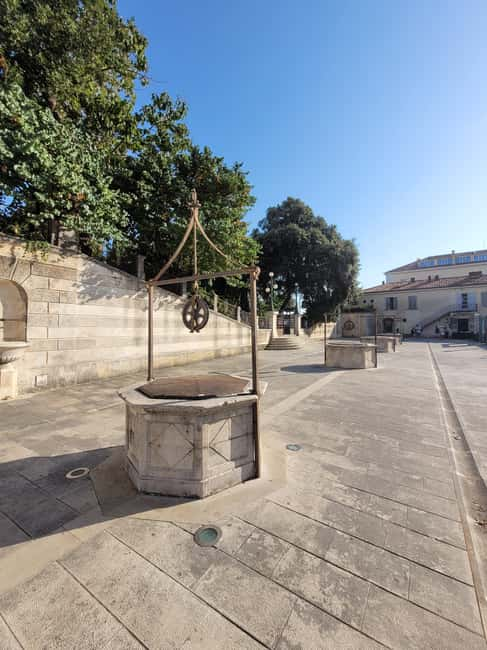
- Five Wells Square gives the walk a strong early stop, with a useful sense of how the old city managed water.
- The Roman Forum and Church of St. Donatus bring Zadar’s ancient Roman and medieval past into one compact area.
- The tour is conducted in Polish, with a live guide leading the group throughout.
- The final stop is the Sea Organ, where the walk ends with Zadar’s famous sunset and the sound of waves shaping the music.
- At $23 per person, the tour offers a focused introduction to central Zadar, especially if you want context rather than a quiet solo stroll.
In This Review
- Why an evening walk suits Zadar
- Starting at the Land Gate
- Five Wells Square and the city’s water story
- Passing St. Szymon before National Square
- The Roman Forum and Church of St. Donatus
- Photographing Zadar as dusk arrives
- Ending beside the Sea Organ
- What $23 gets you
- Who will enjoy this Polish walking tour
- My take on the route and guide
- Should you book it?
- FAQ
- How long does the Zadar walking tour last?
- What language is the tour conducted in?
- Where does the tour begin?
- Where does the tour finish?
- Which main sights are included?
- Is the Sea Organ part of the tour?
- What should you bring?
- Is there a minimum group size?
- Can I cancel for a refund?
Why an evening walk suits Zadar
Zadar is at its best when you can see its old stone under changing light. An evening departure gives the tour a clear rhythm: begin at the city entrance, move through squares and monuments, and finish beside the sea as the sun goes down.
That timing matters. A midday walk can make historic stone feel flat and hot, while dusk brings out the color and texture of the buildings. You are not only collecting a list of sights. You are watching Zadar shift from a historic city into an evening meeting place by the water.
The tour lasts two hours, so it is long enough to cover the main center without taking up your entire day. I would place it early in your stay. It can help you get your bearings before you return to the places that catch your interest.
The route is on foot, with no transport included. That keeps the experience simple and keeps you close to the city’s details. It also means you should take the practical advice seriously: comfortable shoes, water, and a hat are useful, especially if the day has been warm before the evening begins.
Starting at the Land Gate
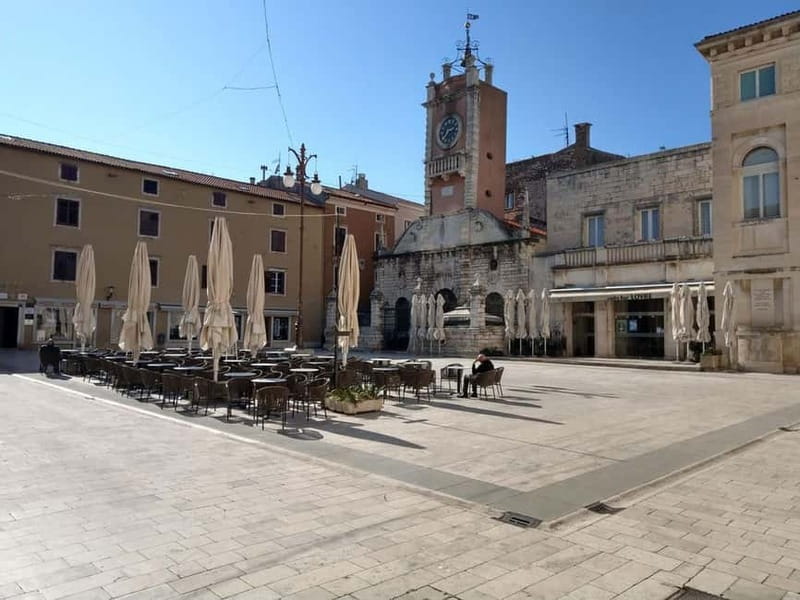
Meet your guide in front of the Land Gate, known locally as Kopnena vrata, at the entrance to the city. This is a good starting point because the gate gives you an immediate sense of Zadar as a fortified historic center.
The Land Gate is more than a place to gather. It is a visual introduction to the old city, and the tour uses it as a backdrop for photographs. As you begin, you can expect the guide to place Zadar’s long development into a wider story, covering changes over roughly 3,000 years.
That broad time span is one of the tour’s useful features. Zadar is not only Roman, not only medieval, and not only a coastal Croatian city shaped by modern tourism. Its identity has shifted many times. A guide can connect those layers as you walk, rather than leaving you to study each monument as an isolated object.
The meeting point is also practical for first-time visitors. You do not need to search for a restaurant, hotel, or obscure side street. Go to the entrance of the city and look for the guide in front of the gate.
More Walking Tours in Zadar
- Zadar: Guided Walking Tour
★ 4.8 · 445 reviews - Zadar City Tour 120min Walk
★ 5.0 · 203 reviews - Zadar Walking Tour sponsored by Gligora Cheese and deli.
★ 5.0 · 119 reviews
Five Wells Square and the city’s water story
From the Land Gate, the walk continues toward Five Wells Square. This stop gives the route a welcome change of scale. Instead of looking only at grand religious or Roman monuments, you get a place tied to the daily needs of the old city.
The name points to the square’s five wells. Their presence helps you think about how people once secured water inside a fortified town. That small detail adds practical meaning to Zadar’s walls and gates. Fortification was not only about defending a city. People also needed water, food, shelter, and working public spaces.
Five Wells Square is one of the places where you can pause for photographs. The Land Gate can appear in the background, giving you a picture that connects two parts of the route. I like this kind of stop because it makes a better travel memory than a quick look at a monument followed by another quick look at a monument.
The square also helps break up the walk. You are moving through central Zadar, but the route is not a race. Your guide can point out how the city’s structure changed over time, while you get a moment to look around and take in the setting.
Passing St. Szymon before National Square
The next section takes you past the Church of St. Szymon on the way to National Square. The church adds another layer to the walk and keeps the focus on the city as a place shaped by faith, public life, and changing periods of construction.
You should be ready for the possibility of entering churches. Appropriate clothing may be required, so avoid treating this as a beach outing even if Zadar’s coast is part of your wider trip. The activity does not promise entry into every church, but modest clothing gives you more flexibility.
National Square is a useful contrast to Five Wells Square. Here, the route moves from a place associated with water and fortification toward a major civic space. The guide’s role becomes especially helpful in connecting what you see with how the city has changed across the centuries.
The walk is in Polish, which is the central reason to choose this particular departure. If Polish is your preferred language, you can focus on the stories and explanations without translating them in your head. The guide is live, so the experience is not simply an audio recording played while you walk.
The Roman Forum and Church of St. Donatus
The Roman Forum is the historical center of gravity for much of the walk. Here, ancient Zadar becomes easier to picture as a Roman city, with public space, monumental buildings, and a layout that still shapes the old center.
The forum is especially effective in the evening. As the light drops, the surviving stone and surrounding buildings take on a different character. You can look at the remains as archaeological evidence, but you can also see how modern Zadar has grown around them.
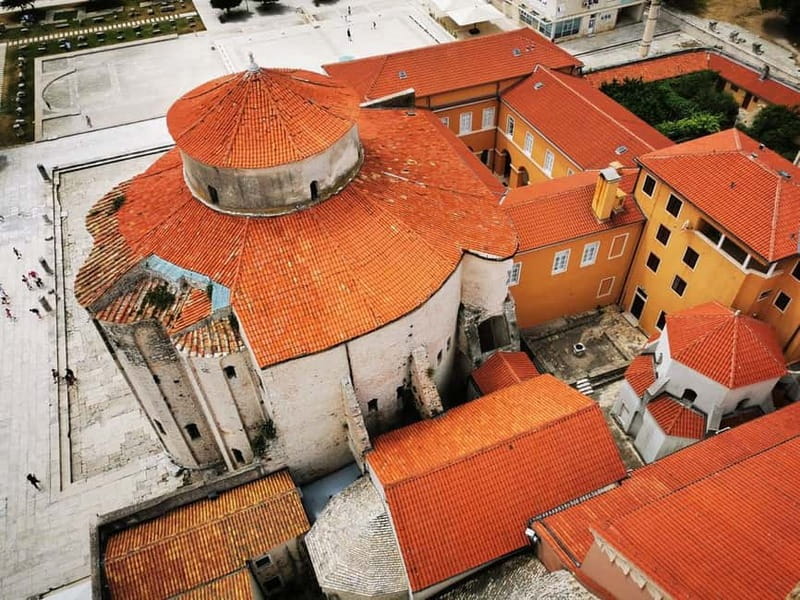
Nearby, the Church of St. Donatus provides one of the tour’s most recognizable photo subjects. Its distinctive form makes it easy to identify, even if you have only seen pictures of Zadar before arriving. The tour includes time to take photographs with the church in the background.
I would not expect a full archaeological lecture in a two-hour city walk. The value here is the connection between places. The Land Gate, Five Wells Square, National Square, Roman Forum, and St. Donatus are not scattered sights requiring separate trips. They form a walkable story in the old center.
That compact route also makes the tour a good choice if your time in Zadar is limited. You can see several major points without spending a day on a formal museum schedule. The tradeoff is that you will not get an exhaustive treatment of each site. This is an introduction, not a specialist study.
Still Zadar, at a slower pace:
- Zadar: Plitvice Lakes Guided Day Tour with Tickets
★ 4.9 · 3,148 reviews - Zadar: Kornati Boat Trip with Lunch and Swim Stops
★ 4.5 · 1,498 reviews - Zadar: Plitvice Lakes with Boat Ride and Zadar Old Town Tour
★ 4.9 · 1,368 reviews - Zadar: Kornati and Telašćica Full-Day Boat Trip with Lunch
★ 4.1 · 1,193 reviews
Photographing Zadar as dusk arrives
The tour’s evening setting is not just a scheduling detail. It is part of the experience. The guide leads you through the monuments while the sun is lowering, giving you a chance to photograph the same buildings under softer light.
The Land Gate, Five Wells Square, and Church of St. Donatus are specifically useful photo locations. Bring a phone or camera, but keep your attention on the walk too. A good guide can add the details that a photograph cannot show.
I like the balance between explanation and atmosphere here. You are learning how Zadar changed over 3,000 years, but you are also seeing the city in a moment that feels special. The light helps the route feel like an evening outing rather than a checklist.
There is one practical limit: sunset times change during the year, and the exact starting time depends on availability. Check the departure time before booking. You want the final approach to the Sea Organ to match the evening light, not leave you guessing about the timing.
Ending beside the Sea Organ
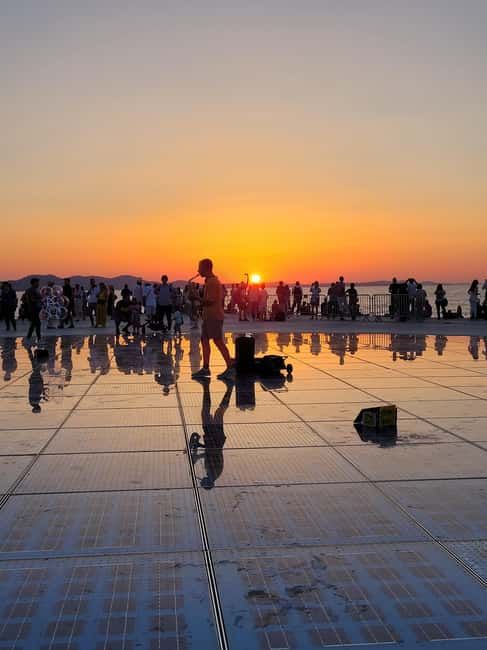
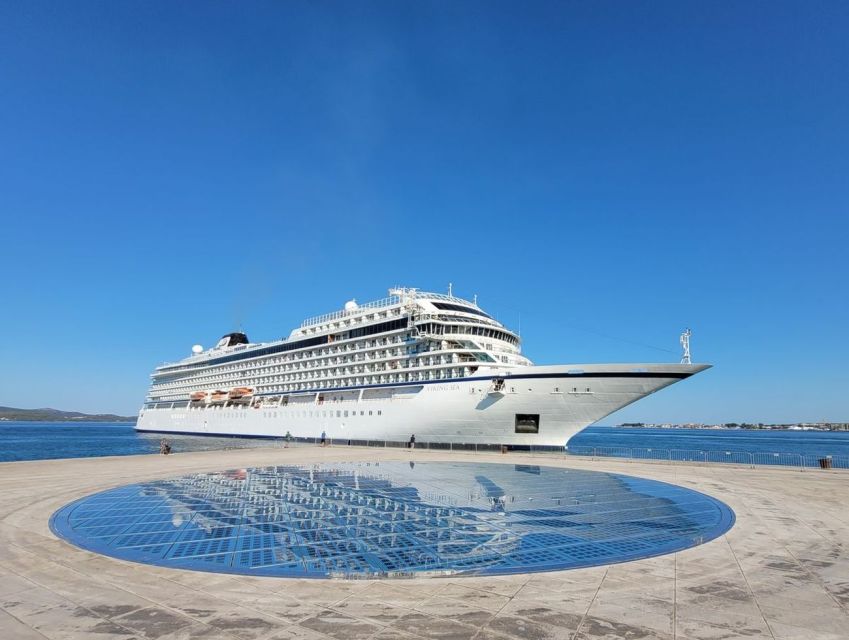
The walk finishes at the Sea Organ, one of Zadar’s most famous modern attractions. The instrument uses the movement of the sea to create sound, so the ending is not simply a view over the water. It is a place where architecture, waves, and listening come together.
This is the tour’s strongest finale. After walking through gates, squares, churches, and Roman remains, you arrive at the edge of the Adriatic for the sunset. The change from old stone to open water gives the two-hour route a satisfying shape.
You can expect to spend time admiring the sunset and listening to the Sea Organ. The experience provider describes the view as one of the world’s most beautiful sunsets, but you should treat that as enthusiastic promotion rather than a guarantee of perfect weather. Clouds, haze, or a late arrival can affect the show.
Still, the Sea Organ is a smart place to end. It gives you a memorable final image and leaves you in an area where you may want to linger afterward. The activity ends back at the meeting point, so you should confirm how the return works with your guide and plan your evening accordingly.
What $23 gets you
At $23 per person, this is reasonably priced for a guided two-hour introduction to central Zadar. The fee covers the walking tour and guide. It does not include transport, meals, or separately listed admissions.
The value depends on what you want. If you enjoy wandering alone and reading signs, you can see many of these central sights without paying for a guide. But you may miss the connections between them, especially the way Zadar’s Roman, religious, civic, and coastal settings fit together.
For a Polish-speaking visitor, the price is easier to justify. A live guide in your language can make the difference between recognizing a monument and understanding why it matters. The highly positive 4.9 rating from 34 reviews, along with direct praise for Łukasz Mrzygłód’s interesting storytelling, points to the guide’s explanations as a major strength.
The minimum of six full-price participants is the main financial and planning concern. If you are traveling alone or as a small party, the tour depends on other bookings. You can reserve now and pay later, and cancellation is free up to 24 hours in advance for a full refund. Those terms reduce the risk, but you should still check that the departure is confirmed.
Who will enjoy this Polish walking tour
I would recommend this experience most strongly to Polish-speaking visitors who want a first look at Zadar with a clear route and a local guide. It suits couples, families with older children, and small groups who prefer a short evening activity over a long daytime tour.
It is also useful for anyone who wants to photograph the old center in late light. The route gives you several named photo stops and finishes at the Sea Organ, so you get both historic buildings and the coast in one outing.
You may want something else if you prefer a slow, unstructured stroll. Two hours covering several central sights means the pace has a purpose. It is also not the right choice if you need a tour in another language, since the live guide speaks Polish.
Bring water and a hat, even for an evening departure. Wear shoes that can handle a walking route over the old city streets. If church interiors matter to you, dress appropriately from the start.
My take on the route and guide
The strongest part of this tour is its storytelling potential. The route is compact, but the subject is large: Zadar has changed over 3,000 years, and you move through evidence of that change in a short distance.
The direct praise for Łukasz Mrzygłód focuses on interesting stories, which is exactly what this itinerary needs. The monuments are important, but a good explanation gives them purpose. I would choose this walk for the guide and language as much as for the places themselves.
The tour also avoids a common problem with city walks: ending at an ordinary street corner with no clear final moment. The Sea Organ and sunset provide a natural close. You finish with sound, water, and changing light instead of simply being told that the tour is over.
The limitations are clear and manageable. The group needs at least six full-price participants, the exact starting time varies, and the walk does not promise extensive interior visits. If you understand those points, the experience offers a focused and attractive way to meet Zadar.
Should you book it?
Book this tour if you want Zadar’s main sights explained in Polish, prefer an evening schedule, and like the idea of ending at the Sea Organ during sunset. At $23, it is a fair way to put the city’s landmarks into context without giving up an entire day.
I would skip it if you want a private walk, a different language, or a very slow visit to each monument. For everyone else, especially first-time visitors with six or more full-price participants ready to join, the route offers a strong mix of history, photographs, and coastal atmosphere.
FAQ
How long does the Zadar walking tour last?
The tour lasts two hours. Starting times vary, so you need to check availability for the date you want.
What language is the tour conducted in?
The live tour guide speaks Polish.
Where does the tour begin?
Meet at the entrance to the city, in front of the Land Gate, also called Kopnena vrata.
Where does the tour finish?
The activity ends back at the meeting point after the walking route.
Which main sights are included?
The route includes the Land Gate, Five Wells Square, the Church of St. Szymon, National Square, the Roman Forum, the Church of St. Donatus, and the Sea Organ.
Is the Sea Organ part of the tour?
Yes. The walk ends at the Sea Organ, where you can admire the sunset and listen to the sea-created sounds.
What should you bring?
Bring comfortable shoes, a hat, and water.
Is there a minimum group size?
Yes. At least six participants paying full price are required for the tour to go ahead.
Can I cancel for a refund?
You can cancel up to 24 hours in advance for a full refund. You can also reserve now and pay later.
Just added around Zadar
- Zrmanja river & 3 Croatian seas boat tour★ 4.6 · 23 reviews
- Zadar: Ugljan and Preko Islands SpeedBoat Tour —with Drinks★ 4.9 · 81 reviews
- Zadar Private Walking Tour: German★ 5.0 · 16 reviews
- From Zadar: Romantic Sunset Sailboat Tour★ 5.0 · 5 reviews
- Zadar: Three Islands Private Boat Tour★ 5.0 · 80 reviews
- Zadar: Island-Hopping, Swimming & Snorkeling SpeedBoat Tour★ 5.0 · 33 reviews
- ✪ Zadar: Speedboat Tour to 3 Islands with Refreshing Drinks★ 4.7 · 14 reviews
- Zadar: Golden Hour Cruise RIB Tour Island Dinner Stop & Swim★ 4.8 · 73 reviews
Walking Tours, compared.

Walking Tour of Split and Diocletian’s Palace
Read our review →


Krka Waterfalls tour with Trogir Walking tour and Krka panoramic boat cruise
Read our review →
City Walls Early Morning or Sunset Walking Tour
Read our review →Browse the lists this tour appears in