
Reviewed · WALKING TOURS
Trogir walking tour with a local guide
Trogir rewards slow looking. This 90-minute walking tour packs the tiny island old town with cathedral carvings, Venetian courtyards, plague history, and stories from local guides who grew up here. It is a useful first look at one of Croatia’s most atmospheric historic towns.
I especially like the mix of major sights and small details, from Radovan’s remarkable portal to the bald-headed figure of Kairos. I also like the guides’ personal connection to Trogir. Daniela, Kristina, Blanka, Christina, Michaela, Mihaela, and Michael are all praised for making the past feel human. The main caution is timing: the advertised duration is about an hour and a half, but one experience ended after roughly 60 minutes.
In This Review
- Key points to know before you book
- Why Trogir makes a fine walking-tour town
- Starting at the cathedral and Radovan’s Portal
- John Paul II Square, Trogir’s outdoor living room
- Town Hall, St. Sebastian, and the Clock Tower
- The Town Loggia and the story of public life
- Cipiko Palace and the Venetian imprint
- North Gate, the museum, and Our Lady of Mount Carmel
- Kairos, the little figure with a big lesson
- Walking the Riva to Kamerlengo Castle
- What the $18.14 price really buys you
- Which kind of visitor will enjoy this walk most
- Should you book the Trogir walking tour?
- FAQ
- How long is the Trogir walking tour?
- How much does the tour cost?
- In which language is the tour offered?
- Where does the tour start?
- Where does the tour end?
- How large is the group?
- What happens if bad weather cancels the tour?
Key points to know before you book
- Radovan’s Portal gives you a close look at rare 13th-century Romanesque sculpture.
- Local guides add family stories and personal memories to the account of Trogir and Croatia.
- The route covers the old town’s main sights before ending along the palm-lined Riva.
- Kamerlengo Castle and Čiovo views provide a strong finish by the water.
- The group is capped at 15 people, keeping the walk smaller than a large coach excursion.
- The price is $18.14 per person, a fair amount for a focused introduction, though you should confirm the actual duration on the day.
Why Trogir makes a fine walking-tour town
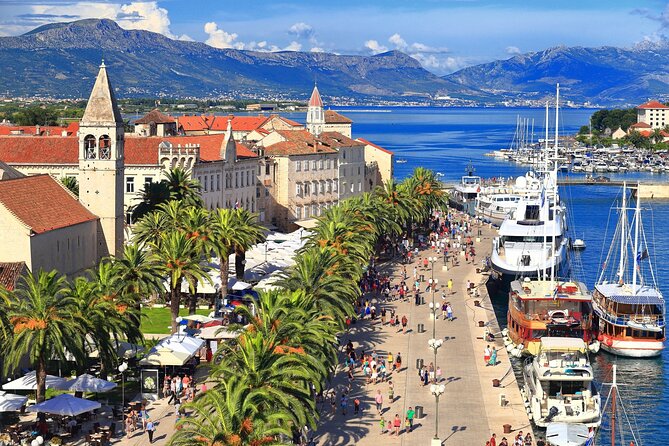
Trogir is compact, but it is not simple. Its old town occupies a small island, with narrow lanes, old stone houses, churches, palaces, public buildings, and fortifications crowded into a short walk. Without context, you can admire the pretty streets and miss the reasons they look the way they do.
That is where this tour earns its keep. A local guide can explain how Romanesque, Gothic, and Venetian influences overlap in the same few blocks. You are not just looking at old stone. You are seeing a town shaped by medieval builders, Venetian rule, religious devotion, trade, disease, war, and modern Croatian life.
The personal side is a major strength. Daniela is praised for connecting Trogir’s past with her family’s long roots in the region and with her experience growing up during the Homeland War. Kristina also brings family stories and memories of local life, including seeing her elementary school during the walk.
Those details give the town a human scale. You may forget a date or two, but you are more likely to remember how a local explains what it meant to grow up in this place.
More Walking Tours in Split
- Trogir: City Highlights Guided Walking Tour
★ 4.9 · 199 reviews - Trogir: Old Town Guided Walking Tour
★ 4.6 · 76 reviews - Split Old Town Walking Tour
★ 5.0 · 25 reviews
Starting at the cathedral and Radovan’s Portal
The walk begins at Ul. Gradska vrata 5, near one of Trogir’s historic gates. From there, the route moves toward the Cathedral of St. Lawrence, the town’s architectural anchor.
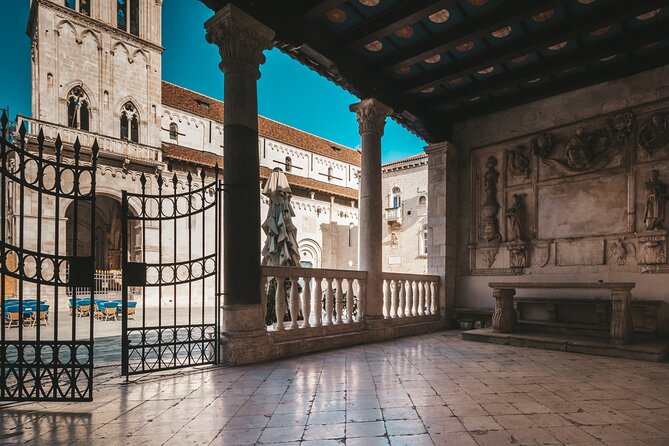
Construction began in 1213 and continued for five centuries. That long building period explains the cathedral’s mixed character. Its massive form has three naves, with Romanesque and Gothic elements layered together over time.
The most important detail here is Radovan’s Portal, the main entrance. Master Radovan, a medieval craftsman from Trogir, carved this extraordinary work in the first half of the 13th century. Look closely at the figures and decorative scenes. This is not merely a doorway. It is a stone lesson in medieval sculpture and religious storytelling.
The scheduled stop is about 10 minutes, with no admission charge listed. The tour information also notes that the cathedral’s bell tower offers wide views over Trogir, Čiovo, the mainland, and the Adriatic Sea. Ask your guide how the tower visit fits into the walk, since the stated route does not clearly promise tower admission.
That point matters if the panorama is high on your wish list. The street-level tour still gives you a strong introduction, but do not assume every interior or tower visit is included simply because the building appears in the route.
John Paul II Square, Trogir’s outdoor living room
Next comes John Paul II Square, or Trg Ivana Pavla II. This is one of those public spaces that makes Trogir feel relaxed rather than museum-like.
The piazza is framed by several important buildings, while cafe tables and umbrellas spread across much of the open space. I like this stop because it shows how the old town works today. You get architecture, but you also see people using the square for coffee, conversation, and a slow afternoon.
The official stop lasts about 15 minutes. That is enough time for your guide to point out the surrounding buildings and explain their place in Trogir’s civic life. It is not enough time to settle in for the coffee and ice cream that make the square so inviting, so mark it as a place to return after the tour.
This is also a good moment to look around before the route gets moving again. Trogir’s details can blur together after several churches and palaces. A broad square gives your eyes a break and helps you understand how the narrow lanes connect.
Town Hall, St. Sebastian, and the Clock Tower
The Town Hall comes next. Built in the 15th century, it has a stone courtyard decorated with coats of arms. The exterior staircase is particularly striking, with the elegant lines associated with Venetian architecture.
The stop is brief, about 10 minutes. That is suitable for an outside explanation and a quick look at the courtyard, but it may feel short if you want architectural details or photographs without rushing.
From there, the walk continues to St. Sebastian’s Church and Clock Tower. The church was built in 1476 by the citizens of Trogir in gratitude for deliverance from the plague. Its architect was Niccolò di Giovanni Fiorentino, also known in English as Nicolas of Florence.
This is a useful reminder that Trogir’s public buildings were shaped by fear and gratitude as much as by politics or wealth. The church is not just an attractive stop. It records how a deadly epidemic affected the town’s people and how they expressed relief.
The clock tower adds a practical civic note. Timekeeping, law, worship, and public gathering all met in this part of town. Your guide can help connect those functions instead of treating each building as an isolated photo stop.
More Walking Tours in Trogir:
- Private Trogir walking tour with LOCAL guide
★ 4.8 · 23 reviews - Discover Trogir: Guided Walking Tour of a Medieval Gem
★ 5.0 · 13 reviews - Trogir Old City Walking Tour
★ 5.0 · 8 reviews - Trogir Old Town History and Monuments Private Guided Walking Tour
★ 5.0 · 5 reviews
The Town Loggia and the story of public life

The Town Loggia is a covered space beside the Clock Tower, dating from the 13th century. In earlier centuries, citizens gathered here to discuss public matters. The local court also met here on certain days to announce laws and hear cases.
I find this one of the most useful stops because it reveals how medieval civic life took place in public. The loggia was not a grand palace reserved for rulers. It was a working space for announcements, debate, and justice.
The scheduled visit lasts around 10 minutes, and admission is free. Listen for the difference between a loggia and a modern town hall. The building’s open design reflects a time when public business happened in shared spaces, often within earshot of anyone nearby.
It is also a good example of why a guide helps in Trogir. A covered stone arcade can look decorative when you walk past it alone. Once you know its civic role, it becomes one of the town’s clearest windows into daily life.
Cipiko Palace and the Venetian imprint
The Great Cipiko Palace is a group of Romanesque buildings remodeled between the 15th and 17th centuries. Its later appearance reflects Venetian Renaissance taste, and Niccolò di Giovanni Fiorentino also worked on the project.
The south portal is a detail worth seeking out. The palace tells you how wealthy families adapted older structures rather than replacing the entire medieval town with something new. Romanesque foundations, later Renaissance decoration, and Venetian power all meet in one complex.
The stop is listed at about five minutes, so expect a concise explanation rather than a long interior visit. Admission is listed as free, but the route details do not promise entry into every building. You should plan on seeing the palace from public areas unless your guide tells you otherwise.
This stop also helps make sense of Trogir’s scale. The old town may feel like a maze of small streets, but the palaces reveal the money and status that once shaped those streets.
North Gate, the museum, and Our Lady of Mount Carmel

The itinerary also includes the North Gate, one of the two main historic entrances through the old town walls. The museum is housed in a series of palaces once owned by the Venetian Garagnin-Fonfogna family, and you encounter it as you enter through this gate.
The supplied route does not give a separate time or admission detail for the museum. That means you should treat it as a point of orientation unless the guide confirms that the group will go inside. If you want a museum visit, ask about it before the walk begins.
The Church of Our Lady of Mount Carmel sits near the waterfront promenade in the western part of the old town. Founded in the Middle Ages, it was historically associated with Trogir’s fishermen, craftsmen, and laborers.
This church adds a welcome social balance to the palaces and civic buildings. The tour is not only about officials and wealthy families. It also points toward the working people who depended on the sea and local trades.
If your visit falls on July 16, the church has a traditional evening procession with a statue of Our Lady. That event is not part of the walking tour, but the guide can help you understand why the church matters to the local community.
Kairos, the little figure with a big lesson
One of the most memorable details on the route is the bas-relief of Kairos. The young figure stands on tiptoe, with outstretched arms holding scales. A long lock of hair falls over his forehead, while the back of his head is bald.
The image carries a simple warning. When the right moment comes, seize it by the lock of hair. If you wait, Kairos flies away, and there is nothing to grasp at the back of his head.
This is exactly the sort of detail that can disappear if you explore alone. It is small, easy to miss, and far more interesting once you know the story. It also gives the tour a lighter, more memorable pause between larger monuments.
I would pay attention here, especially if you are tired of dates and architectural labels. A short myth can stay with you longer than a list of rulers.
Walking the Riva to Kamerlengo Castle
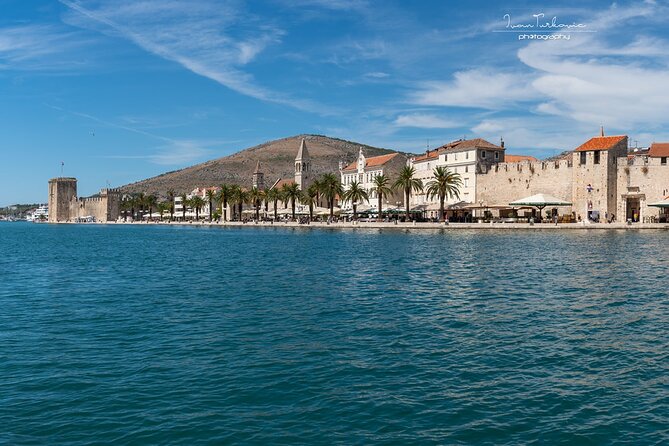
The final portion reaches the Riva, Trogir’s broad waterfront promenade. Palm trees line the route, and the straight, flat path offers views across the sea channel toward Čiovo.
This is an easy section physically, especially compared with the uneven lanes of the old town. It also changes the mood. After courtyards, churches, and narrow streets, you get open water and a wider sense of where Trogir sits.
The promenade stop is listed at about 10 minutes. Use it to take photographs, but also listen to the guide’s explanation of the relationship between the town, the channel, and Čiovo. The view helps you understand Trogir as a coastal settlement rather than a collection of monuments.
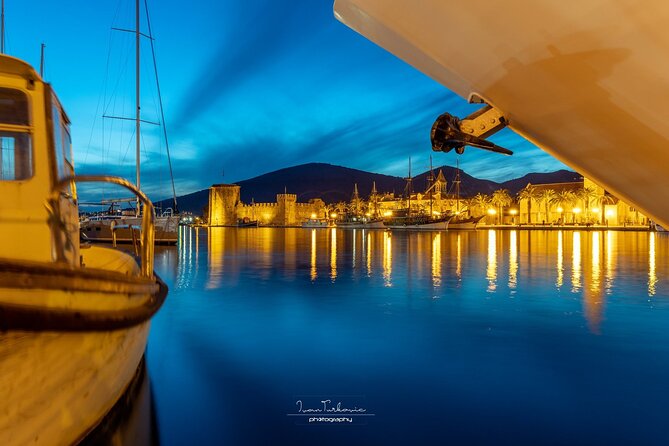
The tour ends on Obala bana Berislavića, near Kamerlengo Castle. This early 15th-century fortress occupies the end of the promenade on the corner of the small island holding the old town.
The castle is next to a local football pitch, a children’s playground, and stalls run by local tour operators. That mix is charmingly ordinary. A medieval fortress sharing space with a football field tells you that Trogir is a living town, not a preserved stage set.
The tour information does not list castle entry as part of the experience, so plan for an exterior look unless your guide says otherwise. The location is useful for continuing your day, since you finish near the waterfront rather than being returned to the starting gate.
What the $18.14 price really buys you
At $18.14 per person, this is priced as an affordable introduction rather than a full-day historical program. For an hour and a half, the value is good if you want a clear route, the main landmarks, and local interpretation without spending a large amount.
The strongest value comes from the guide, not from admission tickets. The listed stops are free, so you are paying for organization, explanation, and access to local perspective. Daniela’s family connection and accounts of growing up in Trogir are especially useful if you want more than dates and construction styles.
The small maximum of 15 people is another plus. It is large enough to keep the price down but small enough for questions and conversation. The guides are repeatedly praised for being warm, engaging, and able to mix historical facts with funny anecdotes.
There is one practical concern. The official duration is approximately 90 minutes, but one booking reportedly lasted exactly 60 minutes. That may have been an unusual circumstance, but it is worth keeping in mind if you are arranging a tight connection or planning around a fixed schedule.
Most people can take part, and the route is near public transportation. Still, this is a walking tour through an old stone town, so comfortable shoes and sun protection are sensible choices. One experience was described as very hot, while another took place on a cold evening. Trogir’s weather can change the feel of the walk considerably.
The tour is offered in English, uses a mobile ticket, and has confirmation at booking. It is non-refundable, except when poor weather forces cancellation by the operator. In that case, you are offered another date or a full refund.
Which kind of visitor will enjoy this walk most
I would choose this tour early in a Trogir stay. It helps you get your bearings in the maze-like old town and shows you which churches, squares, palaces, and waterfront spots deserve a second look.
It also works well as a first introduction for families and mixed-age groups. Daniela is praised for keeping people of different ages engaged, while other guides are described as friendly, patient, and lively. The route is short enough to suit a morning or early evening, though the heat can make midday less pleasant.
History fans will enjoy the Roman and medieval references, the Venetian architecture, and the stories behind the plague church and public loggia. You do not need specialist knowledge. A good guide explains the connections in plain language.
This may be less suitable if you want long interior visits, a detailed museum program, or a slow photography tour. The schedule moves through many stops in a short period, and several locations receive only five or 10 minutes.
The guide can also make a difference. The strongest accounts praise Daniela, Kristina, Blanka, Christina, Michaela, Mihaela, and Michael for combining facts with local experience. Since guides can vary, approach the walk as a shared introduction rather than expecting a scripted performance from one particular person.
Should you book the Trogir walking tour?
Yes, I would book it if you want a reasonably priced first look at Trogir, especially near the beginning of your visit. The route covers the cathedral, main square, civic buildings, palace, churches, Kairos relief, Riva, and Kamerlengo Castle, while local stories add a personal layer that a guidebook cannot easily provide.
I would be more cautious if your schedule depends on a full 90 minutes or if you expect every building to be visited inside. Confirm the timing and interior access at the start.
For most people, the balance is right: a small group, a low price, a compact route, and a guide who can explain why this little island town has so many layers. Leave time afterward for coffee in John Paul II Square, a return to the waterfront, or a closer look at the places you only glimpsed during the walk.
FAQ
How long is the Trogir walking tour?
The tour is advertised as approximately 1 hour and 30 minutes. One booking ended after about 60 minutes, so the exact duration may vary.
How much does the tour cost?
The listed price is $18.14 per person.
In which language is the tour offered?
The tour is offered in English.
Where does the tour start?
The meeting point is Ul. Gradska vrata 5, 21220 Trogir, Croatia.
Where does the tour end?
The tour ends at Obala bana Berislavića, 21218 Trogir, Croatia, near Kamerlengo Castle and the waterfront.
How large is the group?
The maximum group size is 15 people.
What happens if bad weather cancels the tour?
If poor weather causes the operator to cancel, you are offered a different date or a full refund. Otherwise, the experience is non-refundable and cannot be changed.
Just added around Trogir
- Trogir: White Lagoon, Maslinica & Blue Lagoon Speedboat Tour★ 4.8 · 11 reviews
- Trogir; Private walking tour of higlights of Trogir★ 4.7 · 3 reviews
- Trogir: Old Town Guided Walking Tour★ 4.6 · 76 reviews
- TROGIR: Blue Lagoon & 3 Islands Half-day Speedboat tour★ 4.6 · 28 reviews
- Trogir 1.5-Hour City Tour★ 4.4 · 37 reviews
- Trogir: Blue Lagoon, Maslinica, and Solinska Bay Boat Tour★ 4.9 · 88 reviews
- Private Transfer from Split Croatia Airport to Hotel★ 5.0 · 4 reviews
- Trogir Old City Walking Tour★ 5.0 · 8 reviews
Walking Tours, compared.
Walking Tour of Split and Diocletian’s Palace
Read our review →
Krka Waterfalls tour with Trogir Walking tour and Krka panoramic boat cruise
Read our review →
City Walls Early Morning or Sunset Walking Tour
Read our review →Browse the lists this tour appears in