
Reviewed · CITY TOURS
Pula city tour in German
Ancient stones, local stories, no giant flag. This German-language walk makes Pula’s Roman past easier to understand while adding useful insight into Croatian life, food, and customs. I like the personal format and Marina’s warm, conversational approach.
I also like the route’s small scale, with no more than 15 people, and the way it points out easy-to-miss details such as the Punishment of Dirce mosaic. The main limitation is simple: at 90 minutes, the tour gives you a smart introduction rather than a full study of Pula, and admission to the Arena is not included.
In This Review
- Key points at a glance
- A short German walking tour with a clear purpose
- Starting beneath the Roman Arena
- The market, included on the morning route
- Roman gates that are easy to overlook
- The Temple of Augustus and Pula’s Forum
- The mosaic most people walk past
- What Marina’s guiding style adds
- How much value do you get for $28.66?
- Timing, walking, and practical planning
- Who should choose this Pula tour?
- Should you book this German tour in Pula?
- FAQ
- How long does the Pula city tour in German last?
- What time does the tour begin?
- Where does the tour begin?
- Where does the tour end?
- Is admission to Pula Arena included?
- Is admission to the Temple of Augustus included?
- How many people can join the tour?
- Can I cancel for a full refund?
Key points at a glance
- Marina’s German-language guiding: Marina is praised for clear German, friendly conversation, and answering questions rather than delivering a stiff speech.
- A strong opening at Pula Arena: You get about 30 minutes on the Roman amphitheater, including its purpose, design, and role in public life.
- Small-group feel: The tour is capped at 15 people, a welcome alternative to a large city group.
- Good morning route: The 10:30 a.m. start allows the market stop, which is included only on the morning version of the walk.
- Small details beyond the headline sights: The route includes the Punishment of Dirce mosaic, Roman mausoleum, and city gates that are easy to miss alone.
- Useful local advice: Marina has offered restaurant suggestions and tips for the rest of an Istrian holiday.
A short German walking tour with a clear purpose

Pula city tour in German is designed to help you get oriented quickly. It lasts about one hour and 30 minutes, begins outside Pula Arena at 10:30 a.m., and ends at the city market on Flanatička Street.
The route links the city’s most important Roman remains with a few quieter details. You move from the Arena through the old center, passing Roman gates, the Forum area, the Temple of Augustus, a market, and the remains of a mausoleum.
I like this arrangement because Pula can feel scattered when you first arrive. The Roman monuments are not gathered in one single archaeological park. A guide helps you connect them into a story instead of seeing them as separate photo stops.
The German-language format is the main reason to choose this experience. Marina is repeatedly praised for speaking very good German and for explaining difficult subjects in a lively way. That matters at the Arena, where a few facts about Roman entertainment can turn a massive stone shell into a place with a human story.
The tour is described as private, but the stated maximum is 15 people. I would think of it as a small, personal walking tour rather than assume you will always have the guide entirely to yourself. That group limit is still much more comfortable than a standard large coach excursion.
A few more Pula trips worth comparing
- Medulin -Kamenjak 5h boat trip with lunch & drinks on Sandra Boat
★ 5.0 · 1,621 reviews - Full-Day Boat Tour of the Medulin Archipelago from Medulin
★ 5.0 · 1,389 reviews - 3hours all inclusive Sunset&Dolphin Tour from Medulin on Sandra
★ 5.0 · 1,130 reviews
Starting beneath the Roman Arena
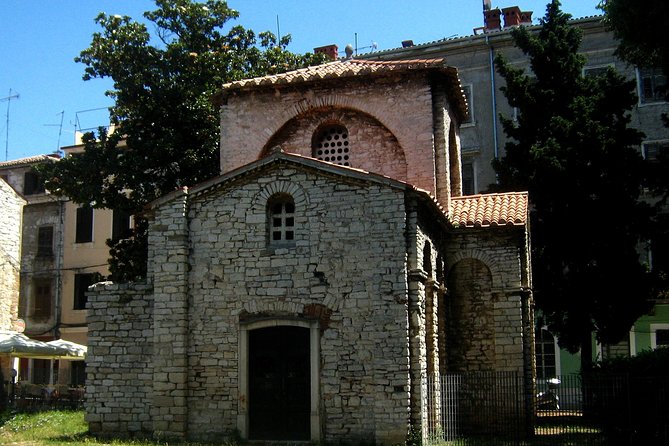
The tour begins at Pula Arena on Flavijevska Street. This is the natural place to start, since the amphitheater is Pula’s great visual marker and the stop receives the largest share of the tour, about 30 minutes.
The guide explains the Roman idea of bread and games, the public entertainment used by emperors to keep citizens content. You can expect discussion of how the building worked, why it was constructed, and the events that took place there.
This opening is especially useful if you have only seen photographs of Roman amphitheaters. Pula’s Arena is not just a smaller echo of Rome’s Colosseum. Its setting and surviving outer walls make it one of the city’s defining sights, and the guide’s explanation gives you a better sense of its original function.
The tour price does not include entry into the Arena. That is an important cost to note before booking. You can still learn about the building from outside, but if you want to walk inside, see the arena floor, and inspect the interior more closely, you will need to pay the admission fee separately.
That arrangement can work well. Some people want a quick outside explanation before moving through town, while others already plan to visit the amphitheater on their own. If the Arena is your main reason for coming to Pula, budget extra time and money for a separate visit.
The market, included on the morning route
From the Arena, the walk continues toward Gradska Tržnica Pula, the city market. The stop takes about 10 minutes and includes the green market and fish market.
This is one of the route’s most useful everyday touches. Roman monuments tell you about Pula’s distant past, but a market gives you a glimpse of how the city functions now. Local produce and seafood bring the tour closer to ordinary life than a procession of grand buildings would.
The market is included only on the guided tour in the morning. Since this tour starts at 10:30 a.m., you have the right timing for it. If you are comparing this walk with another departure, check the start time carefully, because the market is not part of every version.
The tour ends at the market on Flanatička Street 21. That makes the finish practical. You can stay in the area for food, continue exploring on foot, or use the guide’s restaurant advice as a starting point for lunch.
Roman gates that are easy to overlook
The next stops focus on parts of Pula that many people walk past without understanding. At the Arco dei Sergi, you see one of the city’s Roman gates. The stop lasts about 10 minutes and requires no admission fee.
A gate can look like a simple monument if nobody explains its place in the city. Here, the guide connects it with Pula’s Roman street plan and the way people once entered and moved through the city.
The Twin Gate receives another 10-minute stop. Its name is easy enough to remember, but the attraction is not only the Roman past beneath it. The guide uses it to show how layers of Pula’s story survive in the modern center.
The Gate of Hercules takes about five minutes. It is a small stop, but it adds variety to the route and gives the ancient city another recognizable marker. The Hercules reference also makes the site more memorable for children, who may connect more easily with a protective figure than with a date or architectural term.
The route includes the Roman Mausoleum as well. Only the lower remains of this first-century octagonal structure are visible, and the stop takes about five minutes. Do not expect a complete monument. Its value is in learning to recognize archaeological traces that you might otherwise dismiss as old stonework.
I appreciate this part of the walk because it teaches you how to look. Pula’s most rewarding details are not always the largest buildings. A local guide can point to a fragment, gate, or half-hidden structure and explain why it matters.
Still Pula, at a slower pace:
- Dolphin Watching & Sunset Boat Tour With Dinner and Drinks
★ 5.0 · 1,075 reviews - Pula: Kayaking,Snorkeling, Cliff jumping Tour with Wetsuit
★ 4.8 · 861 reviews - BOAT & KAYAK! Sea Adventure – Snorkeling & Cliff Jumps
★ 5.0 · 808 reviews - Pula: National Park Brijuni Island Visit & Dolphin Cruise
★ 4.5 · 788 reviews
The Temple of Augustus and Pula’s Forum
The Temple of Augustus receives about 15 minutes, making it the second major history stop after the Arena. It is described as the oldest and most beautiful Roman temple in Croatia, and its position in the Forum gives it a strong place in the city’s story.
The tour helps you read the temple as part of a public center rather than as an isolated facade. This is where a guide’s explanation earns its fee. Without context, you may admire the columns, take a photograph, and move on. With a clear account of its age and purpose, the building becomes part of a larger picture of Roman Pula.
Admission to the Temple of Augustus is not included. The supplied tour information does not give a separate entrance price, so check locally if you intend to go inside. The guided stop itself lets you understand the exterior and its setting.
Some people may find the temple stop too brief if they want a detailed architectural study. Fifteen minutes is enough for a focused explanation, but not for an extensive examination of every feature. That is consistent with the tour’s overall aim: give you a useful introduction, then leave room for your own exploring.
The mosaic most people walk past
One of the best details on the route is the five-minute stop at the Punishment of Dirce mosaic. It is easy to miss while walking through Pula, which is precisely why it earns a place here.
The mosaic shows how Pula’s ancient remains are sometimes tucked into the modern city rather than presented as a large, obvious attraction. A guide can make sure you do not pass it without noticing.
This is also the kind of stop that gives the walk a local feel. You are not simply being taken from one famous monument to another. You are being shown a detail that rewards attention, and you leave with a better sense of what to look for during the rest of your stay.
The stop is short, so you should not expect a long lecture on Roman mosaics or the complete story of Dirce. Instead, treat it as a well-chosen introduction to a piece of Pula that many independent visitors overlook.
What Marina’s guiding style adds
Marina is the named guide praised throughout the supplied feedback. The strongest pattern is not just accuracy or fluency. It is her personal manner.
She is described as friendly, open, and easy to talk with. The tour is presented as a dialogue, with room for questions and connections to the subjects that interest you. That can make a major difference in German, especially if you want to ask about daily life in Croatia, differences between Croatia and Germany, or practical matters for the rest of your stay.
Several comments praise her ability to keep information interesting without making it dry. That is useful in Pula, where the Roman period, Venetian influence, and Austrian rule can blur together if presented as a list of dates.
Marina has also been praised for contacting participants by WhatsApp the day before to confirm arrangements. That is a helpful touch, although you should still rely on the official meeting details: 10:30 a.m. at Pula Arena.
Families may find the style a good fit. The tour has been described as interesting for children, and the stories of the Arena and Hercules give younger listeners something concrete to follow. Still, the walk is history-led, so very young children may need encouragement during the shorter monument stops.
How much value do you get for $28.66?

At $28.66 per person, this is not the cheapest way to walk around Pula. You can see many exterior monuments without paying anything. The value comes from the German-language explanation, the route planning, and the details you might miss on your own.
The price is easier to justify if you are staying in Pula for only a short time. In 90 minutes, you get an overview of the Arena, market, gates, temple, mosaic, and mausoleum, then finish in a useful central location.
It is also good value for visitors who prefer conversation to audio guides. You can ask questions, request local suggestions, and adjust the discussion to your interests. Marina’s restaurant recommendation has been singled out as useful, which adds practical help beyond the historical tour.
The price is less attractive if you want a long, detailed archaeological visit. The Arena and Temple of Augustus are not included inside, and the route moves at a steady pace. You may want to return to those sites later and explore them independently.
The rating is 4.9 out of 5 from 34 ratings, with 100 percent recommending the experience. That is a strong result, though the small number of ratings means I would still pay attention to the tour’s clear limits: 90 minutes, a fixed route, and separate admission for the Arena.
Timing, walking, and practical planning
The tour uses a mobile ticket, and booking confirmation is sent at the time of booking. The meeting point is Pula Arena, Flavijevska ul., 52100 Pula, Croatia. The finish is at Market, Flanatička ul. 21.
You should arrive with comfortable shoes. The tour is a walking route through the city center, and the itinerary includes several stops close together. The supplied details do not state the exact walking distance, so I would allow a little extra time rather than arrive at the Arena at the last second.
Public transportation is nearby, and service animals are allowed. Most people can participate. The maximum group size is 15, which keeps the guide easier to hear and makes questions more practical.
The experience offers free cancellation if you cancel at least 24 hours before the local start time. Cancellations or changes within 24 hours are not refunded or accepted, so keep that deadline in mind when making plans.
Who should choose this Pula tour?
I would choose this walk if you want:
- A German-language introduction to Pula
- A guide who welcomes questions
- Roman history explained in plain terms
- A small group rather than a large organized outing
- A morning route that includes the market
- Local suggestions for food and the rest of an Istrian holiday
- A family-friendly introduction with stories children can follow
I would look elsewhere if you want a long visit inside the Arena, a specialist archaeology tour, or a route that includes every nearby sight. One four-star assessment found the walk informative and engaging but wished it were longer and included more close attractions.
That criticism is fair, but it also points to the right way to use the tour. Think of it as a well-paced orientation, not the final word on Pula. Afterward, you can return to the Arena or temple, spend more time at the market, and explore the center with a better sense of what you are seeing.
Should you book this German tour in Pula?
Yes, if you want a friendly, focused introduction in German and value stories over a long list of dates. Marina’s clear German, willingness to answer questions, and eye for overlooked details are the strongest reasons to book.
Before committing, remember the practical tradeoffs. The tour lasts only 90 minutes, the Arena and Temple of Augustus do not include admission, and the group may contain up to 15 people despite the private-tour wording.
For a first morning in Pula, the timing is especially useful. You get the Arena, the market, Roman gates, the temple, the mosaic, and the mausoleum, then finish where you can continue exploring or stop for lunch. If that sounds like the right amount of history and local orientation, $28.66 is a reasonable price.
FAQ
How long does the Pula city tour in German last?
The tour lasts approximately one hour and 30 minutes.
What time does the tour begin?
The stated start time is 10:30 a.m.
Where does the tour begin?
The meeting point is Pula Arena on Flavijevska Street in Pula, Croatia.
Where does the tour end?
The walk ends at the market at Flanatička ul. 21 in Pula.
Is admission to Pula Arena included?
No. Admission to the Arena is not included in the tour price.
Is admission to the Temple of Augustus included?
No. Admission to the Temple of Augustus is not included.
How many people can join the tour?
The activity has a maximum of 15 participants.
Can I cancel for a full refund?
Yes. You can cancel at least 24 hours before the local start time for a full refund. Cancellations or changes made within 24 hours are not refunded or accepted.
Just added around Pula
- Pula Sightseeing Walking Tour★ 5.0 · 3 reviews
- Pula: Sunset/Night-time Illuminated Transparent Kayak Tour★ 4.0 · 9 reviews
- Pula Essentials Walking Tour★ 5.0 · 62 reviews
- Pula Discover Scuba Diving Package★ 4.5 · 18 reviews
- Pula Boat Trip with Snorkeling★ 4.0 · 7 reviews
- Pula Kayak, Cliffs & Snorkeling Adventure★ 5.0 · 164 reviews
- Pula Kayaking at Blue Cave with Cliffs Tour and Snorkeling★ 5.0 · 4 reviews
- Pula Arena Amphitheater Admission Ticket★ 4.0 · 68 reviews
City Tours, compared.
City Walls Early Morning or Sunset Walking Tour
Read our review →
Dubrovnik Combo: Old Town & Ancient City Walls
Read our review →
Small Group Walking Tour City Center and WW2 Tunnels
Read our review →
Hop On Hop Off Panoramic bus – Zagreb City Tour
Read our review →
Browse the lists this tour appears in