
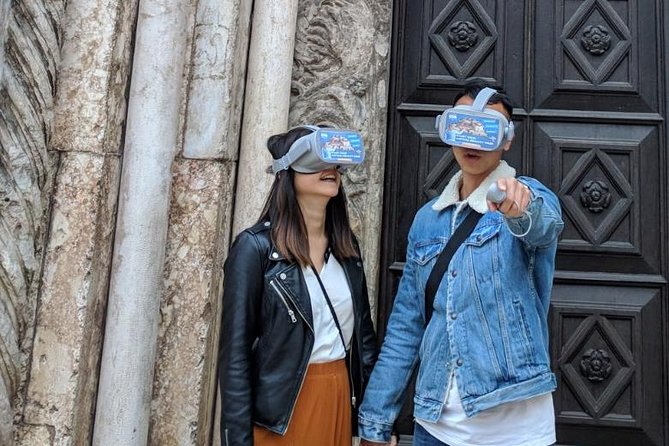
Reviewed · GUIDED
Zadar Guided Tour with Virtual Reality Experience
History becomes easier to picture here. This walking tour pairs Zadar’s old-town sights with virtual reality scenes that rebuild lost churches, ancient forums, and wartime streets. I like the access to places normally closed to the public, especially St. Krševan’s church and hidden parts of St. Anastasia Cathedral. I also like the guide-led format, which gives the technology some human help. The main drawback is clear: the VR graphics can feel dated, and a few scenes are little more than panoramic views.
At about two hours, this is a manageable introduction to Zadar’s past. The route moves through the historic center and ends at the Sea Organ, so you get a useful orientation without spending a whole day on it. The tour costs $36.04 per person, which is fair if you care about history and enjoy unusual presentation, but less attractive if you want a traditional walking tour with polished modern visuals.
In This Review
- Key points to know before booking
- Why the VR format works in Zadar
- Starting near Poljana Pape Aleksandra III
- St. Krševan: a church brought back to life
- St. Simeon and Zadar’s treasured chest
- Five Wells and the city’s changing defenses
- The Roman Forum from above and within
- Bell Tower and the hard story of World War II
- St. Anastasia Cathedral beyond the public areas
- Paseo Maritimo and the vanished market
- The Sea Organ and a medieval attack
- Is $36.04 a fair price?
- Who should book this Zadar experience?
- What to know before you go
- Should you book it?
- FAQ
- How long does the Zadar VR tour last?
- What time does the tour start?
- Where does the tour begin?
- Where does the tour end?
- Is the tour offered in English?
- How many people can join the tour?
- Can I cancel for a full refund?
Key points to know before booking

- The tour visits places you cannot fully enter: VR lets you see inside St. Krševan’s church, the cathedral baptistery, and the cathedral sacristy.
- The Roman Forum is reconstructed in three dimensions: You see it from above, walk through a recreated version, and face the ancient temple of Jupiter, Juno, and Minerva.
- Zadar’s wartime story receives real attention: Scenes at the bell tower and former market show the destruction caused by World War II bombing.
- The guide is the strongest part of the experience: Expect friendly help with the headset, clear English, local history, and practical tips about Zadar.
- The technology is useful but not cutting-edge: Some images feel basic, and certain panoramic scenes may look better with your own eyes.
- The route ends at the Sea Organ: This makes the tour easy to combine with an afternoon along Zadar’s waterfront.
Why the VR format works in Zadar

Zadar has an unusual problem for anyone trying to understand its past. The city has Roman ruins, medieval churches, Venetian walls, wartime gaps, and modern waterfront art, but many earlier layers have vanished. A normal walking tour can point to an empty space and explain what once stood there. VR gives you a chance to see that missing city.
The most effective scenes are the ones that restore buildings or show a major change over time. The Roman Forum is a good example. Today, you see scattered columns, stones, and fragments. With the headset, you look down from a hot-air balloon, then enter a reconstructed Forum surrounded by buildings and statues. The contrast helps you understand the size and purpose of the site.
The weakest moments are the simple panoramic views. At some stops, the headset mainly places a broad image around you. That can feel less useful than simply turning your head and looking at the real street. The software also has an older computer-game look in places, so you should book this for the historical content and the guide, not for high-end visual effects.
The guide matters because the equipment alone would not carry the tour. You receive help with the headset, and the guide adds facts at each stop. One especially useful quality is the willingness to give extra information at the individual sites rather than rushing through a fixed script.
A few more Zadar trips worth comparing
- Zadar: Plitvice Lakes Guided Day Tour with Tickets
★ 4.9 · 3,148 reviews - Zadar: Kornati Boat Trip with Lunch and Swim Stops
★ 4.5 · 1,498 reviews - Zadar: Plitvice Lakes with Boat Ride and Zadar Old Town Tour
★ 4.9 · 1,368 reviews
Starting near Poljana Pape Aleksandra III
The tour begins at the Magic Croatia travel agency at Poljana Pape Aleksandra III. The listed start time is 10:00 a.m., and the group can include up to 25 people. That is large enough to provide a lively setting, but still small enough for a guide to help with the devices.
You should arrive ready for a walking tour through the old town. The experience lasts about two hours, with roughly 10 to 15 minutes at each main stop. There is no separate admission charge at the listed sights, since the VR access and explanations form the heart of the experience.
The route is offered in English, with tours in multiple languages available. If language matters to you, confirm the language option when booking. The tour is near public transportation, and service animals are allowed. Most people can take part, but the supplied information does not specify detailed mobility conditions for every street or stop.
St. Krševan: a church brought back to life
The first stop introduces one of the tour’s best ideas. St. Krševan, or Chrysogonus, was built as a male Benedictine monastery church in 1175. Its Romanesque exterior is well preserved, yet the church is closed to the public and easy to miss.
That makes the VR visit more than a gimmick. You can see the monastery courtyard and look inside the church through the headset, places you would not normally explore. For anyone interested in medieval architecture, this is likely to be more satisfying than a quick exterior stop.
The time here is about 10 minutes. That is enough for the guide to explain the church and let you view the virtual interior, but not enough for a long architectural study. If this is the stop that most interests you, pay close attention while the headset is on and ask questions before the group moves on.
St. Simeon and Zadar’s treasured chest
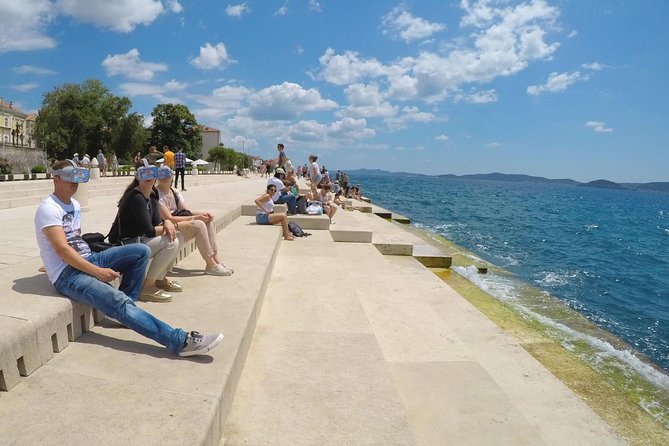
At St. Simon’s Church, the focus shifts to the city’s religious tradition and one of its most important objects: the silver-plated Gothic chest holding the relics of St. Simeon. He remains a favorite patron saint of Zadar.
The church visit combines a real historic setting with a look at its interior and treasure. This stop is less about rebuilding a vanished city than about helping you understand why the church matters to local identity.
The guide’s explanation is important here. A display like the chest can seem distant if you only hear its name and date. The tour gives it a place in Zadar’s religious story. Allow about 10 minutes.
Still Zadar, at a slower pace:
- Zadar: Kornati and Telašćica Full-Day Boat Trip with Lunch
★ 4.1 · 1,193 reviews - From Zadar: Plitvice Lakes with Boat Ride & Zadar Old town tour
★ 5.0 · 1,129 reviews - Zadar: Plitvice Lakes Full-Day Guided Tour with a Boat Ride
★ 4.7 · 807 reviews - From Zadar: Kornati National Park and Telascica Boat Trip
★ 3.8 · 788 reviews
Five Wells and the city’s changing defenses
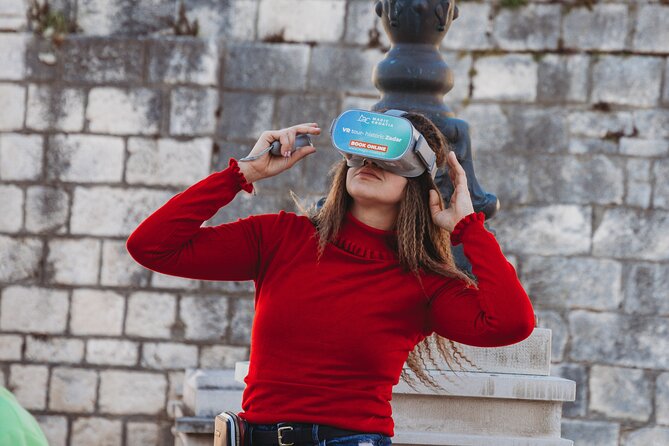
At the Five Wells, you get a compact lesson in Zadar’s layers of defense. The guide explains the Roman gates that once served as entrances to the ancient city, then points out the entrance to the medieval city and the later Venetian walls.
This is a useful stop because Zadar’s walls are not all from one period. The city changed hands and changed shape, and its defenses were rebuilt to meet new military needs. The short visit helps you separate Roman, medieval, and Venetian construction rather than treating every old stone as part of one era.
The stop lasts around 10 minutes. It is mainly an explanation and orientation point, so the VR element may feel less dramatic than at the Forum or the wartime scenes.
The Roman Forum from above and within
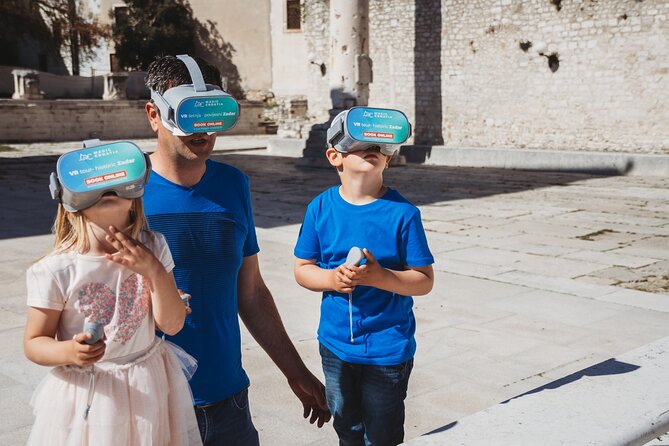
The Forum is the tour’s strongest VR stop. Built between the first and third centuries, it was the largest Roman Forum in Croatia. Today it survives as ruins in the old town, with fragments that can be difficult to read without help.
The first virtual view places you above the Forum, as if you were looking down from a hot-air balloon. An audio guide adds facts while you see the full arrangement. Then the scene places you inside the Forum, surrounded by reconstructed buildings and statues.
The final view brings you before the temple dedicated to Jupiter, Juno, and Minerva, dating from the first century BC. The explanation of ancient religious rituals gives the ruins a social purpose. You are not only seeing walls and columns. You are being shown how the space worked.
The best moment comes after you remove the headset. Some parts of the original construction are still in place after roughly 2,000 years. That contrast between the virtual reconstruction and the stones beneath your feet is exactly where the tour earns its price.
You spend about 15 minutes here. The virtual scenes can feel strange at first, especially when you look down from the balloon and see no legs or floor beneath you. Give yourself a moment to adjust. The odd viewpoint is part of the presentation, but it is not a fully realistic simulation.
Bell Tower and the hard story of World War II
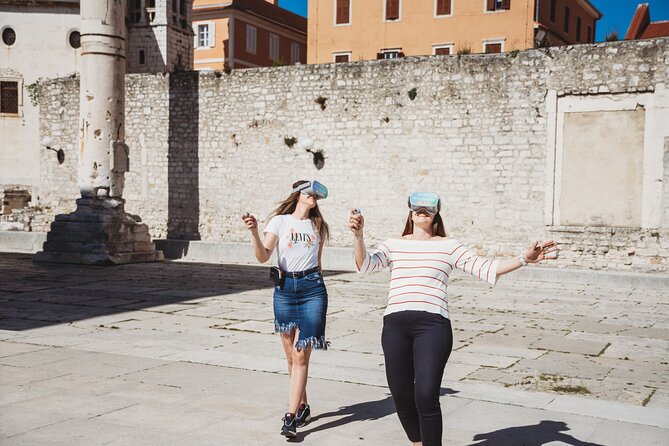
The bell tower stop presents Zadar from above during the World War II bombing. You see the old town as if you were standing at the top of St. Anastasia’s bell tower while airplanes attack. Buildings burn and collapse, and a final map shows areas that suffered heavy damage and no longer exist.
This is a serious shift in tone. The tour does not treat Zadar as an ancient postcard only. It shows how much of the city was damaged in the twentieth century, a fact that can be easy to miss when you admire the restored old town.
The scene lasts about 10 minutes. It may be intense for some people, particularly younger children, although the supplied information does not set an age limit. I would treat this as a historical explanation rather than a light visual effect. The point is to understand the scale of the loss.
St. Anastasia Cathedral beyond the public areas
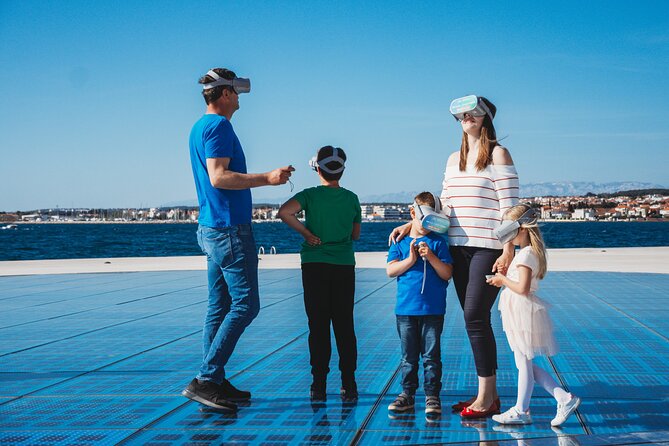
St. Anastasia’s Cathedral is the largest cathedral in Dalmatia and dates from the 12th and 13th centuries. St. Anastasia is one of Zadar’s protectors, and her relics are kept inside.
The VR component lets you see the cathedral interior, the baptistery, and the sacristy. The last two areas are closed to the public, so this is another place where the headset provides access that an ordinary walk cannot.
This stop should appeal to anyone who likes religious art, church architecture, or the less visible parts of historic buildings. The virtual visit also gives the guide room to explain St. Anastasia’s story rather than leaving you to guess why the cathedral carries her name.
Allow approximately 10 minutes. As with St. Krševan, the value comes from seeing restricted spaces. The visual quality matters less here than the access and the explanation.
Paseo Maritimo and the vanished market
At Paseo Maritimo, the tour explains the site of Zadar’s former city market. People once sold fish, vegetables, fruit, and other goods here, but the market was destroyed during the World War II bombing. The modern open market is now on the opposite side of the city.
The VR scenes show residential buildings and a post office that no longer exist. You also see airplanes dropping bombs over the city. This connects the earlier bell tower scene with ordinary daily life. The damage was not limited to monuments. Homes, shops, and civic buildings disappeared as well.
For me, this is one of the more useful historical stops because it corrects a common impression. Zadar’s old town may look orderly today, but the city’s wartime damage was extensive. The tour uses the missing buildings to make that loss visible.
The stop takes about 10 minutes. The bombing scenes repeat the subject introduced at the bell tower, so some people may find the second presentation less fresh. Still, the focus on the market and residential streets adds detail.
The Sea Organ and a medieval attack
The final stop reaches Zadar’s modern waterfront, where the Sea Organ and Greeting to the Sun were built in 2005. The tour finishes beside the Sea Organ on the promenade, a pleasant place to continue your own visit after the guide departs.
The VR scene rewinds the waterfront to the 13th century. You look down from a hot-air balloon as Crusaders attack Zadar from the sea, while the audio explains that Zadar was a Catholic city at the time. That detail gives the episode its shock. The attackers and the city shared the same faith, yet the city was still attacked.
This stop links the modern promenade to a period when the shoreline was a military approach. It is a clever ending because you finish in a place that feels open and contemporary, then see how different it once was.
The visit lasts about 15 minutes. The balloon viewpoint returns, so expect the same unusual sensation of looking down without seeing a floor beneath you. The scene is valuable for its story and setting, even if the graphics are not especially advanced.
Is $36.04 a fair price?
At $36.04 per person, the tour sits above a basic free walking route but includes more than a guide pointing out buildings. You receive about two hours of commentary, headset use, and virtual access to closed interiors and vanished structures.
I think the price is reasonable for three kinds of visitors:
- You want a quick introduction to Zadar before exploring alone.
- You enjoy history but find bare ruins hard to imagine.
- You are traveling with teenagers who may respond better to a headset than to a standard lecture.
The value is weaker if your main goal is polished technology. The VR program has been described as dated, and some scenes are simple panoramic images. You might prefer a conventional walking tour if you want long explanations, more time inside each church, or a close look at architectural details.
The group limit of 25 keeps the tour from becoming huge, but it is not a private experience. The guide’s ability to help with the headset is one of the reasons to choose this format, so a smaller group may feel more comfortable than a full 25-person departure.
Who should book this Zadar experience?
I would recommend it to first-time visitors who want a clear historical framework. The route covers Roman Zadar, medieval religious life, Venetian defenses, World War II destruction, and the modern waterfront in a single outing.
It also suits families and mixed-age groups. The tour is not too long, and the virtual reconstructions give younger people a reason to pay attention. The German-language feedback specifically found it a good alternative to a normal city tour for teenagers, while also wishing for more time jumps between the medieval period and World War II. That is a fair criticism: the tour covers major periods, but it does not fill every historical gap.
The guide-led approach is another strong reason to book. You can expect a friendly guide with strong English, help using the headset, and extra local information at the stops. That human contact offsets the limits of the software.
What to know before you go
Wear shoes suitable for walking through the old town. The tour runs from the agency near Poljana Pape Aleksandra III to the Sea Organ, and the route is designed as a walk rather than a bus excursion.
Keep your expectations realistic about the headset. At some locations, the virtual scene is highly useful because it restores a lost building or closed room. At others, it may feel like a basic 360-degree picture. The experience works best when you treat VR as a history tool, not as a modern video game.
If you are sensitive to unusual visual perspectives, the hot-air-balloon scenes may take adjustment. One useful tip is to listen closely to the narration even when the image feels odd. The explanations carry much of the experience.
Free cancellation is available if you cancel at least 24 hours before the 10:00 a.m. start time. Changes or cancellations made inside that window are not accepted for a refund.
Should you book it?
Book this tour if you want Zadar’s missing buildings and vanished streets made visible. The Roman Forum, St. Krševan’s interior, the cathedral’s restricted areas, and the World War II scenes give the walk a purpose beyond ticking off landmarks.
Skip it if you want cutting-edge VR or a slow, detailed architectural tour. The software can look old, and a few views are more impressive in concept than in execution.
For most first-time visitors, I think the friendly guide and the range of history make this a worthwhile two-hour introduction. You get your bearings, understand why Zadar looks the way it does, and finish at the Sea Organ with the rest of the waterfront still ahead of you.
FAQ
How long does the Zadar VR tour last?
The tour lasts approximately two hours.
What time does the tour start?
The listed start time is 10:00 a.m.
Where does the tour begin?
It begins at Magic Croatia, Travel Agency, Poljana Pape Aleksandra III 7 in Zadar.
Where does the tour end?
The tour ends at the Sea Organ on Obala kralja Petra Krešimira IV.
Is the tour offered in English?
Yes. English is offered, and tours in multiple languages are available.
How many people can join the tour?
The maximum group size is 25 people.
Can I cancel for a full refund?
Yes, if you cancel at least 24 hours before the experience start time. Cancellations made less than 24 hours in advance are not refunded.
Just added around Zadar
- Zrmanja river & 3 Croatian seas boat tour★ 4.6 · 23 reviews
- Zadar: Ugljan and Preko Islands SpeedBoat Tour —with Drinks★ 4.9 · 81 reviews
- Zadar Private Walking Tour: German★ 5.0 · 16 reviews
- From Zadar: Romantic Sunset Sailboat Tour★ 5.0 · 5 reviews
- Zadar: Three Islands Private Boat Tour★ 5.0 · 80 reviews
- Zadar: Island-Hopping, Swimming & Snorkeling SpeedBoat Tour★ 5.0 · 33 reviews
- ✪ Zadar: Speedboat Tour to 3 Islands with Refreshing Drinks★ 4.7 · 14 reviews
- Zadar: Golden Hour Cruise RIB Tour Island Dinner Stop & Swim★ 4.8 · 73 reviews
Guided, compared.



Plitvice & Rastoke Guided Day Trip with Ticket
Read our review →
Plitvice Lakes Guided Tour with Entry Tickets
Read our review →
Plitvice Lakes National Park Guided Day Tour from Split
Read our review →
Rastoke & Plitvice Lakes Guided Tour with Ticket
Read our review →
Zrmanja River: Half-Day Guided Kayaking Tour Near Zadar
Read our review →Browse the lists this tour appears in