Reviewed · GUIDED
Experience Trogir with a Local Guide
Small towns can hold big stories. This private walking tour makes Trogir’s medieval lanes easier to read, linking ancient beginnings, Venetian rule, local customs, and daily life. I like the personal scale of the experience, and I like that the route includes both famous sights and ordinary places where people still meet for coffee.
The guide, Sandra, is the tour’s strongest feature. Her local connections help the town feel lived-in rather than arranged for sightseeing. One consideration is the price: at $82.80 per person, it is a serious spend for a walk lasting about 1 hour 20 minutes to 2 hours, especially before adding the optional cathedral admission.
In This Review
- Key points to know before you book
- Why a local guide changes the way you see Trogir
- Starting at the North Gate and entering old Trogir
- The former noble palace and Trogir’s social life
- Karmelengo Fortress and the story of the chains
- Batarija, a football field inside a protected historic area
- Trogir Promenade, where the town slows down
- The South Gate and the town of happy moments
- Central Square, Venetian lions, and vanished buildings
- Saint Lawrence’s Cathedral and Radovan’s Portal
- Price, timing, and what you receive
- Who will get the most from this Trogir walk?
- Should you book Experience Trogir with a Local Guide?
- FAQ
- Where does the tour begin?
- Where does the tour end?
- How long does the tour last?
- Is the tour private?
- What language is offered?
- Is a guide included?
- Is entry to Saint Lawrence’s Cathedral included?
- Can you enter Karmelengo Fortress during the tour?
- Is the tour accessible with a pushchair?
- Can you cancel for a full refund?
Key points to know before you book

- Sandra gives the town a personal voice: Her local ties and practical recommendations are a major part of the appeal.
- The route covers Trogir’s essential sights: You visit the North Gate, South Gate, central square, cathedral, fortress, football field, and promenade.
- The tour is private: Only your group takes part, so you can expect a more personal pace than on a large group walk.
- The Cathedral of Saint Lawrence costs extra: Entry is optional and priced at €6 per person.
- The route mixes grand monuments with daily life: The promenade, bells, narrow lanes, and local meeting places are as important as the formal buildings.
- The tour works well for first-time visitors: It gives you a clear introduction to Trogir without requiring transportation between stops.
Why a local guide changes the way you see Trogir
Trogir is compact, but its story is layered. The town’s roots reach back to the 3rd century BC, while its gates, palaces, churches, and fortress show later medieval and Venetian influence. Without context, you might simply see attractive stone streets. With a guide, the same streets become clues.
Sandra’s approach appears to be especially personal. She has been greeted by local children and people around town, and she has offered recommendations beyond the basic route. That matters in a place where the line between historic center and living community is very thin.
I also appreciate the balanced way she handles difficult subjects. One example concerns the French destruction of parts of the city walls. The act caused damage, but it also helped address poor sanitation in streets where waste had once been thrown from windows. That is a useful kind of explanation. It avoids turning Trogir’s past into a parade of heroes and villains.
The tour is private, which gives your group more room to ask questions. The advertised duration ranges from 1 hour 20 minutes to 2 hours, and the planned stops add up to about two hours. Your exact timing may depend on questions, walking speed, and whether you enter the cathedral or fortress.
A few more Trogir trips worth comparing
- Blue cave, Mama Mia and Hvar, 5 island speedboat tour from Trogir
★ 5.0 · 2,861 reviews - From Trogir: Three Islands Half-Day Speedboat Tour
★ 4.8 · 804 reviews - From Trogir or Split: Full-Day Blue Cave & Hvar Island Tour
★ 4.7 · 413 reviews
Starting at the North Gate and entering old Trogir
The meeting point is at Ul. Gradska vrata 6, at the North Gate. This was the main entrance in medieval times, when the town was protected by walls and access was controlled. Beginning here gives you a clear sense of Trogir as a fortified settlement rather than just a pretty island town.
The first part of the walk takes you through narrow streets shaped by centuries of use. Sandra explains the town’s name, its earliest settlers, and how life has continued here since the 3rd century BC. You also hear about present-day Trogir, which helps keep the tour from becoming a lesson aimed only at the distant past.
A particularly appealing detail is the attention given to bells. In earlier times, bells helped organize daily life and communicate important events. That simple sound, which can seem decorative to a modern visitor, had a practical role in a town where church, civic, and household life were closely linked.
The route also pauses at the birthplace of Petar Berislavić, a Croatian nobleman important to the wider history of Croatia. This is the kind of stop that can easily be missed if you walk alone. A birth house may not look dramatic, but it gives you a personal link to the political world behind the stones.
The former noble palace and Trogir’s social life
The tour also points out a museum that was once a noble palace. The building carries stories from Trogir’s past, but its importance is not limited to its architecture. It also plays a role in the town’s social life today.
That combination is worth noting. Trogir is not a museum piece sealed behind glass. Its old buildings still support community activity, and the tour helps you see how historic spaces remain useful. The information provided does not include a separate museum admission or a required interior visit, so you should treat this as a guided exterior or orientation stop unless Sandra tells you otherwise.
For me, this is one of the better reasons to take a local walk. You are not only collecting dates and names. You are learning which places still matter to people who live here.
Karmelengo Fortress and the story of the chains
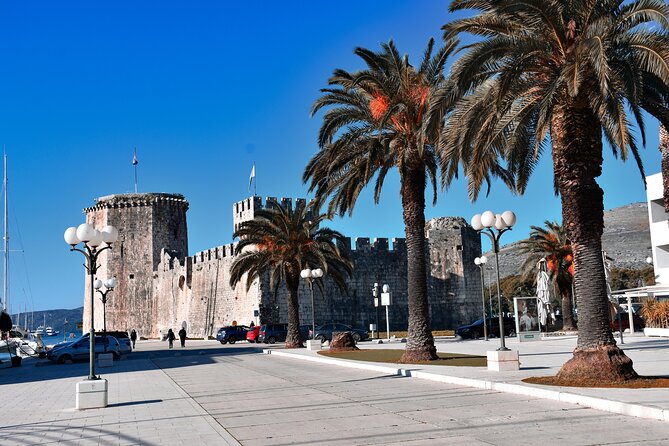
Kula Karmelengo comes next, with about 10 minutes devoted to the site. The fortress was intended to shelter Trogir’s rector during Ottoman invasions. That purpose gives the structure a practical edge. It was not built simply to look impressive from the waterfront.
You will also hear why it was once called the fort of chains. The supplied details do not spell out the full explanation, so this is a good moment to ask Sandra directly. A local guide can provide the missing context while you look at the fortress from outside.
The tour does not include fortress entry. The visit is exterior only, and admission is optional if you want to go in separately. That keeps the standard walk affordable compared with a tour that includes several paid sights, but it also means you should not expect an extended fortress visit within the scheduled route.
Today, Karmelengo hosts summer concerts. Music in a fortress is one of those details that connects the old defensive role with modern Trogir. If you are visiting during the concert season, Sandra may be able to explain how the setting fits into local life, though concert tickets are not part of this activity.
Still Trogir, at a slower pace:
- Half Day Speedboat Tour to Three Islands from Trogir
★ 5.0 · 401 reviews - Blue Lagoon & Šolta Island from Trogir LUNCH & DRINKS INCLUDED
★ 4.5 · 374 reviews - Trogir, Žedno: Čiovo Island 100% Off-Road Quad ATV Tour
★ 4.9 · 331 reviews - Trogir: Blue Lagoon and 3 Islands Speedboat Tour
★ 4.8 · 263 reviews
Batarija, a football field inside a protected historic area
The stop at Igralište Batarija lasts about 10 minutes and offers an unusual contrast. Trogir has a football field in an area protected by UNESCO, a rare arrangement in the world. It is a useful reminder that historic preservation does not always mean removing ordinary life from old districts.
From here, you can also see a gloriette dedicated to the French period and the Tower of Saint Mark. The stop is brief, but it adds visual variety to the walk. Instead of moving only from church to palace, you see how military, political, sporting, and public spaces overlap.
I would pay attention to Sandra’s explanation here, since the site’s value is less obvious than the cathedral or central square. This is the kind of place where a guide gives you the reason to care.
Trogir Promenade, where the town slows down
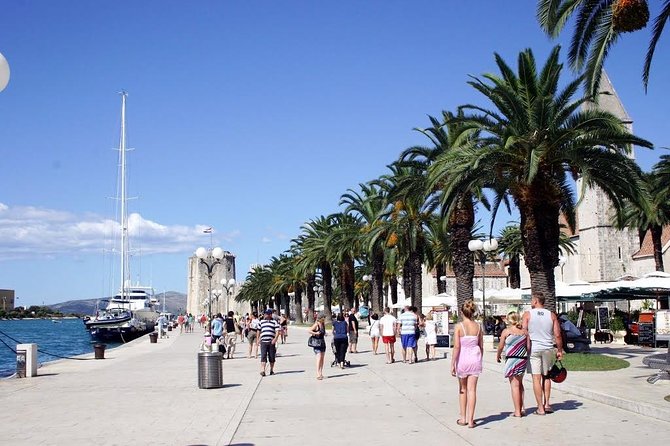
The promenade is the tour’s most relaxed stop. It is where locals and tourists spend time over coffee, conversation, and an unhurried look at the waterfront. You get about 10 minutes here, but the stop helps you understand how Trogir works beyond its monuments.
The promenade also gives your group a natural pause after the tighter streets and fortress area. I like that the route includes a place for everyday life. A town is more than its grandest buildings, and Trogir’s waterfront is where that becomes clear.
Do not expect a long café break as part of the tour. The scheduled stop is short, and the activity remains a walking tour. Still, you can use Sandra’s recommendations to decide where to return after the tour for a longer coffee or meal.
The South Gate and the town of happy moments
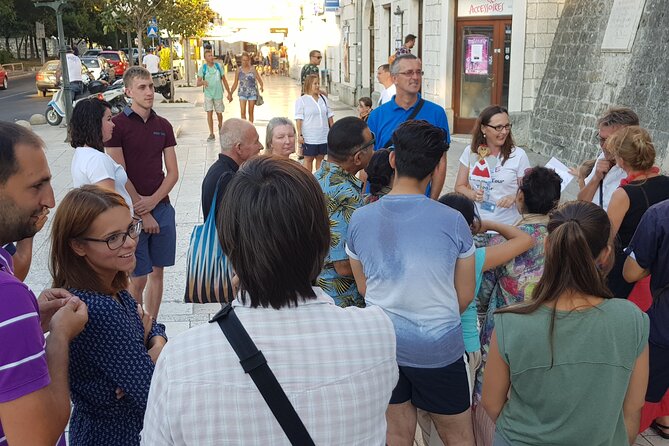
The South Gate retains its original doors, which were closed in the evening. That detail makes the old town’s boundaries easy to imagine. After dark, the gate was not just a decorative arch. It controlled movement and helped protect the community.
Beside the gate is the Small Lodge, where people could find shelter during the night. These modest practical spaces often tell you more about past daily life than a formal palace does. They show how the town handled movement, safety, and people who needed a place to stay.
The South Gate is also a good photo setting. It frames the view, and its colors change with the time of day. The tour operates Monday through Saturday from 9 a.m. to 7 p.m., so your start time can affect the light. If photography matters to you, ask about a morning or late-day departure.
Behind the gate are the church and Benedictine Monastery of St. Nicholas. This area carries a story about Trogir as the town of the happy moment. The supplied details do not explain the full story, so ask Sandra to develop it rather than treating the stop as a quick photo opportunity.
Central Square, Venetian lions, and vanished buildings
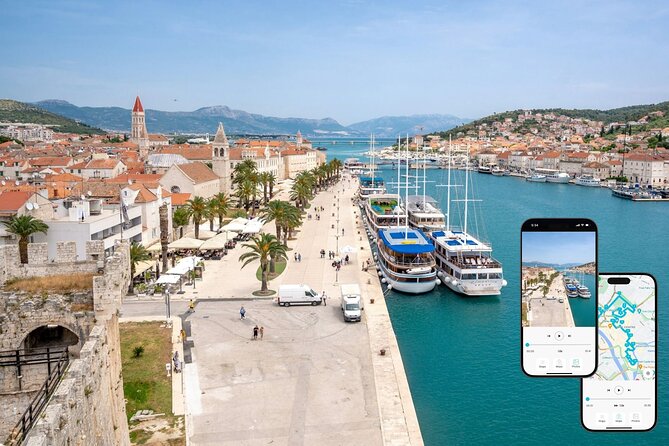
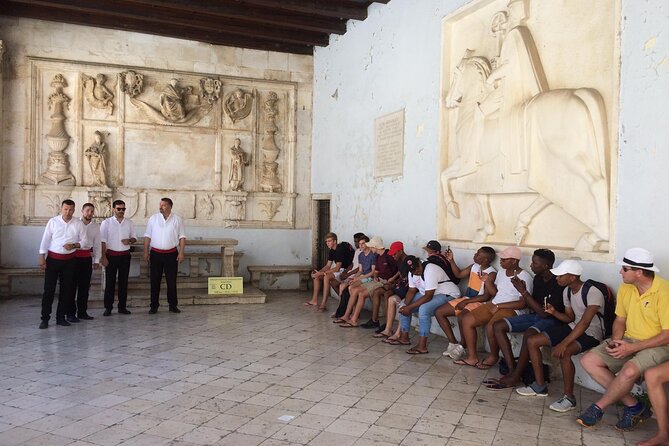
The central square gathers many of Trogir’s most important buildings in one place. You see the court, Rector’s Palace, noble palaces, and the cathedral. In a compact setting, the square makes the political and social structure of old Trogir easier to understand.
Sandra discusses Venetian lions, trials, wealthy families, and a theatre that once stood at the heart of the town. This is where the tour’s stories can help you read the facades. A palace is not simply an attractive stone building. It reflects who held power, who had money, and how public decisions were made.
The theatre story is especially useful because it points to what has disappeared. Historic centers can trick you into thinking every important building still exists. Learning what once occupied the square gives you a fuller picture of change.
You have about 20 minutes here. That is enough for an orientation and several questions, though not enough for a slow architectural study of every palace. If you enjoy details about civic history, this may be the part where you want to extend the conversation.
Saint Lawrence’s Cathedral and Radovan’s Portal
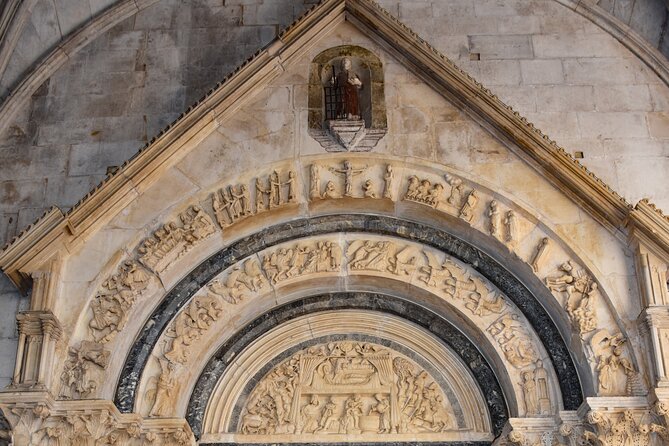
The Cathedral of Saint Lawrence is the tour’s main attraction and the one place I would consider entering if time allows. The exterior already gives you plenty to see, including Radovan’s Portal and the magnificent bell tower.
The portal is a major artistic feature of the cathedral, and the guide explains what makes it important. You will also hear about a drawing on the cathedral wall that continues to surprise people. The details provided do not identify the drawing, so this is another point where Sandra’s explanation is central to the experience.
The standard tour stops outside. If you choose to enter, admission is €6 per person, paid separately. Inside, you can see the Chapel of St. John, the baptistery, and climb the bell tower for views over Trogir.
That extra fee is reasonable if you care about church art, local architecture, or views from above. It is less essential if you mainly want a short introduction to the town and prefer to keep the cost down. Since the cathedral is the principal building on the route, I would decide before arriving rather than losing time at the end.
The advertised 20-minute cathedral stop is also worth reading carefully. It includes the exterior explanation, not necessarily a full interior visit and bell tower climb. Ask Sandra how much time is available if you want to go inside.
Price, timing, and what you receive
At $82.80 per person, this is not a budget orientation walk. The price makes the most sense for a private group that values a local voice, flexible questions, and a route built around one compact historic center.
Because only your group participates, the cost can work better when shared among several people. Group discounts are available, though the exact discount is not provided. If you are traveling alone or as a couple, compare the price with larger group walks before booking.
The licensed guide is included. Cathedral entry costs extra at €6 per person, and Karmelengo Fortress admission is not included if you decide to enter. There are no transportation costs within the tour because the route is on foot and begins and ends at the North Gate.
The timing is efficient. You cover the major parts of Trogir without spending half a day on a single church or museum. Still, the short schedule means you should not expect long interior visits, a meal stop, or extensive free time.
The activity is offered in English. Confirmation arrives at booking, and free cancellation is available up to 24 hours before the start time. Changes or cancellations made less than 24 hours in advance are not accepted for a refund.
Who will get the most from this Trogir walk?
I would recommend this tour to a first-time visitor who wants the town explained in a clear sequence. The route gives you a useful map of Trogir, both physically and historically, and you can return later to the places that catch your attention.
It also suits families and mixed-age groups. The walk is short, pushchair accessible, and most people can participate. Service animals are allowed, and the starting point is near public transportation.
History fans will appreciate the mix of ancient origins, medieval fortifications, Venetian symbols, French rule, noble families, and religious buildings. Photographers will like the gates, square, bell tower, and promenade, especially if they can choose a favorable time of day.
You may want a different experience if you prefer long museum visits, a food-focused tour, or a full-day excursion beyond Trogir. This is a focused town walk, not a broad tour of the surrounding Dalmatian coast.
Should you book Experience Trogir with a Local Guide?
Book it if you want personal storytelling and local context rather than a quick checklist of monuments. Sandra’s ties to the town, balanced handling of its past, and practical recommendations give the walk a human quality that a self-guided route may miss.
The main question is value. At $82.80 per person, it is easiest to justify for a private group that will ask questions and make use of the guide’s local perspective. Add the €6 cathedral ticket if the interior and bell tower appeal to you.
If you have only a short time in Trogir, this tour covers the right ground. If you want the lowest-cost way to see the old town, walk the route independently and consider paying only for the cathedral. For most first-time visitors who value a local introduction, this is a strong, well-focused choice.
FAQ
Where does the tour begin?
The tour begins at Ul. Gradska vrata 6, 21220 Trogir, Croatia, at the North Gate.
Where does the tour end?
The activity ends back at the meeting point.
How long does the tour last?
The approximate duration is 1 hour 20 minutes to 2 hours.
Is the tour private?
Yes. Only your group participates in this private activity.
What language is offered?
The tour is offered in English.
Is a guide included?
Yes. A licensed guide is included.
Is entry to Saint Lawrence’s Cathedral included?
No. Cathedral entry is optional and costs €6 per person, paid by the client.
Can you enter Karmelengo Fortress during the tour?
The scheduled visit is from outside. Fortress entry is optional and not included.
Is the tour accessible with a pushchair?
Yes. The activity is listed as pushchair accessible, and most people can participate.
Can you cancel for a full refund?
Yes. You can cancel at least 24 hours before the start time for a full refund. Cancellations or changes made less than 24 hours in advance are not accepted for a refund.
Just added around Trogir
- Trogir: White Lagoon, Maslinica & Blue Lagoon Speedboat Tour★ 4.8 · 11 reviews
- Trogir; Private walking tour of higlights of Trogir★ 4.7 · 3 reviews
- Trogir: Old Town Guided Walking Tour★ 4.6 · 76 reviews
- TROGIR: Blue Lagoon & 3 Islands Half-day Speedboat tour★ 4.6 · 28 reviews
- Trogir 1.5-Hour City Tour★ 4.4 · 37 reviews
- Trogir: Blue Lagoon, Maslinica, and Solinska Bay Boat Tour★ 4.9 · 88 reviews
- Private Transfer from Split Croatia Airport to Hotel★ 5.0 · 4 reviews
- Trogir Old City Walking Tour★ 5.0 · 8 reviews
Guided, compared.
Plitvice & Rastoke Guided Day Trip with Ticket
Read our review →
Plitvice Lakes Guided Tour with Entry Tickets
Read our review →
Plitvice Lakes National Park Guided Day Tour from Split
Read our review →
Rastoke & Plitvice Lakes Guided Tour with Ticket
Read our review →