
Reviewed · WALKING TOURS
Dubrovnik By Night Walking Tour
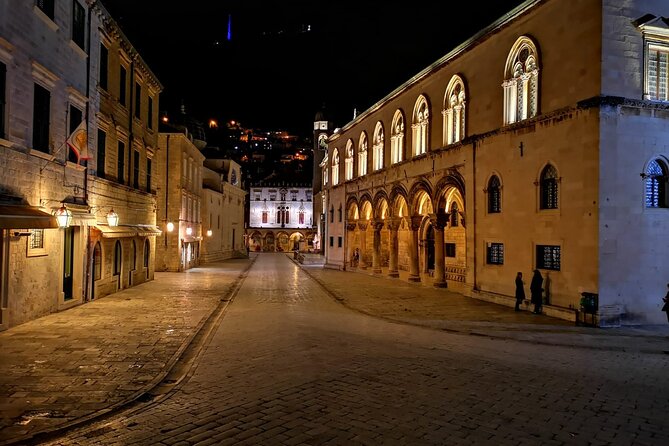
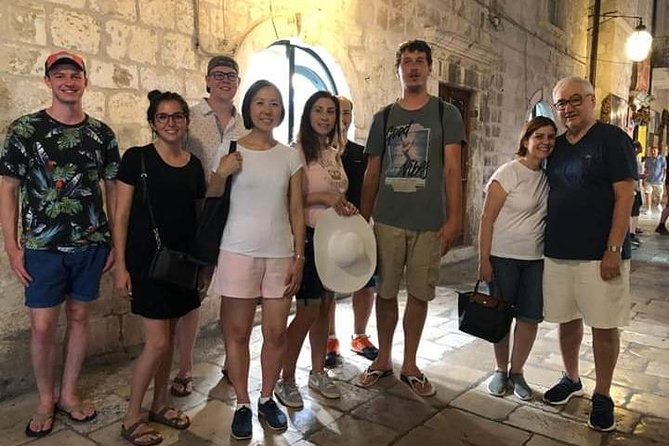
Dubrovnik looks different after sunset. This 90-minute walk gives you a cooler, quieter introduction to the Old Town, with major sights, local stories, and beautifully lit stone streets. I especially like the evening timing, which helps you avoid the worst heat and daytime crowds, and the way guides such as Mihaela, Petra, Daniela, Davor, and Goran add personal stories about Dubrovnik’s past and recent war. The main drawback is that this is an exterior walking tour, so you should not expect museum visits or long stops inside historic buildings.
The tour costs $24.19 per person and accepts a maximum of 20 people. That is fair value if you want to get your bearings, learn the basic story of the city, and decide what to revisit later. Group size and guide quality matter here, though. Most experiences sound warm, clear, and engaging, but one combined group had trouble hearing the guide, and another booking involved a guide no-show.
In This Review
- Key points to know before booking
- Why Dubrovnik works better after dark
- Meeting the guide at Pile Square
- Pile Gate and the city’s basic shape
- Franciscan Monastery, the pharmacy, and Onofrio’s Fountain
- Walking the full length of Stradun
- Luža Square and Dubrovnik’s civic center
- Rector’s Palace and the story of power
- The Cathedral and its treasury
- Gundulić Square and the Jesuit Steps
- Prijeko Street and the local view
- Guide quality is the key variable
- Is $24.19 a fair price?
- Who should book this evening walk?
- Should you book Dubrovnik By Night?
- FAQ
- How long is the Dubrovnik By Night Walking Tour?
- How much does the tour cost?
- What language is the tour offered in?
- Where does the tour start?
- Where does the tour end?
- Are attraction entrance tickets included?
- Is hotel pickup included?
- How many people can join the tour?
- Can I cancel for a full refund?
Key points to know before booking
- The evening start is the big advantage: Some departures begin around 6 p.m., while others begin at about 8 p.m., making summer heat easier to handle.
- You see the Old Town’s main sights in one circuit: The route includes Pile Gate, Stradun, Luža Square, Rector’s Palace, the Cathedral, Gundulić Square, and Prijeko Street.
- This is a storytelling walk, not an attraction-entry tour: Admission tickets are not included because the stops are viewed from outside.
- Local guides can add real depth: Guides including Mihaela, Daniela, Petra, Davor, and Goran have been praised for history, war stories, food advice, and personal connections to Dubrovnik.
- The group can reach 20 people: That is manageable when everyone can hear, but a merged group or failed radio system can affect the experience.
- You finish at Luža Square: That puts you near the center of the Old Town, useful for dinner, a drink, or an evening wander.
Why Dubrovnik works better after dark
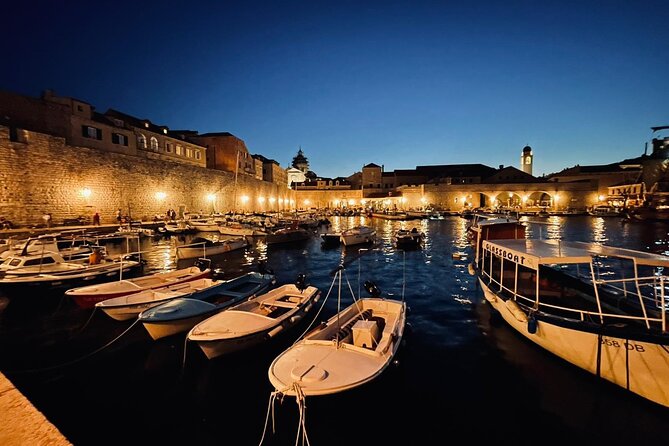
Dubrovnik’s Old Town can feel intense during the day. Stone streets hold the heat, popular lanes fill quickly, and the bright Adriatic sun can make a long walk tiring. At night, the city becomes easier to read. The limestone facades catch the lights, the narrow lanes feel more atmospheric, and you can pay closer attention to the shape of the streets.
The tour is not a late-night adventure in the usual sense. It is a guided city walk that may begin around sunset or in the early evening. The exact departure time can vary, so check your booking carefully. A 6 p.m. start can still have daylight, while an 8 p.m. departure may give you the full evening effect.
I like this timing for a first night in Dubrovnik. You can learn the basic layout before exploring on your own, then use the guide’s restaurant and sightseeing suggestions for the rest of your stay. One guide, Goran, was also praised for advice about local food and culture, which can be especially useful when you are deciding where to eat.
The route lasts about an hour and a half. That is long enough to cover the Old Town’s main landmarks without turning into an exhausting history lecture. It is also short enough to fit before dinner.
More Walking Tours in Dubrovnik
- Dubrovnik: Old Town Walking Tour
★ 4.8 · 5,174 reviews - Dubrovnik Discovery Old Town Walking Tour
★ 5.0 · 4,458 reviews - Dubrovnik: Game of Thrones Walking Tour
★ 5.0 · 1,732 reviews
Meeting the guide at Pile Square
The official meeting point is listed as Brsalje ul. 2, near Pile. The more specific instructions point you to the Amerling Fountain beside the Dubravka gift shop, outside the walls at Pile Square. Look for a guide with a blue umbrella.
This is a sensible starting point. Pile is one of the main gateways into Dubrovnik, and it is easy to recognize once you reach the area outside the western entrance. Still, give yourself a few extra minutes. The meeting information includes both a street address and the fountain landmark, so use the blue umbrella as your main visual clue and keep your mobile ticket available.
There is no hotel pickup, hotel drop-off, or transport to arrange. You make your own way to Pile and walk from there. The tour ends at Luža Square, inside the Old Town, rather than returning you to the starting point.
The guide begins at Amerling Fountain with a short welcome. This opening is practical rather than grand, but it gives the group a chance to gather before entering the walls. Since the maximum group size is 20, the walk should usually feel more personal than a large coach excursion.
Pile Gate and the city’s basic shape
The first substantial stop is Pile Gate. Here, the guide uses the city map to explain how Dubrovnik is organized and gives a short introduction to its past.
This is one of the most useful stops for orientation. Dubrovnik’s Old Town is compact, but its lanes can feel confusing at first. A quick explanation of the main street, squares, gates, and side lanes helps you understand where you are before the tour moves deeper inside.
The guide’s opening history lesson also sets expectations. Dubrovnik was not simply a pretty medieval town. It developed as a maritime city with its own political identity, trading connections, defenses, churches, palaces, and civic rules. The best guides connect those subjects to what you can see around you instead of listing dates.
Several strong guide accounts describe the history as stretching from Roman times through the modern period, including the effects of the 1990s war. Mihaela was praised for explaining Dubrovnik as a city-state and for sharing personal family memories connected to the war and its aftermath. That sort of account gives the Old Town a human scale that a plaque cannot provide.
Franciscan Monastery, the pharmacy, and Onofrio’s Fountain
After entering through Pile Gate, you reach the Franciscan Church and Monastery near the beginning of Stradun. The guide explains the old pharmacy and Dubrovnik’s early water supply, including Onofrio’s Fountain.
These are excellent subjects for a first look at the city. The monastery is one of the Old Town’s most important religious buildings, while the pharmacy points to the practical side of medieval urban life. Onofrio’s Fountain is more than a decorative landmark. It helps explain how water reached the city and why reliable water mattered so much within fortified walls.
You will see these sights as part of the walk, but the tour does not include admission to the church, monastery, pharmacy, or other interior attractions. If you want to explore the pharmacy or church more closely, plan a separate daytime visit and check opening arrangements yourself.
At night, the fountain and surrounding stonework can be especially pleasing to see. The reduced foot traffic also makes it easier to stop, listen, and take in the details without feeling pushed along by a busy street.
Still Dubrovnik, at a slower pace:
- Blue Cave Small-Group Boat Tour from Dubrovnik
★ 5.0 · 9,360 reviews - Full-Day Dubrovnik Elaphite Islands Cruise with Lunch and Drinks
★ 5.0 · 8,823 reviews - Dubrovnik: Epic Game of Thrones Tour + Lokrum & Saver Option
★ 4.9 · 5,995 reviews - Dubrovnik: Elaphiti Islands Full-Day Cruise with Lunch
★ 5.0 · 5,938 reviews
Walking the full length of Stradun
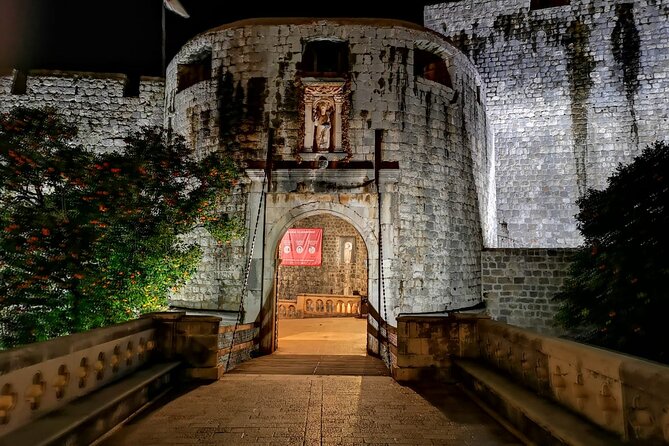
Stradun is Dubrovnik’s main street and the natural spine of the Old Town. The guide discusses its houses, shops, and role as the city’s most recognizable public space.
This part of the walk is less about one single monument and more about reading the city as a whole. Stradun is broad and orderly compared with the side lanes. Its straight run gives you a clear sense of the Old Town’s scale and shows how the city’s public life gathers around one central route.
The guide may point out architectural details, daily customs, and small features that you could miss while simply walking from one end to the other. Several highly praised guides were described as good storytellers who made the city easier to understand through local details, personal memories, and clear explanations.
The drawback is that Stradun can still be active in the evening, especially during the high season. It may be quieter than during the day, but do not expect an empty movie set. Stay close enough to hear the guide, especially if the group spreads out.
Luža Square and Dubrovnik’s civic center
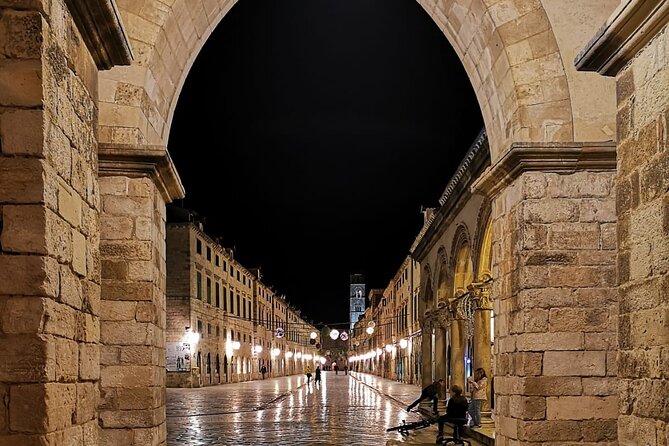
The route continues to Luža Square, the main square of the Old Town. The guide points out the patron church, the Bell Tower, and Sponza Palace.
This is one of the strongest visual sections of the walk. Several major buildings meet here, so you get a compact lesson in Dubrovnik’s religious, civic, and commercial life. Sponza Palace is particularly important to the city’s public story, while the Bell Tower gives the square a clear vertical marker.
Luža Square also helps you understand how the Old Town functions as a series of connected spaces rather than one long street. Stradun brings you toward the square, then the square opens into several directions. This is the kind of layout that becomes much easier after a guide explains it once.
The tour ends here, which is convenient. You can remain in the square after the guide leaves, walk back along Stradun, or continue toward dinner. Because the end point is central, you do not need to arrange transport back to a distant hotel meeting point.
Rector’s Palace and the story of power
Rector’s Palace is presented as one of Dubrovnik’s most beautiful buildings. The guide discusses its design, history, and present-day use.
This stop gives the tour a strong political center. The palace represents the city’s governing tradition and provides a chance to understand how authority operated in Dubrovnik. The building itself has enough architectural detail to reward a slow look, even when you are viewing it from outside.
The guide’s approach matters here. A short talk can make the palace feel like a living part of the city, while a dry list of dates may leave you admiring only the facade. The strongest guides on this tour, including Davor and Daniela, were praised for explaining history in a clear, engaging way and for connecting official events with personal stories.
You will not enter the palace during this walk. If the building interests you most, treat the tour as an introduction and return later for a separate visit when it is open.
The Cathedral and its treasury
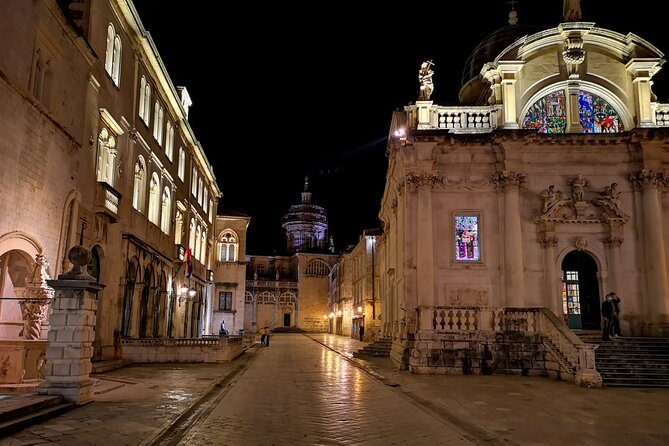
The Cathedral of the Assumption of the Virgin Mary is the largest church in Dubrovnik, and the guide explains its importance along with its treasury.
This is another stop where the exterior tour gives you useful context but not the complete experience. The cathedral’s scale and position make sense within the Old Town’s central plan, while the treasury adds a reminder of the city’s religious wealth and long civic history.
You should not assume the treasury is included. The itinerary lists the stop and provides no entrance ticket, so the guide’s role is to explain what you are seeing from the street. That keeps the cost low and the route moving, but it also means you may want to return during opening hours if you want to see the interior collection.
For many people, this balance works well on a first evening. You get an overview without spending the whole night inside one building.
Gundulić Square and the Jesuit Steps
The walk then reaches the monument to poet Ivan Gundulić and the nearby Jesuit Steps. This section brings in literature, public art, and one of Dubrovnik’s most recognizable stairway views.
The steps are a good reminder that Dubrovnik is not only a fortress and a collection of palaces. Poetry, religion, public ceremony, and ordinary movement all shape the Old Town. A good guide can explain why the monument matters and help you notice how the square connects to the surrounding lanes.
This is also the kind of location where a local guide can improve your evening. Daniela was praised for leading the group through picturesque lanes and stairways with confidence, while other guides were credited with pointing out small features in buildings and street channels. You should expect some stairs and uneven stone underfoot, so comfortable shoes are sensible.
Prijeko Street and the local view
The final walking section follows Prijeko Street and nearby narrow lanes. The stated goal is to see the town through local eyes rather than simply follow the postcard route.
This may be the most rewarding part for you if you have already seen Stradun and the major squares. Prijeko feels more intimate, with a maze of side streets that show how the Old Town works at a human level. The guide can point out features that do not have a large sign or famous name but still explain how people live among the historic walls.
The route does not promise a food tasting, although one account describes a separate food and wine experience with restaurants and dessert. Do not book this walking tour expecting meals. It includes only the licensed local guide, taxes, and the walking tour itself.
Still, the local advice can be valuable. Several guides offered restaurant suggestions, food tips, and comments about Croatian customs. Ask questions if the guide invites them, especially if you want ideas for dinner after the tour.
Guide quality is the key variable
The strongest part of this experience is the guide. Petra was praised for detailed historical explanations. Mihaela received repeated praise for warmth, clear English, personal war stories, and her ability to handle an unusual group. Daniela was valued for local insight and vivid storytelling, while Davor was described as an effective storyteller who clearly loved Dubrovnik.
That praise is consistent with the tour’s design. Since you do not enter buildings, the guide must supply the extra value. The history, personal accounts, advice, and ability to manage the pace are what turn a simple walk into a worthwhile experience.
The feedback is not perfect. One person found the delivery flat, and a family felt ready for the tour to end rather than wanting to learn more. Another group was merged because of guide shortages, and a radio communication problem made it hard to hear. One booking also reported a guide who did not arrive and a difficult refund process.
These problems appear to be exceptions, but they are worth keeping in mind. Stay near the guide, arrive early, and speak up quickly if you cannot hear. The stated maximum is 20 people, but operational changes can affect that on a particular night.
Is $24.19 a fair price?
At $24.19, this is a reasonably priced introduction to Dubrovnik. You are paying for 90 minutes with a licensed local guide, not for attraction entry, food, transport, or a private group.
The value is strongest on your first evening. The walk helps you understand the Old Town’s layout, gives you historical context, and may save you time later by showing which buildings and squares deserve a closer visit. It also lets you avoid spending your first afternoon in the heat.
The value is weaker if you want a detailed study of architecture or access to interiors. You will need separate tickets and extra time for that. The tour is an overview, and one participant felt it was not sufficiently deep. That criticism is fair if you already know Dubrovnik well.
The group discount option may make the price more attractive for families or larger parties. The maximum group size is 20, so this is not a private tour, but it is smaller than many mass-market sightseeing groups when it runs normally.
Who should book this evening walk?
I would choose this tour if you are visiting Dubrovnik for the first time, want a quick historical framework, or dislike walking the Old Town under the midday sun. It also suits solo visitors because the guide provides structure and the group setting makes the city less daunting at first.
Families can enjoy it, especially when the guide adjusts the pace and explains the 1990s war in a way that works for both adults and teenagers. The route also suits people interested in modern Croatian history, since several guides have shared personal and family experiences.
You may want a different option if you need wheelchair-friendly certainty, a private guide, building interiors, food tastings, or a highly academic history lesson. The tour is described as suitable for most people, and service animals are allowed, but the route includes historic streets and stairs, so specific mobility needs should be confirmed before booking.
Free cancellation is available up to 24 hours before the start time. Changes or cancellations inside that window are not refunded. Poor weather can cancel the walk, with a different date or full refund offered, and the same applies if the minimum number of participants is not reached.
Should you book Dubrovnik By Night?
Book it if you want a cooler, easy first look at Dubrovnik with a local voice and a useful route through the Old Town. The strongest reason to go is not simply seeing Stradun and Rector’s Palace. It is hearing the city’s story tied to places you can recognize, including the water fountain, the cathedral, the Jesuit Steps, and the lanes of Prijeko.
Choose the latest available evening time in summer if heat is a concern. Arrive at Pile early, look for the blue umbrella near Amerling Fountain, and stay close enough to hear every word. If the guide is as engaging as Mihaela, Petra, Daniela, Davor, or Goran, $24.19 buys a very good start to your Dubrovnik stay.
FAQ
How long is the Dubrovnik By Night Walking Tour?
The tour lasts approximately 1 hour and 30 minutes.
How much does the tour cost?
The listed price is $24.19 per person. Group discounts are available.
What language is the tour offered in?
The tour is offered in English.
Where does the tour start?
The listed starting point is Brsalje ul. 2 in Dubrovnik. More specific directions place the meeting point at Amerling Fountain beside the Dubravka gift shop outside the walls at Pile Square. The guide will have a blue umbrella.
Where does the tour end?
The tour ends at Luža Square, Luža ul., in Dubrovnik’s Old Town.
Are attraction entrance tickets included?
No. The stops are listed with free admission, and the tour does not include paid entry into buildings or attractions.
Is hotel pickup included?
No. Hotel pickup, hotel drop-off, and transportation to or from attractions are not included.
How many people can join the tour?
The maximum group size is 20 people. Minimum numbers apply, so the tour can be canceled if too few people book.
Can I cancel for a full refund?
Yes. You can cancel at least 24 hours before the start time for a full refund. Cancellations or changes made less than 24 hours before the start time are not refunded.
Just added around Dubrovnik
- Elaphiti Islands Private Dubrovnik Boat Unique Experience★ 5.0 · 10 reviews
- Full- Day Private Speedboat Tour in Dubrovnik on Elaphiti Islands★ 5.0 · 21 reviews
- PRIVATE Wine Tour to Konavle country side★ 5.0 · 11 reviews
- Wine Lover’s Tour of Peljesac Peninsula★ 5.0 · 150 reviews
- Wine tour peninsula Pelješac★ 5.0 · 3 reviews
- Parasailing in Cavtat★ 5.0 · 62 reviews
- Welcome to Dubrovnik Walking Tour★ 5.0 · 36 reviews
- Dubrovnik at War 1991-1992 Private Walking Tour★ 5.0 · 4 reviews
Walking Tours, compared.

Walking Tour of Split and Diocletian’s Palace
Read our review →


Krka Waterfalls tour with Trogir Walking tour and Krka panoramic boat cruise
Read our review →
City Walls Early Morning or Sunset Walking Tour
Read our review →Browse the lists this tour appears in